
Oracle Critical Patch Update October 2022
Released October 2022 · Oracle's advisory ↗ · ← Critical Patch Update, July 2022 · Critical Patch Update, January 2023 →
179 CVEs in this release, one square each
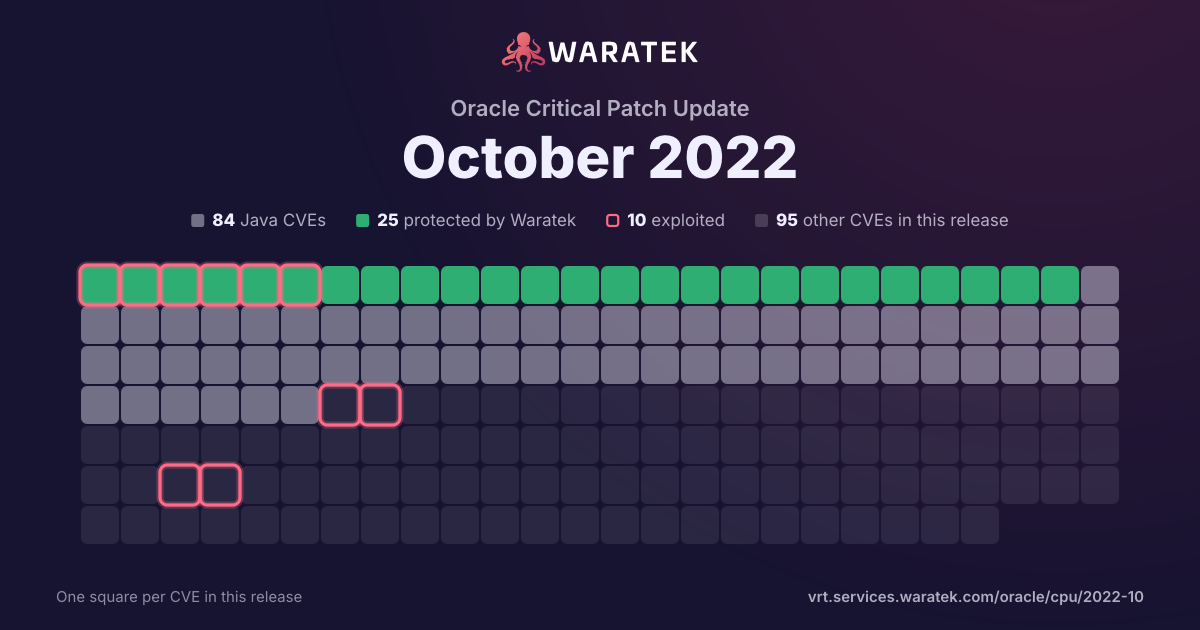
By status
25Protected by Waratek4Mitigation candidate55No exploit published48Outside Waratek scope47Not applicable
10Exploited, marked by the ring
No exploit published. For 33 of them, Oracle's security advisory is the source of public detail.
Protected by Waratek. Waratek RASP can block exploitation of these on systems that have not applied the patch yet.
Overview 141 matches · 67 in Waratek scope · 15 protected · 0 exploited · 0 CISA KEV · 0 public PoC · 0 EPSS ≥ 0.5
141matches
67in Waratek scope47.5%
15protected10.6%
0exploited0.0%
0CISA KEV0.0%
0public PoC0.0%
0EPSS ≥ 0.50.0%
Protected by Waratek
15
10.6%
Rule in development
0
0.0%
Mitigation candidate
0
0.0%
No exploit published
52
36.9%
Outside Waratek scope
36
25.5%
Not applicable
38
27.0%
Withdrawn CVE
0
0.0%
blocked by ARMR today
15
10.6%
partly blocked
0
0.0%
not blocked
126
89.4%
not established
0
0.0%
unrecorded
0
0.0%
Exploited
0
0.0%
Working exploit published
0
0.0%
Proof of concept only
0
0.0%
Forecast only
0
0.0%
No public exploit
141
100.0%
split by
peak 77 / quarter
Q2 181
Not applicable1
High1
not blocked1
No public exploit1
Q3 180
Q4 180
Q1 192
No exploit published1
Not applicable1
Critical1
Medium1
not blocked2
No public exploit2
Q2 190
Q3 191
Protected by Waratek1
High1
blocked by ARMR today1
No public exploit1
Q4 192
Protected by Waratek1
Not applicable1
High1
Medium1
blocked by ARMR today1
not blocked1
No public exploit2
Q1 200
Q2 204
Protected by Waratek1
Outside Waratek scope2
Not applicable1
Critical2
High1
Medium1
blocked by ARMR today1
not blocked3
No public exploit4
Q3 202
Outside Waratek scope1
Not applicable1
High1
Medium1
not blocked2
No public exploit2
Q4 202
Protected by Waratek1
No exploit published1
High1
Medium1
blocked by ARMR today1
not blocked1
No public exploit2
Q1 217
Protected by Waratek1
No exploit published6
Critical2
High3
Medium2
blocked by ARMR today1
not blocked6
No public exploit7
Q2 213
Protected by Waratek1
Not applicable2
Medium3
blocked by ARMR today1
not blocked2
No public exploit3
Q3 219
No exploit published7
Not applicable2
High6
Medium3
not blocked9
No public exploit9
Q4 216
Outside Waratek scope3
Not applicable3
Critical3
Medium3
not blocked6
No public exploit6
Q1 228
Protected by Waratek1
No exploit published2
Outside Waratek scope1
Not applicable4
Critical1
High6
Medium1
blocked by ARMR today1
not blocked7
No public exploit8
Q2 2212
Protected by Waratek3
No exploit published4
Outside Waratek scope2
Not applicable3
Critical3
High1
Medium7
Low1
blocked by ARMR today3
not blocked9
No public exploit12
Q3 225
Protected by Waratek1
No exploit published3
Outside Waratek scope1
Critical1
High3
Medium1
blocked by ARMR today1
not blocked4
No public exploit5
Q4 2277
Protected by Waratek4
No exploit published28
Outside Waratek scope26
Not applicable19
Critical1
High22
Medium48
Low6
blocked by ARMR today4
not blocked73
No public exploit77
Q2 18Q4 18Q2 19Q4 19Q2 20Q4 20Q2 21Q4 21Q2 22Q4 22
| CVE | Severity | Published▾ | Status | Exploitation | Description |
|---|---|---|---|---|---|
| CVE-2022-23181 | High | 2022-01-27 | Protected by Waratek | No public exploit | The fix for bug CVE-2020-9484 introduced a time of check, time of use vulnerability into Apache Tomcat 10.1.0-M1 to 10.1.0-M8, 10.0.0-M5 to 10.0.14, 9.0.35 to 9.0.56 and 8.5.55 to 8.5.73 that allowed a local attacker to perform actions with the privileges of the user that the Tomcat process is using. This issue is only exploitable when Tomcat is configured to persist sessions using the FileStore. |
| CVE-2022-23437 | Medium | 2022-01-24 | No exploit published | No public exploit | There's a vulnerability within the Apache Xerces Java (XercesJ) XML parser when handling specially crafted XML document payloads. This causes, the XercesJ XML parser to wait in an infinite loop, which may sometimes consume system resources for prolonged duration. This vulnerability is present within XercesJ version 2.12.1 and the previous versions. |
| CVE-2021-41495 | Medium | 2021-12-17 | Not applicable | No public exploit | Null Pointer Dereference vulnerability exists in numpy.sort in NumPy < and 1.19 in the PyArray_DescrNew function due to missing return-value validation, which allows attackers to conduct DoS attacks by repetitively creating sort arrays. NOTE: While correct that validation is missing, an error can only occur due to an exhaustion of memory. If the user can exhaust memory, they are already privileged. Further, it should be practically impossible to construct an attack which can target the memory exhaustion to occur at exactly this place |
| CVE-2021-23450 | Critical | 2021-12-17 | Outside Waratek scope | No public exploit | All versions of package dojo are vulnerable to Prototype Pollution via the setObject function. |
| CVE-2021-43527 | Critical | 2021-12-08 | Outside Waratek scope | No public exploit | NSS (Network Security Services) versions prior to 3.73 or 3.68.1 ESR are vulnerable to a heap overflow when handling DER-encoded DSA or RSA-PSS signatures. Applications using NSS for handling signatures encoded within CMS, S/MIME, PKCS \#7, or PKCS \#12 are likely to be impacted. Applications using NSS for certificate validation or other TLS, X.509, OCSP or CRL functionality may be impacted, depending on how they configure NSS. *Note: This vulnerability does NOT impact Mozilla Firefox.* However, email clients and PDF viewers that use NSS for signature verification, such as Thunderbird, LibreOffice, Evolution and Evince are believed to be impacted. This vulnerability affects NSS < 3.73 and NSS < 3.68.1. |
| CVE-2021-21707 | Medium | 2021-11-29 | Not applicable | No public exploit | In PHP versions 7.3.x below 7.3.33, 7.4.x below 7.4.26 and 8.0.x below 8.0.13, certain XML parsing functions, like simplexml_load_file(), URL-decode the filename passed to them. If that filename contains URL-encoded NUL character, this may cause the function to interpret this as the end of the filename, thus interpreting the filename differently from what the user intended, which may lead it to reading a different file than intended. |
| CVE-2021-3918 | Critical | 2021-11-13 | Not applicable | No public exploit | json-schema is vulnerable to Improperly Controlled Modification of Object Prototype Attributes ('Prototype Pollution') |
| CVE-2021-41182 | Medium | 2021-10-26 | Outside Waratek scope | No public exploit | jQuery-UI is the official jQuery user interface library. Prior to version 1.13.0, accepting the value of the `altField` option of the Datepicker widget from untrusted sources may execute untrusted code. The issue is fixed in jQuery UI 1.13.0. Any string value passed to the `altField` option is now treated as a CSS selector. A workaround is to not accept the value of the `altField` option from untrusted sources. |
| CVE-2021-40690 | High | 2021-09-19 | No exploit published | No public exploit | All versions of Apache Santuario - XML Security for Java prior to 2.2.3 and 2.1.7 are vulnerable to an issue where the "secureValidation" property is not passed correctly when creating a KeyInfo from a KeyInfoReference element. This allows an attacker to abuse an XPath Transform to extract any local .xml files in a RetrievalMethod element. |
| CVE-2021-40528 | Medium | 2021-09-06 | Not applicable | No public exploit | The ElGamal implementation in Libgcrypt before 1.9.4 allows plaintext recovery because, during interaction between two cryptographic libraries, a certain dangerous combination of the prime defined by the receiver's public key, the generator defined by the receiver's public key, and the sender's ephemeral exponents can lead to a cross-configuration attack against OpenPGP. |
| CVE-2021-28490 | High | 2021-08-19 | No exploit published | No public exploit | In OWASP CSRFGuard through 3.1.0, CSRF can occur because the CSRF cookie may be retrieved by using only a session token. |
| CVE-2021-36483 | High | 2021-08-04 | Not applicable | No public exploit | DevExpress.XtraReports.UI through v21.1 allows attackers to execute arbitrary code via insecure deserialization. |
| CVE-2021-22144 | Medium | 2021-07-26 | No exploit published | No public exploit | In Elasticsearch versions before 7.13.3 and 6.8.17 an uncontrolled recursion vulnerability that could lead to a denial of service attack was identified in the Elasticsearch Grok parser. A user with the ability to submit arbitrary queries to Elasticsearch could create a malicious Grok query that will crash the Elasticsearch node. |
| CVE-2021-2351 | High | 2021-07-21 | No exploit published | No public exploit | Vulnerability in the Advanced Networking Option component of Oracle Database Server. Supported versions that are affected are 12.1.0.2, 12.2.0.1 and 19c. Difficult to exploit vulnerability allows unauthenticated attacker with network access via Oracle Net to compromise Advanced Networking Option. Successful attacks require human interaction from a person other than the attacker and while the vulnerability is in Advanced Networking Option, attacks may significantly impact additional products. Successful attacks of this vulnerability can result in takeover of Advanced Networking Option. Note: The July 2021 Critical Patch Update introduces a number of Native Network Encryption changes to deal with vulnerability CVE-2021-2351 and prevent the use of weaker ciphers. Customers should review: "Changes in Native Network Encryption with the July 2021 Critical Patch Update" (Doc ID 2791571.1). CVSS 3.1 Base Score 8.3 (Confidentiality, Integrity and Availability impacts). CVSS Vector: (CVSS:3.1/AV:N/AC:H/PR:N/UI:R/S:C/C:H/I:H/A:H). |
| CVE-2021-36374 | Medium | 2021-07-14 | No exploit published | No public exploit | When reading a specially crafted ZIP archive, or a derived formats, an Apache Ant build can be made to allocate large amounts of memory that leads to an out of memory error, even for small inputs. This can be used to disrupt builds using Apache Ant. Commonly used derived formats from ZIP archives are for instance JAR files and many office files. Apache Ant prior to 1.9.16 and 1.10.11 were affected. |
| CVE-2021-36090 | High | 2021-07-13 | No exploit published | No public exploit | When reading a specially crafted ZIP archive, Compress can be made to allocate large amounts of memory that finally leads to an out of memory error even for very small inputs. This could be used to mount a denial of service attack against services that use Compress' zip package. |
| CVE-2021-30639 | High | 2021-07-12 | No exploit published | No public exploit | A vulnerability in Apache Tomcat allows an attacker to remotely trigger a denial of service. An error introduced as part of a change to improve error handling during non-blocking I/O meant that the error flag associated with the Request object was not reset between requests. This meant that once a non-blocking I/O error occurred, all future requests handled by that request object would fail. Users were able to trigger non-blocking I/O errors, e.g. by dropping a connection, thereby creating the possibility of triggering a DoS. Applications that do not use non-blocking I/O are not exposed to this vulnerability. This issue affects Apache Tomcat 10.0.3 to 10.0.4; 9.0.44; 8.5.64. |
| CVE-2021-3426 | Medium | 2021-05-20 | Not applicable | No public exploit | There's a flaw in Python 3's pydoc. A local or adjacent attacker who discovers or is able to convince another local or adjacent user to start a pydoc server could access the server and use it to disclose sensitive information belonging to the other user that they would not normally be able to access. The highest risk of this flaw is to data confidentiality. This flaw affects Python versions before 3.8.9, Python versions before 3.9.3 and Python versions before 3.10.0a7. |
| CVE-2021-3537 | Medium | 2021-05-14 | Not applicable | No public exploit | A vulnerability found in libxml2 in versions before 2.9.11 shows that it did not propagate errors while parsing XML mixed content, causing a NULL dereference. If an untrusted XML document was parsed in recovery mode and post-validated, the flaw could be used to crash the application. The highest threat from this vulnerability is to system availability. |
| CVE-2021-29425 | Medium | 2021-04-13 | Protected by Waratek | No public exploit | In Apache Commons IO before 2.7, When invoking the method FileNameUtils.normalize with an improper input string, like "//../foo", or "\\..\foo", the result would be the same value, thus possibly providing access to files in the parent directory, but not further above (thus "limited" path traversal), if the calling code would use the result to construct a path value. |
| CVE-2021-21783 | Critical | 2021-03-25 | No exploit published | No public exploit | A code execution vulnerability exists in the WS-Addressing plugin functionality of Genivia gSOAP 2.8.107. A specially crafted SOAP request can lead to remote code execution. An attacker can send an HTTP request to trigger this vulnerability. |
| CVE-2020-13936 | High | 2021-03-10 | No exploit published | No public exploit | An attacker that is able to modify Velocity templates may execute arbitrary Java code or run arbitrary system commands with the same privileges as the account running the Servlet container. This applies to applications that allow untrusted users to upload/modify velocity templates running Apache Velocity Engine versions up to 2.2. |
| CVE-2021-21295 | Medium | 2021-03-09 | No exploit published | No public exploit | Netty is an open-source, asynchronous event-driven network application framework for rapid development of maintainable high performance protocol servers & clients. In Netty (io.netty:netty-codec-http2) before version 4.1.60.Final there is a vulnerability that enables request smuggling. If a Content-Length header is present in the original HTTP/2 request, the field is not validated by `Http2MultiplexHandler` as it is propagated up. This is fine as long as the request is not proxied through as HTTP/1.1. If the request comes in as an HTTP/2 stream, gets converted into the HTTP/1.1 domain objects (`HttpRequest`, `HttpContent`, etc.) via `Http2StreamFrameToHttpObjectCodec `and then sent up to the child channel's pipeline and proxied through a remote peer as HTTP/1.1 this may result in request smuggling. In a proxy case, users may assume the content-length is validated somehow, which is not the case. If the request is forwarded to a backend channel that is a HTTP/1.1 connection, the Content-Length now has meaning and needs to be checked. An attacker can smuggle requests inside the body as it gets downgraded from HTTP/2 to HTTP/1.1. For an example attack refer to the linked GitHub Advisory. Users are only affected if all of this is true: `HTTP2MultiplexCodec` or `Http2FrameCodec` is used, `Http2StreamFrameToHttpObjectCodec` is used to convert to HTTP/1.1 objects, and these HTTP/1.1 objects are forwarded to another remote peer. This has been patched in 4.1.60.Final As a workaround, the user can do the validation by themselves by implementing a custom `ChannelInboundHandler` that is put in the `ChannelPipeline` behind `Http2StreamFrameToHttpObjectCodec`. |
| CVE-2020-11987 | High | 2021-02-24 | No exploit published | No public exploit | Apache Batik 1.13 is vulnerable to server-side request forgery, caused by improper input validation by the NodePickerPanel. By using a specially-crafted argument, an attacker could exploit this vulnerability to cause the underlying server to make arbitrary GET requests. |
| CVE-2020-29582 | Medium | 2021-02-03 | No exploit published | No public exploit | In JetBrains Kotlin before 1.4.21, a vulnerable Java API was used for temporary file and folder creation. An attacker was able to read data from such files and list directories due to insecure permissions. |
| CVE-2020-9492 | High | 2021-01-26 | No exploit published | No public exploit | In Apache Hadoop 3.2.0 to 3.2.1, 3.0.0-alpha1 to 3.1.3, and 2.0.0-alpha to 2.10.0, WebHDFS client might send SPNEGO authorization header to remote URL without proper verification. |
| CVE-2021-23926 | Critical | 2021-01-14 | Protected by Waratek | No public exploit | The XML parsers used by XMLBeans up to version 2.6.0 did not set the properties needed to protect the user from malicious XML input. Vulnerabilities include possibilities for XML Entity Expansion attacks. Affects XMLBeans up to and including v2.6.0. |
| CVE-2020-28052 | High | 2020-12-18 | No exploit published | No public exploit | An issue was discovered in Legion of the Bouncy Castle BC Java 1.65 and 1.66. The OpenBSDBCrypt.checkPassword utility method compared incorrect data when checking the password, allowing incorrect passwords to indicate they were matching with previously hashed ones that were different. |
| CVE-2020-17521 | Medium | 2020-12-07 | Protected by Waratek | No public exploit | Apache Groovy provides extension methods to aid with creating temporary directories. Prior to this fix, Groovy's implementation of those extension methods was using a now superseded Java JDK method call that is potentially not secure on some operating systems in some contexts. Users not using the extension methods mentioned in the advisory are not affected, but may wish to read the advisory for further details. Versions Affected: 2.0 to 2.4.20, 2.5.0 to 2.5.13, 3.0.0 to 3.0.6, and 4.0.0-alpha-1. Fixed in versions 2.4.21, 2.5.14, 3.0.7, 4.0.0-alpha-2. |
| CVE-2020-16856 | High | 2020-09-11 | Not applicable | No public exploit | <p>A remote code execution vulnerability exists in Visual Studio when it improperly handles objects in memory. An attacker who successfully exploited the vulnerability could run arbitrary code in the context of the current user. If the current user is logged on with administrative user rights, an attacker could take control of the affected system. An attacker could then install programs; view, change, or delete data; or create new accounts with full user rights. Users whose accounts are configured to have fewer user rights on the system could be less impacted than users who operate with administrative user rights.</p> <p>To exploit the vulnerability, an attacker would have to convince a user to open a specially crafted file with an affected version of Visual Studio.</p> <p>The update addresses the vulnerability by correcting how Visual Studio handles objects in memory.</p> |
| CVE-2020-24977 | Medium | 2020-09-04 | Outside Waratek scope | No public exploit | GNOME project libxml2 v2.9.10 has a global buffer over-read vulnerability in xmlEncodeEntitiesInternal at libxml2/entities.c. The issue has been fixed in commit 50f06b3e. |
| CVE-2020-14155 | Medium | 2020-06-15 | Not applicable | No public exploit | libpcre in PCRE before 8.44 allows an integer overflow via a large number after a (?C substring. |
| CVE-2020-10878 | High | 2020-06-05 | Outside Waratek scope | No public exploit | Perl before 5.30.3 has an integer overflow related to mishandling of a "PL_regkind[OP(n)] == NOTHING" situation. A crafted regular expression could lead to malformed bytecode with a possibility of instruction injection. |
| CVE-2018-1285 | Critical | 2020-05-11 | Outside Waratek scope | No public exploit | Apache log4net versions before 2.0.10 do not disable XML external entities when parsing log4net configuration files. This allows for XXE-based attacks in applications that accept attacker-controlled log4net configuration files. |
| CVE-2020-10683 | Critical | 2020-05-01 | Protected by Waratek | No public exploit | dom4j before 2.0.3 and 2.1.x before 2.1.3 allows external DTDs and External Entities by default, which might enable XXE attacks. However, there is popular external documentation from OWASP showing how to enable the safe, non-default behavior in any application that uses dom4j. |
| CVE-2018-1311 | High | 2019-12-18 | Not applicable | No public exploit | The Apache Xerces-C 3.0.0 to 3.2.3 XML parser contains a use-after-free error triggered during the scanning of external DTDs. This flaw has not been addressed in the maintained version of the library and has no current mitigation other than to disable DTD processing. This can be accomplished via the DOM using a standard parser feature, or via SAX using the XERCES_DISABLE_DTD environment variable. |
| CVE-2019-12415 | Medium | 2019-10-23 | Protected by Waratek | No public exploit | In Apache POI up to 4.1.0, when using the tool XSSFExportToXml to convert user-provided Microsoft Excel documents, a specially crafted document can allow an attacker to read files from the local filesystem or from internal network resources via XML External Entity (XXE) Processing. |
| CVE-2019-10086 | High | 2019-08-20 | Protected by Waratek | No public exploit | In Apache Commons Beanutils 1.9.2, a special BeanIntrospector class was added which allows suppressing the ability for an attacker to access the classloader via the class property available on all Java objects. We, however were not using this by default characteristic of the PropertyUtilsBean. |
| CVE-2019-3862 | Critical | 2019-03-21 | Not applicable | No public exploit | An out of bounds read flaw was discovered in libssh2 before 1.8.1 in the way SSH_MSG_CHANNEL_REQUEST packets with an exit status message and no payload are parsed. A remote attacker who compromises a SSH server may be able to cause a Denial of Service or read data in the client memory. |
| CVE-2018-18893 | Medium | 2019-01-03 | No exploit published | No public exploit | Jinjava before 2.4.6 does not block the getClass method, related to com/hubspot/jinjava/el/ext/JinjavaBeanELResolver.java. |
| CVE-2018-5158 | High | 2018-06-11 | Not applicable | No public exploit | The PDF viewer does not sufficiently sanitize PostScript calculator functions, allowing malicious JavaScript to be injected through a crafted PDF file. This JavaScript can then be run with the permissions of the PDF viewer by its worker. This vulnerability affects Firefox ESR < 52.8 and Firefox < 60. |