
Oracle Critical Patch Update October 2022
Released October 2022 · Oracle's advisory ↗ · ← Critical Patch Update, July 2022 · Critical Patch Update, January 2023 →
179 CVEs in this release, one square each
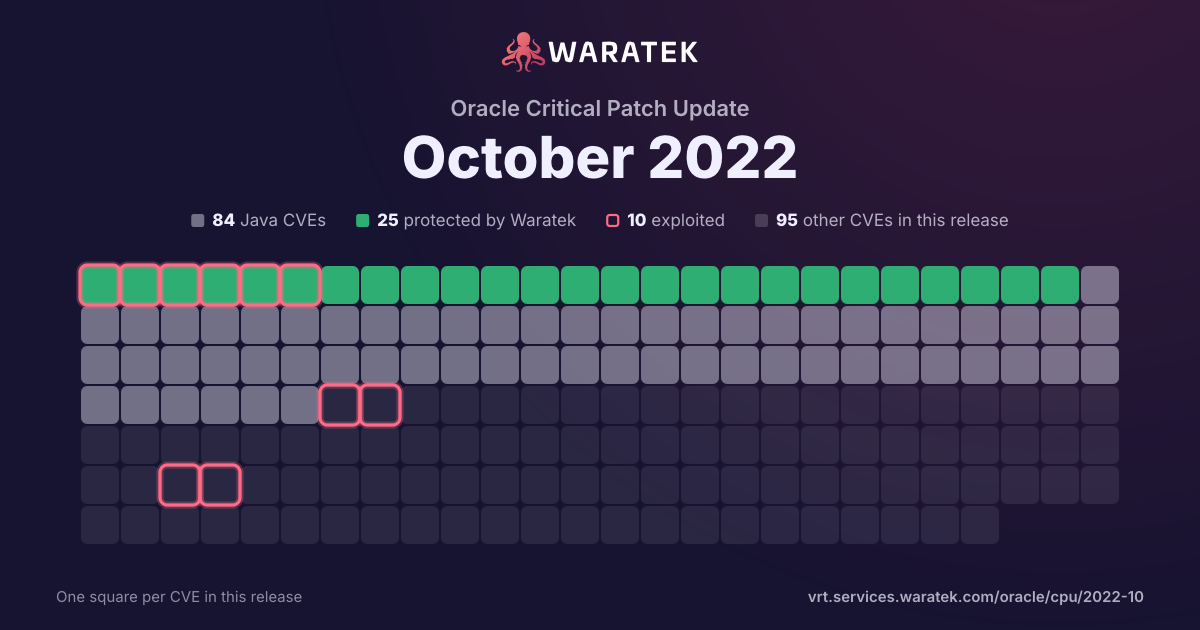
By status
24Protected by Waratek9Mitigation candidate58No exploit published3Outside Waratek scope85Not applicable
10Exploited, marked by the ring
No exploit published. For 33 of them, Oracle's security advisory is the source of public detail.
Protected by Waratek. Waratek RASP can block exploitation of these on systems that have not applied the patch yet.
Overview 9 matches · 3 in Waratek scope · 1 protected · 0 exploited · 0 CISA KEV · 3 public PoC · 1 EPSS ≥ 0.5
9matches
3in Waratek scope33.3%
1protected11.1%
0exploited0.0%
0CISA KEV0.0%
3public PoC33.3%
1EPSS ≥ 0.511.1%
Protected by Waratek
1
11.1%
Rule in development
0
0.0%
Mitigation candidate
2
22.2%
No exploit published
0
0.0%
Outside Waratek scope
0
0.0%
Not applicable
6
66.7%
Withdrawn CVE
0
0.0%
blocked by ARMR today
1
11.1%
partly blocked
0
0.0%
not blocked
8
88.9%
not established
0
0.0%
unrecorded
0
0.0%
Exploited
0
0.0%
Working exploit published
0
0.0%
Proof of concept only
9
100.0%
Forecast only
0
0.0%
No public exploit
0
0.0%
split by
peak 4 / month
Jun 223
Mitigation candidate1
Not applicable2
Critical2
High1
not blocked3
Proof of concept only3
Jul 224
Mitigation candidate1
Not applicable3
Critical2
High1
Medium1
not blocked4
Proof of concept only4
Aug 222
Protected by Waratek1
Not applicable1
High1
Medium1
blocked by ARMR today1
not blocked1
Proof of concept only2
Jun 22Jul 22Aug 22
| CVE | Severity | Published▾ | Status | Exploitation | Description |
|---|---|---|---|---|---|
| CVE-2022-36033 | Medium | 2022-08-29 | Protected by Waratek | Proof of concept only | jsoup is a Java HTML parser, built for HTML editing, cleaning, scraping, and cross-site scripting (XSS) safety. jsoup may incorrectly sanitize HTML including `javascript:` URL expressions, which could allow XSS attacks when a reader subsequently clicks that link. If the non-default `SafeList.preserveRelativeLinks` option is enabled, HTML including `javascript:` URLs that have been crafted with control characters will not be sanitized. If the site that this HTML is published on does not set a Content Security Policy, an XSS attack is then possible. This issue is patched in jsoup 1.15.3. Users should upgrade to this version. Additionally, as the unsanitized input may have been persisted, old content should be cleaned again using the updated version. To remediate this issue without immediately upgrading: - disable `SafeList.preserveRelativeLinks`, which will rewrite input URLs as absolute URLs - ensure an appropriate [Content Security Policy](https://developer.mozilla.org/en-US/docs/Web/HTTP/CSP) is defined. (This should be used regardless of upgrading, as a defence-in-depth best practice.) |
| CVE-2022-35737 | High | 2022-08-03 | Not applicable | Proof of concept only | SQLite 1.0.12 through 3.39.x before 3.39.2 sometimes allows an array-bounds overflow if billions of bytes are used in a string argument to a C API. |
| CVE-2022-32207 | Critical | 2022-07-07 | Not applicable | Proof of concept only | When curl < 7.84.0 saves cookies, alt-svc and hsts data to local files, it makes the operation atomic by finalizing the operation with a rename from a temporary name to the final target file name.In that rename operation, it might accidentally *widen* the permissions for the target file, leaving the updated file accessible to more users than intended. |
| CVE-2022-32206 | Medium | 2022-07-07 | Not applicable | Proof of concept only | curl < 7.84.0 supports "chained" HTTP compression algorithms, meaning that a serverresponse can be compressed multiple times and potentially with different algorithms. The number of acceptable "links" in this "decompression chain" was unbounded, allowing a malicious server to insert a virtually unlimited number of compression steps.The use of such a decompression chain could result in a "malloc bomb", makingcurl end up spending enormous amounts of allocated heap memory, or trying toand returning out of memory errors. |
| CVE-2022-33980 | Critical | 2022-07-06 | Mitigation candidate | Proof of concept only | Apache Commons Configuration performs variable interpolation, allowing properties to be dynamically evaluated and expanded. The standard format for interpolation is "${prefix:name}", where "prefix" is used to locate an instance of org.apache.commons.configuration2.interpol.Lookup that performs the interpolation. Starting with version 2.4 and continuing through 2.7, the set of default Lookup instances included interpolators that could result in arbitrary code execution or contact with remote servers. These lookups are: - "script" - execute expressions using the JVM script execution engine (javax.script) - "dns" - resolve dns records - "url" - load values from urls, including from remote servers Applications using the interpolation defaults in the affected versions may be vulnerable to remote code execution or unintentional contact with remote servers if untrusted configuration values are used. Users are recommended to upgrade to Apache Commons Configuration 2.8.0, which disables the problematic interpolators by default. |
| CVE-2022-31129 | High | 2022-07-06 | Not applicable | Proof of concept only | moment is a JavaScript date library for parsing, validating, manipulating, and formatting dates. Affected versions of moment were found to use an inefficient parsing algorithm. Specifically using string-to-date parsing in moment (more specifically rfc2822 parsing, which is tried by default) has quadratic (N^2) complexity on specific inputs. Users may notice a noticeable slowdown is observed with inputs above 10k characters. Users who pass user-provided strings without sanity length checks to moment constructor are vulnerable to (Re)DoS attacks. The problem is patched in 2.29.4, the patch can be applied to all affected versions with minimal tweaking. Users are advised to upgrade. Users unable to upgrade should consider limiting date lengths accepted from user input. |
| CVE-2022-32532 | Critical | 2022-06-29 | Mitigation candidate | Proof of concept only | Apache Shiro before 1.9.1, A RegexRequestMatcher can be misconfigured to be bypassed on some servlet containers. Applications using RegExPatternMatcher with `.` in the regular expression are possibly vulnerable to an authorization bypass. |
| CVE-2022-2068 | Critical | 2022-06-21 | Not applicable | Proof of concept only | In addition to the c_rehash shell command injection identified in CVE-2022-1292, further circumstances where the c_rehash script does not properly sanitise shell metacharacters to prevent command injection were found by code review. When the CVE-2022-1292 was fixed it was not discovered that there are other places in the script where the file names of certificates being hashed were possibly passed to a command executed through the shell. This script is distributed by some operating systems in a manner where it is automatically executed. On such operating systems, an attacker could execute arbitrary commands with the privileges of the script. Use of the c_rehash script is considered obsolete and should be replaced by the OpenSSL rehash command line tool. Fixed in OpenSSL 3.0.4 (Affected 3.0.0,3.0.1,3.0.2,3.0.3). Fixed in OpenSSL 1.1.1p (Affected 1.1.1-1.1.1o). Fixed in OpenSSL 1.0.2zf (Affected 1.0.2-1.0.2ze). |
| CVE-2022-27782 | High | 2022-06-02 | Not applicable | Proof of concept only | libcurl would reuse a previously created connection even when a TLS or SSHrelated option had been changed that should have prohibited reuse.libcurl keeps previously used connections in a connection pool for subsequenttransfers to reuse if one of them matches the setup. However, several TLS andSSH settings were left out from the configuration match checks, making themmatch too easily. |