
Oracle Critical Patch Update October 2022
Released October 2022 · Oracle's advisory ↗ · ← Critical Patch Update, July 2022 · Critical Patch Update, January 2023 →
179 CVEs in this release, one square each
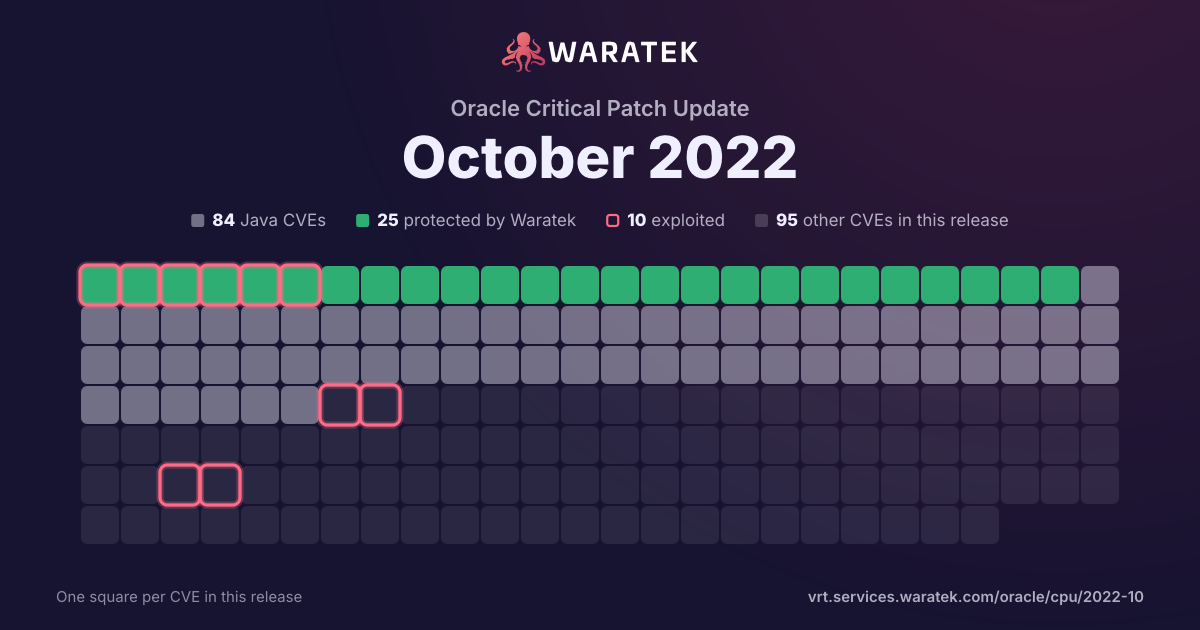
By status
25Protected by Waratek4Mitigation candidate55No exploit published48Outside Waratek scope47Not applicable
10Exploited, marked by the ring
No exploit published. For 33 of them, Oracle's security advisory is the source of public detail.
Protected by Waratek. Waratek RASP can block exploitation of these on systems that have not applied the patch yet.
Overview 2 matches · 1 in Waratek scope · 1 protected
Protected by Waratek
1
50.0%
Rule in development
0
0.0%
Mitigation candidate
0
0.0%
No exploit published
0
0.0%
Outside Waratek scope
0
0.0%
Not applicable
1
50.0%
Withdrawn CVE
0
0.0%
blocked by ARMR today
1
50.0%
partly blocked
0
0.0%
not blocked
1
50.0%
not established
0
0.0%
unrecorded
0
0.0%
Exploited
2
100.0%
Working exploit published
0
0.0%
Proof of concept only
0
0.0%
Forecast only
0
0.0%
No public exploit
0
0.0%
split by
peak 1 / month
Jan 22Feb 22Mar 22Apr 22May 22Jun 22Jul 22Aug 22Sep 22Oct 22
| CVE | Severity | Published▾ | Status | Exploitation | Description |
|---|---|---|---|---|---|
| CVE-2022-21587 | Critical | 2022-10-18 | Protected by Waratek | Exploited | Vulnerability in the Oracle Web Applications Desktop Integrator product of Oracle E-Business Suite (component: Upload). Supported versions that are affected are 12.2.3-12.2.11. Easily exploitable vulnerability allows unauthenticated attacker with network access via HTTP to compromise Oracle Web Applications Desktop Integrator. Successful attacks of this vulnerability can result in takeover of Oracle Web Applications Desktop Integrator. CVSS 3.1 Base Score 9.8 (Confidentiality, Integrity and Availability impacts). CVSS Vector: (CVSS:3.1/AV:N/AC:L/PR:N/UI:N/S:U/C:H/I:H/A:H). |
| CVE-2021-4034 | High | 2022-01-28 | Not applicable | Exploited | A local privilege escalation vulnerability was found on polkit's pkexec utility. The pkexec application is a setuid tool designed to allow unprivileged users to run commands as privileged users according predefined policies. The current version of pkexec doesn't handle the calling parameters count correctly and ends trying to execute environment variables as commands. An attacker can leverage this by crafting environment variables in such a way it'll induce pkexec to execute arbitrary code. When successfully executed the attack can cause a local privilege escalation given unprivileged users administrative rights on the target machine. |