
Oracle Critical Patch Update October 2022
Released October 2022 · Oracle's advisory ↗ · ← Critical Patch Update, July 2022 · Critical Patch Update, January 2023 →
179 CVEs in this release, one square each
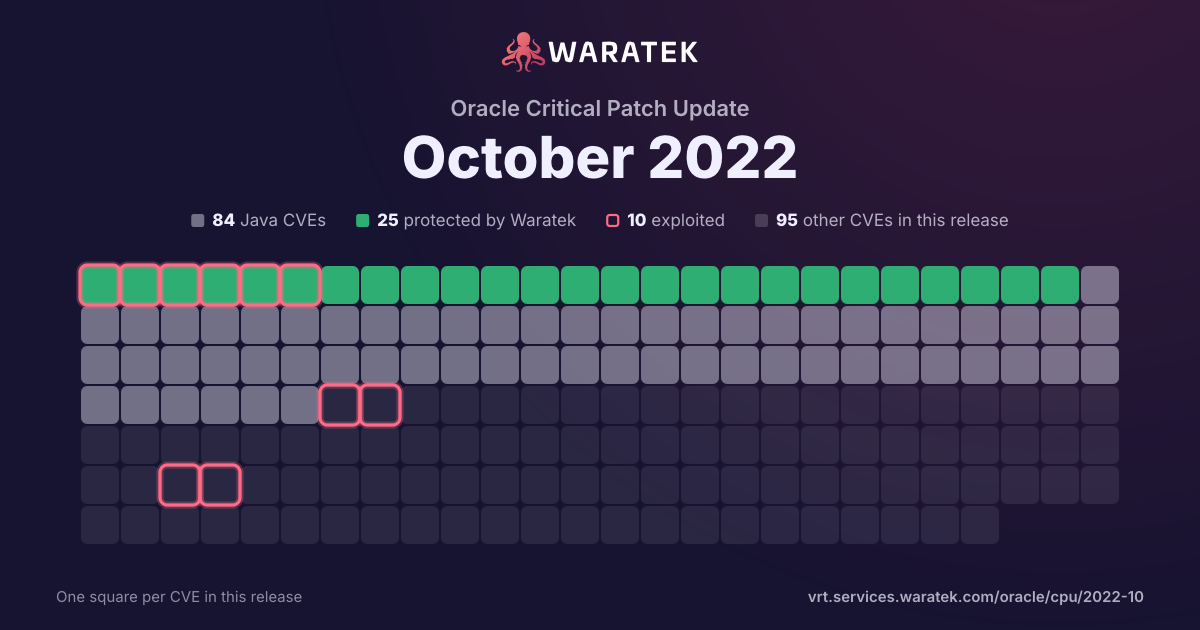
By status
26Protected by Waratek5Mitigation candidate57No exploit published3Outside Waratek scope88Not applicable
10Exploited, marked by the ring
No exploit published. For 33 of them, Oracle's security advisory is the source of public detail.
Protected by Waratek. Waratek RASP can block exploitation of these on systems that have not applied the patch yet.
Overview 5 matches · 0 protected · 0 exploited · 0 CISA KEV · 1 public PoC · 0 EPSS ≥ 0.5
Protected by Waratek
0
0.0%
Rule in development
0
0.0%
Mitigation candidate
1
20.0%
No exploit published
4
80.0%
blocked by ARMR today
0
0.0%
partly blocked
0
0.0%
not blocked
5
100.0%
not established
0
0.0%
unrecorded
0
0.0%
Exploited
0
0.0%
Working exploit published
0
0.0%
Proof of concept only
1
20.0%
Forecast only
0
0.0%
No public exploit
4
80.0%
split by
peak 2 / month
Oct 191
Mitigation candidate1
Critical1
not blocked1
Proof of concept only1
Nov 190
Dec 190
Jan 200
Feb 200
Mar 200
Apr 200
May 200
Jun 200
Jul 200
Aug 200
Sep 200
Oct 200
Nov 200
Dec 201
No exploit published1
High1
not blocked1
No public exploit1
Jan 210
Feb 211
No exploit published1
High1
not blocked1
No public exploit1
Mar 212
No exploit published2
High1
Medium1
not blocked2
No public exploit2
Nov 19Jan 20Mar 20May 20Jul 20Sep 20Nov 20Jan 21Mar 21
| CVE | Severity | Published▾ | Status | Exploitation | Description |
|---|---|---|---|---|---|
| CVE-2020-13936 | High | 2021-03-10 | No exploit published | No public exploit | An attacker that is able to modify Velocity templates may execute arbitrary Java code or run arbitrary system commands with the same privileges as the account running the Servlet container. This applies to applications that allow untrusted users to upload/modify velocity templates running Apache Velocity Engine versions up to 2.2. |
| CVE-2021-21295 | Medium | 2021-03-09 | No exploit published | No public exploit | Netty is an open-source, asynchronous event-driven network application framework for rapid development of maintainable high performance protocol servers & clients. In Netty (io.netty:netty-codec-http2) before version 4.1.60.Final there is a vulnerability that enables request smuggling. If a Content-Length header is present in the original HTTP/2 request, the field is not validated by `Http2MultiplexHandler` as it is propagated up. This is fine as long as the request is not proxied through as HTTP/1.1. If the request comes in as an HTTP/2 stream, gets converted into the HTTP/1.1 domain objects (`HttpRequest`, `HttpContent`, etc.) via `Http2StreamFrameToHttpObjectCodec `and then sent up to the child channel's pipeline and proxied through a remote peer as HTTP/1.1 this may result in request smuggling. In a proxy case, users may assume the content-length is validated somehow, which is not the case. If the request is forwarded to a backend channel that is a HTTP/1.1 connection, the Content-Length now has meaning and needs to be checked. An attacker can smuggle requests inside the body as it gets downgraded from HTTP/2 to HTTP/1.1. For an example attack refer to the linked GitHub Advisory. Users are only affected if all of this is true: `HTTP2MultiplexCodec` or `Http2FrameCodec` is used, `Http2StreamFrameToHttpObjectCodec` is used to convert to HTTP/1.1 objects, and these HTTP/1.1 objects are forwarded to another remote peer. This has been patched in 4.1.60.Final As a workaround, the user can do the validation by themselves by implementing a custom `ChannelInboundHandler` that is put in the `ChannelPipeline` behind `Http2StreamFrameToHttpObjectCodec`. |
| CVE-2020-11987 | High | 2021-02-24 | No exploit published | No public exploit | Apache Batik 1.13 is vulnerable to server-side request forgery, caused by improper input validation by the NodePickerPanel. By using a specially-crafted argument, an attacker could exploit this vulnerability to cause the underlying server to make arbitrary GET requests. |
| CVE-2020-28052 | High | 2020-12-18 | No exploit published | No public exploit | An issue was discovered in Legion of the Bouncy Castle BC Java 1.65 and 1.66. The OpenBSDBCrypt.checkPassword utility method compared incorrect data when checking the password, allowing incorrect passwords to indicate they were matching with previously hashed ones that were different. |
| CVE-2019-17195 | Critical | 2019-10-15 | Mitigation candidate | Proof of concept only | Connect2id Nimbus JOSE+JWT before v7.9 can throw various uncaught exceptions while parsing a JWT, which could result in an application crash (potential information disclosure) or a potential authentication bypass. |