
Oracle Critical Patch Update October 2022
Released October 2022 · Oracle's advisory ↗ · ← Critical Patch Update, July 2022 · Critical Patch Update, January 2023 →
179 CVEs in this release, one square each
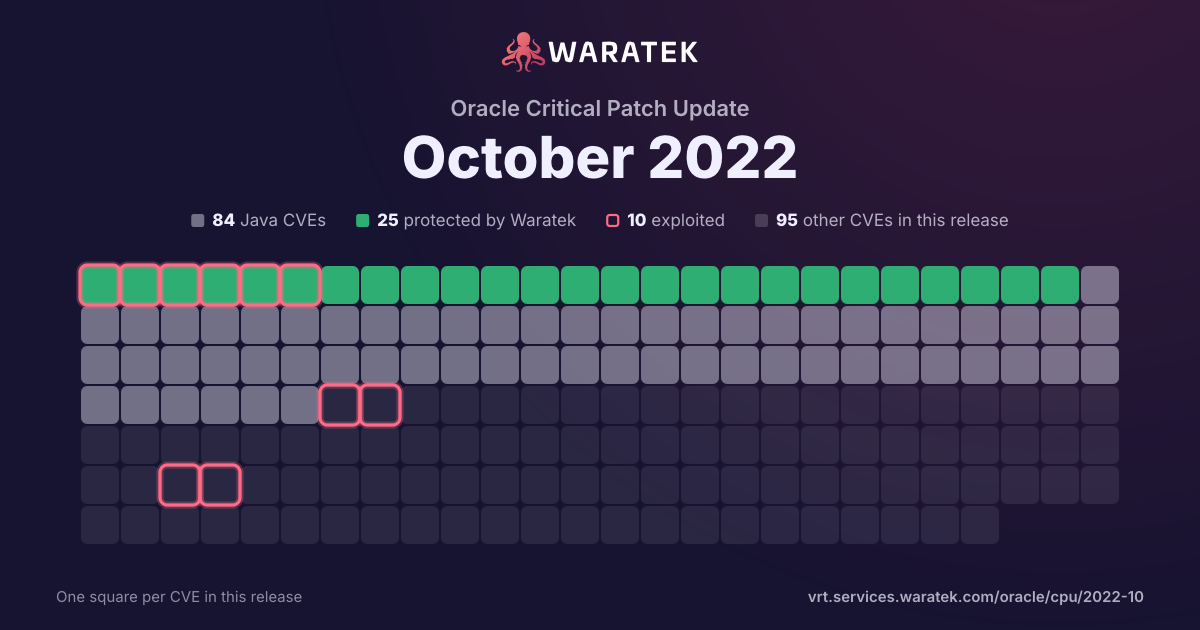
By status
26Protected by Waratek5Mitigation candidate57No exploit published3Outside Waratek scope88Not applicable
10Exploited, marked by the ring
No exploit published. For 33 of them, Oracle's security advisory is the source of public detail.
Protected by Waratek. Waratek RASP can block exploitation of these on systems that have not applied the patch yet.
Overview 9 matches · 3 exploited · 0 CISA KEV · 3 public PoC · 3 EPSS ≥ 0.5
Protected by Waratek
9
100.0%
Rule in development
0
0.0%
Mitigation candidate
0
0.0%
No exploit published
0
0.0%
blocked by ARMR today
9
100.0%
partly blocked
0
0.0%
not blocked
0
0.0%
not established
0
0.0%
unrecorded
0
0.0%
Exploited
3
33.3%
Working exploit published
0
0.0%
Proof of concept only
1
11.1%
Forecast only
0
0.0%
No public exploit
5
55.6%
split by
peak 3 / month
Dec 212
Protected by Waratek2
High1
Medium1
blocked by ARMR today2
Exploited2
Jan 223
Protected by Waratek3
Critical1
High1
Medium1
blocked by ARMR today3
Proof of concept only1
No public exploit2
Feb 220
Mar 220
Apr 220
May 222
Protected by Waratek2
High1
Medium1
blocked by ARMR today2
No public exploit2
Jun 221
Protected by Waratek1
Medium1
blocked by ARMR today1
Exploited1
Jul 220
Aug 221
Protected by Waratek1
High1
blocked by ARMR today1
No public exploit1
Dec 21Jan 22Feb 22Mar 22Apr 22May 22Jun 22Jul 22Aug 22
| CVE | Severity | Published▾ | Status | Exploitation | Description |
|---|---|---|---|---|---|
| CVE-2022-25857 | High | 2022-08-30 | Protected by Waratek | No public exploit | The package org.yaml:snakeyaml from 0 and before 1.31 are vulnerable to Denial of Service (DoS) due missing to nested depth limitation for collections. |
| CVE-2022-34305 | Medium | 2022-06-23 | Protected by Waratek | Exploited | In Apache Tomcat 10.1.0-M1 to 10.1.0-M16, 10.0.0-M1 to 10.0.22, 9.0.30 to 9.0.64 and 8.5.50 to 8.5.81 the Form authentication example in the examples web application displayed user provided data without filtering, exposing a XSS vulnerability. |
| CVE-2022-22971 | Medium | 2022-05-12 | Protected by Waratek | No public exploit | In spring framework versions prior to 5.3.20+ , 5.2.22+ and old unsupported versions, application with a STOMP over WebSocket endpoint is vulnerable to a denial of service attack by an authenticated user. |
| CVE-2022-25647 | High | 2022-05-01 | Protected by Waratek | No public exploit | The package com.google.code.gson:gson before 2.8.9 are vulnerable to Deserialization of Untrusted Data via the writeReplace() method in internal classes, which may lead to DoS attacks. |
| CVE-2022-23181 | High | 2022-01-27 | Protected by Waratek | No public exploit | The fix for bug CVE-2020-9484 introduced a time of check, time of use vulnerability into Apache Tomcat 10.1.0-M1 to 10.1.0-M8, 10.0.0-M5 to 10.0.14, 9.0.35 to 9.0.56 and 8.5.55 to 8.5.73 that allowed a local attacker to perform actions with the privileges of the user that the Tomcat process is using. This issue is only exploitable when Tomcat is configured to persist sessions using the FileStore. |
| CVE-2022-23437 | Medium | 2022-01-24 | Protected by Waratek | No public exploit | There's a vulnerability within the Apache Xerces Java (XercesJ) XML parser when handling specially crafted XML document payloads. This causes, the XercesJ XML parser to wait in an infinite loop, which may sometimes consume system resources for prolonged duration. This vulnerability is present within XercesJ version 2.12.1 and the previous versions. |
| CVE-2022-23305 | Critical | 2022-01-18 | Protected by Waratek | Proof of concept only | By design, the JDBCAppender in Log4j 1.2.x accepts an SQL statement as a configuration parameter where the values to be inserted are converters from PatternLayout. The message converter, %m, is likely to always be included. This allows attackers to manipulate the SQL by entering crafted strings into input fields or headers of an application that are logged allowing unintended SQL queries to be executed. Note this issue only affects Log4j 1.x when specifically configured to use the JDBCAppender, which is not the default. Beginning in version 2.0-beta8, the JDBCAppender was re-introduced with proper support for parameterized SQL queries and further customization over the columns written to in logs. Apache Log4j 1.2 reached end of life in August 2015. Users should upgrade to Log4j 2 as it addresses numerous other issues from the previous versions. |
| CVE-2021-44832 | Medium | 2021-12-28 | Protected by Waratek | Exploited | Apache Log4j2 versions 2.0-beta7 through 2.17.0 (excluding security fix releases 2.3.2 and 2.12.4) are vulnerable to a remote code execution (RCE) attack when a configuration uses a JDBC Appender with a JNDI LDAP data source URI when an attacker has control of the target LDAP server. This issue is fixed by limiting JNDI data source names to the java protocol in Log4j2 versions 2.17.1, 2.12.4, and 2.3.2. |
| CVE-2021-4104 | High | 2021-12-14 | Protected by Waratek | Exploited | JMSAppender in Log4j 1.2 is vulnerable to deserialization of untrusted data when the attacker has write access to the Log4j configuration. The attacker can provide TopicBindingName and TopicConnectionFactoryBindingName configurations causing JMSAppender to perform JNDI requests that result in remote code execution in a similar fashion to CVE-2021-44228. Note this issue only affects Log4j 1.2 when specifically configured to use JMSAppender, which is not the default. Apache Log4j 1.2 reached end of life in August 2015. Users should upgrade to Log4j 2 as it addresses numerous other issues from the previous versions. |