
Oracle Critical Patch Update October 2022
Released October 2022 · Oracle's advisory ↗ · ← Critical Patch Update, July 2022 · Critical Patch Update, January 2023 →
179 CVEs in this release, one square each
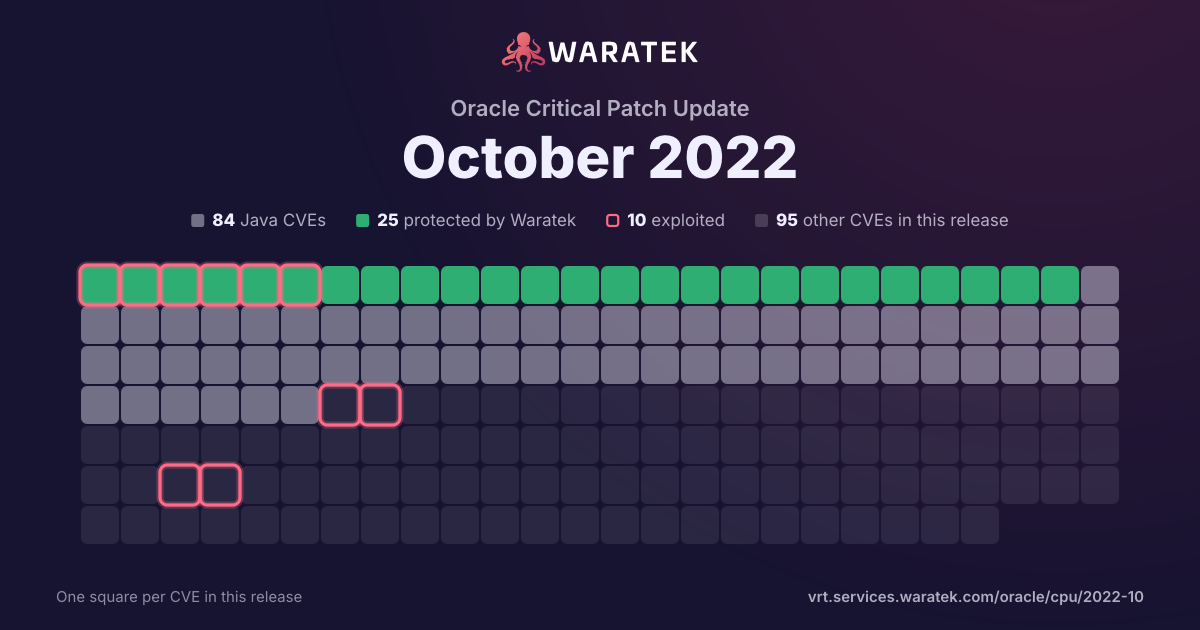
By status
26Protected by Waratek7Mitigation candidate58No exploit published3Outside Waratek scope85Not applicable
10Exploited, marked by the ring
No exploit published. For 34 of them, Oracle's security advisory is the source of public detail.
Protected by Waratek. Waratek RASP can block exploitation of these on systems that have not applied the patch yet.
Overview 18 matches · 11 in Waratek scope · 6 protected · 1 exploited · 0 CISA KEV · 2 public PoC · 1 EPSS ≥ 0.5
18matches
11in Waratek scope61.1%
6protected33.3%
1exploited5.6%
0CISA KEV0.0%
2public PoC11.1%
1EPSS ≥ 0.55.6%
Protected by Waratek
6
33.3%
Rule in development
0
0.0%
Mitigation candidate
2
11.1%
No exploit published
3
16.7%
Outside Waratek scope
0
0.0%
Not applicable
7
38.9%
Withdrawn CVE
0
0.0%
blocked by ARMR today
6
33.3%
partly blocked
0
0.0%
not blocked
12
66.7%
not established
0
0.0%
unrecorded
0
0.0%
Exploited
1
5.6%
Working exploit published
0
0.0%
Proof of concept only
1
5.6%
Forecast only
0
0.0%
No public exploit
16
88.9%
split by
peak 5 / quarter
Q2 181
Not applicable1
High1
not blocked1
No public exploit1
Q3 180
Q4 180
Q1 192
No exploit published1
Not applicable1
Critical1
Medium1
not blocked2
No public exploit2
Q2 190
Q3 191
Protected by Waratek1
High1
blocked by ARMR today1
No public exploit1
Q4 193
Protected by Waratek1
Mitigation candidate1
Not applicable1
Critical1
High1
Medium1
blocked by ARMR today1
not blocked2
Proof of concept only1
No public exploit2
Q1 200
Q2 205
Protected by Waratek2
Mitigation candidate1
Not applicable2
Critical2
High1
Medium2
blocked by ARMR today2
not blocked3
Exploited1
No public exploit4
Q3 202
Not applicable2
High1
Medium1
not blocked2
No public exploit2
Q4 202
Protected by Waratek1
No exploit published1
High1
Medium1
blocked by ARMR today1
not blocked1
No public exploit2
Q1 212
Protected by Waratek1
No exploit published1
Critical1
High1
blocked by ARMR today1
not blocked1
No public exploit2
Q2 18Q3 18Q4 18Q1 19Q2 19Q3 19Q4 19Q1 20Q2 20Q3 20Q4 20Q1 21
| CVE | Severity | Published▾ | Status | Exploitation | Description |
|---|---|---|---|---|---|
| CVE-2020-9492 | High | 2021-01-26 | No exploit published | No public exploit | In Apache Hadoop 3.2.0 to 3.2.1, 3.0.0-alpha1 to 3.1.3, and 2.0.0-alpha to 2.10.0, WebHDFS client might send SPNEGO authorization header to remote URL without proper verification. |
| CVE-2021-23926 | Critical | 2021-01-14 | Protected by Waratek | No public exploit | The XML parsers used by XMLBeans up to version 2.6.0 did not set the properties needed to protect the user from malicious XML input. Vulnerabilities include possibilities for XML Entity Expansion attacks. Affects XMLBeans up to and including v2.6.0. |
| CVE-2020-28052 | High | 2020-12-18 | No exploit published | No public exploit | An issue was discovered in Legion of the Bouncy Castle BC Java 1.65 and 1.66. The OpenBSDBCrypt.checkPassword utility method compared incorrect data when checking the password, allowing incorrect passwords to indicate they were matching with previously hashed ones that were different. |
| CVE-2020-17521 | Medium | 2020-12-07 | Protected by Waratek | No public exploit | Apache Groovy provides extension methods to aid with creating temporary directories. Prior to this fix, Groovy's implementation of those extension methods was using a now superseded Java JDK method call that is potentially not secure on some operating systems in some contexts. Users not using the extension methods mentioned in the advisory are not affected, but may wish to read the advisory for further details. Versions Affected: 2.0 to 2.4.20, 2.5.0 to 2.5.13, 3.0.0 to 3.0.6, and 4.0.0-alpha-1. Fixed in versions 2.4.21, 2.5.14, 3.0.7, 4.0.0-alpha-2. |
| CVE-2020-16856 | High | 2020-09-11 | Not applicable | No public exploit | <p>A remote code execution vulnerability exists in Visual Studio when it improperly handles objects in memory. An attacker who successfully exploited the vulnerability could run arbitrary code in the context of the current user. If the current user is logged on with administrative user rights, an attacker could take control of the affected system. An attacker could then install programs; view, change, or delete data; or create new accounts with full user rights. Users whose accounts are configured to have fewer user rights on the system could be less impacted than users who operate with administrative user rights.</p> <p>To exploit the vulnerability, an attacker would have to convince a user to open a specially crafted file with an affected version of Visual Studio.</p> <p>The update addresses the vulnerability by correcting how Visual Studio handles objects in memory.</p> |
| CVE-2020-24977 | Medium | 2020-09-04 | Not applicable | No public exploit | GNOME project libxml2 v2.9.10 has a global buffer over-read vulnerability in xmlEncodeEntitiesInternal at libxml2/entities.c. The issue has been fixed in commit 50f06b3e. |
| CVE-2020-14155 | Medium | 2020-06-15 | Not applicable | No public exploit | libpcre in PCRE before 8.44 allows an integer overflow via a large number after a (?C substring. |
| CVE-2020-10878 | High | 2020-06-05 | Not applicable | No public exploit | Perl before 5.30.3 has an integer overflow related to mishandling of a "PL_regkind[OP(n)] == NOTHING" situation. A crafted regular expression could lead to malformed bytecode with a possibility of instruction injection. |
| CVE-2018-1285 | Critical | 2020-05-11 | Protected by Waratek | No public exploit | Apache log4net versions before 2.0.10 do not disable XML external entities when parsing log4net configuration files. This allows for XXE-based attacks in applications that accept attacker-controlled log4net configuration files. |
| CVE-2020-10683 | Critical | 2020-05-01 | Protected by Waratek | No public exploit | dom4j before 2.0.3 and 2.1.x before 2.1.3 allows external DTDs and External Entities by default, which might enable XXE attacks. However, there is popular external documentation from OWASP showing how to enable the safe, non-default behavior in any application that uses dom4j. |
| CVE-2020-11022 | Medium | 2020-04-29 | Mitigation candidate | Exploited | In jQuery starting with 1.12.0 and before 3.5.0, passing HTML from untrusted sources - even after sanitizing it - to one of jQuery's DOM manipulation methods (i.e. .html(), .append(), and others) may execute untrusted code. This problem is patched in jQuery 3.5.0. |
| CVE-2018-1311 | High | 2019-12-18 | Not applicable | No public exploit | The Apache Xerces-C 3.0.0 to 3.2.3 XML parser contains a use-after-free error triggered during the scanning of external DTDs. This flaw has not been addressed in the maintained version of the library and has no current mitigation other than to disable DTD processing. This can be accomplished via the DOM using a standard parser feature, or via SAX using the XERCES_DISABLE_DTD environment variable. |
| CVE-2019-12415 | Medium | 2019-10-23 | Protected by Waratek | No public exploit | In Apache POI up to 4.1.0, when using the tool XSSFExportToXml to convert user-provided Microsoft Excel documents, a specially crafted document can allow an attacker to read files from the local filesystem or from internal network resources via XML External Entity (XXE) Processing. |
| CVE-2019-17195 | Critical | 2019-10-15 | Mitigation candidate | Proof of concept only | Connect2id Nimbus JOSE+JWT before v7.9 can throw various uncaught exceptions while parsing a JWT, which could result in an application crash (potential information disclosure) or a potential authentication bypass. |
| CVE-2019-10086 | High | 2019-08-20 | Protected by Waratek | No public exploit | In Apache Commons Beanutils 1.9.2, a special BeanIntrospector class was added which allows suppressing the ability for an attacker to access the classloader via the class property available on all Java objects. We, however were not using this by default characteristic of the PropertyUtilsBean. |
| CVE-2019-3862 | Critical | 2019-03-21 | Not applicable | No public exploit | An out of bounds read flaw was discovered in libssh2 before 1.8.1 in the way SSH_MSG_CHANNEL_REQUEST packets with an exit status message and no payload are parsed. A remote attacker who compromises a SSH server may be able to cause a Denial of Service or read data in the client memory. |
| CVE-2018-18893 | Medium | 2019-01-03 | No exploit published | No public exploit | Jinjava before 2.4.6 does not block the getClass method, related to com/hubspot/jinjava/el/ext/JinjavaBeanELResolver.java. |
| CVE-2018-5158 | High | 2018-06-11 | Not applicable | No public exploit | The PDF viewer does not sufficiently sanitize PostScript calculator functions, allowing malicious JavaScript to be injected through a crafted PDF file. This JavaScript can then be run with the permissions of the PDF viewer by its worker. This vulnerability affects Firefox ESR < 52.8 and Firefox < 60. |