
Oracle Critical Patch Update October 2022
Released October 2022 · Oracle's advisory ↗ · ← Critical Patch Update, July 2022 · Critical Patch Update, January 2023 →
179 CVEs in this release, one square each
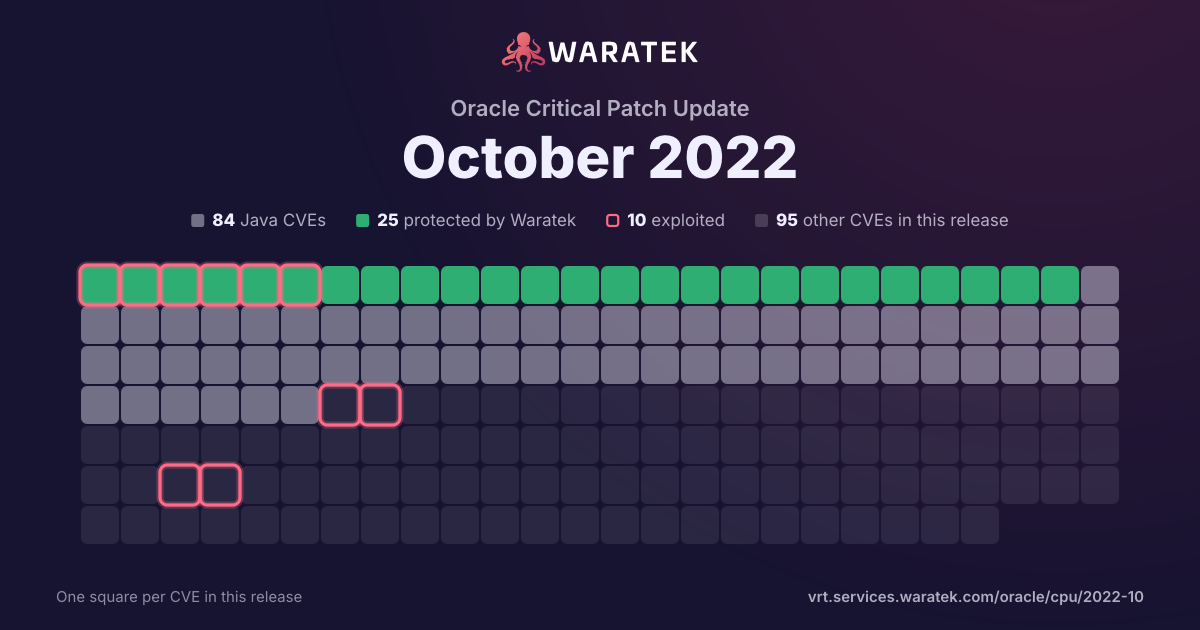
By status
26Protected by Waratek5Mitigation candidate57No exploit published3Outside Waratek scope88Not applicable
10Exploited, marked by the ring
No exploit published. For 33 of them, Oracle's security advisory is the source of public detail.
Protected by Waratek. Waratek RASP can block exploitation of these on systems that have not applied the patch yet.
Overview 16 matches · 2 protected · 1 exploited · 0 CISA KEV · 3 public PoC · 0 EPSS ≥ 0.5
Protected by Waratek
2
12.5%
Rule in development
0
0.0%
Mitigation candidate
2
12.5%
No exploit published
12
75.0%
blocked by ARMR today
2
12.5%
partly blocked
0
0.0%
not blocked
14
87.5%
not established
0
0.0%
unrecorded
0
0.0%
Exploited
1
6.2%
Working exploit published
0
0.0%
Proof of concept only
3
18.8%
Forecast only
0
0.0%
No public exploit
12
75.0%
split by
peak 11 / month
Jun 223
Protected by Waratek1
Mitigation candidate1
No exploit published1
Critical1
Medium1
Low1
blocked by ARMR today1
not blocked2
Exploited1
Proof of concept only1
No public exploit1
Jul 221
Mitigation candidate1
Critical1
not blocked1
Proof of concept only1
Aug 221
Protected by Waratek1
Medium1
blocked by ARMR today1
Proof of concept only1
Sep 220
Oct 2211
No exploit published11
High8
Medium3
not blocked11
No public exploit11
Jun 22Jul 22Aug 22Sep 22Oct 22
| CVE | Severity | Published▾ | Status | Exploitation | Description |
|---|---|---|---|---|---|
| CVE-2022-39412 | High | 2022-10-18 | No exploit published | No public exploit | Vulnerability in the Oracle Access Manager product of Oracle Fusion Middleware (component: Admin Console). The supported version that is affected is 12.2.1.4.0. Easily exploitable vulnerability allows unauthenticated attacker with network access via HTTP to compromise Oracle Access Manager. Successful attacks of this vulnerability can result in unauthorized access to critical data or complete access to all Oracle Access Manager accessible data. CVSS 3.1 Base Score 7.5 (Confidentiality impacts). CVSS Vector: (CVSS:3.1/AV:N/AC:L/PR:N/UI:N/S:U/C:H/I:N/A:N). |
| CVE-2022-39405 | Medium | 2022-10-18 | No exploit published | No public exploit | Vulnerability in the Oracle Access Manager product of Oracle Fusion Middleware (component: Authentication Engine). The supported version that is affected is 12.2.1.3.0. Easily exploitable vulnerability allows unauthenticated attacker with network access via HTTP to compromise Oracle Access Manager. Successful attacks of this vulnerability can result in unauthorized update, insert or delete access to some of Oracle Access Manager accessible data. CVSS 3.1 Base Score 5.3 (Integrity impacts). CVSS Vector: (CVSS:3.1/AV:N/AC:L/PR:N/UI:N/S:U/C:N/I:L/A:N). |
| CVE-2022-21622 | High | 2022-10-18 | No exploit published | No public exploit | Vulnerability in the Oracle SOA Suite product of Oracle Fusion Middleware (component: Adapters). Supported versions that are affected are 12.2.1.3.0 and 12.2.1.4.0. Easily exploitable vulnerability allows unauthenticated attacker with network access via HTTP to compromise Oracle SOA Suite. Successful attacks of this vulnerability can result in unauthorized creation, deletion or modification access to critical data or all Oracle SOA Suite accessible data. CVSS 3.1 Base Score 7.5 (Integrity impacts). CVSS Vector: (CVSS:3.1/AV:N/AC:L/PR:N/UI:N/S:U/C:N/I:H/A:N). |
| CVE-2022-21616 | Medium | 2022-10-18 | No exploit published | No public exploit | Vulnerability in the Oracle WebLogic Server product of Oracle Fusion Middleware (component: Web Container). Supported versions that are affected are 12.2.1.3.0, 12.2.1.4.0 and 14.1.1.0.0. Difficult to exploit vulnerability allows high privileged attacker with logon to the infrastructure where Oracle WebLogic Server executes to compromise Oracle WebLogic Server. Successful attacks of this vulnerability can result in unauthorized ability to cause a hang or frequently repeatable crash (complete DOS) of Oracle WebLogic Server as well as unauthorized update, insert or delete access to some of Oracle WebLogic Server accessible data and unauthorized read access to a subset of Oracle WebLogic Server accessible data. CVSS 3.1 Base Score 5.2 (Confidentiality, Integrity and Availability impacts). CVSS Vector: (CVSS:3.1/AV:L/AC:H/PR:H/UI:N/S:U/C:L/I:L/A:H). |
| CVE-2022-21615 | High | 2022-10-18 | No exploit published | No public exploit | Vulnerability in the Oracle Enterprise Data Quality product of Oracle Fusion Middleware (component: Dashboard). Supported versions that are affected are 12.2.1.3.0 and 12.2.1.4.0. Easily exploitable vulnerability allows unauthenticated attacker with network access via HTTP to compromise Oracle Enterprise Data Quality. Successful attacks require human interaction from a person other than the attacker and while the vulnerability is in Oracle Enterprise Data Quality, attacks may significantly impact additional products (scope change). Successful attacks of this vulnerability can result in unauthorized access to critical data or complete access to all Oracle Enterprise Data Quality accessible data. CVSS 3.1 Base Score 7.4 (Confidentiality impacts). CVSS Vector: (CVSS:3.1/AV:N/AC:L/PR:N/UI:R/S:C/C:H/I:N/A:N). |
| CVE-2022-21614 | High | 2022-10-18 | No exploit published | No public exploit | Vulnerability in the Oracle Enterprise Data Quality product of Oracle Fusion Middleware (component: Dashboard). Supported versions that are affected are 12.2.1.3.0 and 12.2.1.4.0. Easily exploitable vulnerability allows unauthenticated attacker with network access via HTTP to compromise Oracle Enterprise Data Quality. Successful attacks of this vulnerability can result in unauthorized access to critical data or complete access to all Oracle Enterprise Data Quality accessible data. CVSS 3.1 Base Score 7.5 (Confidentiality impacts). CVSS Vector: (CVSS:3.1/AV:N/AC:L/PR:N/UI:N/S:U/C:H/I:N/A:N). |
| CVE-2022-21613 | High | 2022-10-18 | No exploit published | No public exploit | Vulnerability in the Oracle Enterprise Data Quality product of Oracle Fusion Middleware (component: Dashboard). Supported versions that are affected are 12.2.1.3.0 and 12.2.1.4.0. Easily exploitable vulnerability allows unauthenticated attacker with network access via HTTP to compromise Oracle Enterprise Data Quality. Successful attacks require human interaction from a person other than the attacker and while the vulnerability is in Oracle Enterprise Data Quality, attacks may significantly impact additional products (scope change). Successful attacks of this vulnerability can result in unauthorized access to critical data or complete access to all Oracle Enterprise Data Quality accessible data as well as unauthorized update, insert or delete access to some of Oracle Enterprise Data Quality accessible data and unauthorized ability to cause a partial denial of service (partial DOS) of Oracle Enterprise Data Quality. CVSS 3.1 Base Score 8.8 (Confidentiality, Integrity and Availability impacts). CVSS Vector: (CVSS:3.1/AV:N/AC:L/PR:N/UI:R/S:C/C:H/I:L/A:L). |
| CVE-2022-21612 | High | 2022-10-18 | No exploit published | No public exploit | Vulnerability in the Oracle Enterprise Data Quality product of Oracle Fusion Middleware (component: Dashboard). Supported versions that are affected are 12.2.1.3.0 and 12.2.1.4.0. Easily exploitable vulnerability allows low privileged attacker with network access via HTTP to compromise Oracle Enterprise Data Quality. Successful attacks of this vulnerability can result in unauthorized creation, deletion or modification access to critical data or all Oracle Enterprise Data Quality accessible data as well as unauthorized access to critical data or complete access to all Oracle Enterprise Data Quality accessible data. CVSS 3.1 Base Score 8.1 (Confidentiality and Integrity impacts). CVSS Vector: (CVSS:3.1/AV:N/AC:L/PR:L/UI:N/S:U/C:H/I:H/A:N). |
| CVE-2022-21609 | Medium | 2022-10-18 | No exploit published | No public exploit | Vulnerability in the Oracle Business Intelligence Enterprise Edition product of Oracle Fusion Middleware (component: Analytics Server). The supported version that is affected is 5.9.0.0. Easily exploitable vulnerability allows low privileged attacker with network access via HTTP to compromise Oracle Business Intelligence Enterprise Edition. Successful attacks require human interaction from a person other than the attacker. Successful attacks of this vulnerability can result in unauthorized access to critical data or complete access to all Oracle Business Intelligence Enterprise Edition accessible data. CVSS 3.1 Base Score 5.7 (Confidentiality impacts). CVSS Vector: (CVSS:3.1/AV:N/AC:L/PR:L/UI:R/S:U/C:H/I:N/A:N). |
| CVE-2022-21593 | High | 2022-10-18 | No exploit published | No public exploit | Vulnerability in the Oracle HTTP Server product of Oracle Fusion Middleware (component: OHS Config MBeans). Supported versions that are affected are 12.2.1.3.0 and 12.2.1.4.0. Easily exploitable vulnerability allows unauthenticated attacker with network access via HTTP to compromise Oracle HTTP Server. Successful attacks require human interaction from a person other than the attacker. Successful attacks of this vulnerability can result in unauthorized access to critical data or complete access to all Oracle HTTP Server accessible data as well as unauthorized update, insert or delete access to some of Oracle HTTP Server accessible data. CVSS 3.1 Base Score 7.1 (Confidentiality and Integrity impacts). CVSS Vector: (CVSS:3.1/AV:N/AC:L/PR:N/UI:R/S:U/C:H/I:L/A:N). |
| CVE-2022-21590 | High | 2022-10-18 | No exploit published | No public exploit | Vulnerability in the Oracle BI Publisher product of Oracle Fusion Middleware (component: Core Formatting API). Supported versions that are affected are 5.9.0.0, 6.4.0.0.0, 12.2.1.3.0 and 12.2.1.4.0. Easily exploitable vulnerability allows low privileged attacker with network access via HTTP to compromise Oracle BI Publisher. Successful attacks of this vulnerability can result in unauthorized access to critical data or complete access to all Oracle BI Publisher accessible data as well as unauthorized update, insert or delete access to some of Oracle BI Publisher accessible data and unauthorized ability to cause a partial denial of service (partial DOS) of Oracle BI Publisher. CVSS 3.1 Base Score 7.6 (Confidentiality, Integrity and Availability impacts). CVSS Vector: (CVSS:3.1/AV:N/AC:L/PR:L/UI:N/S:U/C:H/I:L/A:L). |
| CVE-2022-36033 | Medium | 2022-08-29 | Protected by Waratek | Proof of concept only | jsoup is a Java HTML parser, built for HTML editing, cleaning, scraping, and cross-site scripting (XSS) safety. jsoup may incorrectly sanitize HTML including `javascript:` URL expressions, which could allow XSS attacks when a reader subsequently clicks that link. If the non-default `SafeList.preserveRelativeLinks` option is enabled, HTML including `javascript:` URLs that have been crafted with control characters will not be sanitized. If the site that this HTML is published on does not set a Content Security Policy, an XSS attack is then possible. This issue is patched in jsoup 1.15.3. Users should upgrade to this version. Additionally, as the unsanitized input may have been persisted, old content should be cleaned again using the updated version. To remediate this issue without immediately upgrading: - disable `SafeList.preserveRelativeLinks`, which will rewrite input URLs as absolute URLs - ensure an appropriate [Content Security Policy](https://developer.mozilla.org/en-US/docs/Web/HTTP/CSP) is defined. (This should be used regardless of upgrading, as a defence-in-depth best practice.) |
| CVE-2022-33980 | Critical | 2022-07-06 | Mitigation candidate | Proof of concept only | Apache Commons Configuration performs variable interpolation, allowing properties to be dynamically evaluated and expanded. The standard format for interpolation is "${prefix:name}", where "prefix" is used to locate an instance of org.apache.commons.configuration2.interpol.Lookup that performs the interpolation. Starting with version 2.4 and continuing through 2.7, the set of default Lookup instances included interpolators that could result in arbitrary code execution or contact with remote servers. These lookups are: - "script" - execute expressions using the JVM script execution engine (javax.script) - "dns" - resolve dns records - "url" - load values from urls, including from remote servers Applications using the interpolation defaults in the affected versions may be vulnerable to remote code execution or unintentional contact with remote servers if untrusted configuration values are used. Users are recommended to upgrade to Apache Commons Configuration 2.8.0, which disables the problematic interpolators by default. |
| CVE-2022-32532 | Critical | 2022-06-29 | Mitigation candidate | Proof of concept only | Apache Shiro before 1.9.1, A RegexRequestMatcher can be misconfigured to be bypassed on some servlet containers. Applications using RegExPatternMatcher with `.` in the regular expression are possibly vulnerable to an authorization bypass. |
| CVE-2022-33879 | Low | 2022-06-27 | No exploit published | No public exploit | The initial fixes in CVE-2022-30126 and CVE-2022-30973 for regexes in the StandardsExtractingContentHandler were insufficient, and we found a separate, new regex DoS in a different regex in the StandardsExtractingContentHandler. These are now fixed in 1.28.4 and 2.4.1. |
| CVE-2022-34305 | Medium | 2022-06-23 | Protected by Waratek | Exploited | In Apache Tomcat 10.1.0-M1 to 10.1.0-M16, 10.0.0-M1 to 10.0.22, 9.0.30 to 9.0.64 and 8.5.50 to 8.5.81 the Form authentication example in the examples web application displayed user provided data without filtering, exposing a XSS vulnerability. |