
Oracle Critical Patch Update July 2022
Released July 2022 · Oracle's advisory ↗ · ← Critical Patch Update, April 2022 · Critical Patch Update, October 2022 →
188 CVEs in this release, one square each
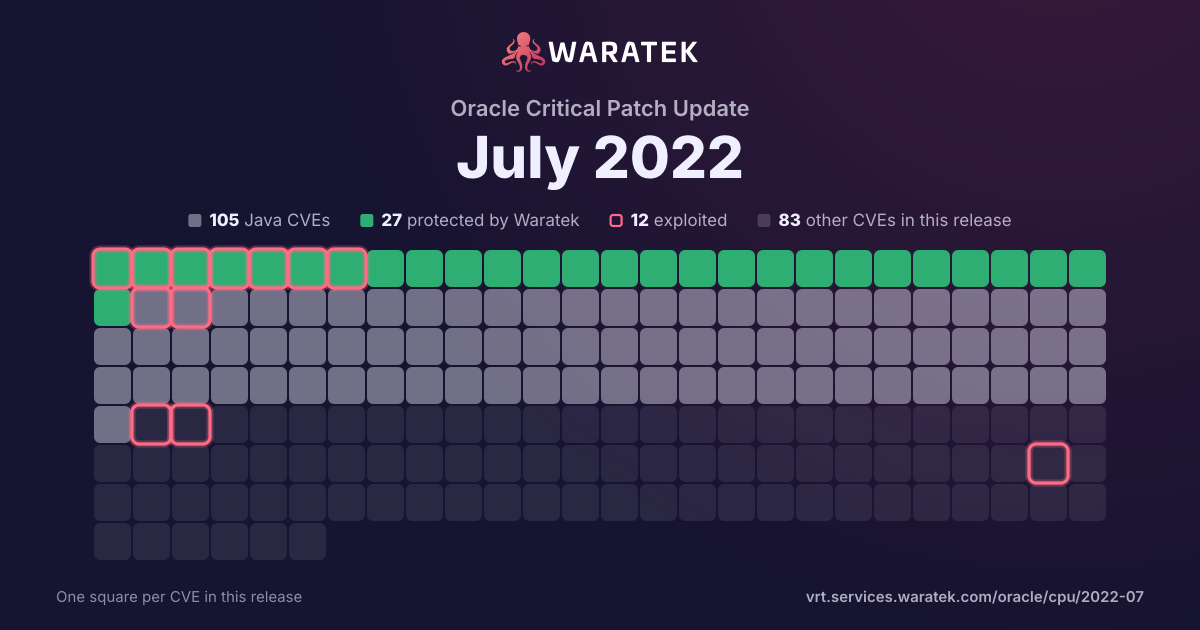
By status
27Protected by Waratek6Mitigation candidate72No exploit published49Outside Waratek scope34Not applicable
12Exploited, marked by the ring
No exploit published. For 47 of them, Oracle's security advisory is the source of public detail.
Protected by Waratek. Waratek RASP can block exploitation of these on systems that have not applied the patch yet.
Overview 19 matches · 0 in Waratek scope · 0 protected · 1 exploited · 0 CISA KEV · 2 public PoC · 0 EPSS ≥ 0.5
19matches
0in Waratek scope0.0%
0protected0.0%
1exploited5.3%
0CISA KEV0.0%
2public PoC10.5%
0EPSS ≥ 0.50.0%
Protected by Waratek
0
0.0%
Rule in development
0
0.0%
Mitigation candidate
0
0.0%
No exploit published
0
0.0%
Outside Waratek scope
0
0.0%
Not applicable
19
100.0%
Withdrawn CVE
0
0.0%
blocked by ARMR today
0
0.0%
partly blocked
0
0.0%
not blocked
19
100.0%
not established
0
0.0%
unrecorded
0
0.0%
Exploited
1
5.3%
Working exploit published
0
0.0%
Proof of concept only
2
10.5%
Forecast only
0
0.0%
No public exploit
16
84.2%
split by
peak 8 / quarter
Q1 212
Not applicable2
High2
not blocked2
Exploited1
No public exploit1
Q2 210
Q3 212
Not applicable2
High2
not blocked2
No public exploit2
Q4 210
Q1 225
Not applicable5
High5
not blocked5
Proof of concept only1
No public exploit4
Q2 222
Not applicable2
High2
not blocked2
Proof of concept only1
No public exploit1
Q3 228
Not applicable8
High8
not blocked8
No public exploit8
Q1 21Q2 21Q3 21Q4 21Q1 22Q2 22Q3 22
| CVE | Severity | Published▾ | Status | Exploitation | Description |
|---|---|---|---|---|---|
| CVE-2022-1271 | High | 2022-08-31 | Not applicable | No public exploit | An arbitrary file write vulnerability was found in GNU gzip's zgrep utility. When zgrep is applied on the attacker's chosen file name (for example, a crafted file name), this can overwrite an attacker's content to an arbitrary attacker-selected file. This flaw occurs due to insufficient validation when processing filenames with two or more newlines where selected content and the target file names are embedded in crafted multi-line file names. This flaw allows a remote, low privileged attacker to force zgrep to write arbitrary files on the system. |
| CVE-2022-21571 | High | 2022-07-19 | Not applicable | No public exploit | Vulnerability in the Oracle VM VirtualBox product of Oracle Virtualization (component: Core). The supported version that is affected is Prior to 6.1.36. Easily exploitable vulnerability allows high privileged attacker with logon to the infrastructure where Oracle VM VirtualBox executes to compromise Oracle VM VirtualBox. While the vulnerability is in Oracle VM VirtualBox, attacks may significantly impact additional products (scope change). Successful attacks of this vulnerability can result in takeover of Oracle VM VirtualBox. CVSS 3.1 Base Score 8.2 (Confidentiality, Integrity and Availability impacts). CVSS Vector: (CVSS:3.1/AV:L/AC:L/PR:H/UI:N/S:C/C:H/I:H/A:H). |
| CVE-2022-21558 | High | 2022-07-19 | Not applicable | No public exploit | Vulnerability in the Oracle Crystal Ball product of Oracle Construction and Engineering (component: Installation). Supported versions that are affected are 11.1.2.0.000-11.1.2.4.900. Difficult to exploit vulnerability allows low privileged attacker with logon to the infrastructure where Oracle Crystal Ball executes to compromise Oracle Crystal Ball. While the vulnerability is in Oracle Crystal Ball, attacks may significantly impact additional products (scope change). Successful attacks of this vulnerability can result in takeover of Oracle Crystal Ball. CVSS 3.1 Base Score 7.8 (Confidentiality, Integrity and Availability impacts). CVSS Vector: (CVSS:3.1/AV:L/AC:H/PR:L/UI:N/S:C/C:H/I:H/A:H). |
| CVE-2022-21524 | High | 2022-07-19 | Not applicable | No public exploit | Vulnerability in the Oracle Solaris product of Oracle Systems (component: Filesystem). The supported version that is affected is 11. Easily exploitable vulnerability allows low privileged attacker with network access via SMB to compromise Oracle Solaris. Successful attacks of this vulnerability can result in unauthorized ability to cause a hang or frequently repeatable crash (complete DOS) of Oracle Solaris as well as unauthorized update, insert or delete access to some of Oracle Solaris accessible data and unauthorized read access to a subset of Oracle Solaris accessible data. CVSS 3.1 Base Score 7.6 (Confidentiality, Integrity and Availability impacts). CVSS Vector: (CVSS:3.1/AV:N/AC:L/PR:L/UI:N/S:U/C:L/I:L/A:H). |
| CVE-2022-21514 | High | 2022-07-19 | Not applicable | No public exploit | Vulnerability in the Oracle Solaris product of Oracle Systems (component: Remote Administration Daemon). The supported version that is affected is 11. Easily exploitable vulnerability allows unauthenticated attacker with network access via multiple protocols to compromise Oracle Solaris. Successful attacks of this vulnerability can result in unauthorized ability to cause a hang or frequently repeatable crash (complete DOS) of Oracle Solaris. CVSS 3.1 Base Score 7.5 (Availability impacts). CVSS Vector: (CVSS:3.1/AV:N/AC:L/PR:N/UI:N/S:U/C:N/I:N/A:H). |
| CVE-2022-21513 | High | 2022-07-19 | Not applicable | No public exploit | Vulnerability in the Oracle ZFS Storage Appliance Kit product of Oracle Systems (component: Core). The supported version that is affected is 8.8. Easily exploitable vulnerability allows high privileged attacker with logon to the infrastructure where Oracle ZFS Storage Appliance Kit executes to compromise Oracle ZFS Storage Appliance Kit. While the vulnerability is in Oracle ZFS Storage Appliance Kit, attacks may significantly impact additional products (scope change). Successful attacks of this vulnerability can result in takeover of Oracle ZFS Storage Appliance Kit. CVSS 3.1 Base Score 8.2 (Confidentiality, Integrity and Availability impacts). CVSS Vector: (CVSS:3.1/AV:L/AC:L/PR:H/UI:N/S:C/C:H/I:H/A:H). |
| CVE-2022-21511 | High | 2022-07-19 | Not applicable | No public exploit | Vulnerability in the Oracle Database - Enterprise Edition Recovery component of Oracle Database Server. For supported versions that are affected see note. Easily exploitable vulnerability allows high privileged attacker having EXECUTE ON DBMS_IR.EXECUTESQLSCRIPT privilege with network access via Oracle Net to compromise Oracle Database - Enterprise Edition Recovery. Successful attacks of this vulnerability can result in takeover of Oracle Database - Enterprise Edition Recovery. Note: None of the supported versions are affected. CVSS 3.1 Base Score 7.2 (Confidentiality, Integrity and Availability impacts). CVSS Vector: (CVSS:3.1/AV:N/AC:L/PR:H/UI:N/S:U/C:H/I:H/A:H). |
| CVE-2022-21510 | High | 2022-07-19 | Not applicable | No public exploit | Vulnerability in the Oracle Database - Enterprise Edition Sharding component of Oracle Database Server. For supported versions that are affected see note. Easily exploitable vulnerability allows low privileged attacker having Local Logon privilege with logon to the infrastructure where Oracle Database - Enterprise Edition Sharding executes to compromise Oracle Database - Enterprise Edition Sharding. While the vulnerability is in Oracle Database - Enterprise Edition Sharding, attacks may significantly impact additional products (scope change). Successful attacks of this vulnerability can result in takeover of Oracle Database - Enterprise Edition Sharding. Note: None of the supported versions are affected. CVSS 3.1 Base Score 8.8 (Confidentiality, Integrity and Availability impacts). CVSS Vector: (CVSS:3.1/AV:L/AC:L/PR:L/UI:N/S:C/C:H/I:H/A:H). |
| CVE-2022-24735 | High | 2022-04-27 | Not applicable | Proof of concept only | Redis is an in-memory database that persists on disk. By exploiting weaknesses in the Lua script execution environment, an attacker with access to Redis prior to version 7.0.0 or 6.2.7 can inject Lua code that will execute with the (potentially higher) privileges of another Redis user. The Lua script execution environment in Redis provides some measures that prevent a script from creating side effects that persist and can affect the execution of the same, or different script, at a later time. Several weaknesses of these measures have been publicly known for a long time, but they had no security impact as the Redis security model did not endorse the concept of users or privileges. With the introduction of ACLs in Redis 6.0, these weaknesses can be exploited by a less privileged users to inject Lua code that will execute at a later time, when a privileged user executes a Lua script. The problem is fixed in Redis versions 7.0.0 and 6.2.7. An additional workaround to mitigate this problem without patching the redis-server executable, if Lua scripting is not being used, is to block access to `SCRIPT LOAD` and `EVAL` commands using ACL rules. |
| CVE-2022-24801 | High | 2022-04-04 | Not applicable | No public exploit | Twisted is an event-based framework for internet applications, supporting Python 3.6+. Prior to version 22.4.0rc1, the Twisted Web HTTP 1.1 server, located in the `twisted.web.http` module, parsed several HTTP request constructs more leniently than permitted by RFC 7230. This non-conformant parsing can lead to desync if requests pass through multiple HTTP parsers, potentially resulting in HTTP request smuggling. Users who may be affected use Twisted Web's HTTP 1.1 server and/or proxy and also pass requests through a different HTTP server and/or proxy. The Twisted Web client is not affected. The HTTP 2.0 server uses a different parser, so it is not affected. The issue has been addressed in Twisted 22.4.0rc1. Two workarounds are available: Ensure any vulnerabilities in upstream proxies have been addressed, such as by upgrading them; or filter malformed requests by other means, such as configuration of an upstream proxy. |
| CVE-2022-1154 | High | 2022-03-30 | Not applicable | No public exploit | Use after free in utf_ptr2char in GitHub repository vim/vim prior to 8.2.4646. |
| CVE-2022-23308 | High | 2022-02-26 | Not applicable | No public exploit | valid.c in libxml2 before 2.9.13 has a use-after-free of ID and IDREF attributes. |
| CVE-2022-25636 | High | 2022-02-24 | Not applicable | Proof of concept only | net/netfilter/nf_dup_netdev.c in the Linux kernel 5.4 through 5.6.10 allows local users to gain privileges because of a heap out-of-bounds write. This is related to nf_tables_offload. |
| CVE-2022-21824 | High | 2022-02-24 | Not applicable | No public exploit | Due to the formatting logic of the "console.table()" function it was not safe to allow user controlled input to be passed to the "properties" parameter while simultaneously passing a plain object with at least one property as the first parameter, which could be "__proto__". The prototype pollution has very limited control, in that it only allows an empty string to be assigned to numerical keys of the object prototype.Node.js >= 12.22.9, >= 14.18.3, >= 16.13.2, and >= 17.3.1 use a null protoype for the object these properties are being assigned to. |
| CVE-2022-23632 | High | 2022-02-17 | Not applicable | No public exploit | Traefik is an HTTP reverse proxy and load balancer. Prior to version 2.6.1, Traefik skips the router transport layer security (TLS) configuration when the host header is a fully qualified domain name (FQDN). For a request, the TLS configuration choice can be different than the router choice, which implies the use of a wrong TLS configuration. When sending a request using FQDN handled by a router configured with a dedicated TLS configuration, the TLS configuration falls back to the default configuration that might not correspond to the configured one. If the CNAME flattening is enabled, the selected TLS configuration is the SNI one and the routing uses the CNAME value, so this can skip the expected TLS configuration. Version 2.6.1 contains a patch for this issue. As a workaround, one may add the FDQN to the host rule. However, there is no workaround if the CNAME flattening is enabled. |
| CVE-2021-3749 | High | 2021-08-31 | Not applicable | No public exploit | axios is vulnerable to Inefficient Regular Expression Complexity |
| CVE-2021-35940 | High | 2021-08-23 | Not applicable | No public exploit | An out-of-bounds array read in the apr_time_exp*() functions was fixed in the Apache Portable Runtime 1.6.3 release (CVE-2017-12613). The fix for this issue was not carried forward to the APR 1.7.x branch, and hence version 1.7.0 regressed compared to 1.6.3 and is vulnerable to the same issue. |
| CVE-2021-3450 | High | 2021-03-25 | Not applicable | No public exploit | The X509_V_FLAG_X509_STRICT flag enables additional security checks of the certificates present in a certificate chain. It is not set by default. Starting from OpenSSL version 1.1.1h a check to disallow certificates in the chain that have explicitly encoded elliptic curve parameters was added as an additional strict check. An error in the implementation of this check meant that the result of a previous check to confirm that certificates in the chain are valid CA certificates was overwritten. This effectively bypasses the check that non-CA certificates must not be able to issue other certificates. If a "purpose" has been configured then there is a subsequent opportunity for checks that the certificate is a valid CA. All of the named "purpose" values implemented in libcrypto perform this check. Therefore, where a purpose is set the certificate chain will still be rejected even when the strict flag has been used. A purpose is set by default in libssl client and server certificate verification routines, but it can be overridden or removed by an application. In order to be affected, an application must explicitly set the X509_V_FLAG_X509_STRICT verification flag and either not set a purpose for the certificate verification or, in the case of TLS client or server applications, override the default purpose. OpenSSL versions 1.1.1h and newer are affected by this issue. Users of these versions should upgrade to OpenSSL 1.1.1k. OpenSSL 1.0.2 is not impacted by this issue. Fixed in OpenSSL 1.1.1k (Affected 1.1.1h-1.1.1j). |
| CVE-2021-23337 | High | 2021-02-15 | Not applicable | Exploited | Lodash versions prior to 4.17.21 are vulnerable to Command Injection via the template function. |