
Oracle Critical Patch Update July 2022
Released July 2022 · Oracle's advisory ↗ · ← Critical Patch Update, April 2022 · Critical Patch Update, October 2022 →
188 CVEs in this release, one square each
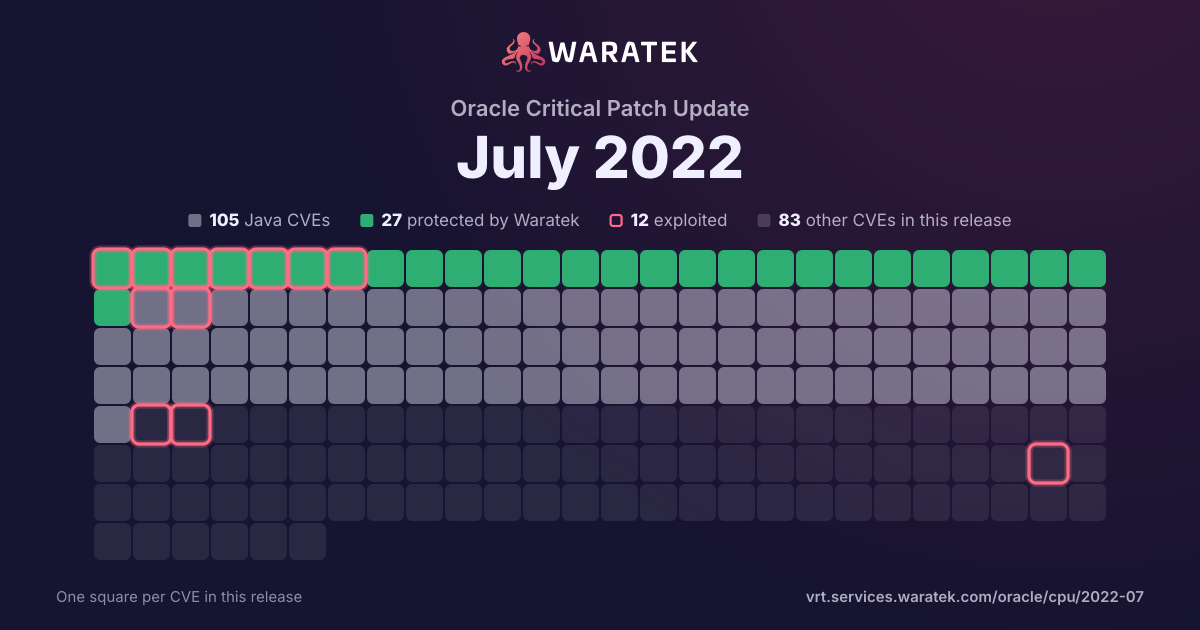
By status
27Protected by Waratek10Mitigation candidate83No exploit published2Outside Waratek scope66Not applicable
12Exploited, marked by the ring
No exploit published. For 50 of them, Oracle's security advisory is the source of public detail.
Protected by Waratek. Waratek RASP can block exploitation of these on systems that have not applied the patch yet.
Overview 10 matches · 8 in Waratek scope · 3 protected · 0 exploited · 0 CISA KEV · 0 public PoC · 0 EPSS ≥ 0.5
10matches
8in Waratek scope80.0%
3protected30.0%
0exploited0.0%
0CISA KEV0.0%
0public PoC0.0%
0EPSS ≥ 0.50.0%
Protected by Waratek
3
30.0%
Rule in development
0
0.0%
Mitigation candidate
0
0.0%
No exploit published
5
50.0%
Outside Waratek scope
0
0.0%
Not applicable
2
20.0%
Withdrawn CVE
0
0.0%
blocked by ARMR today
3
30.0%
partly blocked
0
0.0%
not blocked
7
70.0%
not established
0
0.0%
unrecorded
0
0.0%
Exploited
0
0.0%
Working exploit published
0
0.0%
Proof of concept only
0
0.0%
Forecast only
0
0.0%
No public exploit
10
100.0%
split by
peak 1 / month
Jun 191
Not applicable1
Medium1
not blocked1
No public exploit1
Jul 190
Aug 191
Protected by Waratek1
High1
blocked by ARMR today1
No public exploit1
Sep 191
No exploit published1
Critical1
not blocked1
No public exploit1
Oct 191
No exploit published1
Critical1
not blocked1
No public exploit1
Nov 190
Dec 190
Jan 201
No exploit published1
Critical1
not blocked1
No public exploit1
Feb 200
Mar 201
No exploit published1
High1
not blocked1
No public exploit1
Apr 200
May 201
Protected by Waratek1
Critical1
blocked by ARMR today1
No public exploit1
Jun 200
Jul 200
Aug 201
Protected by Waratek1
High1
blocked by ARMR today1
No public exploit1
Sep 201
Not applicable1
High1
not blocked1
No public exploit1
Oct 200
Nov 201
No exploit published1
High1
not blocked1
No public exploit1
Jul 19Sep 19Nov 19Jan 20Mar 20May 20Jul 20Sep 20Nov 20
| CVE | Severity | Published▾ | Status | Exploitation | Description |
|---|---|---|---|---|---|
| CVE-2020-26237 | High | 2020-11-24 | No exploit published | No public exploit | Highlight.js is a syntax highlighter written in JavaScript. Highlight.js versions before 9.18.2 and 10.1.2 are vulnerable to Prototype Pollution. A malicious HTML code block can be crafted that will result in prototype pollution of the base object's prototype during highlighting. If you allow users to insert custom HTML code blocks into your page/app via parsing Markdown code blocks (or similar) and do not filter the language names the user can provide you may be vulnerable. The pollution should just be harmless data but this can cause problems for applications not expecting these properties to exist and can result in strange behavior or application crashes, i.e. a potential DOS vector. If your website or application does not render user provided data it should be unaffected. Versions 9.18.2 and 10.1.2 and newer include fixes for this vulnerability. If you are using version 7 or 8 you are encouraged to upgrade to a newer release. |
| CVE-2019-20916 | High | 2020-09-04 | Not applicable | No public exploit | The pip package before 19.2 for Python allows Directory Traversal when a URL is given in an install command, because a Content-Disposition header can have ../ in a filename, as demonstrated by overwriting the /root/.ssh/authorized_keys file. This occurs in _download_http_url in _internal/download.py. |
| CVE-2020-7712 | High | 2020-08-30 | Protected by Waratek | No public exploit | This affects the package json before 10.0.0. It is possible to inject arbritary commands using the parseLookup function. |
| CVE-2020-10683 | Critical | 2020-05-01 | Protected by Waratek | No public exploit | dom4j before 2.0.3 and 2.1.x before 2.1.3 allows external DTDs and External Entities by default, which might enable XXE attacks. However, there is popular external documentation from OWASP showing how to enable the safe, non-default behavior in any application that uses dom4j. |
| CVE-2020-5258 | High | 2020-03-10 | No exploit published | No public exploit | In affected versions of dojo (NPM package), the deepCopy method is vulnerable to Prototype Pollution. Prototype Pollution refers to the ability to inject properties into existing JavaScript language construct prototypes, such as objects. An attacker manipulates these attributes to overwrite, or pollute, a JavaScript application object prototype of the base object by injecting other values. This has been patched in versions 1.12.8, 1.13.7, 1.14.6, 1.15.3 and 1.16.2 |
| CVE-2019-0219 | Critical | 2020-01-14 | No exploit published | No public exploit | A website running in the InAppBrowser webview on Android could execute arbitrary JavaScript in the main application's webview using a specially crafted gap-iab: URI. |
| CVE-2019-17495 | Critical | 2019-10-10 | No exploit published | No public exploit | A Cascading Style Sheets (CSS) injection vulnerability in Swagger UI before 3.23.11 allows attackers to use the Relative Path Overwrite (RPO) technique to perform CSS-based input field value exfiltration, such as exfiltration of a CSRF token value. In other words, this product intentionally allows the embedding of untrusted JSON data from remote servers, but it was not previously known that <style>@import within the JSON data was a functional attack method. |
| CVE-2019-10082 | Critical | 2019-09-26 | No exploit published | No public exploit | In Apache HTTP Server 2.4.18-2.4.39, using fuzzed network input, the http/2 session handling could be made to read memory after being freed, during connection shutdown. |
| CVE-2019-10086 | High | 2019-08-20 | Protected by Waratek | No public exploit | In Apache Commons Beanutils 1.9.2, a special BeanIntrospector class was added which allows suppressing the ability for an attacker to access the classloader via the class property available on all Java objects. We, however were not using this by default characteristic of the PropertyUtilsBean. |
| CVE-2019-0220 | Medium | 2019-06-11 | Not applicable | No public exploit | A vulnerability was found in Apache HTTP Server 2.4.0 to 2.4.38. When the path component of a request URL contains multiple consecutive slashes ('/'), directives such as LocationMatch and RewriteRule must account for duplicates in regular expressions while other aspects of the servers processing will implicitly collapse them. |