
Oracle Critical Patch Update July 2022
Released July 2022 · Oracle's advisory ↗ · ← Critical Patch Update, April 2022 · Critical Patch Update, October 2022 →
188 CVEs in this release, one square each
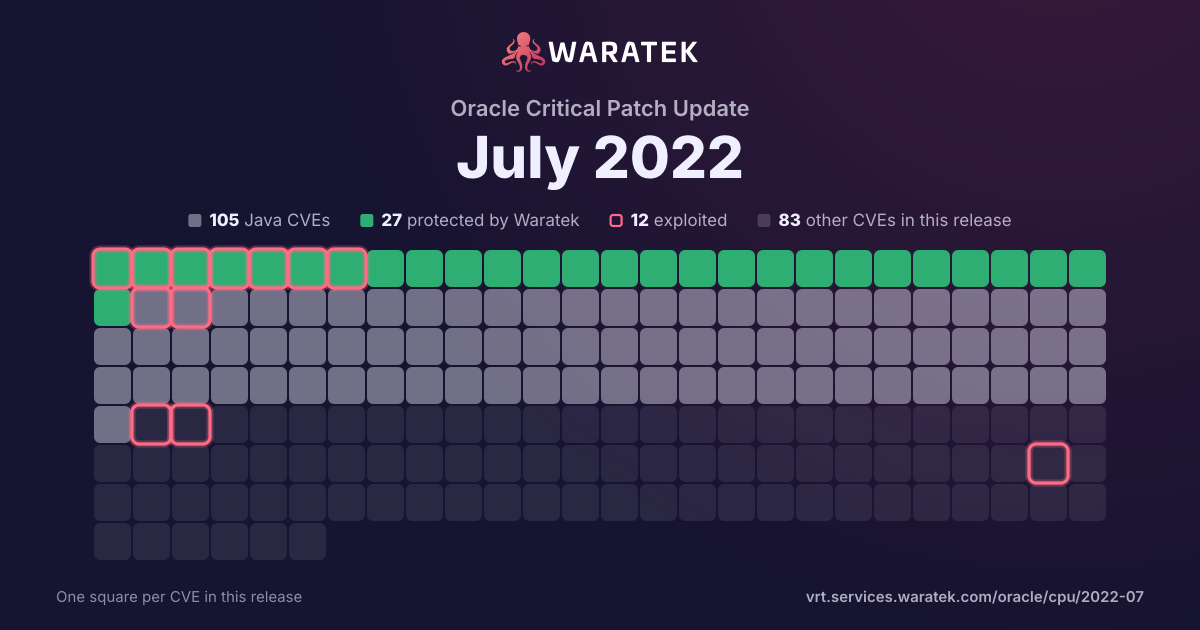
By status
27Protected by Waratek10Mitigation candidate83No exploit published2Outside Waratek scope66Not applicable
12Exploited, marked by the ring
No exploit published. For 50 of them, Oracle's security advisory is the source of public detail.
Protected by Waratek. Waratek RASP can block exploitation of these on systems that have not applied the patch yet.
Overview 8 matches · 3 protected · 0 exploited · 0 CISA KEV · 0 public PoC · 0 EPSS ≥ 0.5
Protected by Waratek
3
37.5%
Rule in development
0
0.0%
Mitigation candidate
0
0.0%
No exploit published
5
62.5%
blocked by ARMR today
3
37.5%
partly blocked
0
0.0%
not blocked
5
62.5%
not established
0
0.0%
unrecorded
0
0.0%
Exploited
0
0.0%
Working exploit published
0
0.0%
Proof of concept only
0
0.0%
Forecast only
0
0.0%
No public exploit
8
100.0%
| CVE | Severity | Published▾ | Status | Exploitation | Description |
|---|---|---|---|---|---|
| CVE-2022-30126 | Medium | 2022-05-16 | No exploit published | No public exploit | In Apache Tika, a regular expression in our StandardsText class, used by the StandardsExtractingContentHandler could lead to a denial of service caused by backtracking on a specially crafted file. This only affects users who are running the StandardsExtractingContentHandler, which is a non-standard handler. This is fixed in 1.28.2 and 2.4.0 |
| CVE-2022-25762 | High | 2022-05-13 | No exploit published | No public exploit | If a web application sends a WebSocket message concurrently with the WebSocket connection closing when running on Apache Tomcat 8.5.0 to 8.5.75 or Apache Tomcat 9.0.0.M1 to 9.0.20, it is possible that the application will continue to use the socket after it has been closed. The error handling triggered in this case could cause the a pooled object to be placed in the pool twice. This could result in subsequent connections using the same object concurrently which could result in data being returned to the wrong use and/or other errors. |
| CVE-2022-22971 | Medium | 2022-05-12 | Protected by Waratek | No public exploit | In spring framework versions prior to 5.3.20+ , 5.2.22+ and old unsupported versions, application with a STOMP over WebSocket endpoint is vulnerable to a denial of service attack by an authenticated user. |
| CVE-2022-25647 | High | 2022-05-01 | Protected by Waratek | No public exploit | The package com.google.code.gson:gson before 2.8.9 are vulnerable to Deserialization of Untrusted Data via the writeReplace() method in internal classes, which may lead to DoS attacks. |
| CVE-2022-29577 | Medium | 2022-04-21 | Protected by Waratek | No public exploit | OWASP AntiSamy before 1.6.7 allows XSS via HTML tag smuggling on STYLE content with crafted input. The output serializer does not properly encode the supposed Cascading Style Sheets (CSS) content. NOTE: this issue exists because of an incomplete fix for CVE-2022-28367. |
| CVE-2022-22969 | Medium | 2022-04-21 | No exploit published | No public exploit | <Issue Description> Spring Security OAuth versions 2.5.x prior to 2.5.2 and older unsupported versions are susceptible to a Denial-of-Service (DoS) attack via the initiation of the Authorization Request in an OAuth 2.0 Client application. A malicious user or attacker can send multiple requests initiating the Authorization Request for the Authorization Code Grant, which has the potential of exhausting system resources using a single session. This vulnerability exposes OAuth 2.0 Client applications only. |
| CVE-2022-22968 | Medium | 2022-04-14 | No exploit published | No public exploit | In Spring Framework versions 5.3.0 - 5.3.18, 5.2.0 - 5.2.20, and older unsupported versions, the patterns for disallowedFields on a DataBinder are case sensitive which means a field is not effectively protected unless it is listed with both upper and lower case for the first character of the field, including upper and lower case for the first character of all nested fields within the property path. |
| CVE-2022-24839 | High | 2022-04-11 | No exploit published | No public exploit | org.cyberneko.html is an html parser written in Java. The fork of `org.cyberneko.html` used by Nokogiri (Rubygem) raises a `java.lang.OutOfMemoryError` exception when parsing ill-formed HTML markup. Users are advised to upgrade to `>= 1.9.22.noko2`. Note: The upstream library `org.cyberneko.html` is no longer maintained. Nokogiri uses its own fork of this library located at https://github.com/sparklemotion/nekohtml and this CVE applies only to that fork. Other forks of nekohtml may have a similar vulnerability. |