
Oracle Critical Patch Update July 2022
Released July 2022 · Oracle's advisory ↗ · ← Critical Patch Update, April 2022 · Critical Patch Update, October 2022 →
188 CVEs in this release, one square each
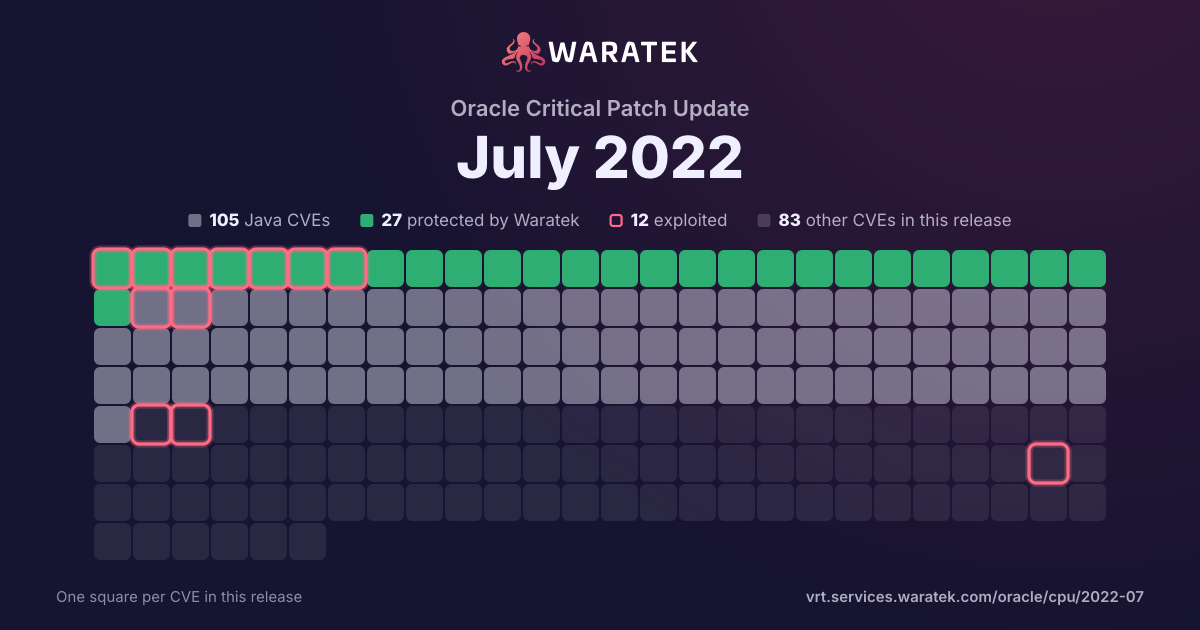
By status
27Protected by Waratek10Mitigation candidate83No exploit published2Outside Waratek scope66Not applicable
12Exploited, marked by the ring
No exploit published. For 50 of them, Oracle's security advisory is the source of public detail.
Protected by Waratek. Waratek RASP can block exploitation of these on systems that have not applied the patch yet.
Overview 7 matches · 5 in Waratek scope · 2 protected · 0 exploited · 0 CISA KEV · 4 public PoC · 2 EPSS ≥ 0.5
7matches
5in Waratek scope71.4%
2protected28.6%
0exploited0.0%
0CISA KEV0.0%
4public PoC57.1%
2EPSS ≥ 0.528.6%
Protected by Waratek
2
28.6%
Rule in development
0
0.0%
Mitigation candidate
2
28.6%
No exploit published
1
14.3%
Outside Waratek scope
0
0.0%
Not applicable
2
28.6%
Withdrawn CVE
0
0.0%
blocked by ARMR today
2
28.6%
partly blocked
0
0.0%
not blocked
5
71.4%
not established
0
0.0%
unrecorded
0
0.0%
Exploited
0
0.0%
Working exploit published
0
0.0%
Proof of concept only
7
100.0%
Forecast only
0
0.0%
No public exploit
0
0.0%
split by
peak 3 / month
Apr 222
Protected by Waratek1
Not applicable1
Critical1
High1
blocked by ARMR today1
not blocked1
Proof of concept only2
May 223
Mitigation candidate1
No exploit published1
Not applicable1
Critical2
Medium1
not blocked3
Proof of concept only3
Jun 221
Mitigation candidate1
Critical1
not blocked1
Proof of concept only1
Jul 221
Protected by Waratek1
High1
blocked by ARMR today1
Proof of concept only1
Apr 22May 22Jun 22Jul 22
| CVE | Severity | Published▾ | Status | Exploitation | Description |
|---|---|---|---|---|---|
| CVE-2022-34169 | High | 2022-07-19 | Protected by Waratek | Proof of concept only | The Apache Xalan Java XSLT library is vulnerable to an integer truncation issue when processing malicious XSLT stylesheets. This can be used to corrupt Java class files generated by the internal XSLTC compiler and execute arbitrary Java bytecode. Users are recommended to update to version 2.7.3 or later. Note: Java runtimes (such as OpenJDK) include repackaged copies of Xalan. |
| CVE-2022-25845 | Critical | 2022-06-10 | Mitigation candidate | Proof of concept only | The package com.alibaba:fastjson before 1.2.83 are vulnerable to Deserialization of Untrusted Data by bypassing the default autoType shutdown restrictions, which is possible under certain conditions. Exploiting this vulnerability allows attacking remote servers. Workaround: If upgrading is not possible, you can enable [safeMode](https://github.com/alibaba/fastjson/wiki/fastjson_safemode). |
| CVE-2022-22978 | Critical | 2022-05-19 | Mitigation candidate | Proof of concept only | In spring security versions prior to 5.4.11+, 5.5.7+ , 5.6.4+ and older unsupported versions, RegexRequestMatcher can easily be misconfigured to be bypassed on some servlet containers. Applications using RegexRequestMatcher with `.` in the regular expression are possibly vulnerable to an authorization bypass. |
| CVE-2022-24823 | Medium | 2022-05-06 | No exploit published | Proof of concept only | Netty is an open-source, asynchronous event-driven network application framework. The package `io.netty:netty-codec-http` prior to version 4.1.77.Final contains an insufficient fix for CVE-2021-21290. When Netty's multipart decoders are used local information disclosure can occur via the local system temporary directory if temporary storing uploads on the disk is enabled. This only impacts applications running on Java version 6 and lower. Additionally, this vulnerability impacts code running on Unix-like systems, and very old versions of Mac OSX and Windows as they all share the system temporary directory between all users. Version 4.1.77.Final contains a patch for this vulnerability. As a workaround, specify one's own `java.io.tmpdir` when starting the JVM or use DefaultHttpDataFactory.setBaseDir(...) to set the directory to something that is only readable by the current user. |
| CVE-2022-1292 | Critical | 2022-05-03 | Not applicable | Proof of concept only | The c_rehash script does not properly sanitise shell metacharacters to prevent command injection. This script is distributed by some operating systems in a manner where it is automatically executed. On such operating systems, an attacker could execute arbitrary commands with the privileges of the script. Use of the c_rehash script is considered obsolete and should be replaced by the OpenSSL rehash command line tool. Fixed in OpenSSL 3.0.3 (Affected 3.0.0,3.0.1,3.0.2). Fixed in OpenSSL 1.1.1o (Affected 1.1.1-1.1.1n). Fixed in OpenSSL 1.0.2ze (Affected 1.0.2-1.0.2zd). |
| CVE-2022-24735 | High | 2022-04-27 | Not applicable | Proof of concept only | Redis is an in-memory database that persists on disk. By exploiting weaknesses in the Lua script execution environment, an attacker with access to Redis prior to version 7.0.0 or 6.2.7 can inject Lua code that will execute with the (potentially higher) privileges of another Redis user. The Lua script execution environment in Redis provides some measures that prevent a script from creating side effects that persist and can affect the execution of the same, or different script, at a later time. Several weaknesses of these measures have been publicly known for a long time, but they had no security impact as the Redis security model did not endorse the concept of users or privileges. With the introduction of ACLs in Redis 6.0, these weaknesses can be exploited by a less privileged users to inject Lua code that will execute at a later time, when a privileged user executes a Lua script. The problem is fixed in Redis versions 7.0.0 and 6.2.7. An additional workaround to mitigate this problem without patching the redis-server executable, if Lua scripting is not being used, is to block access to `SCRIPT LOAD` and `EVAL` commands using ACL rules. |
| CVE-2022-23457 | Critical | 2022-04-25 | Protected by Waratek | Proof of concept only | ESAPI (The OWASP Enterprise Security API) is a free, open source, web application security control library. Prior to version 2.3.0.0, the default implementation of `Validator.getValidDirectoryPath(String, String, File, boolean)` may incorrectly treat the tested input string as a child of the specified parent directory. This potentially could allow control-flow bypass checks to be defeated if an attack can specify the entire string representing the 'input' path. This vulnerability is patched in release 2.3.0.0 of ESAPI. As a workaround, it is possible to write one's own implementation of the Validator interface. However, maintainers do not recommend this. |