
Oracle Critical Patch Update July 2022
Released July 2022 · Oracle's advisory ↗ · ← Critical Patch Update, April 2022 · Critical Patch Update, October 2022 →
188 CVEs in this release, one square each
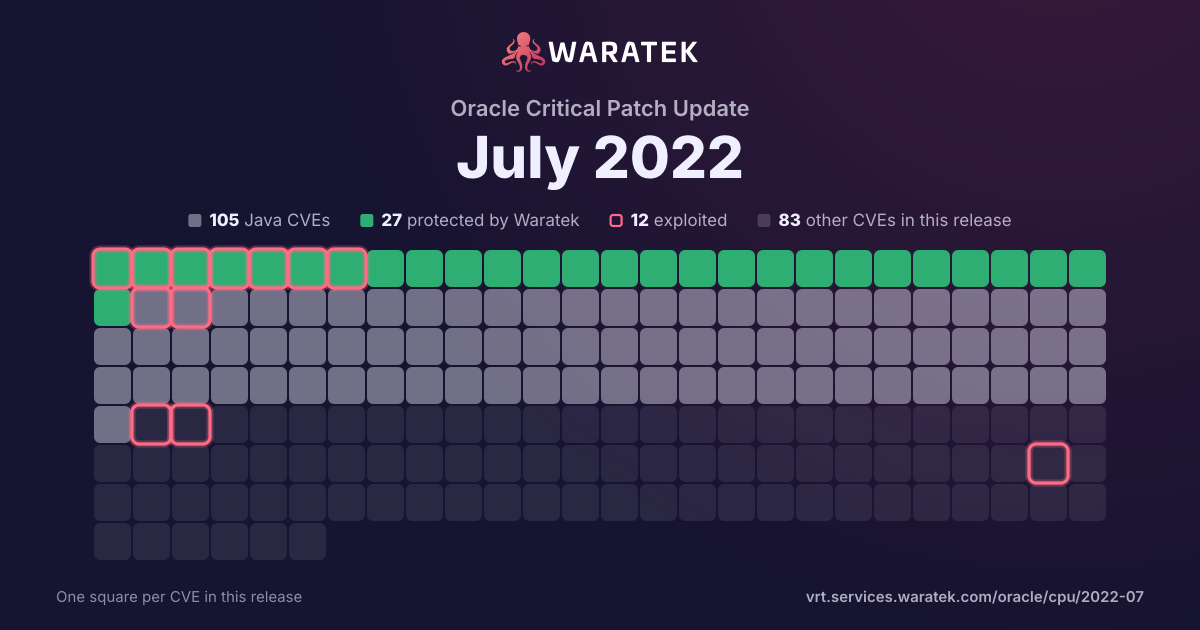
By status
24Protected by Waratek2Rule in development6Mitigation candidate84No exploit published2Outside Waratek scope70Not applicable
12Exploited, marked by the ring
No exploit published. For 47 of them, Oracle's security advisory is the source of public detail.
Protected by Waratek. Waratek RASP can block exploitation of these on systems that have not applied the patch yet.
Overview 11 matches · 2 exploited · 0 CISA KEV · 2 public PoC · 3 EPSS ≥ 0.5
Protected by Waratek
11
100.0%
Rule in development
0
0.0%
Mitigation candidate
0
0.0%
No exploit published
0
0.0%
blocked by ARMR today
11
100.0%
partly blocked
0
0.0%
not blocked
0
0.0%
not established
0
0.0%
unrecorded
0
0.0%
Exploited
2
18.2%
Working exploit published
0
0.0%
Proof of concept only
1
9.1%
Forecast only
0
0.0%
No public exploit
8
72.7%
split by
peak 2 / quarter
Q3 191
Protected by Waratek1
High1
blocked by ARMR today1
No public exploit1
Q4 190
Q1 200
Q2 201
Protected by Waratek1
Critical1
blocked by ARMR today1
No public exploit1
Q3 200
Q4 202
Protected by Waratek2
High1
Medium1
blocked by ARMR today2
No public exploit2
Q1 211
Protected by Waratek1
Critical1
blocked by ARMR today1
No public exploit1
Q2 212
Protected by Waratek2
High1
Medium1
blocked by ARMR today2
No public exploit2
Q3 211
Protected by Waratek1
Medium1
blocked by ARMR today1
Exploited1
Q4 211
Protected by Waratek1
Medium1
blocked by ARMR today1
Exploited1
Q1 222
Protected by Waratek2
Critical1
Medium1
blocked by ARMR today2
Proof of concept only1
No public exploit1
Q3 19Q4 19Q1 20Q2 20Q3 20Q4 20Q1 21Q2 21Q3 21Q4 21Q1 22
| CVE | Severity | Published▾ | Status | Exploitation | Description |
|---|---|---|---|---|---|
| CVE-2022-23437 | Medium | 2022-01-24 | Protected by Waratek | No public exploit | There's a vulnerability within the Apache Xerces Java (XercesJ) XML parser when handling specially crafted XML document payloads. This causes, the XercesJ XML parser to wait in an infinite loop, which may sometimes consume system resources for prolonged duration. This vulnerability is present within XercesJ version 2.12.1 and the previous versions. |
| CVE-2022-23305 | Critical | 2022-01-18 | Protected by Waratek | Proof of concept only | By design, the JDBCAppender in Log4j 1.2.x accepts an SQL statement as a configuration parameter where the values to be inserted are converters from PatternLayout. The message converter, %m, is likely to always be included. This allows attackers to manipulate the SQL by entering crafted strings into input fields or headers of an application that are logged allowing unintended SQL queries to be executed. Note this issue only affects Log4j 1.x when specifically configured to use the JDBCAppender, which is not the default. Beginning in version 2.0-beta8, the JDBCAppender was re-introduced with proper support for parameterized SQL queries and further customization over the columns written to in logs. Apache Log4j 1.2 reached end of life in August 2015. Users should upgrade to Log4j 2 as it addresses numerous other issues from the previous versions. |
| CVE-2021-44832 | Medium | 2021-12-28 | Protected by Waratek | Exploited | Apache Log4j2 versions 2.0-beta7 through 2.17.0 (excluding security fix releases 2.3.2 and 2.12.4) are vulnerable to a remote code execution (RCE) attack when a configuration uses a JDBC Appender with a JNDI LDAP data source URI when an attacker has control of the target LDAP server. This issue is fixed by limiting JNDI data source names to the java protocol in Log4j2 versions 2.17.1, 2.12.4, and 2.3.2. |
| CVE-2021-34429 | Medium | 2021-07-15 | Protected by Waratek | Exploited | For Eclipse Jetty versions 9.4.37-9.4.42, 10.0.1-10.0.5 & 11.0.1-11.0.5, URIs can be crafted using some encoded characters to access the content of the WEB-INF directory and/or bypass some security constraints. This is a variation of the vulnerability reported in CVE-2021-28164/GHSA-v7ff-8wcx-gmc5. |
| CVE-2021-33813 | High | 2021-06-16 | Protected by Waratek | No public exploit | An XXE issue in SAXBuilder in JDOM through 2.0.6 allows attackers to cause a denial of service via a crafted HTTP request. |
| CVE-2021-29425 | Medium | 2021-04-13 | Protected by Waratek | No public exploit | In Apache Commons IO before 2.7, When invoking the method FileNameUtils.normalize with an improper input string, like "//../foo", or "\\..\foo", the result would be the same value, thus possibly providing access to files in the parent directory, but not further above (thus "limited" path traversal), if the calling code would use the result to construct a path value. |
| CVE-2021-23926 | Critical | 2021-01-14 | Protected by Waratek | No public exploit | The XML parsers used by XMLBeans up to version 2.6.0 did not set the properties needed to protect the user from malicious XML input. Vulnerabilities include possibilities for XML Entity Expansion attacks. Affects XMLBeans up to and including v2.6.0. |
| CVE-2020-17521 | Medium | 2020-12-07 | Protected by Waratek | No public exploit | Apache Groovy provides extension methods to aid with creating temporary directories. Prior to this fix, Groovy's implementation of those extension methods was using a now superseded Java JDK method call that is potentially not secure on some operating systems in some contexts. Users not using the extension methods mentioned in the advisory are not affected, but may wish to read the advisory for further details. Versions Affected: 2.0 to 2.4.20, 2.5.0 to 2.5.13, 3.0.0 to 3.0.6, and 4.0.0-alpha-1. Fixed in versions 2.4.21, 2.5.14, 3.0.7, 4.0.0-alpha-2. |
| CVE-2020-25649 | High | 2020-12-03 | Protected by Waratek | No public exploit | A flaw was found in FasterXML Jackson Databind, where it did not have entity expansion secured properly. This flaw allows vulnerability to XML external entity (XXE) attacks. The highest threat from this vulnerability is data integrity. |
| CVE-2020-10683 | Critical | 2020-05-01 | Protected by Waratek | No public exploit | dom4j before 2.0.3 and 2.1.x before 2.1.3 allows external DTDs and External Entities by default, which might enable XXE attacks. However, there is popular external documentation from OWASP showing how to enable the safe, non-default behavior in any application that uses dom4j. |
| CVE-2019-10086 | High | 2019-08-20 | Protected by Waratek | No public exploit | In Apache Commons Beanutils 1.9.2, a special BeanIntrospector class was added which allows suppressing the ability for an attacker to access the classloader via the class property available on all Java objects. We, however were not using this by default characteristic of the PropertyUtilsBean. |