
Oracle Critical Patch Update July 2022
Released July 2022 · Oracle's advisory ↗ · ← Critical Patch Update, April 2022 · Critical Patch Update, October 2022 →
188 CVEs in this release, one square each
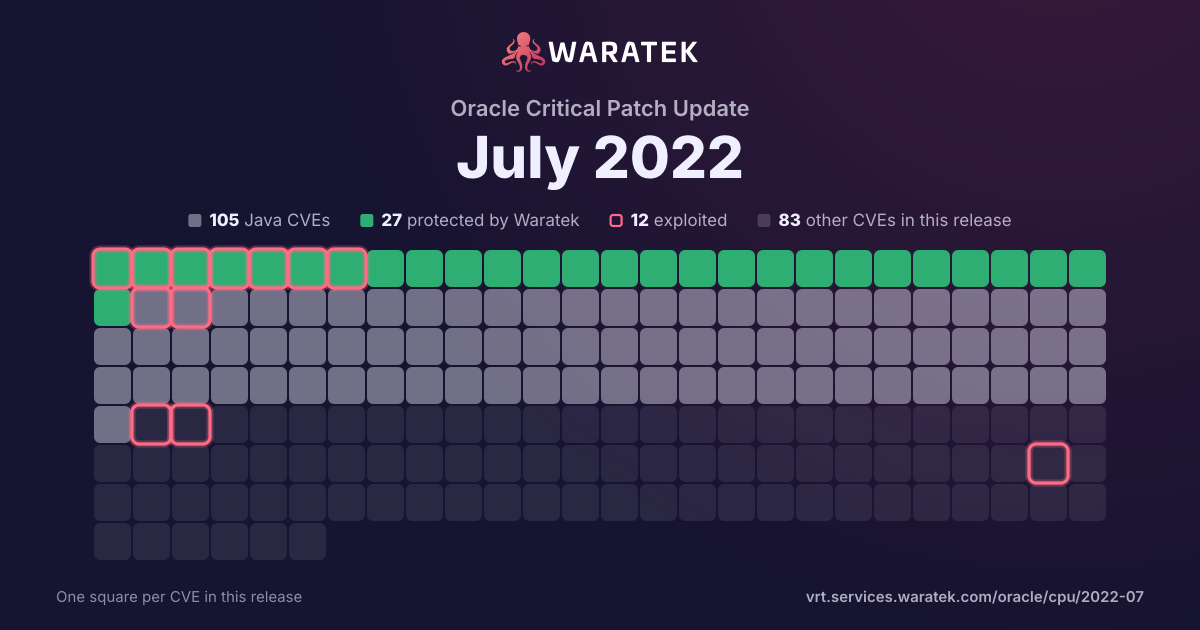
By status
24Protected by Waratek2Rule in development6Mitigation candidate84No exploit published2Outside Waratek scope70Not applicable
12Exploited, marked by the ring
No exploit published. For 47 of them, Oracle's security advisory is the source of public detail.
Protected by Waratek. Waratek RASP can block exploitation of these on systems that have not applied the patch yet.
Overview 13 matches · 0 protected · 0 exploited · 0 CISA KEV · 0 public PoC · 1 EPSS ≥ 0.5
Protected by Waratek
0
0.0%
Rule in development
0
0.0%
Mitigation candidate
0
0.0%
No exploit published
13
100.0%
blocked by ARMR today
0
0.0%
partly blocked
0
0.0%
not blocked
13
100.0%
not established
0
0.0%
unrecorded
0
0.0%
Exploited
0
0.0%
Working exploit published
0
0.0%
Proof of concept only
0
0.0%
Forecast only
1
7.7%
No public exploit
12
92.3%
split by
peak 4 / quarter
Q3 191
No exploit published1
Critical1
not blocked1
No public exploit1
Q4 190
Q1 201
No exploit published1
High1
not blocked1
No public exploit1
Q2 201
No exploit published1
Medium1
not blocked1
Forecast only1
Q3 200
Q4 201
No exploit published1
High1
not blocked1
No public exploit1
Q1 212
No exploit published2
High2
not blocked2
No public exploit2
Q2 213
No exploit published3
Critical1
High1
Medium1
not blocked3
No public exploit3
Q3 214
No exploit published4
High2
Medium2
not blocked4
No public exploit4
Q3 19Q4 19Q1 20Q2 20Q3 20Q4 20Q1 21Q2 21Q3 21
| CVE | Severity | Published▾ | Status | Exploitation | Description |
|---|---|---|---|---|---|
| CVE-2021-2351 | High | 2021-07-21 | No exploit published | No public exploit | Vulnerability in the Advanced Networking Option component of Oracle Database Server. Supported versions that are affected are 12.1.0.2, 12.2.0.1 and 19c. Difficult to exploit vulnerability allows unauthenticated attacker with network access via Oracle Net to compromise Advanced Networking Option. Successful attacks require human interaction from a person other than the attacker and while the vulnerability is in Advanced Networking Option, attacks may significantly impact additional products. Successful attacks of this vulnerability can result in takeover of Advanced Networking Option. Note: The July 2021 Critical Patch Update introduces a number of Native Network Encryption changes to deal with vulnerability CVE-2021-2351 and prevent the use of weaker ciphers. Customers should review: "Changes in Native Network Encryption with the July 2021 Critical Patch Update" (Doc ID 2791571.1). CVSS 3.1 Base Score 8.3 (Confidentiality, Integrity and Availability impacts). CVSS Vector: (CVSS:3.1/AV:N/AC:H/PR:N/UI:R/S:C/C:H/I:H/A:H). |
| CVE-2021-36374 | Medium | 2021-07-14 | No exploit published | No public exploit | When reading a specially crafted ZIP archive, or a derived formats, an Apache Ant build can be made to allocate large amounts of memory that leads to an out of memory error, even for small inputs. This can be used to disrupt builds using Apache Ant. Commonly used derived formats from ZIP archives are for instance JAR files and many office files. Apache Ant prior to 1.9.16 and 1.10.11 were affected. |
| CVE-2021-36090 | High | 2021-07-13 | No exploit published | No public exploit | When reading a specially crafted ZIP archive, Compress can be made to allocate large amounts of memory that finally leads to an out of memory error even for very small inputs. This could be used to mount a denial of service attack against services that use Compress' zip package. |
| CVE-2021-30129 | Medium | 2021-07-12 | No exploit published | No public exploit | A vulnerability in sshd-core of Apache Mina SSHD allows an attacker to overflow the server causing an OutOfMemory error. This issue affects the SFTP and port forwarding features of Apache Mina SSHD version 2.0.0 and later versions. It was addressed in Apache Mina SSHD 2.7.0 |
| CVE-2021-31812 | Medium | 2021-06-12 | No exploit published | No public exploit | In Apache PDFBox, a carefully crafted PDF file can trigger an infinite loop while loading the file. This issue affects Apache PDFBox version 2.0.23 and prior 2.0.x versions. |
| CVE-2021-31684 | High | 2021-06-01 | No exploit published | No public exploit | A vulnerability was discovered in the indexOf function of JSONParserByteArray in JSON Smart versions 1.3 and 2.4 which causes a denial of service (DOS) via a crafted web request. |
| CVE-2021-26291 | Critical | 2021-04-23 | No exploit published | No public exploit | Apache Maven will follow repositories that are defined in a dependency’s Project Object Model (pom) which may be surprising to some users, resulting in potential risk if a malicious actor takes over that repository or is able to insert themselves into a position to pretend to be that repository. Maven is changing the default behavior in 3.8.1+ to no longer follow http (non-SSL) repository references by default. More details available in the referenced urls. If you are currently using a repository manager to govern the repositories used by your builds, you are unaffected by the risks present in the legacy behavior, and are unaffected by this vulnerability and change to default behavior. See this link for more information about repository management: https://maven.apache.org/repository-management.html |
| CVE-2020-11987 | High | 2021-02-24 | No exploit published | No public exploit | Apache Batik 1.13 is vulnerable to server-side request forgery, caused by improper input validation by the NodePickerPanel. By using a specially-crafted argument, an attacker could exploit this vulnerability to cause the underlying server to make arbitrary GET requests. |
| CVE-2020-28491 | High | 2021-02-18 | No exploit published | No public exploit | This affects the package com.fasterxml.jackson.dataformat:jackson-dataformat-cbor from 0 and before 2.11.4, from 2.12.0-rc1 and before 2.12.1. Unchecked allocation of byte buffer can cause a java.lang.OutOfMemoryError exception. |
| CVE-2020-28052 | High | 2020-12-18 | No exploit published | No public exploit | An issue was discovered in Legion of the Bouncy Castle BC Java 1.65 and 1.66. The OpenBSDBCrypt.checkPassword utility method compared incorrect data when checking the password, allowing incorrect passwords to indicate they were matching with previously hashed ones that were different. |
| CVE-2020-1927 | Medium | 2020-04-02 | No exploit published | Forecast only | In Apache HTTP Server 2.4.0 to 2.4.41, redirects configured with mod_rewrite that were intended to be self-referential might be fooled by encoded newlines and redirect instead to an an unexpected URL within the request URL. |
| CVE-2020-5258 | High | 2020-03-10 | No exploit published | No public exploit | In affected versions of dojo (NPM package), the deepCopy method is vulnerable to Prototype Pollution. Prototype Pollution refers to the ability to inject properties into existing JavaScript language construct prototypes, such as objects. An attacker manipulates these attributes to overwrite, or pollute, a JavaScript application object prototype of the base object by injecting other values. This has been patched in versions 1.12.8, 1.13.7, 1.14.6, 1.15.3 and 1.16.2 |
| CVE-2019-10082 | Critical | 2019-09-26 | No exploit published | No public exploit | In Apache HTTP Server 2.4.18-2.4.39, using fuzzed network input, the http/2 session handling could be made to read memory after being freed, during connection shutdown. |