
Oracle Critical Patch Update July 2022
Released July 2022 · Oracle's advisory ↗ · ← Critical Patch Update, April 2022 · Critical Patch Update, October 2022 →
188 CVEs in this release, one square each
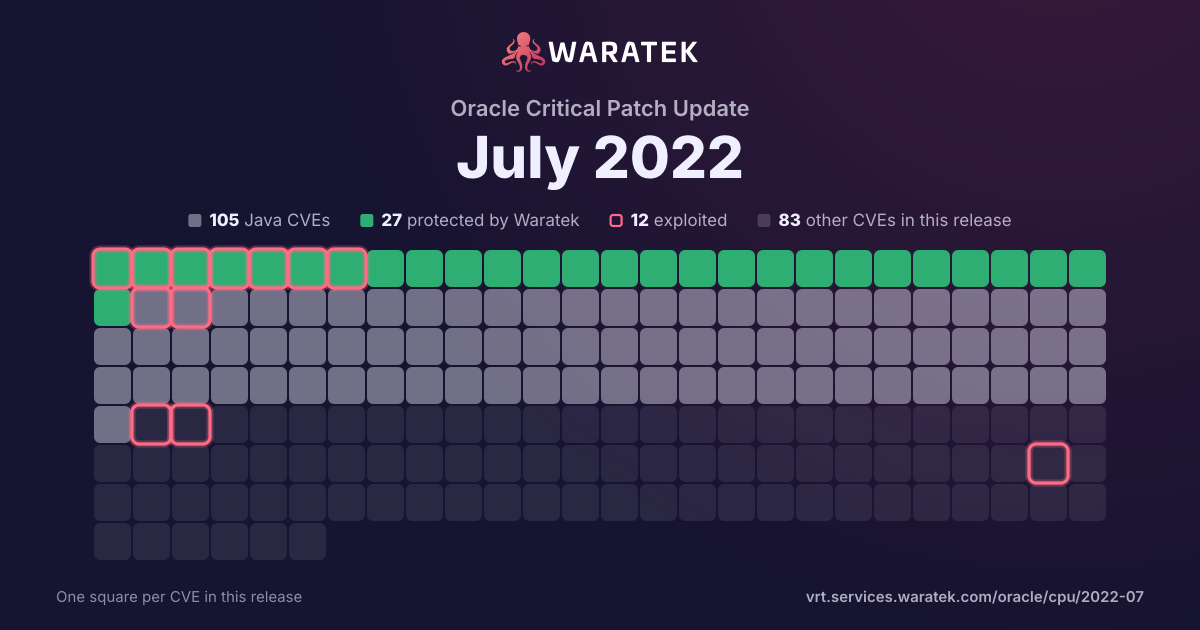
By status
24Protected by Waratek2Rule in development6Mitigation candidate83No exploit published2Outside Waratek scope71Not applicable
12Exploited, marked by the ring
No exploit published. For 46 of them, Oracle's security advisory is the source of public detail.
Protected by Waratek. Waratek RASP can block exploitation of these on systems that have not applied the patch yet.
Overview 5 matches · 3 protected · 2 CISA KEV · 3 public PoC · 4 EPSS ≥ 0.5
Protected by Waratek
3
60.0%
Rule in development
1
20.0%
Mitigation candidate
1
20.0%
No exploit published
0
0.0%
blocked by ARMR today
3
60.0%
partly blocked
0
0.0%
not blocked
2
40.0%
not established
0
0.0%
unrecorded
0
0.0%
Exploited
5
100.0%
Working exploit published
0
0.0%
Proof of concept only
0
0.0%
Forecast only
0
0.0%
No public exploit
0
0.0%
split by
peak 2 / month
Jul 211
Protected by Waratek1
Medium1
blocked by ARMR today1
Exploited1
Aug 210
Sep 211
Mitigation candidate1
Medium1
not blocked1
Exploited1
Oct 210
Nov 210
Dec 211
Protected by Waratek1
Medium1
blocked by ARMR today1
Exploited1
Jan 220
Feb 220
Mar 220
Apr 222
Protected by Waratek1
Rule in development1
Critical2
blocked by ARMR today1
not blocked1
Exploited2
Jul 21Aug 21Sep 21Oct 21Nov 21Dec 21Jan 22Feb 22Mar 22Apr 22
| CVE | Severity | Published▾ | Status | Exploitation | Description |
|---|---|---|---|---|---|
| CVE-2022-22965 | Critical | 2022-04-01 | Protected by Waratek | Exploited | A Spring MVC or Spring WebFlux application running on JDK 9+ may be vulnerable to remote code execution (RCE) via data binding. The specific exploit requires the application to run on Tomcat as a WAR deployment. If the application is deployed as a Spring Boot executable jar, i.e. the default, it is not vulnerable to the exploit. However, the nature of the vulnerability is more general, and there may be other ways to exploit it. |
| CVE-2022-22963 | Critical | 2022-04-01 | Rule in development | Exploited | In Spring Cloud Function versions 3.1.6, 3.2.2 and older unsupported versions, when using routing functionality it is possible for a user to provide a specially crafted SpEL as a routing-expression that may result in remote code execution and access to local resources. |
| CVE-2021-44832 | Medium | 2021-12-28 | Protected by Waratek | Exploited | Apache Log4j2 versions 2.0-beta7 through 2.17.0 (excluding security fix releases 2.3.2 and 2.12.4) are vulnerable to a remote code execution (RCE) attack when a configuration uses a JDBC Appender with a JNDI LDAP data source URI when an attacker has control of the target LDAP server. This issue is fixed by limiting JNDI data source names to the java protocol in Log4j2 versions 2.17.1, 2.12.4, and 2.3.2. |
| CVE-2021-38153 | Medium | 2021-09-22 | Mitigation candidate | Exploited | Some components in Apache Kafka use `Arrays.equals` to validate a password or key, which is vulnerable to timing attacks that make brute force attacks for such credentials more likely to be successful. Users should upgrade to 2.8.1 or higher, or 3.0.0 or higher where this vulnerability has been fixed. The affected versions include Apache Kafka 2.0.0, 2.0.1, 2.1.0, 2.1.1, 2.2.0, 2.2.1, 2.2.2, 2.3.0, 2.3.1, 2.4.0, 2.4.1, 2.5.0, 2.5.1, 2.6.0, 2.6.1, 2.6.2, 2.7.0, 2.7.1, and 2.8.0. |
| CVE-2021-34429 | Medium | 2021-07-15 | Protected by Waratek | Exploited | For Eclipse Jetty versions 9.4.37-9.4.42, 10.0.1-10.0.5 & 11.0.1-11.0.5, URIs can be crafted using some encoded characters to access the content of the WEB-INF directory and/or bypass some security constraints. This is a variation of the vulnerability reported in CVE-2021-28164/GHSA-v7ff-8wcx-gmc5. |