
Oracle Critical Patch Update July 2022
Released July 2022 · Oracle's advisory ↗ · ← Critical Patch Update, April 2022 · Critical Patch Update, October 2022 →
188 CVEs in this release, one square each
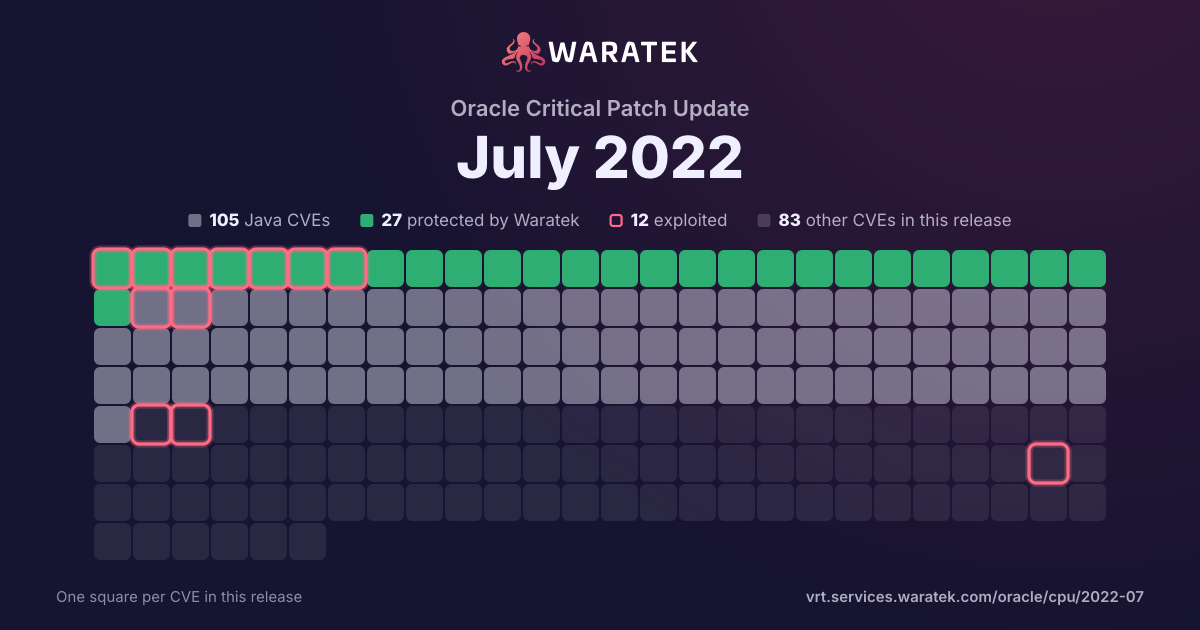
By status
27Protected by Waratek6Mitigation candidate72No exploit published49Outside Waratek scope34Not applicable
12Exploited, marked by the ring
No exploit published. For 47 of them, Oracle's security advisory is the source of public detail.
Protected by Waratek. Waratek RASP can block exploitation of these on systems that have not applied the patch yet.
Overview 5 matches · 0 protected · 0 exploited · 0 CISA KEV · 0 public PoC · 1 EPSS ≥ 0.5
Protected by Waratek
0
0.0%
Rule in development
0
0.0%
Mitigation candidate
0
0.0%
No exploit published
5
100.0%
blocked by ARMR today
0
0.0%
partly blocked
0
0.0%
not blocked
5
100.0%
not established
0
0.0%
unrecorded
0
0.0%
Exploited
0
0.0%
Working exploit published
0
0.0%
Proof of concept only
0
0.0%
Forecast only
1
20.0%
No public exploit
4
80.0%
split by
peak 2 / quarter
Q4 191
No exploit published1
Critical1
not blocked1
No public exploit1
Q1 201
No exploit published1
Critical1
not blocked1
No public exploit1
Q2 200
Q3 200
Q4 200
Q1 210
Q2 210
Q3 211
No exploit published1
Critical1
not blocked1
Forecast only1
Q4 210
Q1 220
Q2 220
Q3 222
No exploit published2
Critical2
not blocked2
No public exploit2
Q4 19Q1 20Q2 20Q3 20Q4 20Q1 21Q2 21Q3 21Q4 21Q1 22Q2 22Q3 22
| CVE | Severity | Published▾ | Status | Exploitation | Description |
|---|---|---|---|---|---|
| CVE-2022-21543 | Critical | 2022-07-19 | No exploit published | No public exploit | Vulnerability in the PeopleSoft Enterprise PeopleTools product of Oracle PeopleSoft (component: Updates Environment Mgmt). Supported versions that are affected are 8.58 and 8.59. Easily exploitable vulnerability allows unauthenticated attacker with network access via HTTP to compromise PeopleSoft Enterprise PeopleTools. Successful attacks of this vulnerability can result in takeover of PeopleSoft Enterprise PeopleTools. CVSS 3.1 Base Score 9.8 (Confidentiality, Integrity and Availability impacts). CVSS Vector: (CVSS:3.1/AV:N/AC:L/PR:N/UI:N/S:U/C:H/I:H/A:H). |
| CVE-2020-35169 | Critical | 2022-07-11 | No exploit published | No public exploit | Dell BSAFE Crypto-C Micro Edition, versions before 4.1.5, and Dell BSAFE Micro Edition Suite, versions before 4.5.2, contain an Improper Input Validation Vulnerability. |
| CVE-2021-41303 | Critical | 2021-09-17 | No exploit published | Forecast only | Apache Shiro before 1.8.0, when using Apache Shiro with Spring Boot, a specially crafted HTTP request may cause an authentication bypass. Users should update to Apache Shiro 1.8.0. |
| CVE-2019-0219 | Critical | 2020-01-14 | No exploit published | No public exploit | A website running in the InAppBrowser webview on Android could execute arbitrary JavaScript in the main application's webview using a specially crafted gap-iab: URI. |
| CVE-2019-17495 | Critical | 2019-10-10 | No exploit published | No public exploit | A Cascading Style Sheets (CSS) injection vulnerability in Swagger UI before 3.23.11 allows attackers to use the Relative Path Overwrite (RPO) technique to perform CSS-based input field value exfiltration, such as exfiltration of a CSRF token value. In other words, this product intentionally allows the embedding of untrusted JSON data from remote servers, but it was not previously known that <style>@import within the JSON data was a functional attack method. |