
Oracle Critical Patch Update July 2022
Released July 2022 · Oracle's advisory ↗ · ← Critical Patch Update, April 2022 · Critical Patch Update, October 2022 →
188 CVEs in this release, one square each
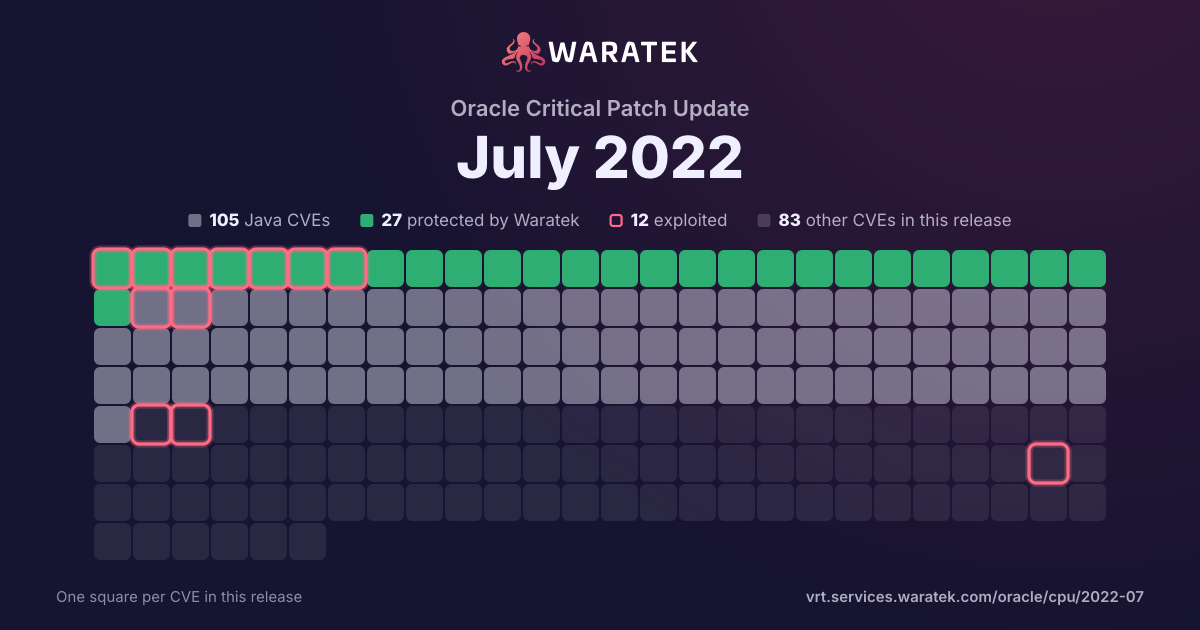
By status
27Protected by Waratek6Mitigation candidate72No exploit published49Outside Waratek scope34Not applicable
12Exploited, marked by the ring
No exploit published. For 47 of them, Oracle's security advisory is the source of public detail.
Protected by Waratek. Waratek RASP can block exploitation of these on systems that have not applied the patch yet.
Overview 161 matches · 78 in Waratek scope · 0 protected · 5 exploited · 2 CISA KEV · 13 public PoC · 12 EPSS ≥ 0.5
161matches
78in Waratek scope48.4%
0protected0.0%
5exploited3.1%
2CISA KEV1.2%
13public PoC8.1%
12EPSS ≥ 0.57.5%
Protected by Waratek
0
0.0%
Rule in development
0
0.0%
Mitigation candidate
6
3.7%
No exploit published
72
44.7%
Outside Waratek scope
49
30.4%
Not applicable
34
21.1%
Withdrawn CVE
0
0.0%
blocked by ARMR today
0
0.0%
partly blocked
0
0.0%
not blocked
161
100.0%
not established
0
0.0%
unrecorded
0
0.0%
split by
peak 85 / quarter
Q2 192
Outside Waratek scope1
Not applicable1
High1
Medium1
not blocked2
Working exploit published1
No public exploit1
Q3 191
Outside Waratek scope1
Critical1
not blocked1
No public exploit1
Q4 191
No exploit published1
Critical1
not blocked1
No public exploit1
Q1 202
No exploit published1
Outside Waratek scope1
Critical1
High1
not blocked2
No public exploit2
Q2 203
Outside Waratek scope3
Medium3
not blocked3
Exploited2
Forecast only1
Q3 201
Outside Waratek scope1
High1
not blocked1
No public exploit1
Q4 202
No exploit published1
Outside Waratek scope1
High2
not blocked2
No public exploit2
Q1 217
No exploit published3
Outside Waratek scope2
Not applicable2
Critical2
High5
not blocked7
Exploited1
Proof of concept only1
No public exploit5
Q2 215
Mitigation candidate1
No exploit published3
Outside Waratek scope1
Critical1
High3
Medium1
not blocked5
Working exploit published1
No public exploit4
Q3 2114
Mitigation candidate1
No exploit published8
Outside Waratek scope2
Not applicable3
Critical2
High8
Medium4
not blocked14
Exploited1
Proof of concept only1
Forecast only1
No public exploit11
Q4 217
Outside Waratek scope5
Not applicable2
Critical1
High1
Medium5
not blocked7
Proof of concept only1
No public exploit6
Q1 2218
Mitigation candidate1
No exploit published5
Outside Waratek scope6
Not applicable6
Critical3
High12
Medium3
not blocked18
Exploited1
Proof of concept only5
No public exploit12
Q2 2213
Mitigation candidate3
No exploit published6
Outside Waratek scope2
Not applicable2
Critical3
High6
Medium4
not blocked13
Working exploit published1
Proof of concept only5
No public exploit7
Q3 2285
No exploit published44
Outside Waratek scope23
Not applicable18
Critical2
High18
Medium61
Low4
not blocked85
Forecast only1
No public exploit84
Q3 19Q1 20Q3 20Q1 21Q3 21Q1 22Q3 22
| CVE | Severity | Published▾ | Status | Exploitation | Description |
|---|---|---|---|---|---|
| CVE-2022-1271 | High | 2022-08-31 | Not applicable | No public exploit | An arbitrary file write vulnerability was found in GNU gzip's zgrep utility. When zgrep is applied on the attacker's chosen file name (for example, a crafted file name), this can overwrite an attacker's content to an arbitrary attacker-selected file. This flaw occurs due to insufficient validation when processing filenames with two or more newlines where selected content and the target file names are embedded in crafted multi-line file names. This flaw allows a remote, low privileged attacker to force zgrep to write arbitrary files on the system. |
| CVE-2022-21586 | Medium | 2022-07-19 | No exploit published | No public exploit | Vulnerability in the Oracle Banking Trade Finance product of Oracle Financial Services Applications (component: Infrastructure). The supported version that is affected is 14.5. Difficult to exploit vulnerability allows low privileged attacker with network access via HTTP to compromise Oracle Banking Trade Finance. Successful attacks require human interaction from a person other than the attacker. Successful attacks of this vulnerability can result in unauthorized creation, deletion or modification access to critical data or all Oracle Banking Trade Finance accessible data as well as unauthorized access to critical data or complete access to all Oracle Banking Trade Finance accessible data. CVSS 3.1 Base Score 6.4 (Confidentiality and Integrity impacts). CVSS Vector: (CVSS:3.1/AV:N/AC:H/PR:L/UI:R/S:U/C:H/I:H/A:N). |
| CVE-2022-21585 | Medium | 2022-07-19 | No exploit published | No public exploit | Vulnerability in the Oracle Banking Trade Finance product of Oracle Financial Services Applications (component: Infrastructure). The supported version that is affected is 14.5. Difficult to exploit vulnerability allows low privileged attacker with network access via HTTP to compromise Oracle Banking Trade Finance. Successful attacks require human interaction from a person other than the attacker. Successful attacks of this vulnerability can result in unauthorized creation, deletion or modification access to critical data or all Oracle Banking Trade Finance accessible data as well as unauthorized access to critical data or complete access to all Oracle Banking Trade Finance accessible data and unauthorized ability to cause a partial denial of service (partial DOS) of Oracle Banking Trade Finance. CVSS 3.1 Base Score 6.7 (Confidentiality, Integrity and Availability impacts). CVSS Vector: (CVSS:3.1/AV:N/AC:H/PR:L/UI:R/S:U/C:H/I:H/A:L). |
| CVE-2022-21584 | Medium | 2022-07-19 | No exploit published | No public exploit | Vulnerability in the Oracle Banking Trade Finance product of Oracle Financial Services Applications (component: Infrastructure). The supported version that is affected is 14.5. Difficult to exploit vulnerability allows low privileged attacker with network access via HTTP to compromise Oracle Banking Trade Finance. Successful attacks require human interaction from a person other than the attacker. Successful attacks of this vulnerability can result in unauthorized creation, deletion or modification access to critical data or all Oracle Banking Trade Finance accessible data as well as unauthorized access to critical data or complete access to all Oracle Banking Trade Finance accessible data. CVSS 3.1 Base Score 6.4 (Confidentiality and Integrity impacts). CVSS Vector: (CVSS:3.1/AV:N/AC:H/PR:L/UI:R/S:U/C:H/I:H/A:N). |
| CVE-2022-21583 | Medium | 2022-07-19 | No exploit published | No public exploit | Vulnerability in the Oracle Banking Trade Finance product of Oracle Financial Services Applications (component: Infrastructure). The supported version that is affected is 14.5. Difficult to exploit vulnerability allows low privileged attacker with network access via HTTP to compromise Oracle Banking Trade Finance. Successful attacks of this vulnerability can result in unauthorized access to critical data or complete access to all Oracle Banking Trade Finance accessible data as well as unauthorized update, insert or delete access to some of Oracle Banking Trade Finance accessible data and unauthorized ability to cause a partial denial of service (partial DOS) of Oracle Banking Trade Finance. CVSS 3.1 Base Score 6.4 (Confidentiality, Integrity and Availability impacts). CVSS Vector: (CVSS:3.1/AV:N/AC:H/PR:L/UI:N/S:U/C:H/I:L/A:L). |
| CVE-2022-21582 | Medium | 2022-07-19 | No exploit published | No public exploit | Vulnerability in the Oracle Banking Trade Finance product of Oracle Financial Services Applications (component: Infrastructure). The supported version that is affected is 14.5. Difficult to exploit vulnerability allows low privileged attacker with network access via HTTP to compromise Oracle Banking Trade Finance. Successful attacks require human interaction from a person other than the attacker. Successful attacks of this vulnerability can result in unauthorized creation, deletion or modification access to critical data or all Oracle Banking Trade Finance accessible data as well as unauthorized access to critical data or complete access to all Oracle Banking Trade Finance accessible data and unauthorized ability to cause a partial denial of service (partial DOS) of Oracle Banking Trade Finance. CVSS 3.1 Base Score 6.7 (Confidentiality, Integrity and Availability impacts). CVSS Vector: (CVSS:3.1/AV:N/AC:H/PR:L/UI:R/S:U/C:H/I:H/A:L). |
| CVE-2022-21581 | Medium | 2022-07-19 | No exploit published | No public exploit | Vulnerability in the Oracle Banking Trade Finance product of Oracle Financial Services Applications (component: Infrastructure). The supported version that is affected is 14.5. Difficult to exploit vulnerability allows low privileged attacker with network access via HTTP to compromise Oracle Banking Trade Finance. Successful attacks require human interaction from a person other than the attacker. Successful attacks of this vulnerability can result in unauthorized creation, deletion or modification access to critical data or all Oracle Banking Trade Finance accessible data as well as unauthorized read access to a subset of Oracle Banking Trade Finance accessible data and unauthorized ability to cause a partial denial of service (partial DOS) of Oracle Banking Trade Finance. CVSS 3.1 Base Score 5.9 (Confidentiality, Integrity and Availability impacts). CVSS Vector: (CVSS:3.1/AV:N/AC:H/PR:L/UI:R/S:U/C:L/I:H/A:L). |
| CVE-2022-21580 | Medium | 2022-07-19 | No exploit published | No public exploit | Vulnerability in the Oracle Financial Services Revenue Management and Billing product of Oracle Financial Services Applications (component: Infrastructure). Supported versions that are affected are 2.9.0.0.0, 2.9.0.1.0, 3.0.0.0.0-3.2.0.0.0 and 4.0.0.0.0. Difficult to exploit vulnerability allows low privileged attacker with network access via HTTP to compromise Oracle Financial Services Revenue Management and Billing. Successful attacks require human interaction from a person other than the attacker. Successful attacks of this vulnerability can result in unauthorized access to critical data or complete access to all Oracle Financial Services Revenue Management and Billing accessible data as well as unauthorized update, insert or delete access to some of Oracle Financial Services Revenue Management and Billing accessible data and unauthorized ability to cause a partial denial of service (partial DOS) of Oracle Financial Services Revenue Management and Billing. CVSS 3.1 Base Score 5.9 (Confidentiality, Integrity and Availability impacts). CVSS Vector: (CVSS:3.1/AV:N/AC:H/PR:L/UI:R/S:U/C:H/I:L/A:L). |
| CVE-2022-21579 | Medium | 2022-07-19 | No exploit published | No public exploit | Vulnerability in the Oracle FLEXCUBE Universal Banking product of Oracle Financial Services Applications (component: Infrastructure). Supported versions that are affected are 12.1-12.4, 14.0-14.3 and 14.5. Difficult to exploit vulnerability allows low privileged attacker with network access via HTTP to compromise Oracle FLEXCUBE Universal Banking. Successful attacks require human interaction from a person other than the attacker. Successful attacks of this vulnerability can result in unauthorized creation, deletion or modification access to critical data or all Oracle FLEXCUBE Universal Banking accessible data as well as unauthorized access to critical data or complete access to all Oracle FLEXCUBE Universal Banking accessible data. CVSS 3.1 Base Score 6.4 (Confidentiality and Integrity impacts). CVSS Vector: (CVSS:3.1/AV:N/AC:H/PR:L/UI:R/S:U/C:H/I:H/A:N). |
| CVE-2022-21578 | Medium | 2022-07-19 | No exploit published | No public exploit | Vulnerability in the Oracle FLEXCUBE Universal Banking product of Oracle Financial Services Applications (component: Infrastructure). Supported versions that are affected are 12.1-12.4, 14.0-14.3 and 14.5. Difficult to exploit vulnerability allows low privileged attacker with network access via HTTP to compromise Oracle FLEXCUBE Universal Banking. Successful attacks require human interaction from a person other than the attacker. Successful attacks of this vulnerability can result in unauthorized creation, deletion or modification access to critical data or all Oracle FLEXCUBE Universal Banking accessible data as well as unauthorized access to critical data or complete access to all Oracle FLEXCUBE Universal Banking accessible data and unauthorized ability to cause a partial denial of service (partial DOS) of Oracle FLEXCUBE Universal Banking. CVSS 3.1 Base Score 6.7 (Confidentiality, Integrity and Availability impacts). CVSS Vector: (CVSS:3.1/AV:N/AC:H/PR:L/UI:R/S:U/C:H/I:H/A:L). |
| CVE-2022-21577 | Medium | 2022-07-19 | No exploit published | No public exploit | Vulnerability in the Oracle FLEXCUBE Universal Banking product of Oracle Financial Services Applications (component: Infrastructure). Supported versions that are affected are 12.1-12.4, 14.0-14.3 and 14.5. Difficult to exploit vulnerability allows low privileged attacker with network access via HTTP to compromise Oracle FLEXCUBE Universal Banking. Successful attacks require human interaction from a person other than the attacker. Successful attacks of this vulnerability can result in unauthorized creation, deletion or modification access to critical data or all Oracle FLEXCUBE Universal Banking accessible data as well as unauthorized access to critical data or complete access to all Oracle FLEXCUBE Universal Banking accessible data. CVSS 3.1 Base Score 6.4 (Confidentiality and Integrity impacts). CVSS Vector: (CVSS:3.1/AV:N/AC:H/PR:L/UI:R/S:U/C:H/I:H/A:N). |
| CVE-2022-21576 | Medium | 2022-07-19 | No exploit published | No public exploit | Vulnerability in the Oracle FLEXCUBE Universal Banking product of Oracle Financial Services Applications (component: Infrastructure). Supported versions that are affected are 12.3, 12.4, 14.0-14.3 and 14.5. Difficult to exploit vulnerability allows low privileged attacker with network access via HTTP to compromise Oracle FLEXCUBE Universal Banking. Successful attacks of this vulnerability can result in unauthorized access to critical data or complete access to all Oracle FLEXCUBE Universal Banking accessible data as well as unauthorized update, insert or delete access to some of Oracle FLEXCUBE Universal Banking accessible data and unauthorized ability to cause a partial denial of service (partial DOS) of Oracle FLEXCUBE Universal Banking. CVSS 3.1 Base Score 6.4 (Confidentiality, Integrity and Availability impacts). CVSS Vector: (CVSS:3.1/AV:N/AC:H/PR:L/UI:N/S:U/C:H/I:L/A:L). |
| CVE-2022-21575 | Medium | 2022-07-19 | No exploit published | No public exploit | Vulnerability in the Oracle WebCenter Sites Support Tools product of Oracle Fusion Middleware (component: User Interface). The supported version that is affected is Prior to 4.4.2. Easily exploitable vulnerability allows high privileged attacker with network access via HTTP to compromise Oracle WebCenter Sites Support Tools. Successful attacks of this vulnerability can result in unauthorized access to critical data or complete access to all Oracle WebCenter Sites Support Tools accessible data as well as unauthorized update, insert or delete access to some of Oracle WebCenter Sites Support Tools accessible data and unauthorized ability to cause a partial denial of service (partial DOS) of Oracle WebCenter Sites Support Tools. CVSS 3.1 Base Score 6.0 (Confidentiality, Integrity and Availability impacts). CVSS Vector: (CVSS:3.1/AV:N/AC:L/PR:H/UI:N/S:U/C:H/I:L/A:L). |
| CVE-2022-21574 | Medium | 2022-07-19 | No exploit published | No public exploit | Vulnerability in the Oracle Communications Billing and Revenue Management product of Oracle Communications Applications (component: Connection Manager). Supported versions that are affected are 12.0.0.4.0-12.0.0.6.0. Easily exploitable vulnerability allows unauthenticated attacker with network access via HTTP to compromise Oracle Communications Billing and Revenue Management. Successful attacks of this vulnerability can result in unauthorized ability to cause a partial denial of service (partial DOS) of Oracle Communications Billing and Revenue Management. CVSS 3.1 Base Score 5.3 (Availability impacts). CVSS Vector: (CVSS:3.1/AV:N/AC:L/PR:N/UI:N/S:U/C:N/I:N/A:L). |
| CVE-2022-21573 | Medium | 2022-07-19 | No exploit published | No public exploit | Vulnerability in the Oracle Communications Billing and Revenue Management product of Oracle Communications Applications (component: Billing Care). Supported versions that are affected are 12.0.0.4.0-12.0.0.6.0. Easily exploitable vulnerability allows low privileged attacker with network access via HTTP to compromise Oracle Communications Billing and Revenue Management. Successful attacks of this vulnerability can result in unauthorized ability to cause a hang or frequently repeatable crash (complete DOS) of Oracle Communications Billing and Revenue Management. CVSS 3.1 Base Score 6.5 (Availability impacts). CVSS Vector: (CVSS:3.1/AV:N/AC:L/PR:L/UI:N/S:U/C:N/I:N/A:H). |
| CVE-2022-21572 | Medium | 2022-07-19 | No exploit published | No public exploit | Vulnerability in the Oracle Communications Billing and Revenue Management product of Oracle Communications Applications (component: Billing Care). Supported versions that are affected are 12.0.0.4.0-12.0.0.6.0. Easily exploitable vulnerability allows low privileged attacker with network access via HTTP to compromise Oracle Communications Billing and Revenue Management. Successful attacks require human interaction from a person other than the attacker and while the vulnerability is in Oracle Communications Billing and Revenue Management, attacks may significantly impact additional products (scope change). Successful attacks of this vulnerability can result in unauthorized update, insert or delete access to some of Oracle Communications Billing and Revenue Management accessible data as well as unauthorized read access to a subset of Oracle Communications Billing and Revenue Management accessible data. CVSS 3.1 Base Score 5.4 (Confidentiality and Integrity impacts). CVSS Vector: (CVSS:3.1/AV:N/AC:L/PR:L/UI:R/S:C/C:L/I:L/A:N). |
| CVE-2022-21571 | High | 2022-07-19 | Not applicable | No public exploit | Vulnerability in the Oracle VM VirtualBox product of Oracle Virtualization (component: Core). The supported version that is affected is Prior to 6.1.36. Easily exploitable vulnerability allows high privileged attacker with logon to the infrastructure where Oracle VM VirtualBox executes to compromise Oracle VM VirtualBox. While the vulnerability is in Oracle VM VirtualBox, attacks may significantly impact additional products (scope change). Successful attacks of this vulnerability can result in takeover of Oracle VM VirtualBox. CVSS 3.1 Base Score 8.2 (Confidentiality, Integrity and Availability impacts). CVSS Vector: (CVSS:3.1/AV:L/AC:L/PR:H/UI:N/S:C/C:H/I:H/A:H). |
| CVE-2022-21570 | High | 2022-07-19 | No exploit published | No public exploit | Vulnerability in the Oracle Coherence product of Oracle Fusion Middleware (component: Core). Supported versions that are affected are 3.7.1.0, 12.2.1.3.0, 12.2.1.4.0 and 14.1.1.0.0. Easily exploitable vulnerability allows unauthenticated attacker with network access via T3, IIOP to compromise Oracle Coherence. Successful attacks of this vulnerability can result in unauthorized ability to cause a hang or frequently repeatable crash (complete DOS) of Oracle Coherence. CVSS 3.1 Base Score 7.5 (Availability impacts). CVSS Vector: (CVSS:3.1/AV:N/AC:L/PR:N/UI:N/S:U/C:N/I:N/A:H). |
| CVE-2022-21569 | Medium | 2022-07-19 | Outside Waratek scope | No public exploit | Vulnerability in the MySQL Server product of Oracle MySQL (component: Server: Optimizer). Supported versions that are affected are 8.0.29 and prior. Easily exploitable vulnerability allows low privileged attacker with network access via multiple protocols to compromise MySQL Server. Successful attacks of this vulnerability can result in unauthorized ability to cause a hang or frequently repeatable crash (complete DOS) of MySQL Server. CVSS 3.1 Base Score 6.5 (Availability impacts). CVSS Vector: (CVSS:3.1/AV:N/AC:L/PR:L/UI:N/S:U/C:N/I:N/A:H). |
| CVE-2022-21568 | Medium | 2022-07-19 | No exploit published | No public exploit | Vulnerability in the Oracle iReceivables product of Oracle E-Business Suite (component: Access Request). Supported versions that are affected are 12.2.3-12.2.11. Easily exploitable vulnerability allows low privileged attacker with network access via HTTP to compromise Oracle iReceivables. Successful attacks of this vulnerability can result in unauthorized access to critical data or complete access to all Oracle iReceivables accessible data. CVSS 3.1 Base Score 6.5 (Confidentiality impacts). CVSS Vector: (CVSS:3.1/AV:N/AC:L/PR:L/UI:N/S:U/C:H/I:N/A:N). |
| CVE-2022-21567 | High | 2022-07-19 | No exploit published | No public exploit | Vulnerability in the Oracle Workflow product of Oracle E-Business Suite (component: Worklist). Supported versions that are affected are 12.2.3-12.2.11. Easily exploitable vulnerability allows unauthenticated attacker with network access via HTTP to compromise Oracle Workflow. Successful attacks of this vulnerability can result in unauthorized access to critical data or complete access to all Oracle Workflow accessible data. CVSS 3.1 Base Score 7.5 (Confidentiality impacts). CVSS Vector: (CVSS:3.1/AV:N/AC:L/PR:N/UI:N/S:U/C:H/I:N/A:N). |
| CVE-2022-21566 | High | 2022-07-19 | No exploit published | No public exploit | Vulnerability in the Oracle Applications Framework product of Oracle E-Business Suite (component: Diagnostics). Supported versions that are affected are 12.2.9-12.2.11. Easily exploitable vulnerability allows unauthenticated attacker with network access via HTTP to compromise Oracle Applications Framework. Successful attacks of this vulnerability can result in unauthorized access to critical data or complete access to all Oracle Applications Framework accessible data. CVSS 3.1 Base Score 7.5 (Confidentiality impacts). CVSS Vector: (CVSS:3.1/AV:N/AC:L/PR:N/UI:N/S:U/C:H/I:N/A:N). |
| CVE-2022-21565 | Medium | 2022-07-19 | Not applicable | No public exploit | Vulnerability in the Java VM component of Oracle Database Server. Supported versions that are affected are 12.1.0.2, 19c and 21c. Easily exploitable vulnerability allows low privileged attacker having Create Procedure privilege with network access via Oracle Net to compromise Java VM. Successful attacks of this vulnerability can result in unauthorized creation, deletion or modification access to critical data or all Java VM accessible data. CVSS 3.1 Base Score 6.5 (Integrity impacts). CVSS Vector: (CVSS:3.1/AV:N/AC:L/PR:L/UI:N/S:U/C:N/I:H/A:N). |
| CVE-2022-21564 | Medium | 2022-07-19 | No exploit published | No public exploit | Vulnerability in the Oracle WebLogic Server product of Oracle Fusion Middleware (component: Web Services). Supported versions that are affected are 12.2.1.3.0, 12.2.1.4.0 and 14.1.1.0.0. Easily exploitable vulnerability allows unauthenticated attacker with network access via T3, IIOP to compromise Oracle WebLogic Server. Successful attacks of this vulnerability can result in unauthorized ability to cause a partial denial of service (partial DOS) of Oracle WebLogic Server. CVSS 3.1 Base Score 5.3 (Availability impacts). CVSS Vector: (CVSS:3.1/AV:N/AC:L/PR:N/UI:N/S:U/C:N/I:N/A:L). |
| CVE-2022-21563 | Low | 2022-07-19 | Not applicable | No public exploit | Vulnerability in the Oracle ZFS Storage Appliance Kit product of Oracle Systems (component: Core). The supported version that is affected is 8.8. Easily exploitable vulnerability allows high privileged attacker with logon to the infrastructure where Oracle ZFS Storage Appliance Kit executes to compromise Oracle ZFS Storage Appliance Kit. Successful attacks of this vulnerability can result in unauthorized update, insert or delete access to some of Oracle ZFS Storage Appliance Kit accessible data and unauthorized ability to cause a partial denial of service (partial DOS) of Oracle ZFS Storage Appliance Kit. CVSS 3.1 Base Score 3.4 (Integrity and Availability impacts). CVSS Vector: (CVSS:3.1/AV:L/AC:L/PR:H/UI:N/S:U/C:N/I:L/A:L). |
| CVE-2022-21562 | High | 2022-07-19 | No exploit published | No public exploit | Vulnerability in the Oracle SOA Suite product of Oracle Fusion Middleware (component: Fabric Layer). Supported versions that are affected are 12.2.1.3.0 and 12.2.1.4.0. Easily exploitable vulnerability allows unauthenticated attacker with network access via HTTP to compromise Oracle SOA Suite. Successful attacks of this vulnerability can result in unauthorized creation, deletion or modification access to critical data or all Oracle SOA Suite accessible data. CVSS 3.1 Base Score 7.5 (Integrity impacts). CVSS Vector: (CVSS:3.1/AV:N/AC:L/PR:N/UI:N/S:U/C:N/I:H/A:N). |
| CVE-2022-21561 | Medium | 2022-07-19 | No exploit published | No public exploit | Vulnerability in the JD Edwards EnterpriseOne Tools product of Oracle JD Edwards (component: Web Runtime). Supported versions that are affected are 9.2.6.3 and prior. Easily exploitable vulnerability allows low privileged attacker with network access via HTTP to compromise JD Edwards EnterpriseOne Tools. Successful attacks of this vulnerability can result in unauthorized access to critical data or complete access to all JD Edwards EnterpriseOne Tools accessible data. CVSS 3.1 Base Score 6.5 (Confidentiality impacts). CVSS Vector: (CVSS:3.1/AV:N/AC:L/PR:L/UI:N/S:U/C:H/I:N/A:N). |
| CVE-2022-21560 | Medium | 2022-07-19 | No exploit published | No public exploit | Vulnerability in the Oracle WebLogic Server product of Oracle Fusion Middleware (component: Core). Supported versions that are affected are 12.2.1.3.0, 12.2.1.4.0 and 14.1.1.0.0. Easily exploitable vulnerability allows unauthenticated attacker with network access via T3, IIOP to compromise Oracle WebLogic Server. Successful attacks of this vulnerability can result in unauthorized ability to cause a partial denial of service (partial DOS) of Oracle WebLogic Server. CVSS 3.1 Base Score 5.3 (Availability impacts). CVSS Vector: (CVSS:3.1/AV:N/AC:L/PR:N/UI:N/S:U/C:N/I:N/A:L). |
| CVE-2022-21559 | Medium | 2022-07-19 | No exploit published | No public exploit | Vulnerability in the Oracle Commerce Platform product of Oracle Commerce (component: Dynamo Application Framework). Supported versions that are affected are 11.3.0, 11.3.1 and 11.3.2. Easily exploitable vulnerability allows low privileged attacker with logon to the infrastructure where Oracle Commerce Platform executes to compromise Oracle Commerce Platform. Successful attacks of this vulnerability can result in unauthorized access to critical data or complete access to all Oracle Commerce Platform accessible data. CVSS 3.1 Base Score 5.5 (Confidentiality impacts). CVSS Vector: (CVSS:3.1/AV:L/AC:L/PR:L/UI:N/S:U/C:H/I:N/A:N). |
| CVE-2022-21558 | High | 2022-07-19 | Not applicable | No public exploit | Vulnerability in the Oracle Crystal Ball product of Oracle Construction and Engineering (component: Installation). Supported versions that are affected are 11.1.2.0.000-11.1.2.4.900. Difficult to exploit vulnerability allows low privileged attacker with logon to the infrastructure where Oracle Crystal Ball executes to compromise Oracle Crystal Ball. While the vulnerability is in Oracle Crystal Ball, attacks may significantly impact additional products (scope change). Successful attacks of this vulnerability can result in takeover of Oracle Crystal Ball. CVSS 3.1 Base Score 7.8 (Confidentiality, Integrity and Availability impacts). CVSS Vector: (CVSS:3.1/AV:L/AC:H/PR:L/UI:N/S:C/C:H/I:H/A:H). |
| CVE-2022-21557 | Medium | 2022-07-19 | No exploit published | No public exploit | Vulnerability in the Oracle WebLogic Server product of Oracle Fusion Middleware (component: Web Container). Supported versions that are affected are 12.2.1.3.0, 12.2.1.4.0 and 14.1.1.0.0. Difficult to exploit vulnerability allows high privileged attacker with logon to the infrastructure where Oracle WebLogic Server executes to compromise Oracle WebLogic Server. Successful attacks of this vulnerability can result in unauthorized creation, deletion or modification access to critical data or all Oracle WebLogic Server accessible data as well as unauthorized access to critical data or complete access to all Oracle WebLogic Server accessible data. CVSS 3.1 Base Score 5.7 (Confidentiality and Integrity impacts). CVSS Vector: (CVSS:3.1/AV:L/AC:H/PR:H/UI:N/S:U/C:H/I:H/A:N). |
| CVE-2022-21556 | Medium | 2022-07-19 | Outside Waratek scope | No public exploit | Vulnerability in the MySQL Server product of Oracle MySQL (component: Server: Optimizer). Supported versions that are affected are 8.0.28 and prior. Easily exploitable vulnerability allows high privileged attacker with network access via multiple protocols to compromise MySQL Server. Successful attacks of this vulnerability can result in unauthorized creation, deletion or modification access to critical data or all MySQL Server accessible data and unauthorized ability to cause a hang or frequently repeatable crash (complete DOS) of MySQL Server. CVSS 3.1 Base Score 6.5 (Integrity and Availability impacts). CVSS Vector: (CVSS:3.1/AV:N/AC:L/PR:H/UI:N/S:U/C:N/I:H/A:H). |
| CVE-2022-21555 | Medium | 2022-07-19 | Not applicable | No public exploit | Vulnerability in the MySQL Shell for VS Code product of Oracle MySQL (component: Shell: GUI). Supported versions that are affected are 1.1.8 and prior. Easily exploitable vulnerability allows high privileged attacker with logon to the infrastructure where MySQL Shell for VS Code executes to compromise MySQL Shell for VS Code. Successful attacks require human interaction from a person other than the attacker and while the vulnerability is in MySQL Shell for VS Code, attacks may significantly impact additional products (scope change). Successful attacks of this vulnerability can result in unauthorized update, insert or delete access to some of MySQL Shell for VS Code accessible data as well as unauthorized read access to a subset of MySQL Shell for VS Code accessible data. CVSS 3.1 Base Score 4.2 (Confidentiality and Integrity impacts). CVSS Vector: (CVSS:3.1/AV:L/AC:L/PR:H/UI:R/S:C/C:L/I:L/A:N). |
| CVE-2022-21554 | Medium | 2022-07-19 | Not applicable | No public exploit | Vulnerability in the Oracle VM VirtualBox product of Oracle Virtualization (component: Core). The supported version that is affected is Prior to 6.1.36. Easily exploitable vulnerability allows high privileged attacker with logon to the infrastructure where Oracle VM VirtualBox executes to compromise Oracle VM VirtualBox. Successful attacks of this vulnerability can result in unauthorized ability to cause a hang or frequently repeatable crash (complete DOS) of Oracle VM VirtualBox. CVSS 3.1 Base Score 4.4 (Availability impacts). CVSS Vector: (CVSS:3.1/AV:L/AC:L/PR:H/UI:N/S:U/C:N/I:N/A:H). |
| CVE-2022-21553 | Medium | 2022-07-19 | Outside Waratek scope | No public exploit | Vulnerability in the MySQL Server product of Oracle MySQL (component: Server: Optimizer). Supported versions that are affected are 8.0.29 and prior. Easily exploitable vulnerability allows high privileged attacker with network access via multiple protocols to compromise MySQL Server. Successful attacks of this vulnerability can result in unauthorized ability to cause a hang or frequently repeatable crash (complete DOS) of MySQL Server. CVSS 3.1 Base Score 4.9 (Availability impacts). CVSS Vector: (CVSS:3.1/AV:N/AC:L/PR:H/UI:N/S:U/C:N/I:N/A:H). |
| CVE-2022-21552 | High | 2022-07-19 | No exploit published | No public exploit | Vulnerability in the Oracle WebCenter Content product of Oracle Fusion Middleware (component: Search). Supported versions that are affected are 12.2.1.3.0 and 12.2.1.4.0. Easily exploitable vulnerability allows unauthenticated attacker with network access via HTTP to compromise Oracle WebCenter Content. While the vulnerability is in Oracle WebCenter Content, attacks may significantly impact additional products (scope change). Successful attacks of this vulnerability can result in unauthorized update, insert or delete access to some of Oracle WebCenter Content accessible data as well as unauthorized read access to a subset of Oracle WebCenter Content accessible data. CVSS 3.1 Base Score 7.2 (Confidentiality and Integrity impacts). CVSS Vector: (CVSS:3.1/AV:N/AC:L/PR:N/UI:N/S:C/C:L/I:L/A:N). |
| CVE-2022-21551 | Medium | 2022-07-19 | Not applicable | No public exploit | Vulnerability in Oracle GoldenGate (component: Oracle GoldenGate). The supported version that is affected is 21c: prior to 21.7.0.0.0; 19c: prior to 19.1.0.0.220719. Easily exploitable vulnerability allows high privileged attacker with network access via HTTP to compromise Oracle GoldenGate. Successful attacks require human interaction from a person other than the attacker. Successful attacks of this vulnerability can result in takeover of Oracle GoldenGate. CVSS 3.1 Base Score 6.8 (Confidentiality, Integrity and Availability impacts). CVSS Vector: (CVSS:3.1/AV:N/AC:L/PR:H/UI:R/S:U/C:H/I:H/A:H). |
| CVE-2022-21550 | Medium | 2022-07-19 | Not applicable | Forecast only | Vulnerability in the MySQL Cluster product of Oracle MySQL (component: Cluster: General). Supported versions that are affected are 7.4.36 and prior, 7.5.26 and prior, 7.6.22 and prior and and 8.0.29 and prior. Difficult to exploit vulnerability allows high privileged attacker with access to the physical communication segment attached to the hardware where the MySQL Cluster executes to compromise MySQL Cluster. Successful attacks require human interaction from a person other than the attacker. Successful attacks of this vulnerability can result in takeover of MySQL Cluster. CVSS 3.1 Base Score 6.3 (Confidentiality, Integrity and Availability impacts). CVSS Vector: (CVSS:3.1/AV:A/AC:H/PR:H/UI:R/S:U/C:H/I:H/A:H). |
| CVE-2022-21549 | Medium | 2022-07-19 | No exploit published | No public exploit | Vulnerability in the Oracle Java SE, Oracle GraalVM Enterprise Edition product of Oracle Java SE (component: Libraries). Supported versions that are affected are Oracle Java SE: 17.0.3.1; Oracle GraalVM Enterprise Edition: 21.3.2 and 22.1.0. Easily exploitable vulnerability allows unauthenticated attacker with network access via multiple protocols to compromise Oracle Java SE, Oracle GraalVM Enterprise Edition. Successful attacks of this vulnerability can result in unauthorized update, insert or delete access to some of Oracle Java SE, Oracle GraalVM Enterprise Edition accessible data. Note: This vulnerability applies to Java deployments, typically in clients running sandboxed Java Web Start applications or sandboxed Java applets, that load and run untrusted code (e.g., code that comes from the internet) and rely on the Java sandbox for security. This vulnerability can also be exploited by using APIs in the specified Component, e.g., through a web service which supplies data to the APIs. CVSS 3.1 Base Score 5.3 (Integrity impacts). CVSS Vector: (CVSS:3.1/AV:N/AC:L/PR:N/UI:N/S:U/C:N/I:L/A:N). |
| CVE-2022-21548 | Medium | 2022-07-19 | No exploit published | No public exploit | Vulnerability in the Oracle WebLogic Server product of Oracle Fusion Middleware (component: Core). Supported versions that are affected are 12.2.1.3.0, 12.2.1.4.0 and 14.1.1.0.0. Easily exploitable vulnerability allows unauthenticated attacker with network access via T3, IIOP to compromise Oracle WebLogic Server. Successful attacks of this vulnerability can result in unauthorized update, insert or delete access to some of Oracle WebLogic Server accessible data and unauthorized ability to cause a partial denial of service (partial DOS) of Oracle WebLogic Server. CVSS 3.1 Base Score 6.5 (Integrity and Availability impacts). CVSS Vector: (CVSS:3.1/AV:N/AC:L/PR:N/UI:N/S:U/C:N/I:L/A:L). |
| CVE-2022-21547 | Medium | 2022-07-19 | Outside Waratek scope | No public exploit | Vulnerability in the MySQL Server product of Oracle MySQL (component: Server: Federated). Supported versions that are affected are 8.0.29 and prior. Easily exploitable vulnerability allows high privileged attacker with network access via multiple protocols to compromise MySQL Server. Successful attacks of this vulnerability can result in unauthorized ability to cause a hang or frequently repeatable crash (complete DOS) of MySQL Server. CVSS 3.1 Base Score 4.9 (Availability impacts). CVSS Vector: (CVSS:3.1/AV:N/AC:L/PR:H/UI:N/S:U/C:N/I:N/A:H). |
| CVE-2022-21545 | Medium | 2022-07-19 | No exploit published | No public exploit | Vulnerability in the Oracle iRecruitment product of Oracle E-Business Suite (component: Candidate Self Service Registration). Supported versions that are affected are 12.2.3-12.2.11. Easily exploitable vulnerability allows unauthenticated attacker with network access via HTTP to compromise Oracle iRecruitment. Successful attacks of this vulnerability can result in unauthorized read access to a subset of Oracle iRecruitment accessible data. CVSS 3.1 Base Score 5.3 (Confidentiality impacts). CVSS Vector: (CVSS:3.1/AV:N/AC:L/PR:N/UI:N/S:U/C:L/I:N/A:N). |
| CVE-2022-21544 | High | 2022-07-19 | No exploit published | No public exploit | Vulnerability in the Oracle FLEXCUBE Universal Banking product of Oracle Financial Services Applications (component: Infrastructure). Supported versions that are affected are 12.1-12.4, 14.0-14.3 and 14.5. Difficult to exploit vulnerability allows low privileged attacker with network access via HTTP to compromise Oracle FLEXCUBE Universal Banking. Successful attacks require human interaction from a person other than the attacker. Successful attacks of this vulnerability can result in takeover of Oracle FLEXCUBE Universal Banking. CVSS 3.1 Base Score 7.1 (Confidentiality, Integrity and Availability impacts). CVSS Vector: (CVSS:3.1/AV:N/AC:H/PR:L/UI:R/S:U/C:H/I:H/A:H). |
| CVE-2022-21543 | Critical | 2022-07-19 | No exploit published | No public exploit | Vulnerability in the PeopleSoft Enterprise PeopleTools product of Oracle PeopleSoft (component: Updates Environment Mgmt). Supported versions that are affected are 8.58 and 8.59. Easily exploitable vulnerability allows unauthenticated attacker with network access via HTTP to compromise PeopleSoft Enterprise PeopleTools. Successful attacks of this vulnerability can result in takeover of PeopleSoft Enterprise PeopleTools. CVSS 3.1 Base Score 9.8 (Confidentiality, Integrity and Availability impacts). CVSS Vector: (CVSS:3.1/AV:N/AC:L/PR:N/UI:N/S:U/C:H/I:H/A:H). |
| CVE-2022-21542 | High | 2022-07-19 | No exploit published | No public exploit | Vulnerability in the JD Edwards EnterpriseOne Tools product of Oracle JD Edwards (component: Web Runtime). Supported versions that are affected are 9.2.6.3 and prior. Easily exploitable vulnerability allows low privileged attacker with network access via HTTP to compromise JD Edwards EnterpriseOne Tools. While the vulnerability is in JD Edwards EnterpriseOne Tools, attacks may significantly impact additional products (scope change). Successful attacks of this vulnerability can result in unauthorized update, insert or delete access to some of JD Edwards EnterpriseOne Tools accessible data as well as unauthorized read access to a subset of JD Edwards EnterpriseOne Tools accessible data and unauthorized ability to cause a partial denial of service (partial DOS) of JD Edwards EnterpriseOne Tools. CVSS 3.1 Base Score 7.4 (Confidentiality, Integrity and Availability impacts). CVSS Vector: (CVSS:3.1/AV:N/AC:L/PR:L/UI:N/S:C/C:L/I:L/A:L). |
| CVE-2022-21541 | Medium | 2022-07-19 | No exploit published | No public exploit | Vulnerability in the Oracle Java SE, Oracle GraalVM Enterprise Edition product of Oracle Java SE (component: Hotspot). Supported versions that are affected are Oracle Java SE: 7u343, 8u333, 11.0.15.1, 17.0.3.1, 18.0.1.1; Oracle GraalVM Enterprise Edition: 20.3.6, 21.3.2 and 22.1.0. Difficult to exploit vulnerability allows unauthenticated attacker with network access via multiple protocols to compromise Oracle Java SE, Oracle GraalVM Enterprise Edition. Successful attacks of this vulnerability can result in unauthorized creation, deletion or modification access to critical data or all Oracle Java SE, Oracle GraalVM Enterprise Edition accessible data. Note: This vulnerability applies to Java deployments, typically in clients running sandboxed Java Web Start applications or sandboxed Java applets, that load and run untrusted code (e.g., code that comes from the internet) and rely on the Java sandbox for security. This vulnerability can also be exploited by using APIs in the specified Component, e.g., through a web service which supplies data to the APIs. CVSS 3.1 Base Score 5.9 (Integrity impacts). CVSS Vector: (CVSS:3.1/AV:N/AC:H/PR:N/UI:N/S:U/C:N/I:H/A:N). |
| CVE-2022-21540 | Medium | 2022-07-19 | Outside Waratek scope | No public exploit | Vulnerability in the Oracle Java SE, Oracle GraalVM Enterprise Edition product of Oracle Java SE (component: Hotspot). Supported versions that are affected are Oracle Java SE: 7u343, 8u333, 11.0.15.1, 17.0.3.1, 18.0.1.1; Oracle GraalVM Enterprise Edition: 20.3.6, 21.3.2 and 22.1.0. Easily exploitable vulnerability allows unauthenticated attacker with network access via multiple protocols to compromise Oracle Java SE, Oracle GraalVM Enterprise Edition. Successful attacks of this vulnerability can result in unauthorized read access to a subset of Oracle Java SE, Oracle GraalVM Enterprise Edition accessible data. Note: This vulnerability applies to Java deployments, typically in clients running sandboxed Java Web Start applications or sandboxed Java applets, that load and run untrusted code (e.g., code that comes from the internet) and rely on the Java sandbox for security. This vulnerability can also be exploited by using APIs in the specified Component, e.g., through a web service which supplies data to the APIs. CVSS 3.1 Base Score 5.3 (Confidentiality impacts). CVSS Vector: (CVSS:3.1/AV:N/AC:L/PR:N/UI:N/S:U/C:L/I:N/A:N). |
| CVE-2022-21539 | Medium | 2022-07-19 | Outside Waratek scope | No public exploit | Vulnerability in the MySQL Server product of Oracle MySQL (component: InnoDB). Supported versions that are affected are 8.0.29 and prior. Difficult to exploit vulnerability allows low privileged attacker with network access via multiple protocols to compromise MySQL Server. Successful attacks of this vulnerability can result in unauthorized update, insert or delete access to some of MySQL Server accessible data as well as unauthorized read access to a subset of MySQL Server accessible data and unauthorized ability to cause a partial denial of service (partial DOS) of MySQL Server. CVSS 3.1 Base Score 5.0 (Confidentiality, Integrity and Availability impacts). CVSS Vector: (CVSS:3.1/AV:N/AC:H/PR:L/UI:N/S:U/C:L/I:L/A:L). |
| CVE-2022-21538 | Low | 2022-07-19 | Outside Waratek scope | No public exploit | Vulnerability in the MySQL Server product of Oracle MySQL (component: Server: Security: Encryption). Supported versions that are affected are 8.0.29 and prior. Difficult to exploit vulnerability allows low privileged attacker with network access via multiple protocols to compromise MySQL Server. Successful attacks of this vulnerability can result in unauthorized ability to cause a partial denial of service (partial DOS) of MySQL Server. CVSS 3.1 Base Score 3.1 (Availability impacts). CVSS Vector: (CVSS:3.1/AV:N/AC:H/PR:L/UI:N/S:U/C:N/I:N/A:L). |
| CVE-2022-21537 | Medium | 2022-07-19 | Outside Waratek scope | No public exploit | Vulnerability in the MySQL Server product of Oracle MySQL (component: InnoDB). Supported versions that are affected are 8.0.29 and prior. Easily exploitable vulnerability allows high privileged attacker with network access via multiple protocols to compromise MySQL Server. Successful attacks of this vulnerability can result in unauthorized ability to cause a hang or frequently repeatable crash (complete DOS) of MySQL Server. CVSS 3.1 Base Score 4.9 (Availability impacts). CVSS Vector: (CVSS:3.1/AV:N/AC:L/PR:H/UI:N/S:U/C:N/I:N/A:H). |
| CVE-2022-21536 | High | 2022-07-19 | No exploit published | No public exploit | Vulnerability in the Enterprise Manager Base Platform product of Oracle Enterprise Manager (component: Policy Framework). Supported versions that are affected are 13.4.0.0 and 13.5.0.0. Difficult to exploit vulnerability allows unauthenticated attacker with network access via HTTP to compromise Enterprise Manager Base Platform. Successful attacks of this vulnerability can result in takeover of Enterprise Manager Base Platform. CVSS 3.1 Base Score 8.1 (Confidentiality, Integrity and Availability impacts). CVSS Vector: (CVSS:3.1/AV:N/AC:H/PR:N/UI:N/S:U/C:H/I:H/A:H). |
| CVE-2022-21535 | Low | 2022-07-19 | Not applicable | No public exploit | Vulnerability in the MySQL Shell product of Oracle MySQL (component: Shell: General/Core Client). Supported versions that are affected are 8.0.28 and prior. Difficult to exploit vulnerability allows unauthenticated attacker with logon to the infrastructure where MySQL Shell executes to compromise MySQL Shell. Successful attacks require human interaction from a person other than the attacker. Successful attacks of this vulnerability can result in unauthorized ability to cause a partial denial of service (partial DOS) of MySQL Shell. CVSS 3.1 Base Score 2.5 (Availability impacts). CVSS Vector: (CVSS:3.1/AV:L/AC:H/PR:N/UI:R/S:U/C:N/I:N/A:L). |
| CVE-2022-21534 | Medium | 2022-07-19 | Outside Waratek scope | No public exploit | Vulnerability in the MySQL Server product of Oracle MySQL (component: Server: Stored Procedure). Supported versions that are affected are 8.0.29 and prior. Easily exploitable vulnerability allows high privileged attacker with network access via multiple protocols to compromise MySQL Server. Successful attacks of this vulnerability can result in unauthorized ability to cause a hang or frequently repeatable crash (complete DOS) of MySQL Server. CVSS 3.1 Base Score 4.9 (Availability impacts). CVSS Vector: (CVSS:3.1/AV:N/AC:L/PR:H/UI:N/S:U/C:N/I:N/A:H). |
| CVE-2022-21533 | Medium | 2022-07-19 | Not applicable | No public exploit | Vulnerability in the Oracle Solaris product of Oracle Systems (component: SMB Server). The supported version that is affected is 11. Easily exploitable vulnerability allows low privileged attacker with logon to the infrastructure where Oracle Solaris executes to compromise Oracle Solaris. Successful attacks of this vulnerability can result in unauthorized ability to cause a hang or frequently repeatable crash (complete DOS) of Oracle Solaris. CVSS 3.1 Base Score 5.5 (Availability impacts). CVSS Vector: (CVSS:3.1/AV:L/AC:L/PR:L/UI:N/S:U/C:N/I:N/A:H). |
| CVE-2022-21532 | Medium | 2022-07-19 | Outside Waratek scope | No public exploit | Vulnerability in the JD Edwards EnterpriseOne Orchestrator product of Oracle JD Edwards (component: E1 IOT Orchestrator). Supported versions that are affected are 9.2.6.3 and prior. Easily exploitable vulnerability allows low privileged attacker with network access via HTTP to compromise JD Edwards EnterpriseOne Orchestrator. Successful attacks of this vulnerability can result in unauthorized read access to a subset of JD Edwards EnterpriseOne Orchestrator accessible data. CVSS 3.1 Base Score 4.3 (Confidentiality impacts). CVSS Vector: (CVSS:3.1/AV:N/AC:L/PR:L/UI:N/S:U/C:L/I:N/A:N). |
| CVE-2022-21531 | Medium | 2022-07-19 | Outside Waratek scope | No public exploit | Vulnerability in the MySQL Server product of Oracle MySQL (component: Server: Optimizer). Supported versions that are affected are 8.0.29 and prior. Easily exploitable vulnerability allows high privileged attacker with network access via multiple protocols to compromise MySQL Server. Successful attacks of this vulnerability can result in unauthorized ability to cause a hang or frequently repeatable crash (complete DOS) of MySQL Server. CVSS 3.1 Base Score 4.9 (Availability impacts). CVSS Vector: (CVSS:3.1/AV:N/AC:L/PR:H/UI:N/S:U/C:N/I:N/A:H). |
| CVE-2022-21530 | Medium | 2022-07-19 | Outside Waratek scope | No public exploit | Vulnerability in the MySQL Server product of Oracle MySQL (component: Server: Optimizer). Supported versions that are affected are 8.0.29 and prior. Easily exploitable vulnerability allows high privileged attacker with network access via multiple protocols to compromise MySQL Server. Successful attacks of this vulnerability can result in unauthorized ability to cause a hang or frequently repeatable crash (complete DOS) of MySQL Server. CVSS 3.1 Base Score 4.9 (Availability impacts). CVSS Vector: (CVSS:3.1/AV:N/AC:L/PR:H/UI:N/S:U/C:N/I:N/A:H). |
| CVE-2022-21529 | Medium | 2022-07-19 | Outside Waratek scope | No public exploit | Vulnerability in the MySQL Server product of Oracle MySQL (component: Server: Optimizer). Supported versions that are affected are 8.0.29 and prior. Easily exploitable vulnerability allows high privileged attacker with network access via multiple protocols to compromise MySQL Server. Successful attacks of this vulnerability can result in unauthorized ability to cause a hang or frequently repeatable crash (complete DOS) of MySQL Server. CVSS 3.1 Base Score 4.9 (Availability impacts). CVSS Vector: (CVSS:3.1/AV:N/AC:L/PR:H/UI:N/S:U/C:N/I:N/A:H). |
| CVE-2022-21528 | Medium | 2022-07-19 | Outside Waratek scope | No public exploit | Vulnerability in the MySQL Server product of Oracle MySQL (component: Server: Optimizer). Supported versions that are affected are 8.0.29 and prior. Easily exploitable vulnerability allows high privileged attacker with network access via multiple protocols to compromise MySQL Server. Successful attacks of this vulnerability can result in unauthorized ability to cause a hang or frequently repeatable crash (complete DOS) of MySQL Server as well as unauthorized update, insert or delete access to some of MySQL Server accessible data. CVSS 3.1 Base Score 5.5 (Integrity and Availability impacts). CVSS Vector: (CVSS:3.1/AV:N/AC:L/PR:H/UI:N/S:U/C:N/I:L/A:H). |
| CVE-2022-21527 | Medium | 2022-07-19 | Outside Waratek scope | No public exploit | Vulnerability in the MySQL Server product of Oracle MySQL (component: Server: Optimizer). Supported versions that are affected are 8.0.29 and prior. Easily exploitable vulnerability allows high privileged attacker with network access via multiple protocols to compromise MySQL Server. Successful attacks of this vulnerability can result in unauthorized ability to cause a hang or frequently repeatable crash (complete DOS) of MySQL Server as well as unauthorized update, insert or delete access to some of MySQL Server accessible data. CVSS 3.1 Base Score 5.5 (Integrity and Availability impacts). CVSS Vector: (CVSS:3.1/AV:N/AC:L/PR:H/UI:N/S:U/C:N/I:L/A:H). |
| CVE-2022-21526 | Medium | 2022-07-19 | Outside Waratek scope | No public exploit | Vulnerability in the MySQL Server product of Oracle MySQL (component: Server: Optimizer). Supported versions that are affected are 8.0.29 and prior. Easily exploitable vulnerability allows high privileged attacker with network access via multiple protocols to compromise MySQL Server. Successful attacks of this vulnerability can result in unauthorized ability to cause a hang or frequently repeatable crash (complete DOS) of MySQL Server. CVSS 3.1 Base Score 4.9 (Availability impacts). CVSS Vector: (CVSS:3.1/AV:N/AC:L/PR:H/UI:N/S:U/C:N/I:N/A:H). |
| CVE-2022-21525 | Medium | 2022-07-19 | Outside Waratek scope | No public exploit | Vulnerability in the MySQL Server product of Oracle MySQL (component: Server: Optimizer). Supported versions that are affected are 8.0.29 and prior. Easily exploitable vulnerability allows high privileged attacker with network access via multiple protocols to compromise MySQL Server. Successful attacks of this vulnerability can result in unauthorized ability to cause a hang or frequently repeatable crash (complete DOS) of MySQL Server. CVSS 3.1 Base Score 4.9 (Availability impacts). CVSS Vector: (CVSS:3.1/AV:N/AC:L/PR:H/UI:N/S:U/C:N/I:N/A:H). |
| CVE-2022-21524 | High | 2022-07-19 | Not applicable | No public exploit | Vulnerability in the Oracle Solaris product of Oracle Systems (component: Filesystem). The supported version that is affected is 11. Easily exploitable vulnerability allows low privileged attacker with network access via SMB to compromise Oracle Solaris. Successful attacks of this vulnerability can result in unauthorized ability to cause a hang or frequently repeatable crash (complete DOS) of Oracle Solaris as well as unauthorized update, insert or delete access to some of Oracle Solaris accessible data and unauthorized read access to a subset of Oracle Solaris accessible data. CVSS 3.1 Base Score 7.6 (Confidentiality, Integrity and Availability impacts). CVSS Vector: (CVSS:3.1/AV:N/AC:L/PR:L/UI:N/S:U/C:L/I:L/A:H). |
| CVE-2022-21523 | Medium | 2022-07-19 | No exploit published | No public exploit | Vulnerability in the Oracle BI Publisher product of Oracle Fusion Middleware (component: BI Publisher Security). Supported versions that are affected are 12.2.1.3.0 and 12.2.1.4.0. Easily exploitable vulnerability allows low privileged attacker with network access via HTTP to compromise Oracle BI Publisher. Successful attacks of this vulnerability can result in unauthorized read access to a subset of Oracle BI Publisher accessible data. CVSS 3.1 Base Score 4.3 (Confidentiality impacts). CVSS Vector: (CVSS:3.1/AV:N/AC:L/PR:L/UI:N/S:U/C:L/I:N/A:N). |
| CVE-2022-21522 | Medium | 2022-07-19 | Outside Waratek scope | No public exploit | Vulnerability in the MySQL Server product of Oracle MySQL (component: Server: Stored Procedure). Supported versions that are affected are 8.0.29 and prior. Difficult to exploit vulnerability allows high privileged attacker with network access via multiple protocols to compromise MySQL Server. Successful attacks of this vulnerability can result in unauthorized ability to cause a hang or frequently repeatable crash (complete DOS) of MySQL Server. CVSS 3.1 Base Score 4.4 (Availability impacts). CVSS Vector: (CVSS:3.1/AV:N/AC:H/PR:H/UI:N/S:U/C:N/I:N/A:H). |
| CVE-2022-21521 | Medium | 2022-07-19 | No exploit published | No public exploit | Vulnerability in the PeopleSoft Enterprise PeopleTools product of Oracle PeopleSoft (component: XML Publisher). Supported versions that are affected are 8.58 and 8.59. Easily exploitable vulnerability allows high privileged attacker with network access via HTTP to compromise PeopleSoft Enterprise PeopleTools. Successful attacks of this vulnerability can result in unauthorized access to critical data or complete access to all PeopleSoft Enterprise PeopleTools accessible data. CVSS 3.1 Base Score 4.9 (Confidentiality impacts). CVSS Vector: (CVSS:3.1/AV:N/AC:L/PR:H/UI:N/S:U/C:H/I:N/A:N). |
| CVE-2022-21520 | Medium | 2022-07-19 | No exploit published | No public exploit | Vulnerability in the PeopleSoft Enterprise PeopleTools product of Oracle PeopleSoft (component: Fluid Core). Supported versions that are affected are 8.58 and 8.59. Easily exploitable vulnerability allows unauthenticated attacker with network access via HTTP to compromise PeopleSoft Enterprise PeopleTools. Successful attacks require human interaction from a person other than the attacker and while the vulnerability is in PeopleSoft Enterprise PeopleTools, attacks may significantly impact additional products (scope change). Successful attacks of this vulnerability can result in unauthorized update, insert or delete access to some of PeopleSoft Enterprise PeopleTools accessible data as well as unauthorized read access to a subset of PeopleSoft Enterprise PeopleTools accessible data. CVSS 3.1 Base Score 6.1 (Confidentiality and Integrity impacts). CVSS Vector: (CVSS:3.1/AV:N/AC:L/PR:N/UI:R/S:C/C:L/I:L/A:N). |
| CVE-2022-21519 | Medium | 2022-07-19 | Not applicable | No public exploit | Vulnerability in the MySQL Cluster product of Oracle MySQL (component: Cluster: General). Supported versions that are affected are 8.0.29 and prior. Difficult to exploit vulnerability allows unauthenticated attacker with network access via multiple protocols to compromise MySQL Cluster. Successful attacks of this vulnerability can result in unauthorized ability to cause a hang or frequently repeatable crash (complete DOS) of MySQL Cluster. CVSS 3.1 Base Score 5.9 (Availability impacts). CVSS Vector: (CVSS:3.1/AV:N/AC:H/PR:N/UI:N/S:U/C:N/I:N/A:H). |
| CVE-2022-21518 | Medium | 2022-07-19 | No exploit published | No public exploit | Vulnerability in the Oracle Health Sciences Data Management Workbench product of Oracle Health Sciences Applications (component: User Interface). Supported versions that are affected are 2.4.8.7 and 2.5.2.1. Easily exploitable vulnerability allows low privileged attacker with network access via HTTP to compromise Oracle Health Sciences Data Management Workbench. Successful attacks of this vulnerability can result in unauthorized access to critical data or complete access to all Oracle Health Sciences Data Management Workbench accessible data. CVSS 3.1 Base Score 6.5 (Confidentiality impacts). CVSS Vector: (CVSS:3.1/AV:N/AC:L/PR:L/UI:N/S:U/C:H/I:N/A:N). |
| CVE-2022-21517 | Medium | 2022-07-19 | Outside Waratek scope | No public exploit | Vulnerability in the MySQL Server product of Oracle MySQL (component: InnoDB). Supported versions that are affected are 8.0.29 and prior. Easily exploitable vulnerability allows high privileged attacker with network access via multiple protocols to compromise MySQL Server. Successful attacks of this vulnerability can result in unauthorized ability to cause a hang or frequently repeatable crash (complete DOS) of MySQL Server. CVSS 3.1 Base Score 4.9 (Availability impacts). CVSS Vector: (CVSS:3.1/AV:N/AC:L/PR:H/UI:N/S:U/C:N/I:N/A:H). |
| CVE-2022-21516 | High | 2022-07-19 | No exploit published | No public exploit | Vulnerability in the Enterprise Manager Base Platform product of Oracle Enterprise Manager (component: Enterprise Manager Install). Supported versions that are affected are 13.4.0.0 and 13.5.0.0. Easily exploitable vulnerability allows unauthenticated attacker with network access via HTTP to compromise Enterprise Manager Base Platform. Successful attacks of this vulnerability can result in unauthorized update, insert or delete access to some of Enterprise Manager Base Platform accessible data as well as unauthorized read access to a subset of Enterprise Manager Base Platform accessible data and unauthorized ability to cause a partial denial of service (partial DOS) of Enterprise Manager Base Platform. CVSS 3.1 Base Score 7.3 (Confidentiality, Integrity and Availability impacts). CVSS Vector: (CVSS:3.1/AV:N/AC:L/PR:N/UI:N/S:U/C:L/I:L/A:L). |
| CVE-2022-21515 | Medium | 2022-07-19 | Outside Waratek scope | No public exploit | Vulnerability in the MySQL Server product of Oracle MySQL (component: Server: Options). Supported versions that are affected are 5.7.38 and prior and 8.0.29 and prior. Easily exploitable vulnerability allows high privileged attacker with network access via multiple protocols to compromise MySQL Server. Successful attacks of this vulnerability can result in unauthorized ability to cause a hang or frequently repeatable crash (complete DOS) of MySQL Server. CVSS 3.1 Base Score 4.9 (Availability impacts). CVSS Vector: (CVSS:3.1/AV:N/AC:L/PR:H/UI:N/S:U/C:N/I:N/A:H). |
| CVE-2022-21514 | High | 2022-07-19 | Not applicable | No public exploit | Vulnerability in the Oracle Solaris product of Oracle Systems (component: Remote Administration Daemon). The supported version that is affected is 11. Easily exploitable vulnerability allows unauthenticated attacker with network access via multiple protocols to compromise Oracle Solaris. Successful attacks of this vulnerability can result in unauthorized ability to cause a hang or frequently repeatable crash (complete DOS) of Oracle Solaris. CVSS 3.1 Base Score 7.5 (Availability impacts). CVSS Vector: (CVSS:3.1/AV:N/AC:L/PR:N/UI:N/S:U/C:N/I:N/A:H). |
| CVE-2022-21513 | High | 2022-07-19 | Not applicable | No public exploit | Vulnerability in the Oracle ZFS Storage Appliance Kit product of Oracle Systems (component: Core). The supported version that is affected is 8.8. Easily exploitable vulnerability allows high privileged attacker with logon to the infrastructure where Oracle ZFS Storage Appliance Kit executes to compromise Oracle ZFS Storage Appliance Kit. While the vulnerability is in Oracle ZFS Storage Appliance Kit, attacks may significantly impact additional products (scope change). Successful attacks of this vulnerability can result in takeover of Oracle ZFS Storage Appliance Kit. CVSS 3.1 Base Score 8.2 (Confidentiality, Integrity and Availability impacts). CVSS Vector: (CVSS:3.1/AV:L/AC:L/PR:H/UI:N/S:C/C:H/I:H/A:H). |
| CVE-2022-21512 | Medium | 2022-07-19 | No exploit published | No public exploit | Vulnerability in the PeopleSoft Enterprise PeopleTools product of Oracle PeopleSoft (component: Integration Broker). Supported versions that are affected are 8.58 and 8.59. Easily exploitable vulnerability allows high privileged attacker with logon to the infrastructure where PeopleSoft Enterprise PeopleTools executes to compromise PeopleSoft Enterprise PeopleTools. Successful attacks of this vulnerability can result in unauthorized access to critical data or complete access to all PeopleSoft Enterprise PeopleTools accessible data. CVSS 3.1 Base Score 4.4 (Confidentiality impacts). CVSS Vector: (CVSS:3.1/AV:L/AC:L/PR:H/UI:N/S:U/C:H/I:N/A:N). |
| CVE-2022-21511 | High | 2022-07-19 | Not applicable | No public exploit | Vulnerability in the Oracle Database - Enterprise Edition Recovery component of Oracle Database Server. For supported versions that are affected see note. Easily exploitable vulnerability allows high privileged attacker having EXECUTE ON DBMS_IR.EXECUTESQLSCRIPT privilege with network access via Oracle Net to compromise Oracle Database - Enterprise Edition Recovery. Successful attacks of this vulnerability can result in takeover of Oracle Database - Enterprise Edition Recovery. Note: None of the supported versions are affected. CVSS 3.1 Base Score 7.2 (Confidentiality, Integrity and Availability impacts). CVSS Vector: (CVSS:3.1/AV:N/AC:L/PR:H/UI:N/S:U/C:H/I:H/A:H). |
| CVE-2022-21510 | High | 2022-07-19 | Not applicable | No public exploit | Vulnerability in the Oracle Database - Enterprise Edition Sharding component of Oracle Database Server. For supported versions that are affected see note. Easily exploitable vulnerability allows low privileged attacker having Local Logon privilege with logon to the infrastructure where Oracle Database - Enterprise Edition Sharding executes to compromise Oracle Database - Enterprise Edition Sharding. While the vulnerability is in Oracle Database - Enterprise Edition Sharding, attacks may significantly impact additional products (scope change). Successful attacks of this vulnerability can result in takeover of Oracle Database - Enterprise Edition Sharding. Note: None of the supported versions are affected. CVSS 3.1 Base Score 8.8 (Confidentiality, Integrity and Availability impacts). CVSS Vector: (CVSS:3.1/AV:L/AC:L/PR:L/UI:N/S:C/C:H/I:H/A:H). |
| CVE-2022-21509 | Medium | 2022-07-19 | Outside Waratek scope | No public exploit | Vulnerability in the MySQL Server product of Oracle MySQL (component: Server: Optimizer). Supported versions that are affected are 8.0.29 and prior. Easily exploitable vulnerability allows high privileged attacker with network access via multiple protocols to compromise MySQL Server. Successful attacks of this vulnerability can result in unauthorized ability to cause a hang or frequently repeatable crash (complete DOS) of MySQL Server as well as unauthorized update, insert or delete access to some of MySQL Server accessible data. CVSS 3.1 Base Score 5.5 (Integrity and Availability impacts). CVSS Vector: (CVSS:3.1/AV:N/AC:L/PR:H/UI:N/S:U/C:N/I:L/A:H). |
| CVE-2022-21508 | Medium | 2022-07-19 | No exploit published | No public exploit | Vulnerability in Oracle Essbase (component: Security and Provisioning). The supported version that is affected is 21.3. Easily exploitable vulnerability allows high privileged attacker with logon to the infrastructure where Oracle Essbase executes to compromise Oracle Essbase. Successful attacks require human interaction from a person other than the attacker. Successful attacks of this vulnerability can result in unauthorized creation, deletion or modification access to critical data or all Oracle Essbase accessible data as well as unauthorized access to critical data or complete access to all Oracle Essbase accessible data. CVSS 3.1 Base Score 5.8 (Confidentiality and Integrity impacts). CVSS Vector: (CVSS:3.1/AV:L/AC:L/PR:H/UI:R/S:U/C:H/I:H/A:N). |
| CVE-2022-21455 | Medium | 2022-07-19 | Outside Waratek scope | No public exploit | Vulnerability in the MySQL Server product of Oracle MySQL (component: Server: PAM Auth Plugin). Supported versions that are affected are 8.0.28 and prior. Easily exploitable vulnerability allows high privileged attacker with network access via multiple protocols to compromise MySQL Server. Successful attacks of this vulnerability can result in unauthorized creation, deletion or modification access to critical data or all MySQL Server accessible data. CVSS 3.1 Base Score 4.9 (Integrity impacts). CVSS Vector: (CVSS:3.1/AV:N/AC:L/PR:H/UI:N/S:U/C:N/I:H/A:N). |
| CVE-2022-21439 | Medium | 2022-07-19 | Not applicable | No public exploit | Vulnerability in the Oracle Solaris product of Oracle Systems (component: Kernel). Supported versions that are affected are 10 and 11. Easily exploitable vulnerability allows high privileged attacker with logon to the infrastructure where Oracle Solaris executes to compromise Oracle Solaris. Successful attacks require human interaction from a person other than the attacker. Successful attacks of this vulnerability can result in unauthorized ability to cause a hang or frequently repeatable crash (complete DOS) of Oracle Solaris. CVSS 3.1 Base Score 4.2 (Availability impacts). CVSS Vector: (CVSS:3.1/AV:L/AC:L/PR:H/UI:R/S:U/C:N/I:N/A:H). |
| CVE-2022-21432 | Low | 2022-07-19 | Outside Waratek scope | No public exploit | Vulnerability in the Oracle Database - Enterprise Edition RDBMS Security component of Oracle Database Server. Supported versions that are affected are 12.1.0.2, 19c and 21c. Easily exploitable vulnerability allows high privileged attacker having DBA role privilege with network access via Oracle Net to compromise Oracle Database - Enterprise Edition RDBMS Security. Successful attacks of this vulnerability can result in unauthorized ability to cause a partial denial of service (partial DOS) of Oracle Database - Enterprise Edition RDBMS Security. CVSS 3.1 Base Score 2.7 (Availability impacts). CVSS Vector: (CVSS:3.1/AV:N/AC:L/PR:H/UI:N/S:U/C:N/I:N/A:L). |
| CVE-2022-21429 | High | 2022-07-19 | No exploit published | No public exploit | Vulnerability in the Oracle Communications Billing and Revenue Management product of Oracle Communications Applications (component: Billing Care). Supported versions that are affected are 12.0.0.4.0-12.0.0.6.0. Difficult to exploit vulnerability allows unauthenticated attacker with network access via HTTP to compromise Oracle Communications Billing and Revenue Management. Successful attacks of this vulnerability can result in takeover of Oracle Communications Billing and Revenue Management. CVSS 3.1 Base Score 8.1 (Confidentiality, Integrity and Availability impacts). CVSS Vector: (CVSS:3.1/AV:N/AC:H/PR:N/UI:N/S:U/C:H/I:H/A:H). |
| CVE-2022-21428 | Medium | 2022-07-19 | No exploit published | No public exploit | Vulnerability in the Oracle FLEXCUBE Universal Banking product of Oracle Financial Services Applications (component: Infrastructure). Supported versions that are affected are 12.1-12.4, 14.0-14.3 and 14.5. Difficult to exploit vulnerability allows low privileged attacker with network access via HTTP to compromise Oracle FLEXCUBE Universal Banking. Successful attacks require human interaction from a person other than the attacker. Successful attacks of this vulnerability can result in unauthorized creation, deletion or modification access to critical data or all Oracle FLEXCUBE Universal Banking accessible data as well as unauthorized access to critical data or complete access to all Oracle FLEXCUBE Universal Banking accessible data and unauthorized ability to cause a partial denial of service (partial DOS) of Oracle FLEXCUBE Universal Banking. CVSS 3.1 Base Score 6.7 (Confidentiality, Integrity and Availability impacts). CVSS Vector: (CVSS:3.1/AV:N/AC:H/PR:L/UI:R/S:U/C:H/I:H/A:L). |
| CVE-2020-35169 | Critical | 2022-07-11 | No exploit published | No public exploit | Dell BSAFE Crypto-C Micro Edition, versions before 4.1.5, and Dell BSAFE Micro Edition Suite, versions before 4.5.2, contain an Improper Input Validation Vulnerability. |
| CVE-2022-25845 | Critical | 2022-06-10 | Mitigation candidate | Proof of concept only | The package com.alibaba:fastjson before 1.2.83 are vulnerable to Deserialization of Untrusted Data by bypassing the default autoType shutdown restrictions, which is possible under certain conditions. Exploiting this vulnerability allows attacking remote servers. Workaround: If upgrading is not possible, you can enable [safeMode](https://github.com/alibaba/fastjson/wiki/fastjson_safemode). |
| CVE-2022-27778 | High | 2022-06-02 | Outside Waratek scope | No public exploit | A use of incorrectly resolved name vulnerability fixed in 7.83.1 might remove the wrong file when `--no-clobber` is used together with `--remove-on-error`. |
| CVE-2022-22978 | Critical | 2022-05-19 | Mitigation candidate | Proof of concept only | In spring security versions prior to 5.4.11+, 5.5.7+ , 5.6.4+ and older unsupported versions, RegexRequestMatcher can easily be misconfigured to be bypassed on some servlet containers. Applications using RegexRequestMatcher with `.` in the regular expression are possibly vulnerable to an authorization bypass. |
| CVE-2022-30126 | Medium | 2022-05-16 | No exploit published | No public exploit | In Apache Tika, a regular expression in our StandardsText class, used by the StandardsExtractingContentHandler could lead to a denial of service caused by backtracking on a specially crafted file. This only affects users who are running the StandardsExtractingContentHandler, which is a non-standard handler. This is fixed in 1.28.2 and 2.4.0 |
| CVE-2022-25762 | High | 2022-05-13 | No exploit published | No public exploit | If a web application sends a WebSocket message concurrently with the WebSocket connection closing when running on Apache Tomcat 8.5.0 to 8.5.75 or Apache Tomcat 9.0.0.M1 to 9.0.20, it is possible that the application will continue to use the socket after it has been closed. The error handling triggered in this case could cause the a pooled object to be placed in the pool twice. This could result in subsequent connections using the same object concurrently which could result in data being returned to the wrong use and/or other errors. |
| CVE-2022-29885 | High | 2022-05-12 | Mitigation candidate | Working exploit published | The documentation of Apache Tomcat 10.1.0-M1 to 10.1.0-M14, 10.0.0-M1 to 10.0.20, 9.0.13 to 9.0.62 and 8.5.38 to 8.5.78 for the EncryptInterceptor incorrectly stated it enabled Tomcat clustering to run over an untrusted network. This was not correct. While the EncryptInterceptor does provide confidentiality and integrity protection, it does not protect against all risks associated with running over any untrusted network, particularly DoS risks. |
| CVE-2022-24823 | Medium | 2022-05-06 | No exploit published | Proof of concept only | Netty is an open-source, asynchronous event-driven network application framework. The package `io.netty:netty-codec-http` prior to version 4.1.77.Final contains an insufficient fix for CVE-2021-21290. When Netty's multipart decoders are used local information disclosure can occur via the local system temporary directory if temporary storing uploads on the disk is enabled. This only impacts applications running on Java version 6 and lower. Additionally, this vulnerability impacts code running on Unix-like systems, and very old versions of Mac OSX and Windows as they all share the system temporary directory between all users. Version 4.1.77.Final contains a patch for this vulnerability. As a workaround, specify one's own `java.io.tmpdir` when starting the JVM or use DefaultHttpDataFactory.setBaseDir(...) to set the directory to something that is only readable by the current user. |
| CVE-2022-1292 | Critical | 2022-05-03 | Outside Waratek scope | Proof of concept only | The c_rehash script does not properly sanitise shell metacharacters to prevent command injection. This script is distributed by some operating systems in a manner where it is automatically executed. On such operating systems, an attacker could execute arbitrary commands with the privileges of the script. Use of the c_rehash script is considered obsolete and should be replaced by the OpenSSL rehash command line tool. Fixed in OpenSSL 3.0.3 (Affected 3.0.0,3.0.1,3.0.2). Fixed in OpenSSL 1.1.1o (Affected 1.1.1-1.1.1n). Fixed in OpenSSL 1.0.2ze (Affected 1.0.2-1.0.2zd). |
| CVE-2022-24735 | High | 2022-04-27 | Not applicable | Proof of concept only | Redis is an in-memory database that persists on disk. By exploiting weaknesses in the Lua script execution environment, an attacker with access to Redis prior to version 7.0.0 or 6.2.7 can inject Lua code that will execute with the (potentially higher) privileges of another Redis user. The Lua script execution environment in Redis provides some measures that prevent a script from creating side effects that persist and can affect the execution of the same, or different script, at a later time. Several weaknesses of these measures have been publicly known for a long time, but they had no security impact as the Redis security model did not endorse the concept of users or privileges. With the introduction of ACLs in Redis 6.0, these weaknesses can be exploited by a less privileged users to inject Lua code that will execute at a later time, when a privileged user executes a Lua script. The problem is fixed in Redis versions 7.0.0 and 6.2.7. An additional workaround to mitigate this problem without patching the redis-server executable, if Lua scripting is not being used, is to block access to `SCRIPT LOAD` and `EVAL` commands using ACL rules. |
| CVE-2022-22969 | Medium | 2022-04-21 | No exploit published | No public exploit | <Issue Description> Spring Security OAuth versions 2.5.x prior to 2.5.2 and older unsupported versions are susceptible to a Denial-of-Service (DoS) attack via the initiation of the Authorization Request in an OAuth 2.0 Client application. A malicious user or attacker can send multiple requests initiating the Authorization Request for the Authorization Code Grant, which has the potential of exhausting system resources using a single session. This vulnerability exposes OAuth 2.0 Client applications only. |
| CVE-2022-22968 | Medium | 2022-04-14 | No exploit published | No public exploit | In Spring Framework versions 5.3.0 - 5.3.18, 5.2.0 - 5.2.20, and older unsupported versions, the patterns for disallowedFields on a DataBinder are case sensitive which means a field is not effectively protected unless it is listed with both upper and lower case for the first character of the field, including upper and lower case for the first character of all nested fields within the property path. |
| CVE-2022-24839 | High | 2022-04-11 | No exploit published | No public exploit | org.cyberneko.html is an html parser written in Java. The fork of `org.cyberneko.html` used by Nokogiri (Rubygem) raises a `java.lang.OutOfMemoryError` exception when parsing ill-formed HTML markup. Users are advised to upgrade to `>= 1.9.22.noko2`. Note: The upstream library `org.cyberneko.html` is no longer maintained. Nokogiri uses its own fork of this library located at https://github.com/sparklemotion/nekohtml and this CVE applies only to that fork. Other forks of nekohtml may have a similar vulnerability. |
| CVE-2022-24801 | High | 2022-04-04 | Not applicable | No public exploit | Twisted is an event-based framework for internet applications, supporting Python 3.6+. Prior to version 22.4.0rc1, the Twisted Web HTTP 1.1 server, located in the `twisted.web.http` module, parsed several HTTP request constructs more leniently than permitted by RFC 7230. This non-conformant parsing can lead to desync if requests pass through multiple HTTP parsers, potentially resulting in HTTP request smuggling. Users who may be affected use Twisted Web's HTTP 1.1 server and/or proxy and also pass requests through a different HTTP server and/or proxy. The Twisted Web client is not affected. The HTTP 2.0 server uses a different parser, so it is not affected. The issue has been addressed in Twisted 22.4.0rc1. Two workarounds are available: Ensure any vulnerabilities in upstream proxies have been addressed, such as by upgrading them; or filter malformed requests by other means, such as configuration of an upstream proxy. |
| CVE-2022-1154 | High | 2022-03-30 | Not applicable | No public exploit | Use after free in utf_ptr2char in GitHub repository vim/vim prior to 8.2.4646. |
| CVE-2018-25032 | High | 2022-03-25 | Outside Waratek scope | Proof of concept only | zlib before 1.2.12 allows memory corruption when deflating (i.e., when compressing) if the input has many distant matches. |