
Oracle Critical Patch Update April 2022
Released April 2022 · Oracle's advisory ↗ · ← Critical Patch Update, January 2022 · Critical Patch Update, July 2022 →
222 CVEs in this release, one square each
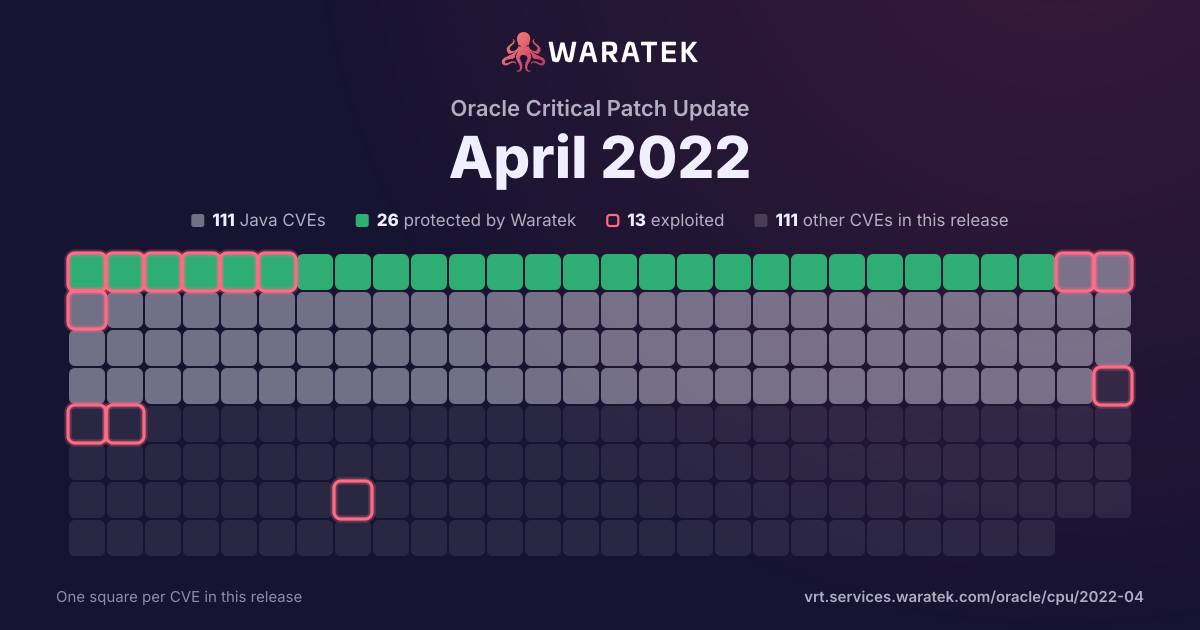
By status
26Protected by Waratek5Mitigation candidate80No exploit published64Outside Waratek scope47Not applicable
13Exploited, marked by the ring
No exploit published. For 40 of them, Oracle's security advisory is the source of public detail.
Protected by Waratek. Waratek RASP can block exploitation of these on systems that have not applied the patch yet.
Overview 11 matches · 2 in Waratek scope · 1 protected · 0 exploited · 0 CISA KEV · 0 public PoC · 0 EPSS ≥ 0.5
11matches
2in Waratek scope18.2%
1protected9.1%
0exploited0.0%
0CISA KEV0.0%
0public PoC0.0%
0EPSS ≥ 0.50.0%
Protected by Waratek
1
9.1%
Rule in development
0
0.0%
Mitigation candidate
0
0.0%
No exploit published
1
9.1%
Outside Waratek scope
3
27.3%
Not applicable
6
54.5%
Withdrawn CVE
0
0.0%
blocked by ARMR today
1
9.1%
partly blocked
0
0.0%
not blocked
10
90.9%
not established
0
0.0%
unrecorded
0
0.0%
Exploited
0
0.0%
Working exploit published
0
0.0%
Proof of concept only
0
0.0%
Forecast only
0
0.0%
No public exploit
11
100.0%
split by
peak 7 / quarter
Q2 201
Outside Waratek scope1
Low1
not blocked1
No public exploit1
Q3 201
Outside Waratek scope1
Low1
not blocked1
No public exploit1
Q4 201
No exploit published1
Low1
not blocked1
No public exploit1
Q1 210
Q2 211
Not applicable1
Low1
not blocked1
No public exploit1
Q3 210
Q4 210
Q1 220
Q2 227
Protected by Waratek1
Outside Waratek scope1
Not applicable5
Low7
blocked by ARMR today1
not blocked6
No public exploit7
Q2 20Q3 20Q4 20Q1 21Q2 21Q3 21Q4 21Q1 22Q2 22
| CVE | Severity | Published▾ | Status | Exploitation | Description |
|---|---|---|---|---|---|
| CVE-2022-21488 | Low | 2022-04-19 | Not applicable | No public exploit | Vulnerability in the Oracle VM VirtualBox product of Oracle Virtualization (component: Core). The supported version that is affected is Prior to 6.1.34. Easily exploitable vulnerability allows low privileged attacker with logon to the infrastructure where Oracle VM VirtualBox executes to compromise Oracle VM VirtualBox. While the vulnerability is in Oracle VM VirtualBox, attacks may significantly impact additional products (scope change). Successful attacks of this vulnerability can result in unauthorized update, insert or delete access to some of Oracle VM VirtualBox accessible data. CVSS 3.1 Base Score 3.8 (Integrity impacts). CVSS Vector: (CVSS:3.1/AV:L/AC:L/PR:L/UI:N/S:C/C:N/I:L/A:N). |
| CVE-2022-21487 | Low | 2022-04-19 | Not applicable | No public exploit | Vulnerability in the Oracle VM VirtualBox product of Oracle Virtualization (component: Core). The supported version that is affected is Prior to 6.1.34. Easily exploitable vulnerability allows low privileged attacker with logon to the infrastructure where Oracle VM VirtualBox executes to compromise Oracle VM VirtualBox. While the vulnerability is in Oracle VM VirtualBox, attacks may significantly impact additional products (scope change). Successful attacks of this vulnerability can result in unauthorized read access to a subset of Oracle VM VirtualBox accessible data. CVSS 3.1 Base Score 3.8 (Confidentiality impacts). CVSS Vector: (CVSS:3.1/AV:L/AC:L/PR:L/UI:N/S:C/C:L/I:N/A:N). |
| CVE-2022-21486 | Low | 2022-04-19 | Not applicable | No public exploit | Vulnerability in the MySQL Cluster product of Oracle MySQL (component: Cluster: General). Supported versions that are affected are 7.4.35 and prior, 7.5.25 and prior, 7.6.21 and prior and 8.0.28 and prior. Difficult to exploit vulnerability allows high privileged attacker with access to the physical communication segment attached to the hardware where the MySQL Cluster executes to compromise MySQL Cluster. Successful attacks require human interaction from a person other than the attacker. Successful attacks of this vulnerability can result in unauthorized read access to a subset of MySQL Cluster accessible data and unauthorized ability to cause a partial denial of service (partial DOS) of MySQL Cluster. CVSS 3.1 Base Score 2.9 (Confidentiality and Availability impacts). CVSS Vector: (CVSS:3.1/AV:A/AC:H/PR:H/UI:R/S:U/C:L/I:N/A:L). |
| CVE-2022-21485 | Low | 2022-04-19 | Not applicable | No public exploit | Vulnerability in the MySQL Cluster product of Oracle MySQL (component: Cluster: General). Supported versions that are affected are 7.4.35 and prior, 7.5.25 and prior, 7.6.21 and prior and 8.0.28 and prior. Difficult to exploit vulnerability allows high privileged attacker with access to the physical communication segment attached to the hardware where the MySQL Cluster executes to compromise MySQL Cluster. Successful attacks require human interaction from a person other than the attacker. Successful attacks of this vulnerability can result in unauthorized read access to a subset of MySQL Cluster accessible data and unauthorized ability to cause a partial denial of service (partial DOS) of MySQL Cluster. CVSS 3.1 Base Score 2.9 (Confidentiality and Availability impacts). CVSS Vector: (CVSS:3.1/AV:A/AC:H/PR:H/UI:R/S:U/C:L/I:N/A:L). |
| CVE-2022-21484 | Low | 2022-04-19 | Not applicable | No public exploit | Vulnerability in the MySQL Cluster product of Oracle MySQL (component: Cluster: General). Supported versions that are affected are 7.4.35 and prior, 7.5.25 and prior, 7.6.21 and prior and 8.0.28 and prior. Difficult to exploit vulnerability allows high privileged attacker with access to the physical communication segment attached to the hardware where the MySQL Cluster executes to compromise MySQL Cluster. Successful attacks require human interaction from a person other than the attacker. Successful attacks of this vulnerability can result in unauthorized read access to a subset of MySQL Cluster accessible data and unauthorized ability to cause a partial denial of service (partial DOS) of MySQL Cluster. CVSS 3.1 Base Score 2.9 (Confidentiality and Availability impacts). CVSS Vector: (CVSS:3.1/AV:A/AC:H/PR:H/UI:R/S:U/C:L/I:N/A:L). |
| CVE-2022-21443 | Low | 2022-04-19 | Protected by Waratek | No public exploit | Vulnerability in the Oracle Java SE, Oracle GraalVM Enterprise Edition product of Oracle Java SE (component: Libraries). Supported versions that are affected are Oracle Java SE: 7u331, 8u321, 11.0.14, 17.0.2, 18; Oracle GraalVM Enterprise Edition: 20.3.5, 21.3.1 and 22.0.0.2. Difficult to exploit vulnerability allows unauthenticated attacker with network access via multiple protocols to compromise Oracle Java SE, Oracle GraalVM Enterprise Edition. Successful attacks of this vulnerability can result in unauthorized ability to cause a partial denial of service (partial DOS) of Oracle Java SE, Oracle GraalVM Enterprise Edition. Note: This vulnerability applies to Java deployments, typically in clients running sandboxed Java Web Start applications or sandboxed Java applets, that load and run untrusted code (e.g., code that comes from the internet) and rely on the Java sandbox for security. This vulnerability can also be exploited by using APIs in the specified Component, e.g., through a web service which supplies data to the APIs. CVSS 3.1 Base Score 3.7 (Availability impacts). CVSS Vector: (CVSS:3.1/AV:N/AC:H/PR:N/UI:N/S:U/C:N/I:N/A:L). |
| CVE-2022-21423 | Low | 2022-04-19 | Outside Waratek scope | No public exploit | Vulnerability in the MySQL Server product of Oracle MySQL (component: InnoDB). Supported versions that are affected are 8.0.28 and prior. Easily exploitable vulnerability allows high privileged attacker with network access via multiple protocols to compromise MySQL Server. Successful attacks of this vulnerability can result in unauthorized ability to cause a partial denial of service (partial DOS) of MySQL Server. CVSS 3.1 Base Score 2.7 (Availability impacts). CVSS Vector: (CVSS:3.1/AV:N/AC:L/PR:H/UI:N/S:U/C:N/I:N/A:L). |
| CVE-2021-3200 | Low | 2021-05-18 | Not applicable | No public exploit | Buffer overflow vulnerability in libsolv 2020-12-13 via the Solver * testcase_read(Pool *pool, FILE *fp, const char *testcase, Queue *job, char **resultp, int *resultflagsp function at src/testcase.c: line 2334, which could cause a denial of service |
| CVE-2020-8908 | Low | 2020-12-10 | No exploit published | No public exploit | A temp directory creation vulnerability exists in all versions of Guava, allowing an attacker with access to the machine to potentially access data in a temporary directory created by the Guava API com.google.common.io.Files.createTempDir(). By default, on unix-like systems, the created directory is world-readable (readable by an attacker with access to the system). The method in question has been marked @Deprecated in versions 30.0 and later and should not be used. For Android developers, we recommend choosing a temporary directory API provided by Android, such as context.getCacheDir(). For other Java developers, we recommend migrating to the Java 7 API java.nio.file.Files.createTempDirectory() which explicitly configures permissions of 700, or configuring the Java runtime's java.io.tmpdir system property to point to a location whose permissions are appropriately configured. |
| CVE-2020-1968 | Low | 2020-09-09 | Outside Waratek scope | No public exploit | The Raccoon attack exploits a flaw in the TLS specification which can lead to an attacker being able to compute the pre-master secret in connections which have used a Diffie-Hellman (DH) based ciphersuite. In such a case this would result in the attacker being able to eavesdrop on all encrypted communications sent over that TLS connection. The attack can only be exploited if an implementation re-uses a DH secret across multiple TLS connections. Note that this issue only impacts DH ciphersuites and not ECDH ciphersuites. This issue affects OpenSSL 1.0.2 which is out of support and no longer receiving public updates. OpenSSL 1.1.1 is not vulnerable to this issue. Fixed in OpenSSL 1.0.2w (Affected 1.0.2-1.0.2v). |
| CVE-2020-9488 | Low | 2020-04-27 | Outside Waratek scope | No public exploit | Improper validation of certificate with host mismatch in Apache Log4j SMTP appender. This could allow an SMTPS connection to be intercepted by a man-in-the-middle attack which could leak any log messages sent through that appender. Fixed in Apache Log4j 2.12.3 and 2.13.1 |