
Oracle Critical Patch Update April 2022
Released April 2022 · Oracle's advisory ↗ · ← Critical Patch Update, January 2022 · Critical Patch Update, July 2022 →
222 CVEs in this release, one square each
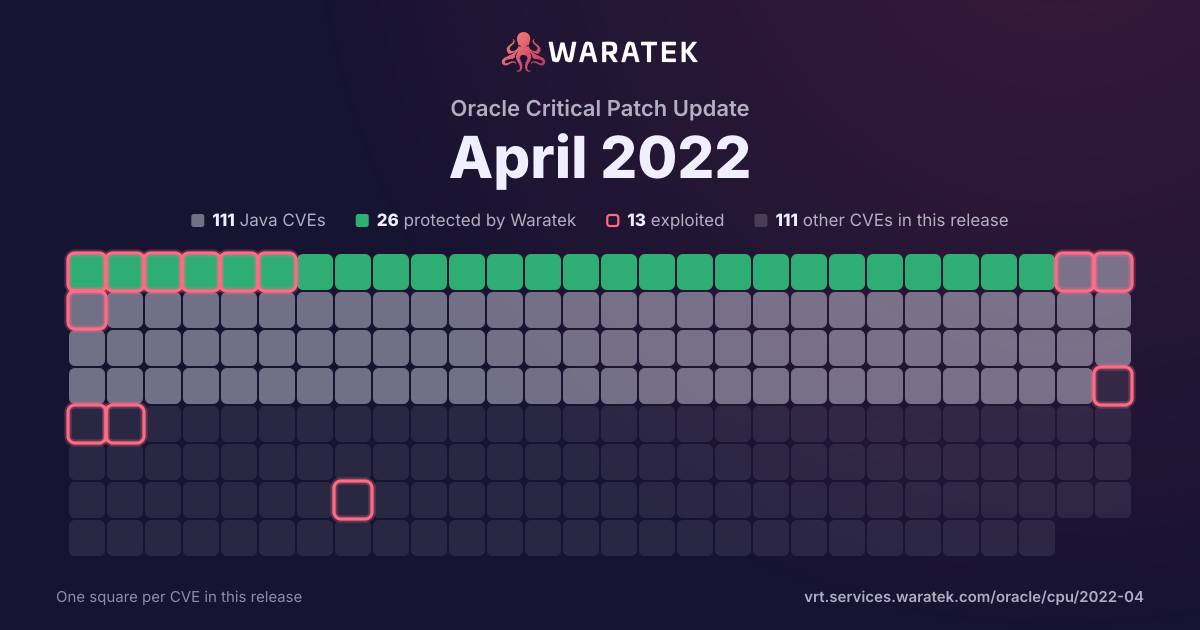
By status
26Protected by Waratek5Mitigation candidate80No exploit published64Outside Waratek scope47Not applicable
13Exploited, marked by the ring
No exploit published. For 40 of them, Oracle's security advisory is the source of public detail.
Protected by Waratek. Waratek RASP can block exploitation of these on systems that have not applied the patch yet.
Overview 17 matches · 0 in Waratek scope · 0 protected · 0 exploited · 0 CISA KEV · 1 public PoC · 1 EPSS ≥ 0.5
17matches
0in Waratek scope0.0%
0protected0.0%
0exploited0.0%
0CISA KEV0.0%
1public PoC5.9%
1EPSS ≥ 0.55.9%
Protected by Waratek
0
0.0%
Rule in development
0
0.0%
Mitigation candidate
0
0.0%
No exploit published
0
0.0%
Outside Waratek scope
0
0.0%
Not applicable
17
100.0%
Withdrawn CVE
0
0.0%
blocked by ARMR today
0
0.0%
partly blocked
0
0.0%
not blocked
17
100.0%
not established
0
0.0%
unrecorded
0
0.0%
Exploited
0
0.0%
Working exploit published
1
5.9%
Proof of concept only
1
5.9%
Forecast only
0
0.0%
No public exploit
15
88.2%
split by
peak 4 / quarter
Q3 191
Not applicable1
High1
not blocked1
No public exploit1
Q4 192
Not applicable2
High2
not blocked2
Proof of concept only1
No public exploit1
Q1 200
Q2 200
Q3 202
Not applicable2
High2
not blocked2
No public exploit2
Q4 200
Q1 211
Not applicable1
High1
not blocked1
No public exploit1
Q2 212
Not applicable2
High2
not blocked2
Working exploit published1
No public exploit1
Q3 213
Not applicable3
High3
not blocked3
No public exploit3
Q4 212
Not applicable2
High2
not blocked2
No public exploit2
Q1 220
Q2 224
Not applicable4
High4
not blocked4
No public exploit4
Q3 19Q4 19Q1 20Q2 20Q3 20Q4 20Q1 21Q2 21Q3 21Q4 21Q1 22Q2 22
| CVE | Severity | Published▾ | Status | Exploitation | Description |
|---|---|---|---|---|---|
| CVE-2022-21491 | High | 2022-04-19 | Not applicable | No public exploit | Vulnerability in the Oracle VM VirtualBox product of Oracle Virtualization (component: Core). The supported version that is affected is Prior to 6.1.34. Easily exploitable vulnerability allows low privileged attacker with logon to the infrastructure where Oracle VM VirtualBox executes to compromise Oracle VM VirtualBox. Successful attacks of this vulnerability can result in takeover of Oracle VM VirtualBox. Note: This vulnerability applies to Windows systems only. CVSS 3.1 Base Score 7.8 (Confidentiality, Integrity and Availability impacts). CVSS Vector: (CVSS:3.1/AV:L/AC:L/PR:L/UI:N/S:U/C:H/I:H/A:H). |
| CVE-2022-21446 | High | 2022-04-19 | Not applicable | No public exploit | Vulnerability in the Oracle Solaris product of Oracle Systems (component: Utility). The supported version that is affected is 11. Easily exploitable vulnerability allows unauthenticated attacker with network access via multiple protocols to compromise Oracle Solaris. Successful attacks of this vulnerability can result in unauthorized creation, deletion or modification access to critical data or all Oracle Solaris accessible data as well as unauthorized read access to a subset of Oracle Solaris accessible data. CVSS 3.1 Base Score 8.2 (Confidentiality and Integrity impacts). CVSS Vector: (CVSS:3.1/AV:N/AC:L/PR:N/UI:N/S:U/C:L/I:H/A:N). |
| CVE-2022-21442 | High | 2022-04-19 | Not applicable | No public exploit | Vulnerability in Oracle GoldenGate (component: OGG Core Library). The supported version that is affected is Prior to 23.1. Easily exploitable vulnerability allows low privileged attacker with logon to the infrastructure where Oracle GoldenGate executes to compromise Oracle GoldenGate. While the vulnerability is in Oracle GoldenGate, attacks may significantly impact additional products (scope change). Successful attacks of this vulnerability can result in takeover of Oracle GoldenGate. CVSS 3.1 Base Score 8.8 (Confidentiality, Integrity and Availability impacts). CVSS Vector: (CVSS:3.1/AV:L/AC:L/PR:L/UI:N/S:C/C:H/I:H/A:H). |
| CVE-2022-21410 | High | 2022-04-19 | Not applicable | No public exploit | Vulnerability in the Oracle Database - Enterprise Edition Sharding component of Oracle Database Server. The supported version that is affected is 19c. Easily exploitable vulnerability allows high privileged attacker having Create Any Procedure privilege with network access via Oracle Net to compromise Oracle Database - Enterprise Edition Sharding. Successful attacks of this vulnerability can result in takeover of Oracle Database - Enterprise Edition Sharding. CVSS 3.1 Base Score 7.2 (Confidentiality, Integrity and Availability impacts). CVSS Vector: (CVSS:3.1/AV:N/AC:L/PR:H/UI:N/S:U/C:H/I:H/A:H). |
| CVE-2021-41165 | High | 2021-11-17 | Not applicable | No public exploit | CKEditor4 is an open source WYSIWYG HTML editor. In affected version a vulnerability has been discovered in the core HTML processing module and may affect all plugins used by CKEditor 4. The vulnerability allowed to inject malformed comments HTML bypassing content sanitization, which could result in executing JavaScript code. It affects all users using the CKEditor 4 at version < 4.17.0. The problem has been recognized and patched. The fix will be available in version 4.17.0. |
| CVE-2021-32626 | High | 2021-10-04 | Not applicable | No public exploit | Redis is an open source, in-memory database that persists on disk. In affected versions specially crafted Lua scripts executing in Redis can cause the heap-based Lua stack to be overflowed, due to incomplete checks for this condition. This can result with heap corruption and potentially remote code execution. This problem exists in all versions of Redis with Lua scripting support, starting from 2.6. The problem is fixed in versions 6.2.6, 6.0.16 and 5.0.14. For users unable to update an additional workaround to mitigate the problem without patching the redis-server executable is to prevent users from executing Lua scripts. This can be done using ACL to restrict EVAL and EVALSHA commands. |
| CVE-2021-2464 | High | 2021-09-24 | Not applicable | No public exploit | Vulnerability in Oracle Linux (component: OSwatcher). Supported versions that are affected are 7 and 8. Easily exploitable vulnerability allows low privileged attacker with logon to the infrastructure where Oracle Linux executes to compromise Oracle Linux. Successful attacks of this vulnerability can result in takeover of Oracle Linux. CVSS 3.1 Base Score 7.8 (Confidentiality, Integrity and Availability impacts). CVSS Vector: (CVSS:3.1/AV:L/AC:L/PR:L/UI:N/S:U/C:H/I:H/A:H). |
| CVE-2021-3807 | High | 2021-09-17 | Not applicable | No public exploit | ansi-regex is vulnerable to Inefficient Regular Expression Complexity |
| CVE-2021-32066 | High | 2021-08-01 | Not applicable | No public exploit | An issue was discovered in Ruby through 2.6.7, 2.7.x through 2.7.3, and 3.x through 3.0.1. Net::IMAP does not raise an exception when StartTLS fails with an an unknown response, which might allow man-in-the-middle attackers to bypass the TLS protections by leveraging a network position between the client and the registry to block the StartTLS command, aka a "StartTLS stripping attack." |
| CVE-2021-23017 | High | 2021-06-01 | Not applicable | Working exploit published | A security issue in nginx resolver was identified, which might allow an attacker who is able to forge UDP packets from the DNS server to cause 1-byte memory overwrite, resulting in worker process crash or potential other impact. |
| CVE-2021-3518 | High | 2021-05-18 | Not applicable | No public exploit | There's a flaw in libxml2 in versions before 2.9.11. An attacker who is able to submit a crafted file to be processed by an application linked with libxml2 could trigger a use-after-free. The greatest impact from this flaw is to confidentiality, integrity, and availability. |
| CVE-2021-3450 | High | 2021-03-25 | Not applicable | No public exploit | The X509_V_FLAG_X509_STRICT flag enables additional security checks of the certificates present in a certificate chain. It is not set by default. Starting from OpenSSL version 1.1.1h a check to disallow certificates in the chain that have explicitly encoded elliptic curve parameters was added as an additional strict check. An error in the implementation of this check meant that the result of a previous check to confirm that certificates in the chain are valid CA certificates was overwritten. This effectively bypasses the check that non-CA certificates must not be able to issue other certificates. If a "purpose" has been configured then there is a subsequent opportunity for checks that the certificate is a valid CA. All of the named "purpose" values implemented in libcrypto perform this check. Therefore, where a purpose is set the certificate chain will still be rejected even when the strict flag has been used. A purpose is set by default in libssl client and server certificate verification routines, but it can be overridden or removed by an application. In order to be affected, an application must explicitly set the X509_V_FLAG_X509_STRICT verification flag and either not set a purpose for the certificate verification or, in the case of TLS client or server applications, override the default purpose. OpenSSL versions 1.1.1h and newer are affected by this issue. Users of these versions should upgrade to OpenSSL 1.1.1k. OpenSSL 1.0.2 is not impacted by this issue. Fixed in OpenSSL 1.1.1k (Affected 1.1.1h-1.1.1j). |
| CVE-2020-8174 | High | 2020-07-24 | Not applicable | No public exploit | napi_get_value_string_*() allows various kinds of memory corruption in node < 10.21.0, 12.18.0, and < 14.4.0. |
| CVE-2020-8203 | High | 2020-07-15 | Not applicable | No public exploit | Prototype pollution attack when using _.zipObjectDeep in lodash before 4.17.20. |
| CVE-2019-16789 | High | 2019-12-26 | Not applicable | No public exploit | In Waitress through version 1.4.0, if a proxy server is used in front of waitress, an invalid request may be sent by an attacker that bypasses the front-end and is parsed differently by waitress leading to a potential for HTTP request smuggling. Specially crafted requests containing special whitespace characters in the Transfer-Encoding header would get parsed by Waitress as being a chunked request, but a front-end server would use the Content-Length instead as the Transfer-Encoding header is considered invalid due to containing invalid characters. If a front-end server does HTTP pipelining to a backend Waitress server this could lead to HTTP request splitting which may lead to potential cache poisoning or unexpected information disclosure. This issue is fixed in Waitress 1.4.1 through more strict HTTP field validation. |
| CVE-2019-18276 | High | 2019-11-28 | Not applicable | Proof of concept only | An issue was discovered in disable_priv_mode in shell.c in GNU Bash through 5.0 patch 11. By default, if Bash is run with its effective UID not equal to its real UID, it will drop privileges by setting its effective UID to its real UID. However, it does so incorrectly. On Linux and other systems that support "saved UID" functionality, the saved UID is not dropped. An attacker with command execution in the shell can use "enable -f" for runtime loading of a new builtin, which can be a shared object that calls setuid() and therefore regains privileges. However, binaries running with an effective UID of 0 are unaffected. |
| CVE-2019-13565 | High | 2019-07-26 | Not applicable | No public exploit | An issue was discovered in OpenLDAP 2.x before 2.4.48. When using SASL authentication and session encryption, and relying on the SASL security layers in slapd access controls, it is possible to obtain access that would otherwise be denied via a simple bind for any identity covered in those ACLs. After the first SASL bind is completed, the sasl_ssf value is retained for all new non-SASL connections. Depending on the ACL configuration, this can affect different types of operations (searches, modifications, etc.). In other words, a successful authorization step completed by one user affects the authorization requirement for a different user. |