
Oracle Critical Patch Update April 2022
Released April 2022 · Oracle's advisory ↗ · ← Critical Patch Update, January 2022 · Critical Patch Update, July 2022 →
222 CVEs in this release, one square each
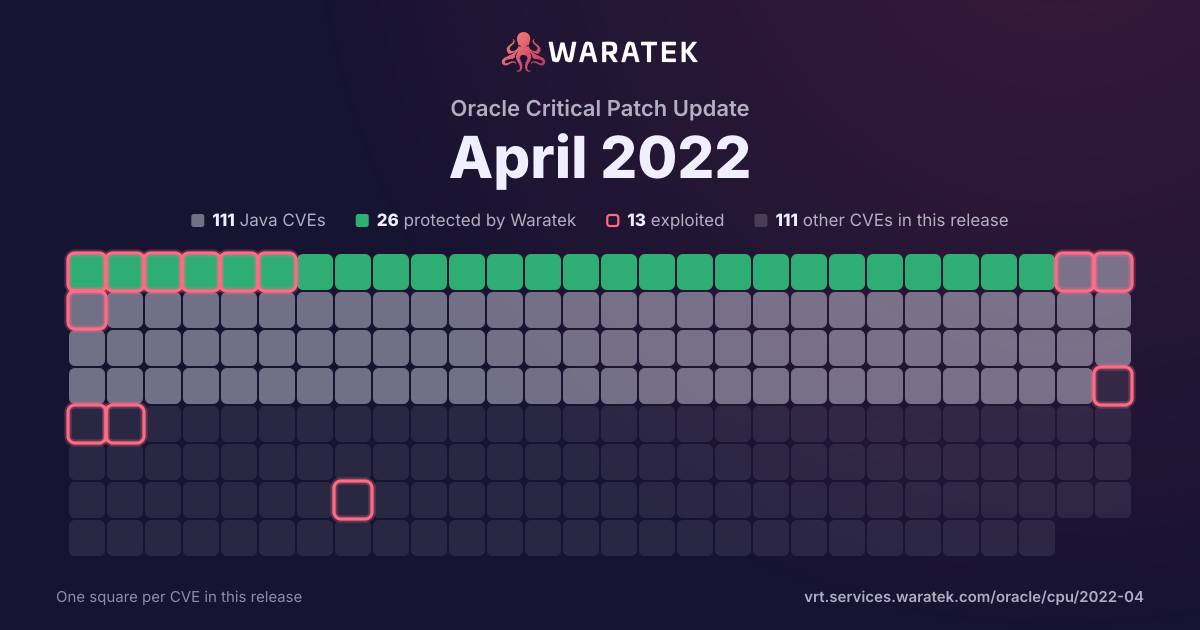
By status
29Protected by Waratek9Mitigation candidate96No exploit published88Not applicable
13Exploited, marked by the ring
No exploit published. For 46 of them, Oracle's security advisory is the source of public detail.
Protected by Waratek. Waratek RASP can block exploitation of these on systems that have not applied the patch yet.
Overview 12 matches · 0 in Waratek scope · 0 protected · 0 exploited · 0 CISA KEV · 1 public PoC · 0 EPSS ≥ 0.5
12matches
0in Waratek scope0.0%
0protected0.0%
0exploited0.0%
0CISA KEV0.0%
1public PoC8.3%
0EPSS ≥ 0.50.0%
Protected by Waratek
0
0.0%
Rule in development
0
0.0%
Mitigation candidate
0
0.0%
No exploit published
0
0.0%
Outside Waratek scope
0
0.0%
Not applicable
12
100.0%
Withdrawn CVE
0
0.0%
blocked by ARMR today
0
0.0%
partly blocked
0
0.0%
not blocked
12
100.0%
not established
0
0.0%
unrecorded
0
0.0%
Exploited
0
0.0%
Working exploit published
1
8.3%
Proof of concept only
0
0.0%
Forecast only
0
0.0%
No public exploit
11
91.7%
split by
peak 5 / quarter
Q2 181
Not applicable1
Medium1
not blocked1
No public exploit1
Q3 180
Q4 180
Q1 190
Q2 190
Q3 191
Not applicable1
High1
not blocked1
No public exploit1
Q4 192
Not applicable2
High2
not blocked2
Working exploit published1
No public exploit1
Q1 200
Q2 203
Not applicable3
High1
Medium2
not blocked3
No public exploit3
Q3 205
Not applicable5
High2
Medium2
Low1
not blocked5
No public exploit5
Q2 18Q3 18Q4 18Q1 19Q2 19Q3 19Q4 19Q1 20Q2 20Q3 20
| CVE | Severity | Published▾ | Status | Exploitation | Description |
|---|---|---|---|---|---|
| CVE-2020-1968 | Low | 2020-09-09 | Not applicable | No public exploit | The Raccoon attack exploits a flaw in the TLS specification which can lead to an attacker being able to compute the pre-master secret in connections which have used a Diffie-Hellman (DH) based ciphersuite. In such a case this would result in the attacker being able to eavesdrop on all encrypted communications sent over that TLS connection. The attack can only be exploited if an implementation re-uses a DH secret across multiple TLS connections. Note that this issue only impacts DH ciphersuites and not ECDH ciphersuites. This issue affects OpenSSL 1.0.2 which is out of support and no longer receiving public updates. OpenSSL 1.1.1 is not vulnerable to this issue. Fixed in OpenSSL 1.0.2w (Affected 1.0.2-1.0.2v). |
| CVE-2020-24977 | Medium | 2020-09-04 | Not applicable | No public exploit | GNOME project libxml2 v2.9.10 has a global buffer over-read vulnerability in xmlEncodeEntitiesInternal at libxml2/entities.c. The issue has been fixed in commit 50f06b3e. |
| CVE-2020-16135 | Medium | 2020-07-29 | Not applicable | No public exploit | libssh 0.9.4 has a NULL pointer dereference in tftpserver.c if ssh_buffer_new returns NULL. |
| CVE-2020-8174 | High | 2020-07-24 | Not applicable | No public exploit | napi_get_value_string_*() allows various kinds of memory corruption in node < 10.21.0, 12.18.0, and < 14.4.0. |
| CVE-2020-8203 | High | 2020-07-15 | Not applicable | No public exploit | Prototype pollution attack when using _.zipObjectDeep in lodash before 4.17.20. |
| CVE-2020-14155 | Medium | 2020-06-15 | Not applicable | No public exploit | libpcre in PCRE before 8.44 allows an integer overflow via a large number after a (?C substring. |
| CVE-2020-10878 | High | 2020-06-05 | Not applicable | No public exploit | Perl before 5.30.3 has an integer overflow related to mishandling of a "PL_regkind[OP(n)] == NOTHING" situation. A crafted regular expression could lead to malformed bytecode with a possibility of instruction injection. |
| CVE-2020-13434 | Medium | 2020-05-24 | Not applicable | No public exploit | SQLite through 3.32.0 has an integer overflow in sqlite3_str_vappendf in printf.c. |
| CVE-2019-16789 | High | 2019-12-26 | Not applicable | No public exploit | In Waitress through version 1.4.0, if a proxy server is used in front of waitress, an invalid request may be sent by an attacker that bypasses the front-end and is parsed differently by waitress leading to a potential for HTTP request smuggling. Specially crafted requests containing special whitespace characters in the Transfer-Encoding header would get parsed by Waitress as being a chunked request, but a front-end server would use the Content-Length instead as the Transfer-Encoding header is considered invalid due to containing invalid characters. If a front-end server does HTTP pipelining to a backend Waitress server this could lead to HTTP request splitting which may lead to potential cache poisoning or unexpected information disclosure. This issue is fixed in Waitress 1.4.1 through more strict HTTP field validation. |
| CVE-2019-18276 | High | 2019-11-28 | Not applicable | Working exploit published | An issue was discovered in disable_priv_mode in shell.c in GNU Bash through 5.0 patch 11. By default, if Bash is run with its effective UID not equal to its real UID, it will drop privileges by setting its effective UID to its real UID. However, it does so incorrectly. On Linux and other systems that support "saved UID" functionality, the saved UID is not dropped. An attacker with command execution in the shell can use "enable -f" for runtime loading of a new builtin, which can be a shared object that calls setuid() and therefore regains privileges. However, binaries running with an effective UID of 0 are unaffected. |
| CVE-2019-13565 | High | 2019-07-26 | Not applicable | No public exploit | An issue was discovered in OpenLDAP 2.x before 2.4.48. When using SASL authentication and session encryption, and relying on the SASL security layers in slapd access controls, it is possible to obtain access that would otherwise be denied via a simple bind for any identity covered in those ACLs. After the first SASL bind is completed, the sasl_ssf value is retained for all new non-SASL connections. Depending on the ACL configuration, this can affect different types of operations (searches, modifications, etc.). In other words, a successful authorization step completed by one user affects the authorization requirement for a different user. |
| CVE-2018-11212 | Medium | 2018-05-16 | Not applicable | No public exploit | An issue was discovered in libjpeg 9a and 9d. The alloc_sarray function in jmemmgr.c allows remote attackers to cause a denial of service (divide-by-zero error) via a crafted file. |