
Oracle Critical Patch Update April 2022
Released April 2022 · Oracle's advisory ↗ · ← Critical Patch Update, January 2022 · Critical Patch Update, July 2022 →
222 CVEs in this release, one square each
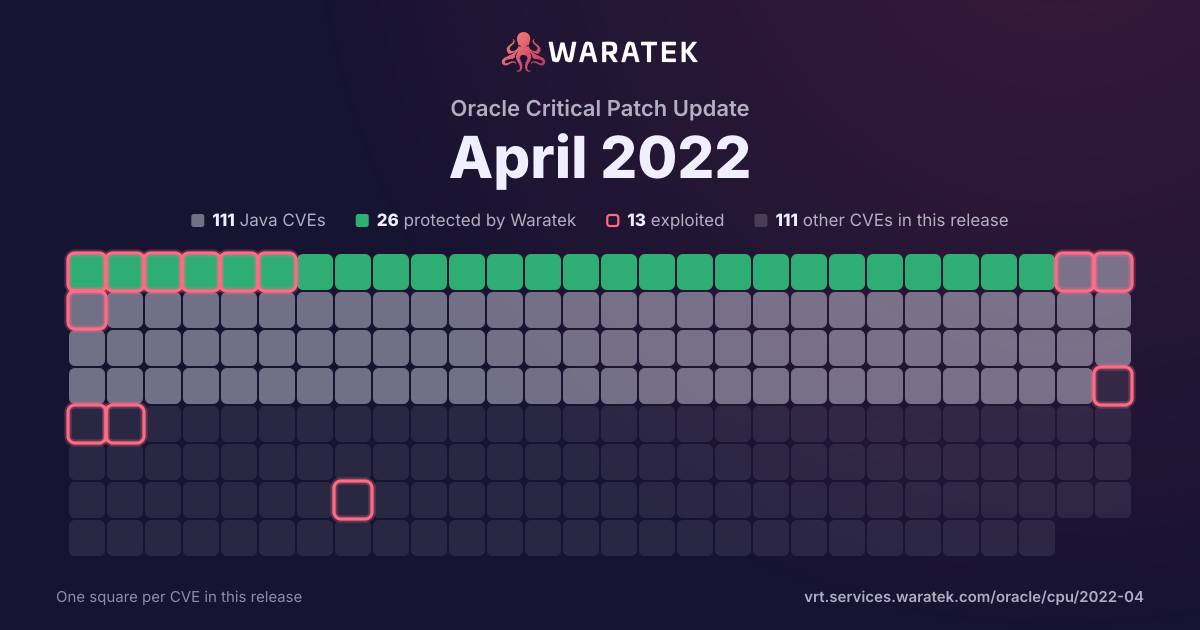
By status
26Protected by Waratek5Mitigation candidate80No exploit published64Outside Waratek scope47Not applicable
13Exploited, marked by the ring
No exploit published. For 40 of them, Oracle's security advisory is the source of public detail.
Protected by Waratek. Waratek RASP can block exploitation of these on systems that have not applied the patch yet.
Overview 105 matches · 49 in Waratek scope · 0 protected · 3 exploited · 0 CISA KEV · 5 public PoC · 6 EPSS ≥ 0.5
105matches
49in Waratek scope46.7%
0protected0.0%
3exploited2.9%
0CISA KEV0.0%
5public PoC4.8%
6EPSS ≥ 0.55.7%
Protected by Waratek
0
0.0%
Rule in development
0
0.0%
Mitigation candidate
3
2.9%
No exploit published
46
43.8%
Outside Waratek scope
35
33.3%
Not applicable
21
20.0%
Withdrawn CVE
0
0.0%
blocked by ARMR today
0
0.0%
partly blocked
0
0.0%
not blocked
105
100.0%
not established
0
0.0%
unrecorded
0
0.0%
Exploited
3
2.9%
Working exploit published
0
0.0%
Proof of concept only
3
2.9%
Forecast only
4
3.8%
No public exploit
95
90.5%
split by
peak 59 / quarter
Q2 181
Not applicable1
Medium1
not blocked1
No public exploit1
Q3 180
Q4 180
Q1 190
Q2 190
Q3 191
Outside Waratek scope1
Medium1
not blocked1
No public exploit1
Q4 190
Q1 201
Outside Waratek scope1
Medium1
not blocked1
No public exploit1
Q2 203
Outside Waratek scope1
Not applicable2
Medium3
not blocked3
Exploited1
No public exploit2
Q3 203
No exploit published1
Outside Waratek scope1
Not applicable1
Medium3
not blocked3
No public exploit3
Q4 203
No exploit published1
Outside Waratek scope2
Medium3
not blocked3
Proof of concept only1
No public exploit2
Q1 217
No exploit published6
Outside Waratek scope1
Medium7
not blocked7
No public exploit7
Q2 216
Mitigation candidate1
No exploit published3
Outside Waratek scope1
Not applicable1
Medium6
not blocked6
Exploited1
No public exploit5
Q3 216
Mitigation candidate1
No exploit published5
Medium6
not blocked6
Exploited1
Forecast only1
No public exploit4
Q4 216
Mitigation candidate1
No exploit published2
Outside Waratek scope2
Not applicable1
Medium6
not blocked6
Proof of concept only2
No public exploit4
Q1 228
No exploit published5
Outside Waratek scope2
Not applicable1
Medium8
not blocked8
Forecast only1
No public exploit7
Q2 2259
No exploit published23
Outside Waratek scope23
Not applicable13
Medium59
not blocked59
Forecast only2
No public exploit57
Q3 221
Not applicable1
Medium1
not blocked1
No public exploit1
Q3 18Q1 19Q3 19Q1 20Q3 20Q1 21Q3 21Q1 22Q3 22
| CVE | Severity | Published▾ | Status | Exploitation | Description |
|---|---|---|---|---|---|
| CVE-2021-3521 | Medium | 2022-08-22 | Not applicable | No public exploit | There is a flaw in RPM's signature functionality. OpenPGP subkeys are associated with a primary key via a "binding signature." RPM does not check the binding signature of subkeys prior to importing them. If an attacker is able to add or socially engineer another party to add a malicious subkey to a legitimate public key, RPM could wrongly trust a malicious signature. The greatest impact of this flaw is to data integrity. To exploit this flaw, an attacker must either compromise an RPM repository or convince an administrator to install an untrusted RPM or public key. It is strongly recommended to only use RPMs and public keys from trusted sources. |
| CVE-2022-21498 | Medium | 2022-04-19 | Not applicable | No public exploit | Vulnerability in the Java VM component of Oracle Database Server. Supported versions that are affected are 12.1.0.2, 19c and 21c. Easily exploitable vulnerability allows low privileged attacker having Create Procedure privilege with network access via multiple protocols to compromise Java VM. Successful attacks of this vulnerability can result in unauthorized creation, deletion or modification access to critical data or all Java VM accessible data. CVSS 3.1 Base Score 6.5 (Integrity impacts). CVSS Vector: (CVSS:3.1/AV:N/AC:L/PR:L/UI:N/S:U/C:N/I:H/A:N). |
| CVE-2022-21496 | Medium | 2022-04-19 | No exploit published | No public exploit | Vulnerability in the Oracle Java SE, Oracle GraalVM Enterprise Edition product of Oracle Java SE (component: JNDI). Supported versions that are affected are Oracle Java SE: 7u331, 8u321, 11.0.14, 17.0.2, 18; Oracle GraalVM Enterprise Edition: 20.3.5, 21.3.1 and 22.0.0.2. Easily exploitable vulnerability allows unauthenticated attacker with network access via multiple protocols to compromise Oracle Java SE, Oracle GraalVM Enterprise Edition. Successful attacks of this vulnerability can result in unauthorized update, insert or delete access to some of Oracle Java SE, Oracle GraalVM Enterprise Edition accessible data. Note: This vulnerability applies to Java deployments, typically in clients running sandboxed Java Web Start applications or sandboxed Java applets, that load and run untrusted code (e.g., code that comes from the internet) and rely on the Java sandbox for security. This vulnerability can also be exploited by using APIs in the specified Component, e.g., through a web service which supplies data to the APIs. CVSS 3.1 Base Score 5.3 (Integrity impacts). CVSS Vector: (CVSS:3.1/AV:N/AC:L/PR:N/UI:N/S:U/C:N/I:L/A:N). |
| CVE-2022-21494 | Medium | 2022-04-19 | Not applicable | No public exploit | Vulnerability in the Oracle Solaris product of Oracle Systems (component: Kernel). The supported version that is affected is 11. Difficult to exploit vulnerability allows high privileged attacker with logon to the infrastructure where Oracle Solaris executes to compromise Oracle Solaris. Successful attacks require human interaction from a person other than the attacker. Successful attacks of this vulnerability can result in unauthorized ability to cause a hang or frequently repeatable crash (complete DOS) of Oracle Solaris. CVSS 3.1 Base Score 4.0 (Availability impacts). CVSS Vector: (CVSS:3.1/AV:L/AC:H/PR:H/UI:R/S:U/C:N/I:N/A:H). |
| CVE-2022-21493 | Medium | 2022-04-19 | Not applicable | No public exploit | Vulnerability in the Oracle Solaris product of Oracle Systems (component: Kernel). The supported version that is affected is 11. Easily exploitable vulnerability allows low privileged attacker with logon to the infrastructure where Oracle Solaris executes to compromise Oracle Solaris. Successful attacks require human interaction from a person other than the attacker and while the vulnerability is in Oracle Solaris, attacks may significantly impact additional products (scope change). Successful attacks of this vulnerability can result in unauthorized ability to cause a hang or frequently repeatable crash (complete DOS) of Oracle Solaris. CVSS 3.1 Base Score 5.9 (Availability impacts). CVSS Vector: (CVSS:3.1/AV:L/AC:L/PR:L/UI:R/S:C/C:N/I:N/A:H). |
| CVE-2022-21492 | Medium | 2022-04-19 | No exploit published | No public exploit | Vulnerability in the Oracle Business Intelligence Enterprise Edition product of Oracle Fusion Middleware (component: Analytics Server). The supported version that is affected is 5.9.0.0.0. Easily exploitable vulnerability allows unauthenticated attacker with network access via HTTP to compromise Oracle Business Intelligence Enterprise Edition. Successful attacks require human interaction from a person other than the attacker and while the vulnerability is in Oracle Business Intelligence Enterprise Edition, attacks may significantly impact additional products (scope change). Successful attacks of this vulnerability can result in unauthorized update, insert or delete access to some of Oracle Business Intelligence Enterprise Edition accessible data as well as unauthorized read access to a subset of Oracle Business Intelligence Enterprise Edition accessible data. CVSS 3.1 Base Score 6.1 (Confidentiality and Integrity impacts). CVSS Vector: (CVSS:3.1/AV:N/AC:L/PR:N/UI:R/S:C/C:L/I:L/A:N). |
| CVE-2022-21490 | Medium | 2022-04-19 | Not applicable | Forecast only | Vulnerability in the MySQL Cluster product of Oracle MySQL (component: Cluster: General). Supported versions that are affected are 7.4.35 and prior, 7.5.25 and prior, 7.6.21 and prior and 8.0.28 and prior. Difficult to exploit vulnerability allows high privileged attacker with access to the physical communication segment attached to the hardware where the MySQL Cluster executes to compromise MySQL Cluster. Successful attacks require human interaction from a person other than the attacker. Successful attacks of this vulnerability can result in takeover of MySQL Cluster. CVSS 3.1 Base Score 6.3 (Confidentiality, Integrity and Availability impacts). CVSS Vector: (CVSS:3.1/AV:A/AC:H/PR:H/UI:R/S:U/C:H/I:H/A:H). |
| CVE-2022-21489 | Medium | 2022-04-19 | Not applicable | Forecast only | Vulnerability in the MySQL Cluster product of Oracle MySQL (component: Cluster: General). Supported versions that are affected are 7.4.35 and prior, 7.5.25 and prior, 7.6.21 and prior and 8.0.28 and prior. Difficult to exploit vulnerability allows high privileged attacker with access to the physical communication segment attached to the hardware where the MySQL Cluster executes to compromise MySQL Cluster. Successful attacks require human interaction from a person other than the attacker. Successful attacks of this vulnerability can result in takeover of MySQL Cluster. CVSS 3.1 Base Score 6.3 (Confidentiality, Integrity and Availability impacts). CVSS Vector: (CVSS:3.1/AV:A/AC:H/PR:H/UI:R/S:U/C:H/I:H/A:H). |
| CVE-2022-21483 | Medium | 2022-04-19 | Not applicable | No public exploit | Vulnerability in the MySQL Cluster product of Oracle MySQL (component: Cluster: General). Supported versions that are affected are 7.4.35 and prior, 7.5.25 and prior, 7.6.21 and prior and 8.0.28 and prior. Difficult to exploit vulnerability allows high privileged attacker with access to the physical communication segment attached to the hardware where the MySQL Cluster executes to compromise MySQL Cluster. Successful attacks require human interaction from a person other than the attacker. Successful attacks of this vulnerability can result in takeover of MySQL Cluster. CVSS 3.1 Base Score 6.3 (Confidentiality, Integrity and Availability impacts). CVSS Vector: (CVSS:3.1/AV:A/AC:H/PR:H/UI:R/S:U/C:H/I:H/A:H). |
| CVE-2022-21482 | Medium | 2022-04-19 | Not applicable | No public exploit | Vulnerability in the MySQL Cluster product of Oracle MySQL (component: Cluster: General). Supported versions that are affected are 8.0.28 and prior. Difficult to exploit vulnerability allows high privileged attacker with access to the physical communication segment attached to the hardware where the MySQL Cluster executes to compromise MySQL Cluster. Successful attacks require human interaction from a person other than the attacker. Successful attacks of this vulnerability can result in takeover of MySQL Cluster. CVSS 3.1 Base Score 6.3 (Confidentiality, Integrity and Availability impacts). CVSS Vector: (CVSS:3.1/AV:A/AC:H/PR:H/UI:R/S:U/C:H/I:H/A:H). |
| CVE-2022-21481 | Medium | 2022-04-19 | No exploit published | No public exploit | Vulnerability in the PeopleSoft Enterprise FIN Cash Management product of Oracle PeopleSoft (component: Financial Gateway). The supported version that is affected is 9.2. Easily exploitable vulnerability allows low privileged attacker with network access via HTTP to compromise PeopleSoft Enterprise FIN Cash Management. Successful attacks require human interaction from a person other than the attacker and while the vulnerability is in PeopleSoft Enterprise FIN Cash Management, attacks may significantly impact additional products (scope change). Successful attacks of this vulnerability can result in unauthorized update, insert or delete access to some of PeopleSoft Enterprise FIN Cash Management accessible data as well as unauthorized read access to a subset of PeopleSoft Enterprise FIN Cash Management accessible data. CVSS 3.1 Base Score 5.4 (Confidentiality and Integrity impacts). CVSS Vector: (CVSS:3.1/AV:N/AC:L/PR:L/UI:R/S:C/C:L/I:L/A:N). |
| CVE-2022-21480 | Medium | 2022-04-19 | No exploit published | No public exploit | Vulnerability in the Oracle Transportation Management product of Oracle Supply Chain (component: User Interface). Supported versions that are affected are 6.4.3 and 6.5.1. Easily exploitable vulnerability allows unauthenticated attacker with network access via HTTP to compromise Oracle Transportation Management. Successful attacks require human interaction from a person other than the attacker and while the vulnerability is in Oracle Transportation Management, attacks may significantly impact additional products (scope change). Successful attacks of this vulnerability can result in unauthorized update, insert or delete access to some of Oracle Transportation Management accessible data as well as unauthorized read access to a subset of Oracle Transportation Management accessible data. CVSS 3.1 Base Score 6.1 (Confidentiality and Integrity impacts). CVSS Vector: (CVSS:3.1/AV:N/AC:L/PR:N/UI:R/S:C/C:L/I:L/A:N). |
| CVE-2022-21479 | Medium | 2022-04-19 | Outside Waratek scope | No public exploit | Vulnerability in the MySQL Server product of Oracle MySQL (component: Server: Optimizer). Supported versions that are affected are 8.0.28 and prior. Easily exploitable vulnerability allows high privileged attacker with network access via multiple protocols to compromise MySQL Server. Successful attacks of this vulnerability can result in unauthorized ability to cause a hang or frequently repeatable crash (complete DOS) of MySQL Server and unauthorized read access to a subset of MySQL Server accessible data. CVSS 3.1 Base Score 5.5 (Confidentiality and Availability impacts). CVSS Vector: (CVSS:3.1/AV:N/AC:L/PR:H/UI:N/S:U/C:L/I:N/A:H). |
| CVE-2022-21478 | Medium | 2022-04-19 | Outside Waratek scope | No public exploit | Vulnerability in the MySQL Server product of Oracle MySQL (component: Server: Optimizer). Supported versions that are affected are 8.0.28 and prior. Easily exploitable vulnerability allows high privileged attacker with network access via multiple protocols to compromise MySQL Server. Successful attacks of this vulnerability can result in unauthorized ability to cause a hang or frequently repeatable crash (complete DOS) of MySQL Server as well as unauthorized update, insert or delete access to some of MySQL Server accessible data. CVSS 3.1 Base Score 5.5 (Integrity and Availability impacts). CVSS Vector: (CVSS:3.1/AV:N/AC:L/PR:H/UI:N/S:U/C:N/I:L/A:H). |
| CVE-2022-21477 | Medium | 2022-04-19 | No exploit published | No public exploit | Vulnerability in the Oracle Applications Framework product of Oracle E-Business Suite (component: Attachments, File Upload). Supported versions that are affected are 12.2.6-12.2.11. Easily exploitable vulnerability allows low privileged attacker with network access via HTTP to compromise Oracle Applications Framework. Successful attacks require human interaction from a person other than the attacker and while the vulnerability is in Oracle Applications Framework, attacks may significantly impact additional products (scope change). Successful attacks of this vulnerability can result in unauthorized update, insert or delete access to some of Oracle Applications Framework accessible data as well as unauthorized read access to a subset of Oracle Applications Framework accessible data. CVSS 3.1 Base Score 5.4 (Confidentiality and Integrity impacts). CVSS Vector: (CVSS:3.1/AV:N/AC:L/PR:L/UI:R/S:C/C:L/I:L/A:N). |
| CVE-2022-21475 | Medium | 2022-04-19 | No exploit published | No public exploit | Vulnerability in the Oracle Banking Payments product of Oracle Financial Services Applications (component: Infrastructure). The supported version that is affected is 14.5. Difficult to exploit vulnerability allows low privileged attacker with network access via HTTP to compromise Oracle Banking Payments. Successful attacks require human interaction from a person other than the attacker. Successful attacks of this vulnerability can result in unauthorized creation, deletion or modification access to critical data or all Oracle Banking Payments accessible data as well as unauthorized read access to a subset of Oracle Banking Payments accessible data and unauthorized ability to cause a partial denial of service (partial DOS) of Oracle Banking Payments. CVSS 3.1 Base Score 5.9 (Confidentiality, Integrity and Availability impacts). CVSS Vector: (CVSS:3.1/AV:N/AC:H/PR:L/UI:R/S:U/C:L/I:H/A:L). |
| CVE-2022-21474 | Medium | 2022-04-19 | No exploit published | No public exploit | Vulnerability in the Oracle Banking Trade Finance product of Oracle Financial Services Applications (component: Infrastructure). The supported version that is affected is 14.5. Difficult to exploit vulnerability allows low privileged attacker with network access via HTTP to compromise Oracle Banking Trade Finance. Successful attacks require human interaction from a person other than the attacker. Successful attacks of this vulnerability can result in unauthorized creation, deletion or modification access to critical data or all Oracle Banking Trade Finance accessible data as well as unauthorized read access to a subset of Oracle Banking Trade Finance accessible data and unauthorized ability to cause a partial denial of service (partial DOS) of Oracle Banking Trade Finance. CVSS 3.1 Base Score 5.9 (Confidentiality, Integrity and Availability impacts). CVSS Vector: (CVSS:3.1/AV:N/AC:H/PR:L/UI:R/S:U/C:L/I:H/A:L). |
| CVE-2022-21473 | Medium | 2022-04-19 | No exploit published | No public exploit | Vulnerability in the Oracle Banking Treasury Management product of Oracle Financial Services Applications (component: Infrastructure). The supported version that is affected is 14.5. Difficult to exploit vulnerability allows low privileged attacker with network access via HTTP to compromise Oracle Banking Treasury Management. Successful attacks require human interaction from a person other than the attacker. Successful attacks of this vulnerability can result in unauthorized creation, deletion or modification access to critical data or all Oracle Banking Treasury Management accessible data as well as unauthorized read access to a subset of Oracle Banking Treasury Management accessible data and unauthorized ability to cause a partial denial of service (partial DOS) of Oracle Banking Treasury Management. CVSS 3.1 Base Score 5.9 (Confidentiality, Integrity and Availability impacts). CVSS Vector: (CVSS:3.1/AV:N/AC:H/PR:L/UI:R/S:U/C:L/I:H/A:L). |
| CVE-2022-21472 | Medium | 2022-04-19 | No exploit published | No public exploit | Vulnerability in the Oracle FLEXCUBE Universal Banking product of Oracle Financial Services Applications (component: Infrastructure). Supported versions that are affected are 12.4, 14.0-14.3 and 14.5. Difficult to exploit vulnerability allows low privileged attacker with network access via HTTP to compromise Oracle FLEXCUBE Universal Banking. Successful attacks require human interaction from a person other than the attacker. Successful attacks of this vulnerability can result in unauthorized creation, deletion or modification access to critical data or all Oracle FLEXCUBE Universal Banking accessible data as well as unauthorized read access to a subset of Oracle FLEXCUBE Universal Banking accessible data and unauthorized ability to cause a partial denial of service (partial DOS) of Oracle FLEXCUBE Universal Banking. CVSS 3.1 Base Score 5.9 (Confidentiality, Integrity and Availability impacts). CVSS Vector: (CVSS:3.1/AV:N/AC:H/PR:L/UI:R/S:U/C:L/I:H/A:L). |
| CVE-2022-21471 | Medium | 2022-04-19 | Not applicable | No public exploit | Vulnerability in the Oracle VM VirtualBox product of Oracle Virtualization (component: Core). The supported version that is affected is Prior to 6.1.34. Easily exploitable vulnerability allows low privileged attacker with logon to the infrastructure where Oracle VM VirtualBox executes to compromise Oracle VM VirtualBox. While the vulnerability is in Oracle VM VirtualBox, attacks may significantly impact additional products (scope change). Successful attacks of this vulnerability can result in unauthorized ability to cause a hang or frequently repeatable crash (complete DOS) of Oracle VM VirtualBox. CVSS 3.1 Base Score 6.5 (Availability impacts). CVSS Vector: (CVSS:3.1/AV:L/AC:L/PR:L/UI:N/S:C/C:N/I:N/A:H). |
| CVE-2022-21470 | Medium | 2022-04-19 | No exploit published | No public exploit | Vulnerability in the PeopleSoft Enterprise PeopleTools product of Oracle PeopleSoft (component: Process Scheduler). Supported versions that are affected are 8.58 and 8.59. Easily exploitable vulnerability allows unauthenticated attacker with network access via HTTP to compromise PeopleSoft Enterprise PeopleTools. Successful attacks require human interaction from a person other than the attacker and while the vulnerability is in PeopleSoft Enterprise PeopleTools, attacks may significantly impact additional products (scope change). Successful attacks of this vulnerability can result in unauthorized update, insert or delete access to some of PeopleSoft Enterprise PeopleTools accessible data as well as unauthorized read access to a subset of PeopleSoft Enterprise PeopleTools accessible data. CVSS 3.1 Base Score 6.1 (Confidentiality and Integrity impacts). CVSS Vector: (CVSS:3.1/AV:N/AC:L/PR:N/UI:R/S:C/C:L/I:L/A:N). |
| CVE-2022-21469 | Medium | 2022-04-19 | No exploit published | No public exploit | Vulnerability in the Enterprise Manager Base Platform product of Oracle Enterprise Manager (component: UI Framework). Supported versions that are affected are 13.4.0.0 and 13.5.0.0. Easily exploitable vulnerability allows unauthenticated attacker with network access via HTTP to compromise Enterprise Manager Base Platform. Successful attacks require human interaction from a person other than the attacker and while the vulnerability is in Enterprise Manager Base Platform, attacks may significantly impact additional products (scope change). Successful attacks of this vulnerability can result in unauthorized update, insert or delete access to some of Enterprise Manager Base Platform accessible data. CVSS 3.1 Base Score 4.7 (Integrity impacts). CVSS Vector: (CVSS:3.1/AV:N/AC:L/PR:N/UI:R/S:C/C:N/I:L/A:N). |
| CVE-2022-21468 | Medium | 2022-04-19 | No exploit published | No public exploit | Vulnerability in the Oracle Applications Framework product of Oracle E-Business Suite (component: Popups). Supported versions that are affected are 12.2.4-12.2.11. Easily exploitable vulnerability allows unauthenticated attacker with network access via HTTP to compromise Oracle Applications Framework. Successful attacks require human interaction from a person other than the attacker and while the vulnerability is in Oracle Applications Framework, attacks may significantly impact additional products (scope change). Successful attacks of this vulnerability can result in unauthorized update, insert or delete access to some of Oracle Applications Framework accessible data as well as unauthorized read access to a subset of Oracle Applications Framework accessible data. CVSS 3.1 Base Score 6.1 (Confidentiality and Integrity impacts). CVSS Vector: (CVSS:3.1/AV:N/AC:L/PR:N/UI:R/S:C/C:L/I:L/A:N). |
| CVE-2022-21467 | Medium | 2022-04-19 | No exploit published | No public exploit | Vulnerability in the Oracle Agile PLM product of Oracle Supply Chain (component: Attachments). The supported version that is affected is 9.3.6. Easily exploitable vulnerability allows low privileged attacker with network access via HTTP to compromise Oracle Agile PLM. Successful attacks of this vulnerability can result in unauthorized access to critical data or complete access to all Oracle Agile PLM accessible data. CVSS 3.1 Base Score 6.5 (Confidentiality impacts). CVSS Vector: (CVSS:3.1/AV:N/AC:L/PR:L/UI:N/S:U/C:H/I:N/A:N). |
| CVE-2022-21465 | Medium | 2022-04-19 | Not applicable | No public exploit | Vulnerability in the Oracle VM VirtualBox product of Oracle Virtualization (component: Core). The supported version that is affected is Prior to 6.1.34. Easily exploitable vulnerability allows high privileged attacker with logon to the infrastructure where Oracle VM VirtualBox executes to compromise Oracle VM VirtualBox. While the vulnerability is in Oracle VM VirtualBox, attacks may significantly impact additional products (scope change). Successful attacks of this vulnerability can result in unauthorized ability to cause a hang or frequently repeatable crash (complete DOS) of Oracle VM VirtualBox as well as unauthorized update, insert or delete access to some of Oracle VM VirtualBox accessible data. CVSS 3.1 Base Score 6.7 (Integrity and Availability impacts). CVSS Vector: (CVSS:3.1/AV:L/AC:L/PR:H/UI:N/S:C/C:N/I:L/A:H). |
| CVE-2022-21463 | Medium | 2022-04-19 | Not applicable | No public exploit | Vulnerability in the Oracle Solaris product of Oracle Systems (component: Kernel). The supported version that is affected is 11. Easily exploitable vulnerability allows low privileged attacker with logon to the infrastructure where Oracle Solaris executes to compromise Oracle Solaris. Successful attacks of this vulnerability can result in unauthorized ability to cause a hang or frequently repeatable crash (complete DOS) of Oracle Solaris. CVSS 3.1 Base Score 5.5 (Availability impacts). CVSS Vector: (CVSS:3.1/AV:L/AC:L/PR:L/UI:N/S:U/C:N/I:N/A:H). |
| CVE-2022-21462 | Medium | 2022-04-19 | Outside Waratek scope | No public exploit | Vulnerability in the MySQL Server product of Oracle MySQL (component: Server: Optimizer). Supported versions that are affected are 8.0.28 and prior. Easily exploitable vulnerability allows high privileged attacker with network access via multiple protocols to compromise MySQL Server. Successful attacks of this vulnerability can result in unauthorized ability to cause a hang or frequently repeatable crash (complete DOS) of MySQL Server. CVSS 3.1 Base Score 4.9 (Availability impacts). CVSS Vector: (CVSS:3.1/AV:N/AC:L/PR:H/UI:N/S:U/C:N/I:N/A:H). |
| CVE-2022-21461 | Medium | 2022-04-19 | Not applicable | No public exploit | Vulnerability in the Oracle Solaris product of Oracle Systems (component: Kernel). The supported version that is affected is 11. Easily exploitable vulnerability allows low privileged attacker with logon to the infrastructure where Oracle Solaris executes to compromise Oracle Solaris. Successful attacks of this vulnerability can result in unauthorized access to critical data or complete access to all Oracle Solaris accessible data. CVSS 3.1 Base Score 5.5 (Confidentiality impacts). CVSS Vector: (CVSS:3.1/AV:L/AC:L/PR:L/UI:N/S:U/C:H/I:N/A:N). |
| CVE-2022-21460 | Medium | 2022-04-19 | Outside Waratek scope | No public exploit | Vulnerability in the MySQL Server product of Oracle MySQL (component: Server: Logging). Supported versions that are affected are 5.7.37 and prior and 8.0.28 and prior. Difficult to exploit vulnerability allows high privileged attacker with network access via multiple protocols to compromise MySQL Server. Successful attacks of this vulnerability can result in unauthorized access to critical data or complete access to all MySQL Server accessible data. CVSS 3.1 Base Score 4.4 (Confidentiality impacts). CVSS Vector: (CVSS:3.1/AV:N/AC:H/PR:H/UI:N/S:U/C:H/I:N/A:N). |
| CVE-2022-21459 | Medium | 2022-04-19 | Outside Waratek scope | No public exploit | Vulnerability in the MySQL Server product of Oracle MySQL (component: Server: Optimizer). Supported versions that are affected are 8.0.28 and prior. Easily exploitable vulnerability allows high privileged attacker with network access via multiple protocols to compromise MySQL Server. Successful attacks of this vulnerability can result in unauthorized ability to cause a hang or frequently repeatable crash (complete DOS) of MySQL Server as well as unauthorized update, insert or delete access to some of MySQL Server accessible data. CVSS 3.1 Base Score 5.5 (Integrity and Availability impacts). CVSS Vector: (CVSS:3.1/AV:N/AC:L/PR:H/UI:N/S:U/C:N/I:L/A:H). |
| CVE-2022-21458 | Medium | 2022-04-19 | No exploit published | No public exploit | Vulnerability in the PeopleSoft Enterprise PeopleTools product of Oracle PeopleSoft (component: Navigation Pages, Portal, Query). Supported versions that are affected are 8.58 and 8.59. Easily exploitable vulnerability allows unauthenticated attacker with network access via HTTP to compromise PeopleSoft Enterprise PeopleTools. Successful attacks require human interaction from a person other than the attacker and while the vulnerability is in PeopleSoft Enterprise PeopleTools, attacks may significantly impact additional products (scope change). Successful attacks of this vulnerability can result in unauthorized update, insert or delete access to some of PeopleSoft Enterprise PeopleTools accessible data as well as unauthorized read access to a subset of PeopleSoft Enterprise PeopleTools accessible data. CVSS 3.1 Base Score 6.1 (Confidentiality and Integrity impacts). CVSS Vector: (CVSS:3.1/AV:N/AC:L/PR:N/UI:R/S:C/C:L/I:L/A:N). |
| CVE-2022-21457 | Medium | 2022-04-19 | Outside Waratek scope | No public exploit | Vulnerability in the MySQL Server product of Oracle MySQL (component: Server: PAM Auth Plugin). Supported versions that are affected are 8.0.28 and prior. Difficult to exploit vulnerability allows unauthenticated attacker with network access via multiple protocols to compromise MySQL Server. Successful attacks of this vulnerability can result in unauthorized access to critical data or complete access to all MySQL Server accessible data. CVSS 3.1 Base Score 5.9 (Confidentiality impacts). CVSS Vector: (CVSS:3.1/AV:N/AC:H/PR:N/UI:N/S:U/C:H/I:N/A:N). |
| CVE-2022-21456 | Medium | 2022-04-19 | No exploit published | No public exploit | Vulnerability in the PeopleSoft Enterprise PeopleTools product of Oracle PeopleSoft (component: Navigation Pages, Portal, Query). Supported versions that are affected are 8.58 and 8.59. Easily exploitable vulnerability allows unauthenticated attacker with network access via HTTP to compromise PeopleSoft Enterprise PeopleTools. Successful attacks require human interaction from a person other than the attacker and while the vulnerability is in PeopleSoft Enterprise PeopleTools, attacks may significantly impact additional products (scope change). Successful attacks of this vulnerability can result in unauthorized update, insert or delete access to some of PeopleSoft Enterprise PeopleTools accessible data as well as unauthorized read access to a subset of PeopleSoft Enterprise PeopleTools accessible data. CVSS 3.1 Base Score 6.1 (Confidentiality and Integrity impacts). CVSS Vector: (CVSS:3.1/AV:N/AC:L/PR:N/UI:R/S:C/C:L/I:L/A:N). |
| CVE-2022-21454 | Medium | 2022-04-19 | Outside Waratek scope | No public exploit | Vulnerability in the MySQL Server product of Oracle MySQL (component: Server: Group Replication Plugin). Supported versions that are affected are 5.7.37 and prior and 8.0.28 and prior. Easily exploitable vulnerability allows low privileged attacker with network access via multiple protocols to compromise MySQL Server. Successful attacks of this vulnerability can result in unauthorized ability to cause a hang or frequently repeatable crash (complete DOS) of MySQL Server. CVSS 3.1 Base Score 6.5 (Availability impacts). CVSS Vector: (CVSS:3.1/AV:N/AC:L/PR:L/UI:N/S:U/C:N/I:N/A:H). |
| CVE-2022-21453 | Medium | 2022-04-19 | No exploit published | No public exploit | Vulnerability in the Oracle WebLogic Server product of Oracle Fusion Middleware (component: Console). Supported versions that are affected are 12.2.1.3.0, 12.2.1.4.0 and 14.1.1.0.0. Easily exploitable vulnerability allows unauthenticated attacker with network access via HTTP to compromise Oracle WebLogic Server. Successful attacks require human interaction from a person other than the attacker and while the vulnerability is in Oracle WebLogic Server, attacks may significantly impact additional products (scope change). Successful attacks of this vulnerability can result in unauthorized update, insert or delete access to some of Oracle WebLogic Server accessible data as well as unauthorized read access to a subset of Oracle WebLogic Server accessible data. CVSS 3.1 Base Score 6.1 (Confidentiality and Integrity impacts). CVSS Vector: (CVSS:3.1/AV:N/AC:L/PR:N/UI:R/S:C/C:L/I:L/A:N). |
| CVE-2022-21452 | Medium | 2022-04-19 | Outside Waratek scope | No public exploit | Vulnerability in the MySQL Server product of Oracle MySQL (component: Server: Optimizer). Supported versions that are affected are 8.0.28 and prior. Easily exploitable vulnerability allows high privileged attacker with network access via multiple protocols to compromise MySQL Server. Successful attacks of this vulnerability can result in unauthorized ability to cause a hang or frequently repeatable crash (complete DOS) of MySQL Server. CVSS 3.1 Base Score 4.9 (Availability impacts). CVSS Vector: (CVSS:3.1/AV:N/AC:L/PR:H/UI:N/S:U/C:N/I:N/A:H). |
| CVE-2022-21451 | Medium | 2022-04-19 | Outside Waratek scope | No public exploit | Vulnerability in the MySQL Server product of Oracle MySQL (component: InnoDB). Supported versions that are affected are 5.7.37 and prior and 8.0.28 and prior. Difficult to exploit vulnerability allows high privileged attacker with network access via multiple protocols to compromise MySQL Server. Successful attacks of this vulnerability can result in unauthorized ability to cause a hang or frequently repeatable crash (complete DOS) of MySQL Server. CVSS 3.1 Base Score 4.4 (Availability impacts). CVSS Vector: (CVSS:3.1/AV:N/AC:H/PR:H/UI:N/S:U/C:N/I:N/A:H). |
| CVE-2022-21450 | Medium | 2022-04-19 | No exploit published | No public exploit | Vulnerability in the PeopleSoft Enterprise PRTL Interaction Hub product of Oracle PeopleSoft (component: My Links). The supported version that is affected is 9.1. Easily exploitable vulnerability allows low privileged attacker with network access via HTTP to compromise PeopleSoft Enterprise PRTL Interaction Hub. Successful attacks require human interaction from a person other than the attacker and while the vulnerability is in PeopleSoft Enterprise PRTL Interaction Hub, attacks may significantly impact additional products (scope change). Successful attacks of this vulnerability can result in unauthorized update, insert or delete access to some of PeopleSoft Enterprise PRTL Interaction Hub accessible data as well as unauthorized read access to a subset of PeopleSoft Enterprise PRTL Interaction Hub accessible data. CVSS 3.1 Base Score 5.4 (Confidentiality and Integrity impacts). CVSS Vector: (CVSS:3.1/AV:N/AC:L/PR:L/UI:R/S:C/C:L/I:L/A:N). |
| CVE-2022-21448 | Medium | 2022-04-19 | No exploit published | No public exploit | Vulnerability in the Oracle Business Intelligence Enterprise Edition product of Oracle Fusion Middleware (component: Visual Analyzer). The supported version that is affected is 5.9.0.0.0. Easily exploitable vulnerability allows unauthenticated attacker with network access via HTTP to compromise Oracle Business Intelligence Enterprise Edition. Successful attacks require human interaction from a person other than the attacker and while the vulnerability is in Oracle Business Intelligence Enterprise Edition, attacks may significantly impact additional products (scope change). Successful attacks of this vulnerability can result in unauthorized update, insert or delete access to some of Oracle Business Intelligence Enterprise Edition accessible data as well as unauthorized read access to a subset of Oracle Business Intelligence Enterprise Edition accessible data. CVSS 3.1 Base Score 6.1 (Confidentiality and Integrity impacts). CVSS Vector: (CVSS:3.1/AV:N/AC:L/PR:N/UI:R/S:C/C:L/I:L/A:N). |
| CVE-2022-21447 | Medium | 2022-04-19 | No exploit published | No public exploit | Vulnerability in the PeopleSoft Enterprise CS Academic Advisement product of Oracle PeopleSoft (component: Advising Notes). The supported version that is affected is 9.2. Easily exploitable vulnerability allows low privileged attacker with network access via HTTP to compromise PeopleSoft Enterprise CS Academic Advisement. Successful attacks of this vulnerability can result in unauthorized access to critical data or complete access to all PeopleSoft Enterprise CS Academic Advisement accessible data. CVSS 3.1 Base Score 6.5 (Confidentiality impacts). CVSS Vector: (CVSS:3.1/AV:N/AC:L/PR:L/UI:N/S:U/C:H/I:N/A:N). |
| CVE-2022-21444 | Medium | 2022-04-19 | Outside Waratek scope | No public exploit | Vulnerability in the MySQL Server product of Oracle MySQL (component: Server: DDL). Supported versions that are affected are 5.7.37 and prior and 8.0.28 and prior. Difficult to exploit vulnerability allows high privileged attacker with network access via multiple protocols to compromise MySQL Server. Successful attacks of this vulnerability can result in unauthorized ability to cause a hang or frequently repeatable crash (complete DOS) of MySQL Server. CVSS 3.1 Base Score 4.4 (Availability impacts). CVSS Vector: (CVSS:3.1/AV:N/AC:H/PR:H/UI:N/S:U/C:N/I:N/A:H). |
| CVE-2022-21440 | Medium | 2022-04-19 | Outside Waratek scope | No public exploit | Vulnerability in the MySQL Server product of Oracle MySQL (component: Server: Optimizer). Supported versions that are affected are 8.0.28 and prior. Easily exploitable vulnerability allows high privileged attacker with network access via multiple protocols to compromise MySQL Server. Successful attacks of this vulnerability can result in unauthorized ability to cause a hang or frequently repeatable crash (complete DOS) of MySQL Server as well as unauthorized update, insert or delete access to some of MySQL Server accessible data. CVSS 3.1 Base Score 5.5 (Integrity and Availability impacts). CVSS Vector: (CVSS:3.1/AV:N/AC:L/PR:H/UI:N/S:U/C:N/I:L/A:H). |
| CVE-2022-21438 | Medium | 2022-04-19 | Outside Waratek scope | No public exploit | Vulnerability in the MySQL Server product of Oracle MySQL (component: Server: Optimizer). Supported versions that are affected are 8.0.28 and prior. Easily exploitable vulnerability allows high privileged attacker with network access via multiple protocols to compromise MySQL Server. Successful attacks of this vulnerability can result in unauthorized ability to cause a hang or frequently repeatable crash (complete DOS) of MySQL Server. CVSS 3.1 Base Score 4.9 (Availability impacts). CVSS Vector: (CVSS:3.1/AV:N/AC:L/PR:H/UI:N/S:U/C:N/I:N/A:H). |
| CVE-2022-21437 | Medium | 2022-04-19 | Outside Waratek scope | No public exploit | Vulnerability in the MySQL Server product of Oracle MySQL (component: Server: Optimizer). Supported versions that are affected are 8.0.28 and prior. Easily exploitable vulnerability allows high privileged attacker with network access via multiple protocols to compromise MySQL Server. Successful attacks of this vulnerability can result in unauthorized ability to cause a hang or frequently repeatable crash (complete DOS) of MySQL Server. CVSS 3.1 Base Score 4.9 (Availability impacts). CVSS Vector: (CVSS:3.1/AV:N/AC:L/PR:H/UI:N/S:U/C:N/I:N/A:H). |
| CVE-2022-21436 | Medium | 2022-04-19 | Outside Waratek scope | No public exploit | Vulnerability in the MySQL Server product of Oracle MySQL (component: Server: Optimizer). Supported versions that are affected are 8.0.28 and prior. Easily exploitable vulnerability allows high privileged attacker with network access via multiple protocols to compromise MySQL Server. Successful attacks of this vulnerability can result in unauthorized ability to cause a hang or frequently repeatable crash (complete DOS) of MySQL Server. CVSS 3.1 Base Score 4.9 (Availability impacts). CVSS Vector: (CVSS:3.1/AV:N/AC:L/PR:H/UI:N/S:U/C:N/I:N/A:H). |
| CVE-2022-21435 | Medium | 2022-04-19 | Outside Waratek scope | No public exploit | Vulnerability in the MySQL Server product of Oracle MySQL (component: Server: Optimizer). Supported versions that are affected are 8.0.28 and prior. Easily exploitable vulnerability allows high privileged attacker with network access via multiple protocols to compromise MySQL Server. Successful attacks of this vulnerability can result in unauthorized ability to cause a hang or frequently repeatable crash (complete DOS) of MySQL Server. CVSS 3.1 Base Score 4.9 (Availability impacts). CVSS Vector: (CVSS:3.1/AV:N/AC:L/PR:H/UI:N/S:U/C:N/I:N/A:H). |
| CVE-2022-21427 | Medium | 2022-04-19 | Outside Waratek scope | No public exploit | Vulnerability in the MySQL Server product of Oracle MySQL (component: Server: FTS). Supported versions that are affected are 5.7.37 and prior and 8.0.28 and prior. Easily exploitable vulnerability allows high privileged attacker with network access via multiple protocols to compromise MySQL Server. Successful attacks of this vulnerability can result in unauthorized ability to cause a hang or frequently repeatable crash (complete DOS) of MySQL Server. CVSS 3.1 Base Score 4.9 (Availability impacts). CVSS Vector: (CVSS:3.1/AV:N/AC:L/PR:H/UI:N/S:U/C:N/I:N/A:H). |
| CVE-2022-21426 | Medium | 2022-04-19 | No exploit published | No public exploit | Vulnerability in the Oracle Java SE, Oracle GraalVM Enterprise Edition product of Oracle Java SE (component: JAXP). Supported versions that are affected are Oracle Java SE: 7u331, 8u321, 11.0.14, 17.0.2, 18; Oracle GraalVM Enterprise Edition: 20.3.5, 21.3.1 and 22.0.0.2. Easily exploitable vulnerability allows unauthenticated attacker with network access via multiple protocols to compromise Oracle Java SE, Oracle GraalVM Enterprise Edition. Successful attacks of this vulnerability can result in unauthorized ability to cause a partial denial of service (partial DOS) of Oracle Java SE, Oracle GraalVM Enterprise Edition. Note: This vulnerability applies to Java deployments, typically in clients running sandboxed Java Web Start applications or sandboxed Java applets, that load and run untrusted code (e.g., code that comes from the internet) and rely on the Java sandbox for security. This vulnerability can also be exploited by using APIs in the specified Component, e.g., through a web service which supplies data to the APIs. CVSS 3.1 Base Score 5.3 (Availability impacts). CVSS Vector: (CVSS:3.1/AV:N/AC:L/PR:N/UI:N/S:U/C:N/I:N/A:L). |
| CVE-2022-21425 | Medium | 2022-04-19 | Outside Waratek scope | No public exploit | Vulnerability in the MySQL Server product of Oracle MySQL (component: Server: DDL). Supported versions that are affected are 8.0.28 and prior. Easily exploitable vulnerability allows high privileged attacker with network access via multiple protocols to compromise MySQL Server. Successful attacks of this vulnerability can result in unauthorized ability to cause a hang or frequently repeatable crash (complete DOS) of MySQL Server as well as unauthorized update, insert or delete access to some of MySQL Server accessible data. CVSS 3.1 Base Score 5.5 (Integrity and Availability impacts). CVSS Vector: (CVSS:3.1/AV:N/AC:L/PR:H/UI:N/S:U/C:N/I:L/A:H). |
| CVE-2022-21419 | Medium | 2022-04-19 | No exploit published | No public exploit | Vulnerability in the Oracle Business Intelligence Enterprise Edition product of Oracle Fusion Middleware (component: Visual Analyzer). Supported versions that are affected are 5.5.0.0.0 and 5.9.0.0.0. Easily exploitable vulnerability allows unauthenticated attacker with network access via HTTP to compromise Oracle Business Intelligence Enterprise Edition. Successful attacks require human interaction from a person other than the attacker and while the vulnerability is in Oracle Business Intelligence Enterprise Edition, attacks may significantly impact additional products (scope change). Successful attacks of this vulnerability can result in unauthorized update, insert or delete access to some of Oracle Business Intelligence Enterprise Edition accessible data as well as unauthorized read access to a subset of Oracle Business Intelligence Enterprise Edition accessible data. CVSS 3.1 Base Score 6.1 (Confidentiality and Integrity impacts). CVSS Vector: (CVSS:3.1/AV:N/AC:L/PR:N/UI:R/S:C/C:L/I:L/A:N). |
| CVE-2022-21418 | Medium | 2022-04-19 | Outside Waratek scope | No public exploit | Vulnerability in the MySQL Server product of Oracle MySQL (component: InnoDB). Supported versions that are affected are 8.0.28 and prior. Difficult to exploit vulnerability allows high privileged attacker with network access via multiple protocols to compromise MySQL Server. Successful attacks of this vulnerability can result in unauthorized ability to cause a hang or frequently repeatable crash (complete DOS) of MySQL Server as well as unauthorized update, insert or delete access to some of MySQL Server accessible data. CVSS 3.1 Base Score 5.0 (Integrity and Availability impacts). CVSS Vector: (CVSS:3.1/AV:N/AC:H/PR:H/UI:N/S:U/C:N/I:L/A:H). |
| CVE-2022-21417 | Medium | 2022-04-19 | Outside Waratek scope | No public exploit | Vulnerability in the MySQL Server product of Oracle MySQL (component: InnoDB). Supported versions that are affected are 5.7.37 and prior and 8.0.28 and prior. Easily exploitable vulnerability allows high privileged attacker with network access via multiple protocols to compromise MySQL Server. Successful attacks of this vulnerability can result in unauthorized ability to cause a hang or frequently repeatable crash (complete DOS) of MySQL Server. CVSS 3.1 Base Score 4.9 (Availability impacts). CVSS Vector: (CVSS:3.1/AV:N/AC:L/PR:H/UI:N/S:U/C:N/I:N/A:H). |
| CVE-2022-21416 | Medium | 2022-04-19 | Not applicable | No public exploit | Vulnerability in the Oracle Solaris product of Oracle Systems (component: Utility). The supported version that is affected is 11. Easily exploitable vulnerability allows low privileged attacker with logon to the infrastructure where Oracle Solaris executes to compromise Oracle Solaris. Successful attacks require human interaction from a person other than the attacker. Successful attacks of this vulnerability can result in unauthorized creation, deletion or modification access to critical data or all Oracle Solaris accessible data. CVSS 3.1 Base Score 5.0 (Integrity impacts). CVSS Vector: (CVSS:3.1/AV:L/AC:L/PR:L/UI:R/S:U/C:N/I:H/A:N). |
| CVE-2022-21415 | Medium | 2022-04-19 | Outside Waratek scope | No public exploit | Vulnerability in the MySQL Server product of Oracle MySQL (component: Server: Replication). Supported versions that are affected are 8.0.28 and prior. Easily exploitable vulnerability allows high privileged attacker with network access via multiple protocols to compromise MySQL Server. Successful attacks of this vulnerability can result in unauthorized ability to cause a hang or frequently repeatable crash (complete DOS) of MySQL Server. CVSS 3.1 Base Score 4.9 (Availability impacts). CVSS Vector: (CVSS:3.1/AV:N/AC:L/PR:H/UI:N/S:U/C:N/I:N/A:H). |
| CVE-2022-21414 | Medium | 2022-04-19 | Outside Waratek scope | No public exploit | Vulnerability in the MySQL Server product of Oracle MySQL (component: Server: Optimizer). Supported versions that are affected are 8.0.28 and prior. Easily exploitable vulnerability allows high privileged attacker with network access via multiple protocols to compromise MySQL Server. Successful attacks of this vulnerability can result in unauthorized ability to cause a hang or frequently repeatable crash (complete DOS) of MySQL Server. CVSS 3.1 Base Score 4.9 (Availability impacts). CVSS Vector: (CVSS:3.1/AV:N/AC:L/PR:H/UI:N/S:U/C:N/I:N/A:H). |
| CVE-2022-21413 | Medium | 2022-04-19 | Outside Waratek scope | No public exploit | Vulnerability in the MySQL Server product of Oracle MySQL (component: Server: DML). Supported versions that are affected are 8.0.28 and prior. Easily exploitable vulnerability allows high privileged attacker with network access via multiple protocols to compromise MySQL Server. Successful attacks of this vulnerability can result in unauthorized ability to cause a hang or frequently repeatable crash (complete DOS) of MySQL Server. CVSS 3.1 Base Score 4.9 (Availability impacts). CVSS Vector: (CVSS:3.1/AV:N/AC:L/PR:H/UI:N/S:U/C:N/I:N/A:H). |
| CVE-2022-21412 | Medium | 2022-04-19 | Outside Waratek scope | No public exploit | Vulnerability in the MySQL Server product of Oracle MySQL (component: Server: Optimizer). Supported versions that are affected are 8.0.28 and prior. Easily exploitable vulnerability allows high privileged attacker with network access via multiple protocols to compromise MySQL Server. Successful attacks of this vulnerability can result in unauthorized ability to cause a hang or frequently repeatable crash (complete DOS) of MySQL Server. CVSS 3.1 Base Score 4.9 (Availability impacts). CVSS Vector: (CVSS:3.1/AV:N/AC:L/PR:H/UI:N/S:U/C:N/I:N/A:H). |
| CVE-2022-21411 | Medium | 2022-04-19 | Not applicable | No public exploit | Vulnerability in the RDBMS Gateway / Generic ODBC Connectivity component of Oracle Database Server. Supported versions that are affected are 12.1.0.2, 19c and 21c. Easily exploitable vulnerability allows low privileged attacker having Create Session privilege with network access via Oracle Net to compromise RDBMS Gateway / Generic ODBC Connectivity. Successful attacks of this vulnerability can result in unauthorized update, insert or delete access to some of RDBMS Gateway / Generic ODBC Connectivity accessible data as well as unauthorized read access to a subset of RDBMS Gateway / Generic ODBC Connectivity accessible data. CVSS 3.1 Base Score 5.4 (Confidentiality and Integrity impacts). CVSS Vector: (CVSS:3.1/AV:N/AC:L/PR:L/UI:N/S:U/C:L/I:L/A:N). |
| CVE-2022-21409 | Medium | 2022-04-19 | No exploit published | No public exploit | Vulnerability in the JD Edwards EnterpriseOne Tools product of Oracle JD Edwards (component: Web Runtime). The supported version that is affected is Prior to 9.2.6.3. Easily exploitable vulnerability allows unauthenticated attacker with network access via HTTP to compromise JD Edwards EnterpriseOne Tools. Successful attacks require human interaction from a person other than the attacker and while the vulnerability is in JD Edwards EnterpriseOne Tools, attacks may significantly impact additional products (scope change). Successful attacks of this vulnerability can result in unauthorized update, insert or delete access to some of JD Edwards EnterpriseOne Tools accessible data as well as unauthorized read access to a subset of JD Edwards EnterpriseOne Tools accessible data. CVSS 3.1 Base Score 6.1 (Confidentiality and Integrity impacts). CVSS Vector: (CVSS:3.1/AV:N/AC:L/PR:N/UI:R/S:C/C:L/I:L/A:N). |
| CVE-2022-21405 | Medium | 2022-04-19 | No exploit published | No public exploit | Vulnerability in the OSS Support Tools product of Oracle Support Tools (component: Oracle Explorer). The supported version that is affected is 18.3. Easily exploitable vulnerability allows high privileged attacker with logon to the infrastructure where OSS Support Tools executes to compromise OSS Support Tools. Successful attacks require human interaction from a person other than the attacker and while the vulnerability is in OSS Support Tools, attacks may significantly impact additional products (scope change). Successful attacks of this vulnerability can result in unauthorized access to critical data or complete access to all OSS Support Tools accessible data. CVSS 3.1 Base Score 5.5 (Confidentiality impacts). CVSS Vector: (CVSS:3.1/AV:L/AC:L/PR:H/UI:R/S:C/C:H/I:N/A:N). |
| CVE-2022-24329 | Medium | 2022-02-25 | No exploit published | No public exploit | In JetBrains Kotlin before 1.6.0, it was not possible to lock dependencies for Multiplatform Gradle Projects. |
| CVE-2021-44533 | Medium | 2022-02-24 | Not applicable | No public exploit | Node.js < 12.22.9, < 14.18.3, < 16.13.2, and < 17.3.1 did not handle multi-value Relative Distinguished Names correctly. Attackers could craft certificate subjects containing a single-value Relative Distinguished Name that would be interpreted as a multi-value Relative Distinguished Name, for example, in order to inject a Common Name that would allow bypassing the certificate subject verification.Affected versions of Node.js that do not accept multi-value Relative Distinguished Names and are thus not vulnerable to such attacks themselves. However, third-party code that uses node's ambiguous presentation of certificate subjects may be vulnerable. |
| CVE-2021-4160 | Medium | 2022-01-28 | Outside Waratek scope | No public exploit | There is a carry propagation bug in the MIPS32 and MIPS64 squaring procedure. Many EC algorithms are affected, including some of the TLS 1.3 default curves. Impact was not analyzed in detail, because the pre-requisites for attack are considered unlikely and include reusing private keys. Analysis suggests that attacks against RSA and DSA as a result of this defect would be very difficult to perform and are not believed likely. Attacks against DH are considered just feasible (although very difficult) because most of the work necessary to deduce information about a private key may be performed offline. The amount of resources required for such an attack would be significant. However, for an attack on TLS to be meaningful, the server would have to share the DH private key among multiple clients, which is no longer an option since CVE-2016-0701. This issue affects OpenSSL versions 1.0.2, 1.1.1 and 3.0.0. It was addressed in the releases of 1.1.1m and 3.0.1 on the 15th of December 2021. For the 1.0.2 release it is addressed in git commit 6fc1aaaf3 that is available to premium support customers only. It will be made available in 1.0.2zc when it is released. The issue only affects OpenSSL on MIPS platforms. Fixed in OpenSSL 3.0.1 (Affected 3.0.0). Fixed in OpenSSL 1.1.1m (Affected 1.1.1-1.1.1l). Fixed in OpenSSL 1.0.2zc-dev (Affected 1.0.2-1.0.2zb). |
| CVE-2021-22570 | Medium | 2022-01-26 | Outside Waratek scope | No public exploit | Nullptr dereference when a null char is present in a proto symbol. The symbol is parsed incorrectly, leading to an unchecked call into the proto file's name during generation of the resulting error message. Since the symbol is incorrectly parsed, the file is nullptr. We recommend upgrading to version 3.15.0 or greater. |
| CVE-2022-23437 | Medium | 2022-01-24 | No exploit published | No public exploit | There's a vulnerability within the Apache Xerces Java (XercesJ) XML parser when handling specially crafted XML document payloads. This causes, the XercesJ XML parser to wait in an infinite loop, which may sometimes consume system resources for prolonged duration. This vulnerability is present within XercesJ version 2.12.1 and the previous versions. |
| CVE-2022-20615 | Medium | 2022-01-12 | No exploit published | Forecast only | Jenkins Matrix Project Plugin 1.19 and earlier does not escape HTML metacharacters in node and label names, and label descriptions, resulting in a stored cross-site scripting (XSS) vulnerability exploitable by attackers with Agent/Configure permission. |
| CVE-2022-20613 | Medium | 2022-01-12 | No exploit published | No public exploit | A cross-site request forgery (CSRF) vulnerability in Jenkins Mailer Plugin 391.ve4a_38c1b_cf4b_ and earlier allows attackers to use the DNS used by the Jenkins instance to resolve an attacker-specified hostname. |
| CVE-2022-20612 | Medium | 2022-01-12 | No exploit published | No public exploit | A cross-site request forgery (CSRF) vulnerability in Jenkins 2.329 and earlier, LTS 2.319.1 and earlier allows attackers to trigger build of job without parameters when no security realm is set. |
| CVE-2021-43797 | Medium | 2021-12-09 | Outside Waratek scope | No public exploit | Netty is an asynchronous event-driven network application framework for rapid development of maintainable high performance protocol servers & clients. Netty prior to version 4.1.71.Final skips control chars when they are present at the beginning / end of the header name. It should instead fail fast as these are not allowed by the spec and could lead to HTTP request smuggling. Failing to do the validation might cause netty to "sanitize" header names before it forward these to another remote system when used as proxy. This remote system can't see the invalid usage anymore, and therefore does not do the validation itself. Users should upgrade to version 4.1.71.Final. |
| CVE-2021-3572 | Medium | 2021-11-10 | Not applicable | No public exploit | A flaw was found in python-pip in the way it handled Unicode separators in git references. A remote attacker could possibly use this issue to install a different revision on a repository. The highest threat from this vulnerability is to data integrity. This is fixed in python-pip version 21.1. |
| CVE-2021-41973 | Medium | 2021-11-01 | No exploit published | No public exploit | In Apache MINA, a specifically crafted, malformed HTTP request may cause the HTTP Header decoder to loop indefinitely. The decoder assumed that the HTTP Header begins at the beginning of the buffer and loops if there is more data than expected. Please update MINA to 2.1.5 or greater. |
| CVE-2021-22096 | Medium | 2021-10-28 | No exploit published | No public exploit | In Spring Framework versions 5.3.0 - 5.3.10, 5.2.0 - 5.2.17, and older unsupported versions, it is possible for a user to provide malicious input to cause the insertion of additional log entries. |
| CVE-2021-41184 | Medium | 2021-10-26 | Outside Waratek scope | Proof of concept only | jQuery-UI is the official jQuery user interface library. Prior to version 1.13.0, accepting the value of the `of` option of the `.position()` util from untrusted sources may execute untrusted code. The issue is fixed in jQuery UI 1.13.0. Any string value passed to the `of` option is now treated as a CSS selector. A workaround is to not accept the value of the `of` option from untrusted sources. |
| CVE-2021-2471 | Medium | 2021-10-20 | Mitigation candidate | Proof of concept only | Vulnerability in the MySQL Connectors product of Oracle MySQL (component: Connector/J). Supported versions that are affected are 8.0.26 and prior. Difficult to exploit vulnerability allows high privileged attacker with network access via multiple protocols to compromise MySQL Connectors. Successful attacks of this vulnerability can result in unauthorized access to critical data or complete access to all MySQL Connectors accessible data and unauthorized ability to cause a hang or frequently repeatable crash (complete DOS) of MySQL Connectors. CVSS 3.1 Base Score 5.9 (Confidentiality and Availability impacts). CVSS Vector: (CVSS:3.1/AV:N/AC:H/PR:H/UI:N/S:U/C:H/I:N/A:H). |
| CVE-2021-38153 | Medium | 2021-09-22 | Mitigation candidate | Exploited | Some components in Apache Kafka use `Arrays.equals` to validate a password or key, which is vulnerable to timing attacks that make brute force attacks for such credentials more likely to be successful. Users should upgrade to 2.8.1 or higher, or 3.0.0 or higher where this vulnerability has been fixed. The affected versions include Apache Kafka 2.0.0, 2.0.1, 2.1.0, 2.1.1, 2.2.0, 2.2.1, 2.2.2, 2.3.0, 2.3.1, 2.4.0, 2.4.1, 2.5.0, 2.5.1, 2.6.0, 2.6.1, 2.6.2, 2.7.0, 2.7.1, and 2.8.0. |
| CVE-2021-39140 | Medium | 2021-08-23 | No exploit published | No public exploit | XStream is a simple library to serialize objects to XML and back again. In affected versions this vulnerability may allow a remote attacker to allocate 100% CPU time on the target system depending on CPU type or parallel execution of such a payload resulting in a denial of service only by manipulating the processed input stream. No user is affected, who followed the recommendation to setup XStream's security framework with a whitelist limited to the minimal required types. XStream 1.4.18 uses no longer a blacklist by default, since it cannot be secured for general purpose. |
| CVE-2021-35043 | Medium | 2021-07-19 | No exploit published | No public exploit | OWASP AntiSamy before 1.6.4 allows XSS via HTML attributes when using the HTML output serializer (XHTML is not affected). This was demonstrated by a javascript: URL with : as the replacement for the : character. |
| CVE-2021-36374 | Medium | 2021-07-14 | No exploit published | No public exploit | When reading a specially crafted ZIP archive, or a derived formats, an Apache Ant build can be made to allocate large amounts of memory that leads to an out of memory error, even for small inputs. This can be used to disrupt builds using Apache Ant. Commonly used derived formats from ZIP archives are for instance JAR files and many office files. Apache Ant prior to 1.9.16 and 1.10.11 were affected. |
| CVE-2021-33037 | Medium | 2021-07-12 | No exploit published | Forecast only | Apache Tomcat 10.0.0-M1 to 10.0.6, 9.0.0.M1 to 9.0.46 and 8.5.0 to 8.5.66 did not correctly parse the HTTP transfer-encoding request header in some circumstances leading to the possibility to request smuggling when used with a reverse proxy. Specifically: - Tomcat incorrectly ignored the transfer encoding header if the client declared it would only accept an HTTP/1.0 response; - Tomcat honoured the identify encoding; and - Tomcat did not ensure that, if present, the chunked encoding was the final encoding. |
| CVE-2021-30129 | Medium | 2021-07-12 | No exploit published | No public exploit | A vulnerability in sshd-core of Apache Mina SSHD allows an attacker to overflow the server causing an OutOfMemory error. This issue affects the SFTP and port forwarding features of Apache Mina SSHD version 2.0.0 and later versions. It was addressed in Apache Mina SSHD 2.7.0 |
| CVE-2021-31812 | Medium | 2021-06-12 | No exploit published | No public exploit | In Apache PDFBox, a carefully crafted PDF file can trigger an infinite loop while loading the file. This issue affects Apache PDFBox version 2.0.23 and prior 2.0.x versions. |
| CVE-2021-28169 | Medium | 2021-06-09 | Mitigation candidate | Exploited | For Eclipse Jetty versions <= 9.4.40, <= 10.0.2, <= 11.0.2, it is possible for requests to the ConcatServlet with a doubly encoded path to access protected resources within the WEB-INF directory. For example a request to `/concat?/%2557EB-INF/web.xml` can retrieve the web.xml file. This can reveal sensitive information regarding the implementation of a web application. |
| CVE-2021-33880 | Medium | 2021-06-06 | Not applicable | No public exploit | The aaugustin websockets library before 9.1 for Python has an Observable Timing Discrepancy on servers when HTTP Basic Authentication is enabled with basic_auth_protocol_factory(credentials=...). An attacker may be able to guess a password via a timing attack. |
| CVE-2020-14340 | Medium | 2021-06-02 | No exploit published | No public exploit | A vulnerability was discovered in XNIO where file descriptor leak caused by growing amounts of NIO Selector file handles between garbage collection cycles. It may allow the attacker to cause a denial of service. It affects XNIO versions 3.6.0.Beta1 through 3.8.1.Final. |
| CVE-2021-28170 | Medium | 2021-05-26 | Outside Waratek scope | No public exploit | In the Jakarta Expression Language implementation 3.0.3 and earlier, a bug in the ELParserTokenManager enables invalid EL expressions to be evaluated as if they were valid. |
| CVE-2021-28168 | Medium | 2021-04-22 | No exploit published | No public exploit | Eclipse Jersey 2.28 to 2.33 and Eclipse Jersey 3.0.0 to 3.0.1 contains a local information disclosure vulnerability. This is due to the use of the File.createTempFile which creates a file inside of the system temporary directory with the permissions: -rw-r--r--. Thus the contents of this file are viewable by all other users locally on the system. As such, if the contents written is security sensitive, it can be disclosed to other local users. |
| CVE-2021-28657 | Medium | 2021-03-31 | No exploit published | No public exploit | A carefully crafted or corrupt file may trigger an infinite loop in Tika's MP3Parser up to and including Tika 1.25. Apache Tika users should upgrade to 1.26 or later. |
| CVE-2021-21409 | Medium | 2021-03-30 | No exploit published | No public exploit | Netty is an open-source, asynchronous event-driven network application framework for rapid development of maintainable high performance protocol servers & clients. In Netty (io.netty:netty-codec-http2) before version 4.1.61.Final there is a vulnerability that enables request smuggling. The content-length header is not correctly validated if the request only uses a single Http2HeaderFrame with the endStream set to to true. This could lead to request smuggling if the request is proxied to a remote peer and translated to HTTP/1.1. This is a followup of GHSA-wm47-8v5p-wjpj/CVE-2021-21295 which did miss to fix this one case. This was fixed as part of 4.1.61.Final. |
| CVE-2021-20289 | Medium | 2021-03-26 | No exploit published | No public exploit | A flaw was found in RESTEasy in all versions of RESTEasy up to 4.6.0.Final. The endpoint class and method names are returned as part of the exception response when RESTEasy cannot convert one of the request URI path or query values to the matching JAX-RS resource method's parameter value. The highest threat from this vulnerability is to data confidentiality. |
| CVE-2020-29582 | Medium | 2021-02-03 | No exploit published | No public exploit | In JetBrains Kotlin before 1.4.21, a vulnerable Java API was used for temporary file and folder creation. An attacker was able to read data from such files and list directories due to insecure permissions. |
| CVE-2021-21275 | Medium | 2021-01-25 | No exploit published | No public exploit | The MediaWiki "Report" extension has a Cross-Site Request Forgery (CSRF) vulnerability. Before fixed version, there was no protection against CSRF checks on Special:Report, so requests to report a revision could be forged. The problem has been fixed in commit f828dc6 by making use of MediaWiki edit tokens. |
| CVE-2020-8554 | Medium | 2021-01-21 | Outside Waratek scope | No public exploit | Kubernetes API server in all versions allow an attacker who is able to create a ClusterIP service and set the spec.externalIPs field, to intercept traffic to that IP address. Additionally, an attacker who is able to patch the status (which is considered a privileged operation and should not typically be granted to users) of a LoadBalancer service can set the status.loadBalancer.ingress.ip to similar effect. |
| CVE-2021-22132 | Medium | 2021-01-14 | No exploit published | No public exploit | Elasticsearch versions 7.7.0 to 7.10.1 contain an information disclosure flaw in the async search API. Users who execute an async search will improperly store the HTTP headers. An Elasticsearch user with the ability to read the .tasks index could obtain sensitive request headers of other users in the cluster. This issue is fixed in Elasticsearch 7.10.2 |
| CVE-2020-1971 | Medium | 2020-12-08 | Outside Waratek scope | Proof of concept only | The X.509 GeneralName type is a generic type for representing different types of names. One of those name types is known as EDIPartyName. OpenSSL provides a function GENERAL_NAME_cmp which compares different instances of a GENERAL_NAME to see if they are equal or not. This function behaves incorrectly when both GENERAL_NAMEs contain an EDIPARTYNAME. A NULL pointer dereference and a crash may occur leading to a possible denial of service attack. OpenSSL itself uses the GENERAL_NAME_cmp function for two purposes: 1) Comparing CRL distribution point names between an available CRL and a CRL distribution point embedded in an X509 certificate 2) When verifying that a timestamp response token signer matches the timestamp authority name (exposed via the API functions TS_RESP_verify_response and TS_RESP_verify_token) If an attacker can control both items being compared then that attacker could trigger a crash. For example if the attacker can trick a client or server into checking a malicious certificate against a malicious CRL then this may occur. Note that some applications automatically download CRLs based on a URL embedded in a certificate. This checking happens prior to the signatures on the certificate and CRL being verified. OpenSSL's s_server, s_client and verify tools have support for the "-crl_download" option which implements automatic CRL downloading and this attack has been demonstrated to work against those tools. Note that an unrelated bug means that affected versions of OpenSSL cannot parse or construct correct encodings of EDIPARTYNAME. However it is possible to construct a malformed EDIPARTYNAME that OpenSSL's parser will accept and hence trigger this attack. All OpenSSL 1.1.1 and 1.0.2 versions are affected by this issue. Other OpenSSL releases are out of support and have not been checked. Fixed in OpenSSL 1.1.1i (Affected 1.1.1-1.1.1h). Fixed in OpenSSL 1.0.2x (Affected 1.0.2-1.0.2w). |
| CVE-2020-13956 | Medium | 2020-12-02 | Outside Waratek scope | No public exploit | Apache HttpClient versions prior to version 4.5.13 and 5.0.3 can misinterpret malformed authority component in request URIs passed to the library as java.net.URI object and pick the wrong target host for request execution. |
| CVE-2020-27218 | Medium | 2020-11-28 | No exploit published | No public exploit | In Eclipse Jetty version 9.4.0.RC0 to 9.4.34.v20201102, 10.0.0.alpha0 to 10.0.0.beta2, and 11.0.0.alpha0 to 11.0.0.beta2, if GZIP request body inflation is enabled and requests from different clients are multiplexed onto a single connection, and if an attacker can send a request with a body that is received entirely but not consumed by the application, then a subsequent request on the same connection will see that body prepended to its body. The attacker will not see any data but may inject data into the body of the subsequent request. |
| CVE-2020-5421 | Medium | 2020-09-19 | No exploit published | No public exploit | In Spring Framework versions 5.2.0 - 5.2.8, 5.1.0 - 5.1.17, 5.0.0 - 5.0.18, 4.3.0 - 4.3.28, and older unsupported versions, the protections against RFD attacks from CVE-2015-5211 may be bypassed depending on the browser used through the use of a jsessionid path parameter. |
| CVE-2020-24977 | Medium | 2020-09-04 | Outside Waratek scope | No public exploit | GNOME project libxml2 v2.9.10 has a global buffer over-read vulnerability in xmlEncodeEntitiesInternal at libxml2/entities.c. The issue has been fixed in commit 50f06b3e. |
| CVE-2020-16135 | Medium | 2020-07-29 | Not applicable | No public exploit | libssh 0.9.4 has a NULL pointer dereference in tftpserver.c if ssh_buffer_new returns NULL. |
| CVE-2020-14155 | Medium | 2020-06-15 | Not applicable | No public exploit | libpcre in PCRE before 8.44 allows an integer overflow via a large number after a (?C substring. |