
Oracle Critical Patch Update April 2022
Released April 2022 · Oracle's advisory ↗ · ← Critical Patch Update, January 2022 · Critical Patch Update, July 2022 →
222 CVEs in this release, one square each
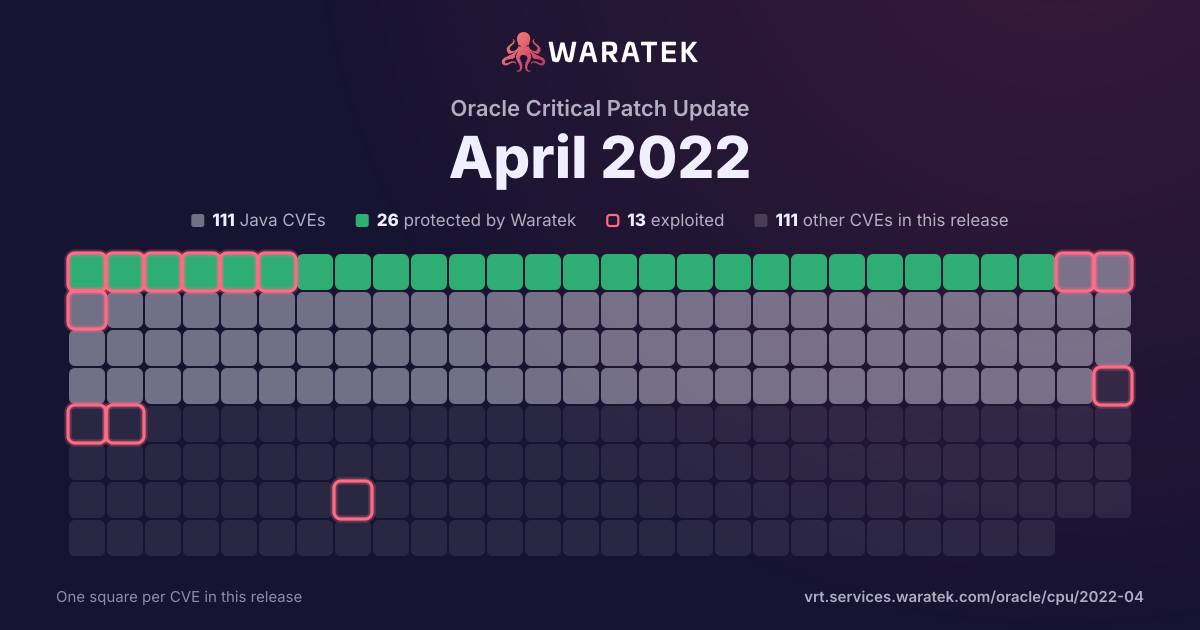
By status
26Protected by Waratek5Mitigation candidate80No exploit published64Outside Waratek scope47Not applicable
13Exploited, marked by the ring
No exploit published. For 40 of them, Oracle's security advisory is the source of public detail.
Protected by Waratek. Waratek RASP can block exploitation of these on systems that have not applied the patch yet.
Overview 113 matches · 57 in Waratek scope · 8 protected · 5 exploited · 0 CISA KEV · 8 public PoC · 9 EPSS ≥ 0.5
113matches
57in Waratek scope50.4%
8protected7.1%
5exploited4.4%
0CISA KEV0.0%
8public PoC7.1%
9EPSS ≥ 0.58.0%
Protected by Waratek
8
7.1%
Rule in development
0
0.0%
Mitigation candidate
3
2.7%
No exploit published
46
40.7%
Outside Waratek scope
35
31.0%
Not applicable
21
18.6%
Withdrawn CVE
0
0.0%
blocked by ARMR today
8
7.1%
partly blocked
0
0.0%
not blocked
105
92.9%
not established
0
0.0%
unrecorded
0
0.0%
split by
peak 60 / quarter
Q2 181
Not applicable1
Medium1
not blocked1
No public exploit1
Q3 180
Q4 180
Q1 190
Q2 191
Protected by Waratek1
Medium1
blocked by ARMR today1
Working exploit published1
Q3 191
Outside Waratek scope1
Medium1
not blocked1
No public exploit1
Q4 190
Q1 201
Outside Waratek scope1
Medium1
not blocked1
No public exploit1
Q2 203
Outside Waratek scope1
Not applicable2
Medium3
not blocked3
Exploited1
No public exploit2
Q3 203
No exploit published1
Outside Waratek scope1
Not applicable1
Medium3
not blocked3
No public exploit3
Q4 205
Protected by Waratek2
No exploit published1
Outside Waratek scope2
Medium5
blocked by ARMR today2
not blocked3
Proof of concept only1
No public exploit4
Q1 217
No exploit published6
Outside Waratek scope1
Medium7
not blocked7
No public exploit7
Q2 218
Protected by Waratek2
Mitigation candidate1
No exploit published3
Outside Waratek scope1
Not applicable1
Medium8
blocked by ARMR today2
not blocked6
Exploited1
Working exploit published1
No public exploit6
Q3 217
Protected by Waratek1
Mitigation candidate1
No exploit published5
Medium7
blocked by ARMR today1
not blocked6
Exploited2
Forecast only1
No public exploit4
Q4 217
Protected by Waratek1
Mitigation candidate1
No exploit published2
Outside Waratek scope2
Not applicable1
Medium7
blocked by ARMR today1
not blocked6
Exploited1
Proof of concept only2
No public exploit4
Q1 228
No exploit published5
Outside Waratek scope2
Not applicable1
Medium8
not blocked8
Forecast only1
No public exploit7
Q2 2260
Protected by Waratek1
No exploit published23
Outside Waratek scope23
Not applicable13
Medium60
blocked by ARMR today1
not blocked59
Forecast only2
No public exploit58
Q3 221
Not applicable1
Medium1
not blocked1
No public exploit1
Q3 18Q1 19Q3 19Q1 20Q3 20Q1 21Q3 21Q1 22Q3 22
| CVE | Severity | Published▾ | Status | Exploitation | Description |
|---|---|---|---|---|---|
| CVE-2020-13956 | Medium | 2020-12-02 | Outside Waratek scope | No public exploit | Apache HttpClient versions prior to version 4.5.13 and 5.0.3 can misinterpret malformed authority component in request URIs passed to the library as java.net.URI object and pick the wrong target host for request execution. |
| CVE-2020-27218 | Medium | 2020-11-28 | No exploit published | No public exploit | In Eclipse Jetty version 9.4.0.RC0 to 9.4.34.v20201102, 10.0.0.alpha0 to 10.0.0.beta2, and 11.0.0.alpha0 to 11.0.0.beta2, if GZIP request body inflation is enabled and requests from different clients are multiplexed onto a single connection, and if an attacker can send a request with a body that is received entirely but not consumed by the application, then a subsequent request on the same connection will see that body prepended to its body. The attacker will not see any data but may inject data into the body of the subsequent request. |
| CVE-2020-15250 | Medium | 2020-10-12 | Protected by Waratek | No public exploit | In JUnit4 from version 4.7 and before 4.13.1, the test rule TemporaryFolder contains a local information disclosure vulnerability. On Unix like systems, the system's temporary directory is shared between all users on that system. Because of this, when files and directories are written into this directory they are, by default, readable by other users on that same system. This vulnerability does not allow other users to overwrite the contents of these directories or files. This is purely an information disclosure vulnerability. This vulnerability impacts you if the JUnit tests write sensitive information, like API keys or passwords, into the temporary folder, and the JUnit tests execute in an environment where the OS has other untrusted users. Because certain JDK file system APIs were only added in JDK 1.7, this this fix is dependent upon the version of the JDK you are using. For Java 1.7 and higher users: this vulnerability is fixed in 4.13.1. For Java 1.6 and lower users: no patch is available, you must use the workaround below. If you are unable to patch, or are stuck running on Java 1.6, specifying the `java.io.tmpdir` system environment variable to a directory that is exclusively owned by the executing user will fix this vulnerability. For more information, including an example of vulnerable code, see the referenced GitHub Security Advisory. |
| CVE-2020-5421 | Medium | 2020-09-19 | No exploit published | No public exploit | In Spring Framework versions 5.2.0 - 5.2.8, 5.1.0 - 5.1.17, 5.0.0 - 5.0.18, 4.3.0 - 4.3.28, and older unsupported versions, the protections against RFD attacks from CVE-2015-5211 may be bypassed depending on the browser used through the use of a jsessionid path parameter. |
| CVE-2020-24977 | Medium | 2020-09-04 | Outside Waratek scope | No public exploit | GNOME project libxml2 v2.9.10 has a global buffer over-read vulnerability in xmlEncodeEntitiesInternal at libxml2/entities.c. The issue has been fixed in commit 50f06b3e. |
| CVE-2020-16135 | Medium | 2020-07-29 | Not applicable | No public exploit | libssh 0.9.4 has a NULL pointer dereference in tftpserver.c if ssh_buffer_new returns NULL. |
| CVE-2020-14155 | Medium | 2020-06-15 | Not applicable | No public exploit | libpcre in PCRE before 8.44 allows an integer overflow via a large number after a (?C substring. |
| CVE-2020-13434 | Medium | 2020-05-24 | Not applicable | No public exploit | SQLite through 3.32.0 has an integer overflow in sqlite3_str_vappendf in printf.c. |
| CVE-2020-11022 | Medium | 2020-04-29 | Outside Waratek scope | Exploited | In jQuery starting with 1.12.0 and before 3.5.0, passing HTML from untrusted sources - even after sanitizing it - to one of jQuery's DOM manipulation methods (i.e. .html(), .append(), and others) may execute untrusted code. This problem is patched in jQuery 3.5.0. |
| CVE-2019-14862 | Medium | 2020-01-02 | Outside Waratek scope | No public exploit | There is a vulnerability in knockout before version 3.5.0-beta, where after escaping the context of the web application, the web application delivers data to its users along with other trusted dynamic content, without validating it. |
| CVE-2019-3740 | Medium | 2019-09-18 | Outside Waratek scope | No public exploit | RSA BSAFE Crypto-J versions prior to 6.2.5 are vulnerable to an Information Exposure Through Timing Discrepancy vulnerabilities during DSA key generation. A malicious remote attacker could potentially exploit those vulnerabilities to recover DSA keys. |
| CVE-2019-3799 | Medium | 2019-05-06 | Protected by Waratek | Working exploit published | Spring Cloud Config, versions 2.1.x prior to 2.1.2, versions 2.0.x prior to 2.0.4, and versions 1.4.x prior to 1.4.6, and older unsupported versions allow applications to serve arbitrary configuration files through the spring-cloud-config-server module. A malicious user, or attacker, can send a request using a specially crafted URL that can lead a directory traversal attack. |
| CVE-2018-11212 | Medium | 2018-05-16 | Not applicable | No public exploit | An issue was discovered in libjpeg 9a and 9d. The alloc_sarray function in jmemmgr.c allows remote attackers to cause a denial of service (divide-by-zero error) via a crafted file. |