
Oracle Critical Patch Update April 2022
Released April 2022 · Oracle's advisory ↗ · ← Critical Patch Update, January 2022 · Critical Patch Update, July 2022 →
222 CVEs in this release, one square each
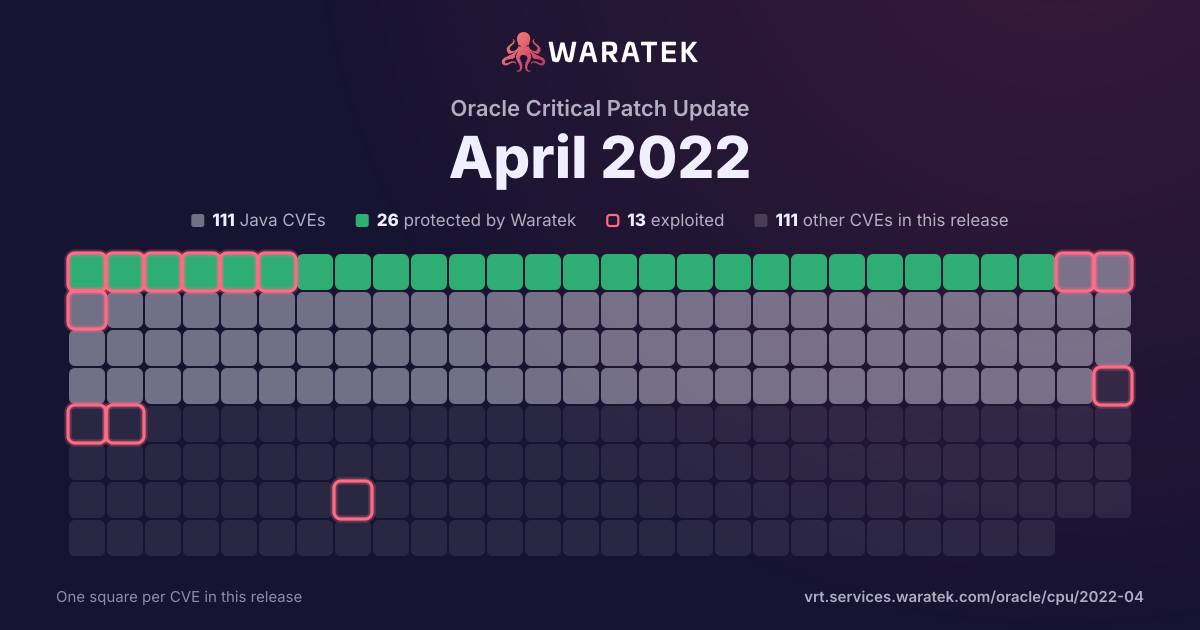
By status
26Protected by Waratek5Mitigation candidate80No exploit published64Outside Waratek scope47Not applicable
13Exploited, marked by the ring
No exploit published. For 40 of them, Oracle's security advisory is the source of public detail.
Protected by Waratek. Waratek RASP can block exploitation of these on systems that have not applied the patch yet.
Overview 2 matches · 0 in Waratek scope · 0 protected · 0 exploited · 0 CISA KEV · 0 public PoC
2matches
0in Waratek scope0.0%
0protected0.0%
0exploited0.0%
0CISA KEV0.0%
0public PoC0.0%
Protected by Waratek
0
0.0%
Rule in development
0
0.0%
Mitigation candidate
0
0.0%
No exploit published
0
0.0%
Outside Waratek scope
2
100.0%
Not applicable
0
0.0%
Withdrawn CVE
0
0.0%
blocked by ARMR today
0
0.0%
partly blocked
0
0.0%
not blocked
2
100.0%
not established
0
0.0%
unrecorded
0
0.0%
Exploited
0
0.0%
Working exploit published
0
0.0%
Proof of concept only
0
0.0%
Forecast only
2
100.0%
No public exploit
0
0.0%
split by
peak 1 / month
Jun 21Jul 21Aug 21Sep 21Oct 21Nov 21Dec 21
| CVE | Severity | Published▾ | Status | Exploitation | Description |
|---|---|---|---|---|---|
| CVE-2021-44224 | High | 2021-12-20 | Outside Waratek scope | Forecast only | A crafted URI sent to httpd configured as a forward proxy (ProxyRequests on) can cause a crash (NULL pointer dereference) or, for configurations mixing forward and reverse proxy declarations, can allow for requests to be directed to a declared Unix Domain Socket endpoint (Server Side Request Forgery). This issue affects Apache HTTP Server 2.4.7 up to 2.4.51 (included). |
| CVE-2021-22901 | High | 2021-06-11 | Outside Waratek scope | Forecast only | curl 7.75.0 through 7.76.1 suffers from a use-after-free vulnerability resulting in already freed memory being used when a TLS 1.3 session ticket arrives over a connection. A malicious server can use this in rare unfortunate circumstances to potentially reach remote code execution in the client. When libcurl at run-time sets up support for TLS 1.3 session tickets on a connection using OpenSSL, it stores pointers to the transfer in-memory object for later retrieval when a session ticket arrives. If the connection is used by multiple transfers (like with a reused HTTP/1.1 connection or multiplexed HTTP/2 connection) that first transfer object might be freed before the new session is established on that connection and then the function will access a memory buffer that might be freed. When using that memory, libcurl might even call a function pointer in the object, making it possible for a remote code execution if the server could somehow manage to get crafted memory content into the correct place in memory. |