
Oracle Critical Patch Update April 2022
Released April 2022 · Oracle's advisory ↗ · ← Critical Patch Update, January 2022 · Critical Patch Update, July 2022 →
222 CVEs in this release, one square each
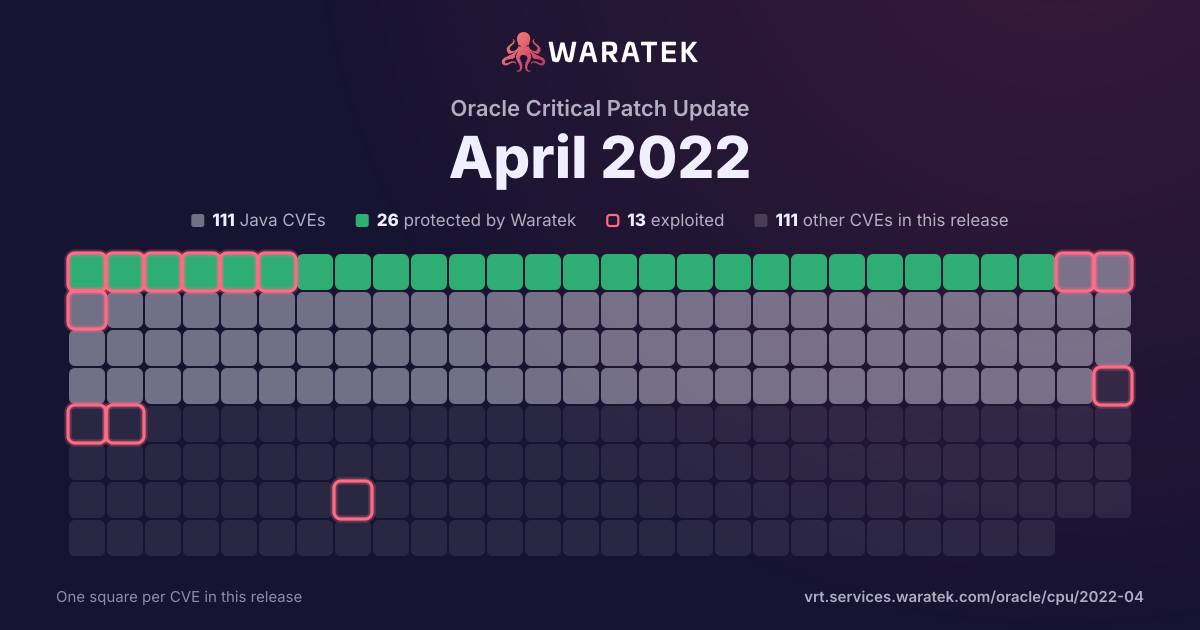
By status
25Protected by Waratek1Rule in development7Mitigation candidate98No exploit published91Not applicable
13Exploited, marked by the ring
No exploit published. For 40 of them, Oracle's security advisory is the source of public detail.
Protected by Waratek. Waratek RASP can block exploitation of these on systems that have not applied the patch yet.
Overview 7 matches · 0 protected · 0 exploited · 0 CISA KEV · 0 public PoC · 0 EPSS ≥ 0.5
7matches
0protected0.0%
0exploited0.0%
0CISA KEV0.0%
0public PoC0.0%
0EPSS ≥ 0.50.0%
Protected by Waratek
0
0.0%
Rule in development
0
0.0%
Mitigation candidate
0
0.0%
No exploit published
7
100.0%
blocked by ARMR today
0
0.0%
partly blocked
0
0.0%
not blocked
7
100.0%
not established
0
0.0%
unrecorded
0
0.0%
Exploited
0
0.0%
Working exploit published
0
0.0%
Proof of concept only
0
0.0%
Forecast only
0
0.0%
No public exploit
7
100.0%
split by
peak 2 / month
Sep 191
No exploit published1
Medium1
not blocked1
No public exploit1
Oct 190
Nov 190
Dec 190
Jan 200
Feb 200
Mar 200
Apr 202
No exploit published2
High1
Low1
not blocked2
No public exploit2
May 200
Jun 200
Jul 200
Aug 200
Sep 202
No exploit published2
High1
Medium1
not blocked2
No public exploit2
Oct 201
No exploit published1
High1
not blocked1
No public exploit1
Nov 201
No exploit published1
High1
not blocked1
No public exploit1
Sep 19Nov 19Jan 20Mar 20May 20Jul 20Sep 20Nov 20
| CVE | Severity | Published▾ | Status | Exploitation | Description |
|---|---|---|---|---|---|
| CVE-2020-28196 | High | 2020-11-06 | No exploit published | No public exploit | MIT Kerberos 5 (aka krb5) before 1.17.2 and 1.18.x before 1.18.3 allows unbounded recursion via an ASN.1-encoded Kerberos message because the lib/krb5/asn.1/asn1_encode.c support for BER indefinite lengths lacks a recursion limit. |
| CVE-2020-11979 | High | 2020-10-01 | No exploit published | No public exploit | As mitigation for CVE-2020-1945 Apache Ant 1.10.8 changed the permissions of temporary files it created so that only the current user was allowed to access them. Unfortunately the fixcrlf task deleted the temporary file and created a new one without said protection, effectively nullifying the effort. This would still allow an attacker to inject modified source files into the build process. |
| CVE-2020-5421 | Medium | 2020-09-19 | No exploit published | No public exploit | In Spring Framework versions 5.2.0 - 5.2.8, 5.1.0 - 5.1.17, 5.0.0 - 5.0.18, 4.3.0 - 4.3.28, and older unsupported versions, the protections against RFD attacks from CVE-2015-5211 may be bypassed depending on the browser used through the use of a jsessionid path parameter. |
| CVE-2020-24750 | High | 2020-09-17 | No exploit published | No public exploit | FasterXML jackson-databind 2.x before 2.9.10.6 mishandles the interaction between serialization gadgets and typing, related to com.pastdev.httpcomponents.configuration.JndiConfiguration. |
| CVE-2020-9488 | Low | 2020-04-27 | No exploit published | No public exploit | Improper validation of certificate with host mismatch in Apache Log4j SMTP appender. This could allow an SMTPS connection to be intercepted by a man-in-the-middle attack which could leak any log messages sent through that appender. Fixed in Apache Log4j 2.12.3 and 2.13.1 |
| CVE-2020-11612 | High | 2020-04-07 | No exploit published | No public exploit | The ZlibDecoders in Netty 4.1.x before 4.1.46 allow for unbounded memory allocation while decoding a ZlibEncoded byte stream. An attacker could send a large ZlibEncoded byte stream to the Netty server, forcing the server to allocate all of its free memory to a single decoder. |
| CVE-2019-3740 | Medium | 2019-09-18 | No exploit published | No public exploit | RSA BSAFE Crypto-J versions prior to 6.2.5 are vulnerable to an Information Exposure Through Timing Discrepancy vulnerabilities during DSA key generation. A malicious remote attacker could potentially exploit those vulnerabilities to recover DSA keys. |