
Oracle Critical Patch Update April 2022
Released April 2022 · Oracle's advisory ↗ · ← Critical Patch Update, January 2022 · Critical Patch Update, July 2022 →
222 CVEs in this release, one square each
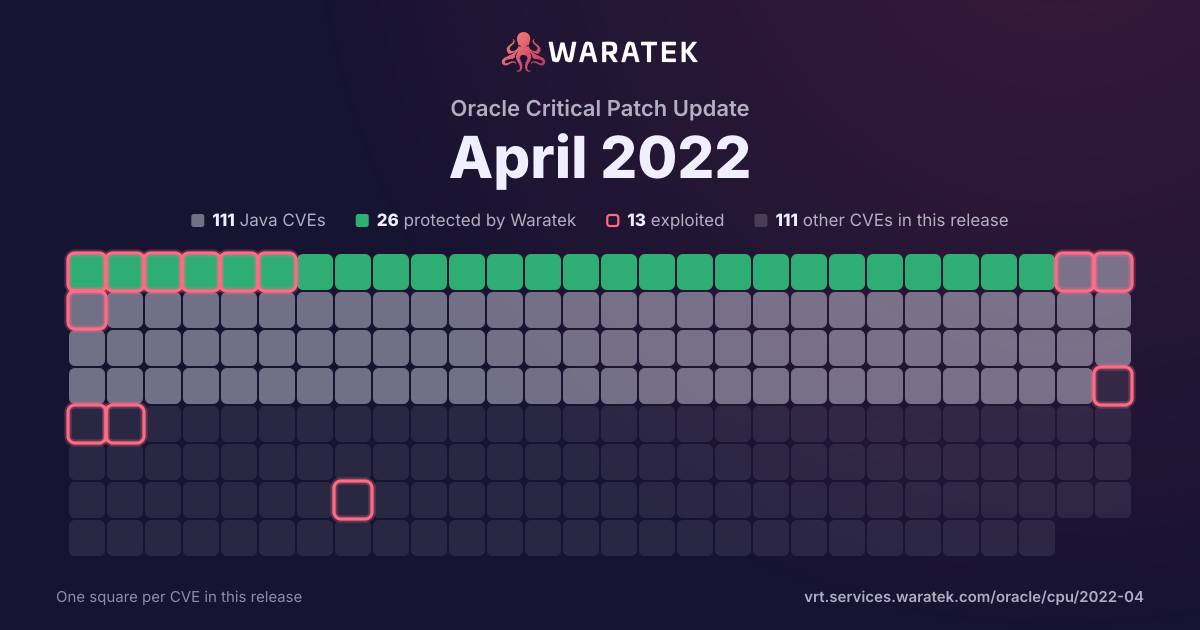
By status
25Protected by Waratek1Rule in development7Mitigation candidate98No exploit published91Not applicable
13Exploited, marked by the ring
No exploit published. For 40 of them, Oracle's security advisory is the source of public detail.
Protected by Waratek. Waratek RASP can block exploitation of these on systems that have not applied the patch yet.
Overview 8 matches · 1 protected · 0 exploited · 0 CISA KEV · 0 public PoC · 0 EPSS ≥ 0.5
Protected by Waratek
1
12.5%
Rule in development
0
0.0%
Mitigation candidate
0
0.0%
No exploit published
7
87.5%
blocked by ARMR today
1
12.5%
partly blocked
0
0.0%
not blocked
7
87.5%
not established
0
0.0%
unrecorded
0
0.0%
Exploited
0
0.0%
Working exploit published
0
0.0%
Proof of concept only
0
0.0%
Forecast only
0
0.0%
No public exploit
8
100.0%
split by
peak 2 / month
Aug 191
Protected by Waratek1
High1
blocked by ARMR today1
No public exploit1
Sep 190
Oct 190
Nov 190
Dec 190
Jan 202
No exploit published2
High2
not blocked2
No public exploit2
Feb 200
Mar 200
Apr 201
No exploit published1
High1
not blocked1
No public exploit1
May 201
No exploit published1
High1
not blocked1
No public exploit1
Jun 200
Jul 200
Aug 200
Sep 201
No exploit published1
High1
not blocked1
No public exploit1
Oct 201
No exploit published1
High1
not blocked1
No public exploit1
Nov 201
No exploit published1
High1
not blocked1
No public exploit1
Sep 19Nov 19Jan 20Mar 20May 20Jul 20Sep 20Nov 20
| CVE | Severity | Published▾ | Status | Exploitation | Description |
|---|---|---|---|---|---|
| CVE-2020-28196 | High | 2020-11-06 | No exploit published | No public exploit | MIT Kerberos 5 (aka krb5) before 1.17.2 and 1.18.x before 1.18.3 allows unbounded recursion via an ASN.1-encoded Kerberos message because the lib/krb5/asn.1/asn1_encode.c support for BER indefinite lengths lacks a recursion limit. |
| CVE-2020-7760 | High | 2020-10-30 | No exploit published | No public exploit | This affects the package codemirror before 5.58.2; the package org.apache.marmotta.webjars:codemirror before 5.58.2. The vulnerable regular expression is located in https://github.com/codemirror/CodeMirror/blob/cdb228ac736369c685865b122b736cd0d397836c/mode/javascript/javascript.jsL129. The ReDOS vulnerability of the regex is mainly due to the sub-pattern (s|/*.*?*/)* |
| CVE-2020-24750 | High | 2020-09-17 | No exploit published | No public exploit | FasterXML jackson-databind 2.x before 2.9.10.6 mishandles the interaction between serialization gadgets and typing, related to com.pastdev.httpcomponents.configuration.JndiConfiguration. |
| CVE-2020-11971 | High | 2020-05-14 | No exploit published | No public exploit | Apache Camel's JMX is vulnerable to Rebind Flaw. Apache Camel 2.22.x, 2.23.x, 2.24.x, 2.25.x, 3.0.0 up to 3.1.0 is affected. Users should upgrade to 3.2.0. |
| CVE-2020-11612 | High | 2020-04-07 | No exploit published | No public exploit | The ZlibDecoders in Netty 4.1.x before 4.1.46 allow for unbounded memory allocation while decoding a ZlibEncoded byte stream. An attacker could send a large ZlibEncoded byte stream to the Netty server, forcing the server to allocate all of its free memory to a single decoder. |
| CVE-2020-7226 | High | 2020-01-24 | No exploit published | No public exploit | CiphertextHeader.java in Cryptacular 1.2.3, as used in Apereo CAS and other products, allows attackers to trigger excessive memory allocation during a decode operation, because the nonce array length associated with "new byte" may depend on untrusted input within the header of encoded data. |
| CVE-2019-12399 | High | 2020-01-14 | No exploit published | No public exploit | When Connect workers in Apache Kafka 2.0.0, 2.0.1, 2.1.0, 2.1.1, 2.2.0, 2.2.1, or 2.3.0 are configured with one or more config providers, and a connector is created/updated on that Connect cluster to use an externalized secret variable in a substring of a connector configuration property value, then any client can issue a request to the same Connect cluster to obtain the connector's task configuration and the response will contain the plaintext secret rather than the externalized secrets variables. |
| CVE-2019-10086 | High | 2019-08-20 | Protected by Waratek | No public exploit | In Apache Commons Beanutils 1.9.2, a special BeanIntrospector class was added which allows suppressing the ability for an attacker to access the classloader via the class property available on all Java objects. We, however were not using this by default characteristic of the PropertyUtilsBean. |