
Oracle Critical Patch Update April 2022
Released April 2022 · Oracle's advisory ↗ · ← Critical Patch Update, January 2022 · Critical Patch Update, July 2022 →
222 CVEs in this release, one square each
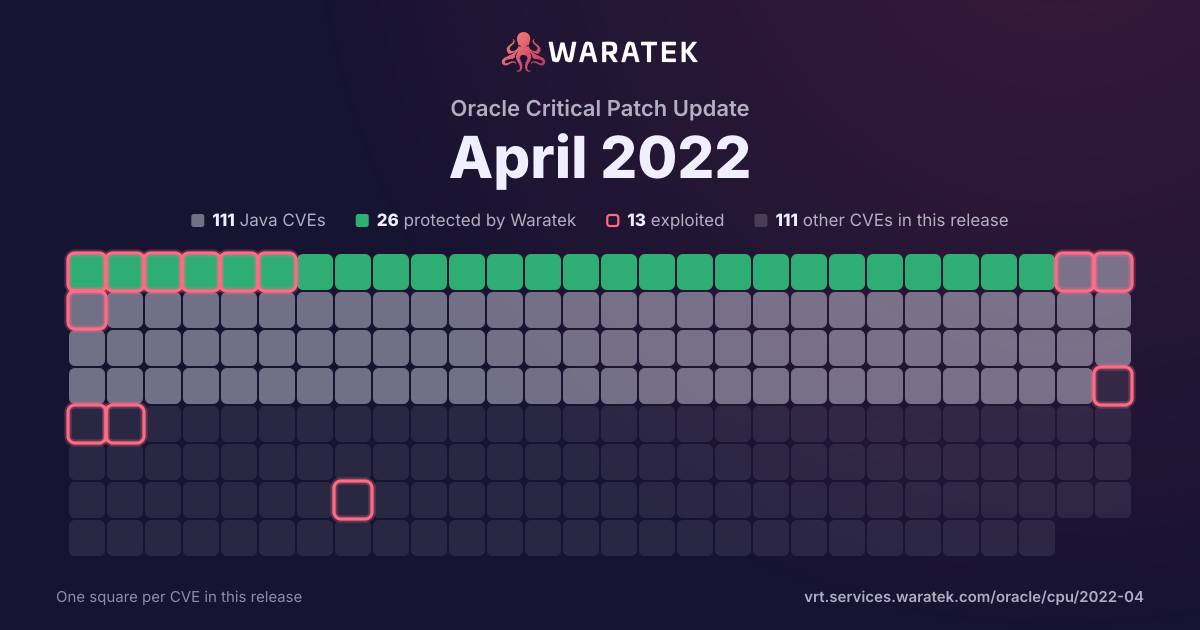
By status
25Protected by Waratek1Rule in development7Mitigation candidate98No exploit published91Not applicable
13Exploited, marked by the ring
No exploit published. For 40 of them, Oracle's security advisory is the source of public detail.
Protected by Waratek. Waratek RASP can block exploitation of these on systems that have not applied the patch yet.
Overview 11 matches · 2 protected · 2 exploited · 0 CISA KEV · 1 public PoC · 1 EPSS ≥ 0.5
Protected by Waratek
2
18.2%
Rule in development
0
0.0%
Mitigation candidate
2
18.2%
No exploit published
7
63.6%
blocked by ARMR today
2
18.2%
partly blocked
0
0.0%
not blocked
9
81.8%
not established
0
0.0%
unrecorded
0
0.0%
Exploited
2
18.2%
Working exploit published
0
0.0%
Proof of concept only
1
9.1%
Forecast only
0
0.0%
No public exploit
8
72.7%
split by
peak 4 / month
Aug 211
No exploit published1
Medium1
not blocked1
No public exploit1
Sep 211
Mitigation candidate1
Medium1
not blocked1
Exploited1
Oct 212
Mitigation candidate1
No exploit published1
Medium2
not blocked2
Proof of concept only1
No public exploit1
Nov 210
Dec 212
Protected by Waratek1
No exploit published1
Medium2
blocked by ARMR today1
not blocked1
Exploited1
No public exploit1
Jan 224
Protected by Waratek1
No exploit published3
Medium4
blocked by ARMR today1
not blocked3
No public exploit4
Feb 221
No exploit published1
Medium1
not blocked1
No public exploit1
Aug 21Sep 21Oct 21Nov 21Dec 21Jan 22Feb 22
| CVE | Severity | Published▾ | Status | Exploitation | Description |
|---|---|---|---|---|---|
| CVE-2022-24329 | Medium | 2022-02-25 | No exploit published | No public exploit | In JetBrains Kotlin before 1.6.0, it was not possible to lock dependencies for Multiplatform Gradle Projects. |
| CVE-2022-23437 | Medium | 2022-01-24 | Protected by Waratek | No public exploit | There's a vulnerability within the Apache Xerces Java (XercesJ) XML parser when handling specially crafted XML document payloads. This causes, the XercesJ XML parser to wait in an infinite loop, which may sometimes consume system resources for prolonged duration. This vulnerability is present within XercesJ version 2.12.1 and the previous versions. |
| CVE-2022-20615 | Medium | 2022-01-12 | No exploit published | No public exploit | Jenkins Matrix Project Plugin 1.19 and earlier does not escape HTML metacharacters in node and label names, and label descriptions, resulting in a stored cross-site scripting (XSS) vulnerability exploitable by attackers with Agent/Configure permission. |
| CVE-2022-20613 | Medium | 2022-01-12 | No exploit published | No public exploit | A cross-site request forgery (CSRF) vulnerability in Jenkins Mailer Plugin 391.ve4a_38c1b_cf4b_ and earlier allows attackers to use the DNS used by the Jenkins instance to resolve an attacker-specified hostname. |
| CVE-2022-20612 | Medium | 2022-01-12 | No exploit published | No public exploit | A cross-site request forgery (CSRF) vulnerability in Jenkins 2.329 and earlier, LTS 2.319.1 and earlier allows attackers to trigger build of job without parameters when no security realm is set. |
| CVE-2021-44832 | Medium | 2021-12-28 | Protected by Waratek | Exploited | Apache Log4j2 versions 2.0-beta7 through 2.17.0 (excluding security fix releases 2.3.2 and 2.12.4) are vulnerable to a remote code execution (RCE) attack when a configuration uses a JDBC Appender with a JNDI LDAP data source URI when an attacker has control of the target LDAP server. This issue is fixed by limiting JNDI data source names to the java protocol in Log4j2 versions 2.17.1, 2.12.4, and 2.3.2. |
| CVE-2021-43797 | Medium | 2021-12-09 | No exploit published | No public exploit | Netty is an asynchronous event-driven network application framework for rapid development of maintainable high performance protocol servers & clients. Netty prior to version 4.1.71.Final skips control chars when they are present at the beginning / end of the header name. It should instead fail fast as these are not allowed by the spec and could lead to HTTP request smuggling. Failing to do the validation might cause netty to "sanitize" header names before it forward these to another remote system when used as proxy. This remote system can't see the invalid usage anymore, and therefore does not do the validation itself. Users should upgrade to version 4.1.71.Final. |
| CVE-2021-22096 | Medium | 2021-10-28 | No exploit published | No public exploit | In Spring Framework versions 5.3.0 - 5.3.10, 5.2.0 - 5.2.17, and older unsupported versions, it is possible for a user to provide malicious input to cause the insertion of additional log entries. |
| CVE-2021-2471 | Medium | 2021-10-20 | Mitigation candidate | Proof of concept only | Vulnerability in the MySQL Connectors product of Oracle MySQL (component: Connector/J). Supported versions that are affected are 8.0.26 and prior. Difficult to exploit vulnerability allows high privileged attacker with network access via multiple protocols to compromise MySQL Connectors. Successful attacks of this vulnerability can result in unauthorized access to critical data or complete access to all MySQL Connectors accessible data and unauthorized ability to cause a hang or frequently repeatable crash (complete DOS) of MySQL Connectors. CVSS 3.1 Base Score 5.9 (Confidentiality and Availability impacts). CVSS Vector: (CVSS:3.1/AV:N/AC:H/PR:H/UI:N/S:U/C:H/I:N/A:H). |
| CVE-2021-38153 | Medium | 2021-09-22 | Mitigation candidate | Exploited | Some components in Apache Kafka use `Arrays.equals` to validate a password or key, which is vulnerable to timing attacks that make brute force attacks for such credentials more likely to be successful. Users should upgrade to 2.8.1 or higher, or 3.0.0 or higher where this vulnerability has been fixed. The affected versions include Apache Kafka 2.0.0, 2.0.1, 2.1.0, 2.1.1, 2.2.0, 2.2.1, 2.2.2, 2.3.0, 2.3.1, 2.4.0, 2.4.1, 2.5.0, 2.5.1, 2.6.0, 2.6.1, 2.6.2, 2.7.0, 2.7.1, and 2.8.0. |
| CVE-2021-39140 | Medium | 2021-08-23 | No exploit published | No public exploit | XStream is a simple library to serialize objects to XML and back again. In affected versions this vulnerability may allow a remote attacker to allocate 100% CPU time on the target system depending on CPU type or parallel execution of such a payload resulting in a denial of service only by manipulating the processed input stream. No user is affected, who followed the recommendation to setup XStream's security framework with a whitelist limited to the minimal required types. XStream 1.4.18 uses no longer a blacklist by default, since it cannot be secured for general purpose. |