
Oracle Critical Patch Update April 2022
Released April 2022 · Oracle's advisory ↗ · ← Critical Patch Update, January 2022 · Critical Patch Update, July 2022 →
222 CVEs in this release, one square each
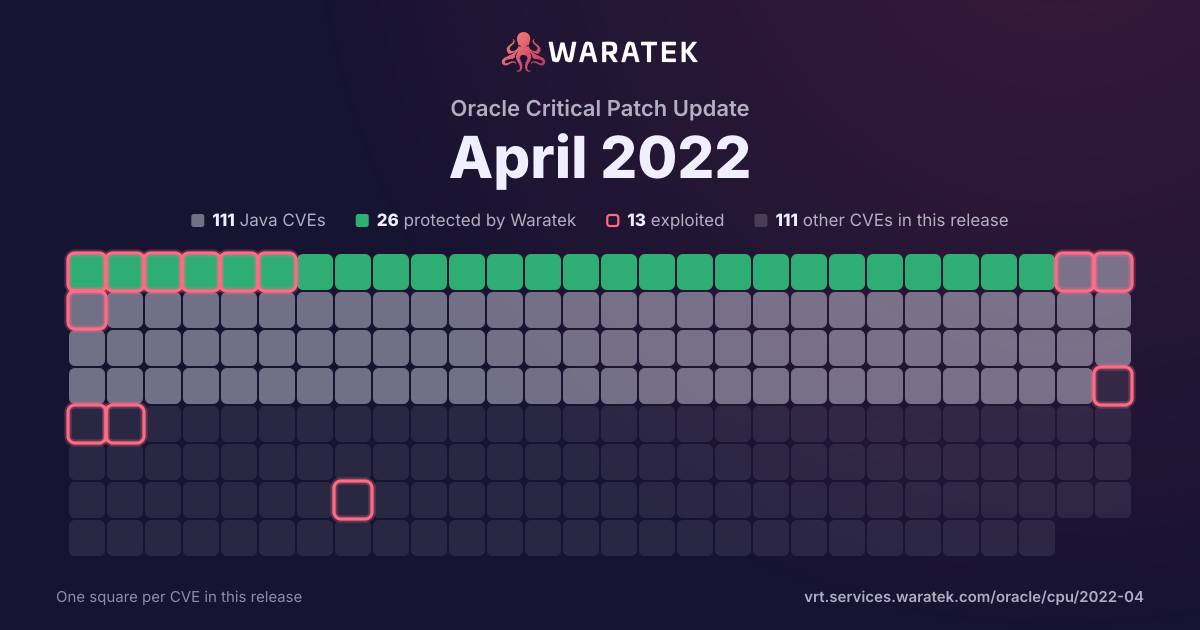
By status
25Protected by Waratek1Rule in development7Mitigation candidate98No exploit published91Not applicable
13Exploited, marked by the ring
No exploit published. For 40 of them, Oracle's security advisory is the source of public detail.
Protected by Waratek. Waratek RASP can block exploitation of these on systems that have not applied the patch yet.
Overview 8 matches · 2 protected · 1 exploited · 0 CISA KEV · 2 public PoC · 1 EPSS ≥ 0.5
Protected by Waratek
2
25.0%
Rule in development
0
0.0%
Mitigation candidate
1
12.5%
No exploit published
5
62.5%
blocked by ARMR today
2
25.0%
partly blocked
0
0.0%
not blocked
6
75.0%
not established
0
0.0%
unrecorded
0
0.0%
Exploited
1
12.5%
Working exploit published
1
12.5%
Proof of concept only
0
0.0%
Forecast only
0
0.0%
No public exploit
6
75.0%
split by
peak 4 / month
Apr 212
Protected by Waratek1
No exploit published1
Medium2
blocked by ARMR today1
not blocked1
No public exploit2
May 212
No exploit published2
High1
Medium1
not blocked2
No public exploit2
Jun 214
Protected by Waratek1
Mitigation candidate1
No exploit published2
High1
Medium3
blocked by ARMR today1
not blocked3
Exploited1
Working exploit published1
No public exploit2
Apr 21May 21Jun 21
| CVE | Severity | Published▾ | Status | Exploitation | Description |
|---|---|---|---|---|---|
| CVE-2021-30468 | High | 2021-06-16 | No exploit published | No public exploit | A vulnerability in the JsonMapObjectReaderWriter of Apache CXF allows an attacker to submit malformed JSON to a web service, which results in the thread getting stuck in an infinite loop, consuming CPU indefinitely. This issue affects Apache CXF versions prior to 3.4.4; Apache CXF versions prior to 3.3.11. |
| CVE-2021-28169 | Medium | 2021-06-09 | Mitigation candidate | Exploited | For Eclipse Jetty versions <= 9.4.40, <= 10.0.2, <= 11.0.2, it is possible for requests to the ConcatServlet with a doubly encoded path to access protected resources within the WEB-INF directory. For example a request to `/concat?/%2557EB-INF/web.xml` can retrieve the web.xml file. This can reveal sensitive information regarding the implementation of a web application. |
| CVE-2020-6950 | Medium | 2021-06-02 | Protected by Waratek | Working exploit published | Directory traversal in Eclipse Mojarra before 2.3.14 allows attackers to read arbitrary files via the loc parameter or con parameter. |
| CVE-2020-14340 | Medium | 2021-06-02 | No exploit published | No public exploit | A vulnerability was discovered in XNIO where file descriptor leak caused by growing amounts of NIO Selector file handles between garbage collection cycles. It may allow the attacker to cause a denial of service. It affects XNIO versions 3.6.0.Beta1 through 3.8.1.Final. |
| CVE-2021-22118 | High | 2021-05-27 | No exploit published | No public exploit | In Spring Framework, versions 5.2.x prior to 5.2.15 and versions 5.3.x prior to 5.3.7, a WebFlux application is vulnerable to a privilege escalation: by (re)creating the temporary storage directory, a locally authenticated malicious user can read or modify files that have been uploaded to the WebFlux application, or overwrite arbitrary files with multipart request data. |
| CVE-2021-28170 | Medium | 2021-05-26 | No exploit published | No public exploit | In the Jakarta Expression Language implementation 3.0.3 and earlier, a bug in the ELParserTokenManager enables invalid EL expressions to be evaluated as if they were valid. |
| CVE-2021-28168 | Medium | 2021-04-22 | No exploit published | No public exploit | Eclipse Jersey 2.28 to 2.33 and Eclipse Jersey 3.0.0 to 3.0.1 contains a local information disclosure vulnerability. This is due to the use of the File.createTempFile which creates a file inside of the system temporary directory with the permissions: -rw-r--r--. Thus the contents of this file are viewable by all other users locally on the system. As such, if the contents written is security sensitive, it can be disclosed to other local users. |
| CVE-2021-29425 | Medium | 2021-04-13 | Protected by Waratek | No public exploit | In Apache Commons IO before 2.7, When invoking the method FileNameUtils.normalize with an improper input string, like "//../foo", or "\\..\foo", the result would be the same value, thus possibly providing access to files in the parent directory, but not further above (thus "limited" path traversal), if the calling code would use the result to construct a path value. |