
Oracle Critical Patch Update April 2022
Released April 2022 · Oracle's advisory ↗ · ← Critical Patch Update, January 2022 · Critical Patch Update, July 2022 →
222 CVEs in this release, one square each
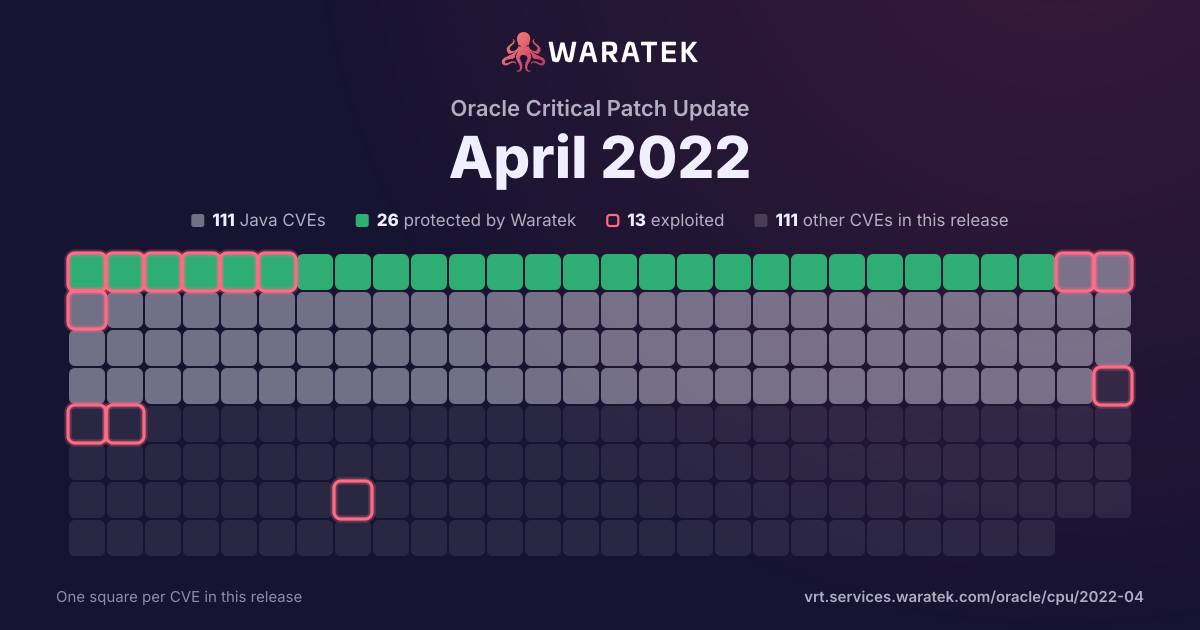
By status
26Protected by Waratek5Mitigation candidate80No exploit published64Outside Waratek scope47Not applicable
13Exploited, marked by the ring
No exploit published. For 40 of them, Oracle's security advisory is the source of public detail.
Protected by Waratek. Waratek RASP can block exploitation of these on systems that have not applied the patch yet.
Overview 9 matches · 6 in Waratek scope · 3 protected · 4 exploited · 0 CISA KEV · 4 public PoC
Protected by Waratek
3
33.3%
Rule in development
0
0.0%
Mitigation candidate
1
11.1%
No exploit published
2
22.2%
Outside Waratek scope
1
11.1%
Not applicable
2
22.2%
Withdrawn CVE
0
0.0%
blocked by ARMR today
3
33.3%
partly blocked
0
0.0%
not blocked
6
66.7%
not established
0
0.0%
unrecorded
0
0.0%
Exploited
4
44.4%
Working exploit published
1
11.1%
Proof of concept only
0
0.0%
Forecast only
4
44.4%
No public exploit
0
0.0%
split by
peak 2 / quarter
Q2 191
Protected by Waratek1
Medium1
blocked by ARMR today1
Working exploit published1
Q3 190
Q4 190
Q1 200
Q2 201
Outside Waratek scope1
Medium1
not blocked1
Exploited1
Q3 200
Q4 200
Q1 210
Q2 211
Mitigation candidate1
Medium1
not blocked1
Exploited1
Q3 212
Protected by Waratek1
No exploit published1
Medium2
blocked by ARMR today1
not blocked1
Exploited1
Forecast only1
Q4 211
Protected by Waratek1
Medium1
blocked by ARMR today1
Exploited1
Q1 221
No exploit published1
Medium1
not blocked1
Forecast only1
Q2 222
Not applicable2
Medium2
not blocked2
Forecast only2
Q2 19Q4 19Q2 20Q4 20Q2 21Q4 21Q2 22
| CVE | Severity | Published▾ | Status | Exploitation | Description |
|---|---|---|---|---|---|
| CVE-2022-21490 | Medium | 2022-04-19 | Not applicable | Forecast only | Vulnerability in the MySQL Cluster product of Oracle MySQL (component: Cluster: General). Supported versions that are affected are 7.4.35 and prior, 7.5.25 and prior, 7.6.21 and prior and 8.0.28 and prior. Difficult to exploit vulnerability allows high privileged attacker with access to the physical communication segment attached to the hardware where the MySQL Cluster executes to compromise MySQL Cluster. Successful attacks require human interaction from a person other than the attacker. Successful attacks of this vulnerability can result in takeover of MySQL Cluster. CVSS 3.1 Base Score 6.3 (Confidentiality, Integrity and Availability impacts). CVSS Vector: (CVSS:3.1/AV:A/AC:H/PR:H/UI:R/S:U/C:H/I:H/A:H). |
| CVE-2022-21489 | Medium | 2022-04-19 | Not applicable | Forecast only | Vulnerability in the MySQL Cluster product of Oracle MySQL (component: Cluster: General). Supported versions that are affected are 7.4.35 and prior, 7.5.25 and prior, 7.6.21 and prior and 8.0.28 and prior. Difficult to exploit vulnerability allows high privileged attacker with access to the physical communication segment attached to the hardware where the MySQL Cluster executes to compromise MySQL Cluster. Successful attacks require human interaction from a person other than the attacker. Successful attacks of this vulnerability can result in takeover of MySQL Cluster. CVSS 3.1 Base Score 6.3 (Confidentiality, Integrity and Availability impacts). CVSS Vector: (CVSS:3.1/AV:A/AC:H/PR:H/UI:R/S:U/C:H/I:H/A:H). |
| CVE-2022-20615 | Medium | 2022-01-12 | No exploit published | Forecast only | Jenkins Matrix Project Plugin 1.19 and earlier does not escape HTML metacharacters in node and label names, and label descriptions, resulting in a stored cross-site scripting (XSS) vulnerability exploitable by attackers with Agent/Configure permission. |
| CVE-2021-44832 | Medium | 2021-12-28 | Protected by Waratek | Exploited | Apache Log4j2 versions 2.0-beta7 through 2.17.0 (excluding security fix releases 2.3.2 and 2.12.4) are vulnerable to a remote code execution (RCE) attack when a configuration uses a JDBC Appender with a JNDI LDAP data source URI when an attacker has control of the target LDAP server. This issue is fixed by limiting JNDI data source names to the java protocol in Log4j2 versions 2.17.1, 2.12.4, and 2.3.2. |
| CVE-2021-34429 | Medium | 2021-07-15 | Protected by Waratek | Exploited | For Eclipse Jetty versions 9.4.37-9.4.42, 10.0.1-10.0.5 & 11.0.1-11.0.5, URIs can be crafted using some encoded characters to access the content of the WEB-INF directory and/or bypass some security constraints. This is a variation of the vulnerability reported in CVE-2021-28164/GHSA-v7ff-8wcx-gmc5. |
| CVE-2021-33037 | Medium | 2021-07-12 | No exploit published | Forecast only | Apache Tomcat 10.0.0-M1 to 10.0.6, 9.0.0.M1 to 9.0.46 and 8.5.0 to 8.5.66 did not correctly parse the HTTP transfer-encoding request header in some circumstances leading to the possibility to request smuggling when used with a reverse proxy. Specifically: - Tomcat incorrectly ignored the transfer encoding header if the client declared it would only accept an HTTP/1.0 response; - Tomcat honoured the identify encoding; and - Tomcat did not ensure that, if present, the chunked encoding was the final encoding. |
| CVE-2021-28169 | Medium | 2021-06-09 | Mitigation candidate | Exploited | For Eclipse Jetty versions <= 9.4.40, <= 10.0.2, <= 11.0.2, it is possible for requests to the ConcatServlet with a doubly encoded path to access protected resources within the WEB-INF directory. For example a request to `/concat?/%2557EB-INF/web.xml` can retrieve the web.xml file. This can reveal sensitive information regarding the implementation of a web application. |
| CVE-2020-11022 | Medium | 2020-04-29 | Outside Waratek scope | Exploited | In jQuery starting with 1.12.0 and before 3.5.0, passing HTML from untrusted sources - even after sanitizing it - to one of jQuery's DOM manipulation methods (i.e. .html(), .append(), and others) may execute untrusted code. This problem is patched in jQuery 3.5.0. |
| CVE-2019-3799 | Medium | 2019-05-06 | Protected by Waratek | Working exploit published | Spring Cloud Config, versions 2.1.x prior to 2.1.2, versions 2.0.x prior to 2.0.4, and versions 1.4.x prior to 1.4.6, and older unsupported versions allow applications to serve arbitrary configuration files through the spring-cloud-config-server module. A malicious user, or attacker, can send a request using a specially crafted URL that can lead a directory traversal attack. |