
Oracle Critical Patch Update April 2022
Released April 2022 · Oracle's advisory ↗ · ← Critical Patch Update, January 2022 · Critical Patch Update, July 2022 →
222 CVEs in this release, one square each
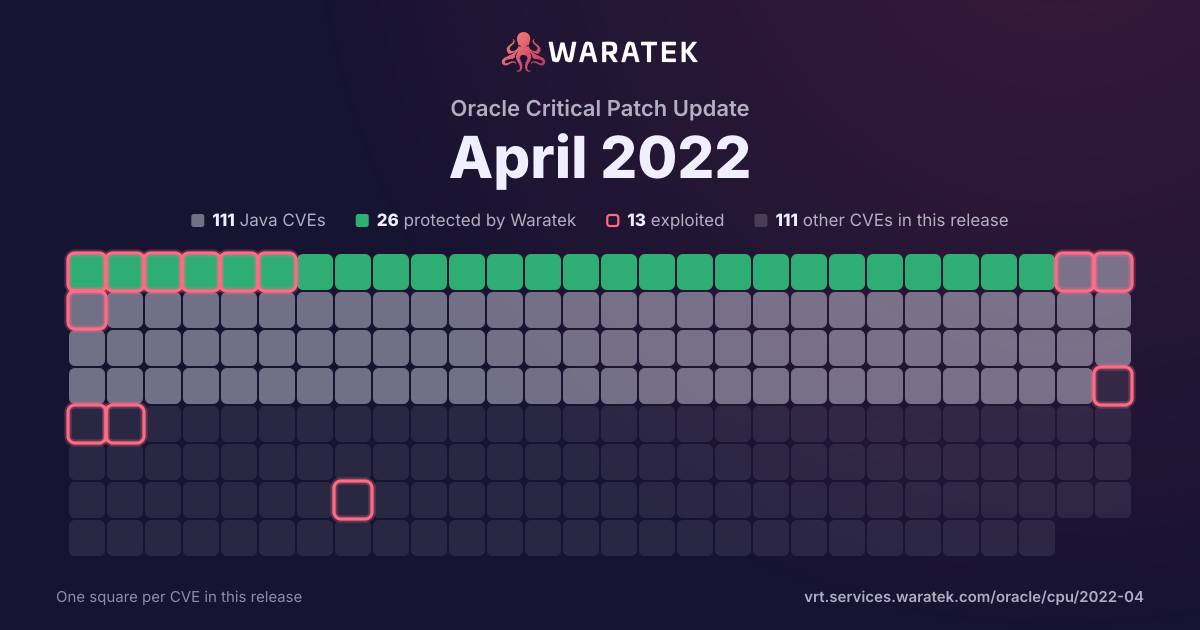
By status
26Protected by Waratek5Mitigation candidate80No exploit published64Outside Waratek scope47Not applicable
13Exploited, marked by the ring
No exploit published. For 40 of them, Oracle's security advisory is the source of public detail.
Protected by Waratek. Waratek RASP can block exploitation of these on systems that have not applied the patch yet.
Overview 5 matches · 0 protected · 2 exploited · 1 CISA KEV · 3 public PoC
Protected by Waratek
0
0.0%
Rule in development
0
0.0%
Mitigation candidate
3
60.0%
No exploit published
2
40.0%
blocked by ARMR today
0
0.0%
partly blocked
0
0.0%
not blocked
5
100.0%
not established
0
0.0%
unrecorded
0
0.0%
Exploited
2
40.0%
Working exploit published
0
0.0%
Proof of concept only
1
20.0%
Forecast only
2
40.0%
No public exploit
0
0.0%
split by
peak 1 / month
Jun 211
Mitigation candidate1
Medium1
not blocked1
Exploited1
Jul 211
No exploit published1
Medium1
not blocked1
Forecast only1
Aug 210
Sep 210
Oct 210
Nov 210
Dec 210
Jan 221
No exploit published1
Medium1
not blocked1
Forecast only1
Feb 220
Mar 221
Mitigation candidate1
Critical1
not blocked1
Exploited1
Apr 221
Mitigation candidate1
High1
not blocked1
Proof of concept only1
Jun 21Jul 21Aug 21Sep 21Oct 21Nov 21Dec 21Jan 22Feb 22Mar 22Apr 22
| CVE | Severity | Published▾ | Status | Exploitation | Description |
|---|---|---|---|---|---|
| CVE-2022-21449 | High | 2022-04-19 | Mitigation candidate | Proof of concept only | Vulnerability in the Oracle Java SE, Oracle GraalVM Enterprise Edition product of Oracle Java SE (component: Libraries). Supported versions that are affected are Oracle Java SE: 17.0.2 and 18; Oracle GraalVM Enterprise Edition: 21.3.1 and 22.0.0.2. Easily exploitable vulnerability allows unauthenticated attacker with network access via multiple protocols to compromise Oracle Java SE, Oracle GraalVM Enterprise Edition. Successful attacks of this vulnerability can result in unauthorized creation, deletion or modification access to critical data or all Oracle Java SE, Oracle GraalVM Enterprise Edition accessible data. Note: This vulnerability applies to Java deployments, typically in clients running sandboxed Java Web Start applications or sandboxed Java applets, that load and run untrusted code (e.g., code that comes from the internet) and rely on the Java sandbox for security. This vulnerability can also be exploited by using APIs in the specified Component, e.g., through a web service which supplies data to the APIs. CVSS 3.1 Base Score 7.5 (Integrity impacts). CVSS Vector: (CVSS:3.1/AV:N/AC:L/PR:N/UI:N/S:U/C:N/I:H/A:N). |
| CVE-2022-22947 | Critical | 2022-03-03 | Mitigation candidate | Exploited | In spring cloud gateway versions prior to 3.1.1+ and 3.0.7+ , applications are vulnerable to a code injection attack when the Gateway Actuator endpoint is enabled, exposed and unsecured. A remote attacker could make a maliciously crafted request that could allow arbitrary remote execution on the remote host. |
| CVE-2022-20615 | Medium | 2022-01-12 | No exploit published | Forecast only | Jenkins Matrix Project Plugin 1.19 and earlier does not escape HTML metacharacters in node and label names, and label descriptions, resulting in a stored cross-site scripting (XSS) vulnerability exploitable by attackers with Agent/Configure permission. |
| CVE-2021-33037 | Medium | 2021-07-12 | No exploit published | Forecast only | Apache Tomcat 10.0.0-M1 to 10.0.6, 9.0.0.M1 to 9.0.46 and 8.5.0 to 8.5.66 did not correctly parse the HTTP transfer-encoding request header in some circumstances leading to the possibility to request smuggling when used with a reverse proxy. Specifically: - Tomcat incorrectly ignored the transfer encoding header if the client declared it would only accept an HTTP/1.0 response; - Tomcat honoured the identify encoding; and - Tomcat did not ensure that, if present, the chunked encoding was the final encoding. |
| CVE-2021-28169 | Medium | 2021-06-09 | Mitigation candidate | Exploited | For Eclipse Jetty versions <= 9.4.40, <= 10.0.2, <= 11.0.2, it is possible for requests to the ConcatServlet with a doubly encoded path to access protected resources within the WEB-INF directory. For example a request to `/concat?/%2557EB-INF/web.xml` can retrieve the web.xml file. This can reveal sensitive information regarding the implementation of a web application. |