
Oracle Critical Patch Update April 2022
Released April 2022 · Oracle's advisory ↗ · ← Critical Patch Update, January 2022 · Critical Patch Update, July 2022 →
222 CVEs in this release, one square each
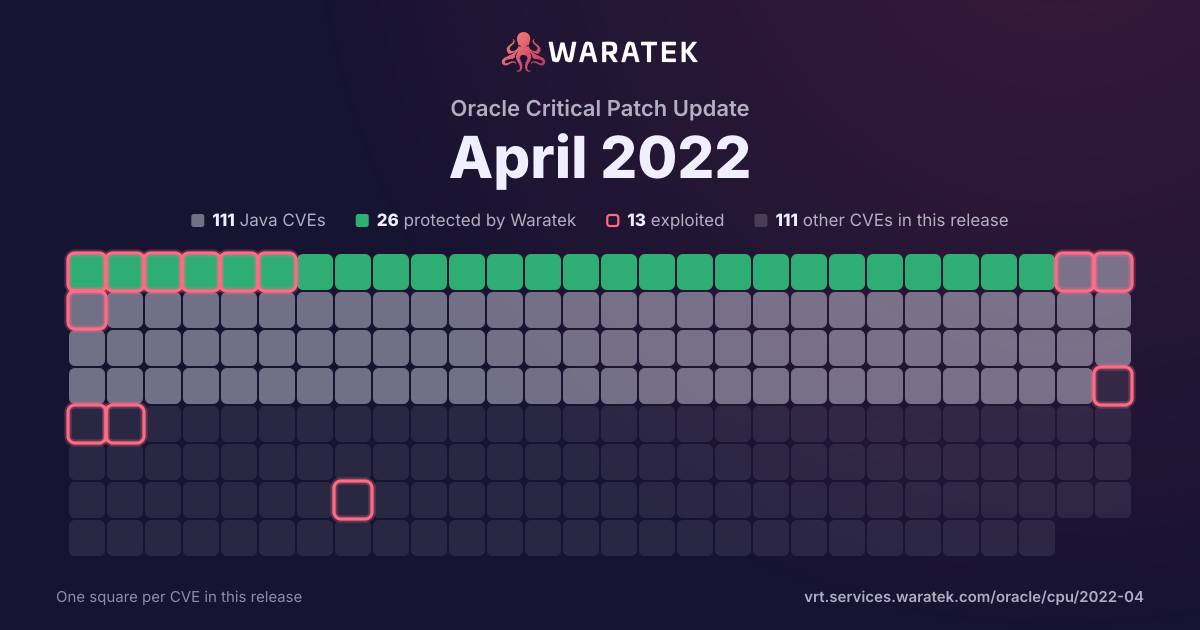
By status
25Protected by Waratek1Rule in development7Mitigation candidate98No exploit published91Not applicable
13Exploited, marked by the ring
No exploit published. For 40 of them, Oracle's security advisory is the source of public detail.
Protected by Waratek. Waratek RASP can block exploitation of these on systems that have not applied the patch yet.
Overview 11 matches · 3 protected · 1 exploited · 1 CISA KEV · 3 public PoC · 2 EPSS ≥ 0.5
Protected by Waratek
3
27.3%
Rule in development
0
0.0%
Mitigation candidate
1
9.1%
No exploit published
7
63.6%
blocked by ARMR today
3
27.3%
partly blocked
0
0.0%
not blocked
8
72.7%
not established
0
0.0%
unrecorded
0
0.0%
split by
peak 3 / quarter
Q1 181
Protected by Waratek1
Critical1
blocked by ARMR today1
Exploited1
Q2 180
Q3 180
Q4 180
Q1 190
Q2 191
Protected by Waratek1
Medium1
blocked by ARMR today1
Working exploit published1
Q3 191
Protected by Waratek1
High1
blocked by ARMR today1
No public exploit1
Q4 191
Mitigation candidate1
Critical1
not blocked1
Proof of concept only1
Q1 202
No exploit published2
High2
not blocked2
No public exploit2
Q2 203
No exploit published3
High2
Low1
not blocked3
No public exploit3
Q3 202
No exploit published2
High1
Medium1
not blocked2
No public exploit2
Q1 18Q2 18Q3 18Q4 18Q1 19Q2 19Q3 19Q4 19Q1 20Q2 20Q3 20
| CVE | Severity | Published▾ | Status | Exploitation | Description |
|---|---|---|---|---|---|
| CVE-2020-5421 | Medium | 2020-09-19 | No exploit published | No public exploit | In Spring Framework versions 5.2.0 - 5.2.8, 5.1.0 - 5.1.17, 5.0.0 - 5.0.18, 4.3.0 - 4.3.28, and older unsupported versions, the protections against RFD attacks from CVE-2015-5211 may be bypassed depending on the browser used through the use of a jsessionid path parameter. |
| CVE-2020-24750 | High | 2020-09-17 | No exploit published | No public exploit | FasterXML jackson-databind 2.x before 2.9.10.6 mishandles the interaction between serialization gadgets and typing, related to com.pastdev.httpcomponents.configuration.JndiConfiguration. |
| CVE-2020-11971 | High | 2020-05-14 | No exploit published | No public exploit | Apache Camel's JMX is vulnerable to Rebind Flaw. Apache Camel 2.22.x, 2.23.x, 2.24.x, 2.25.x, 3.0.0 up to 3.1.0 is affected. Users should upgrade to 3.2.0. |
| CVE-2020-9488 | Low | 2020-04-27 | No exploit published | No public exploit | Improper validation of certificate with host mismatch in Apache Log4j SMTP appender. This could allow an SMTPS connection to be intercepted by a man-in-the-middle attack which could leak any log messages sent through that appender. Fixed in Apache Log4j 2.12.3 and 2.13.1 |
| CVE-2020-11612 | High | 2020-04-07 | No exploit published | No public exploit | The ZlibDecoders in Netty 4.1.x before 4.1.46 allow for unbounded memory allocation while decoding a ZlibEncoded byte stream. An attacker could send a large ZlibEncoded byte stream to the Netty server, forcing the server to allocate all of its free memory to a single decoder. |
| CVE-2020-7226 | High | 2020-01-24 | No exploit published | No public exploit | CiphertextHeader.java in Cryptacular 1.2.3, as used in Apereo CAS and other products, allows attackers to trigger excessive memory allocation during a decode operation, because the nonce array length associated with "new byte" may depend on untrusted input within the header of encoded data. |
| CVE-2019-12399 | High | 2020-01-14 | No exploit published | No public exploit | When Connect workers in Apache Kafka 2.0.0, 2.0.1, 2.1.0, 2.1.1, 2.2.0, 2.2.1, or 2.3.0 are configured with one or more config providers, and a connector is created/updated on that Connect cluster to use an externalized secret variable in a substring of a connector configuration property value, then any client can issue a request to the same Connect cluster to obtain the connector's task configuration and the response will contain the plaintext secret rather than the externalized secrets variables. |
| CVE-2019-17195 | Critical | 2019-10-15 | Mitigation candidate | Proof of concept only | Connect2id Nimbus JOSE+JWT before v7.9 can throw various uncaught exceptions while parsing a JWT, which could result in an application crash (potential information disclosure) or a potential authentication bypass. |
| CVE-2019-10086 | High | 2019-08-20 | Protected by Waratek | No public exploit | In Apache Commons Beanutils 1.9.2, a special BeanIntrospector class was added which allows suppressing the ability for an attacker to access the classloader via the class property available on all Java objects. We, however were not using this by default characteristic of the PropertyUtilsBean. |
| CVE-2019-3799 | Medium | 2019-05-06 | Protected by Waratek | Working exploit published | Spring Cloud Config, versions 2.1.x prior to 2.1.2, versions 2.0.x prior to 2.0.4, and versions 1.4.x prior to 1.4.6, and older unsupported versions allow applications to serve arbitrary configuration files through the spring-cloud-config-server module. A malicious user, or attacker, can send a request using a specially crafted URL that can lead a directory traversal attack. |
| CVE-2017-1000353 | Critical | 2018-01-29 | Protected by Waratek | Exploited | Jenkins versions 2.56 and earlier as well as 2.46.1 LTS and earlier are vulnerable to an unauthenticated remote code execution. An unauthenticated remote code execution vulnerability allowed attackers to transfer a serialized Java `SignedObject` object to the Jenkins CLI, that would be deserialized using a new `ObjectInputStream`, bypassing the existing blacklist-based protection mechanism. We're fixing this issue by adding `SignedObject` to the blacklist. We're also backporting the new HTTP CLI protocol from Jenkins 2.54 to LTS 2.46.2, and deprecating the remoting-based (i.e. Java serialization) CLI protocol, disabling it by default. |