
Oracle Critical Patch Update January 2022
Released January 2022 · Oracle's advisory ↗ · ← Critical Patch Update, October 2021 · Critical Patch Update, April 2022 →
266 CVEs in this release, one square each
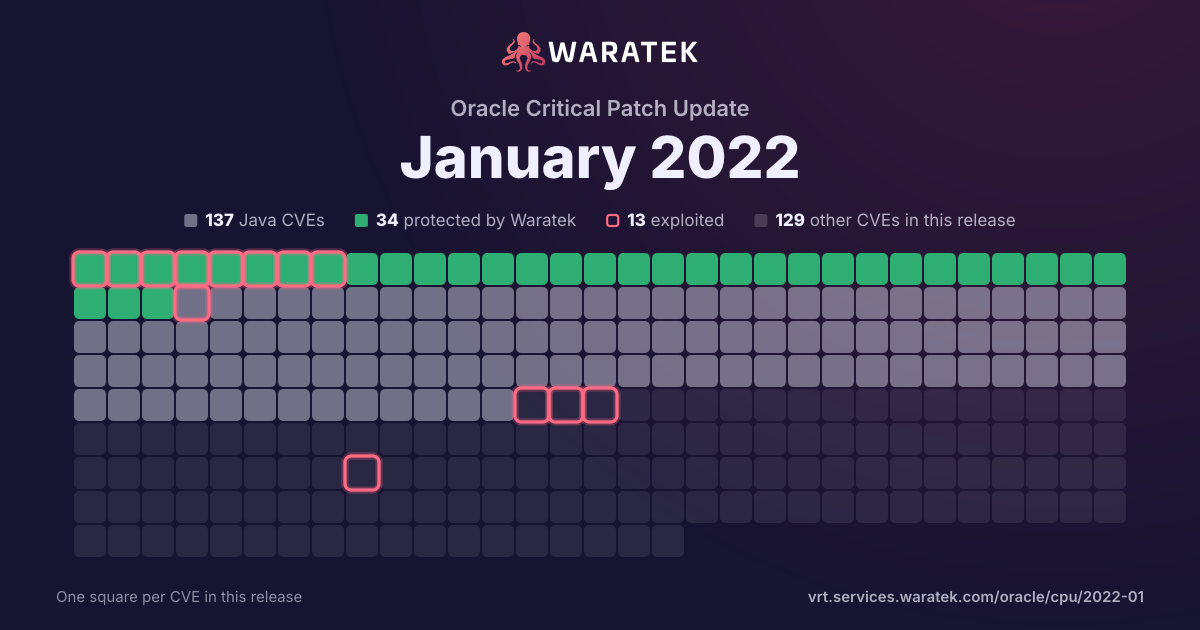
By status
34Protected by Waratek3Mitigation candidate100No exploit published57Outside Waratek scope72Not applicable
13Exploited, marked by the ring
No exploit published. For 71 of them, Oracle's security advisory is the source of public detail.
Protected by Waratek. Waratek RASP can block exploitation of these on systems that have not applied the patch yet.
Overview 12 matches · 0 in Waratek scope · 0 protected · 1 exploited · 0 CISA KEV · 2 public PoC · 1 EPSS ≥ 0.5
12matches
0in Waratek scope0.0%
0protected0.0%
1exploited8.3%
0CISA KEV0.0%
2public PoC16.7%
1EPSS ≥ 0.58.3%
Protected by Waratek
0
0.0%
Rule in development
0
0.0%
Mitigation candidate
0
0.0%
No exploit published
0
0.0%
Outside Waratek scope
0
0.0%
Not applicable
12
100.0%
Withdrawn CVE
0
0.0%
blocked by ARMR today
0
0.0%
partly blocked
0
0.0%
not blocked
12
100.0%
not established
0
0.0%
unrecorded
0
0.0%
split by
peak 5 / quarter
Q4 191
Not applicable1
High1
not blocked1
No public exploit1
Q1 200
Q2 200
Q3 200
Q4 201
Not applicable1
High1
not blocked1
Proof of concept only1
Q1 211
Not applicable1
High1
not blocked1
Exploited1
Q2 215
Not applicable5
High5
not blocked5
Working exploit published1
No public exploit4
Q3 212
Not applicable2
High2
not blocked2
No public exploit2
Q4 212
Not applicable2
High2
not blocked2
No public exploit2
Q4 19Q1 20Q2 20Q3 20Q4 20Q1 21Q2 21Q3 21Q4 21
| CVE | Severity | Published▾ | Status | Exploitation | Description |
|---|---|---|---|---|---|
| CVE-2021-41165 | High | 2021-11-17 | Not applicable | No public exploit | CKEditor4 is an open source WYSIWYG HTML editor. In affected version a vulnerability has been discovered in the core HTML processing module and may affect all plugins used by CKEditor 4. The vulnerability allowed to inject malformed comments HTML bypassing content sanitization, which could result in executing JavaScript code. It affects all users using the CKEditor 4 at version < 4.17.0. The problem has been recognized and patched. The fix will be available in version 4.17.0. |
| CVE-2021-21703 | High | 2021-10-25 | Not applicable | No public exploit | In PHP versions 7.3.x up to and including 7.3.31, 7.4.x below 7.4.25 and 8.0.x below 8.0.12, when running PHP FPM SAPI with main FPM daemon process running as root and child worker processes running as lower-privileged users, it is possible for the child processes to access memory shared with the main process and write to it, modifying it in a way that would cause the root process to conduct invalid memory reads and writes, which can be used to escalate privileges from local unprivileged user to the root user. |
| CVE-2021-37695 | High | 2021-08-13 | Not applicable | No public exploit | ckeditor is an open source WYSIWYG HTML editor with rich content support. A potential vulnerability has been discovered in CKEditor 4 [Fake Objects](https://ckeditor.com/cke4/addon/fakeobjects) package. The vulnerability allowed to inject malformed Fake Objects HTML, which could result in executing JavaScript code. It affects all users using the CKEditor 4 plugins listed above at version < 4.16.2. The problem has been recognized and patched. The fix will be available in version 4.16.2. |
| CVE-2021-29923 | High | 2021-08-07 | Not applicable | No public exploit | Go before 1.17 does not properly consider extraneous zero characters at the beginning of an IP address octet, which (in some situations) allows attackers to bypass access control that is based on IP addresses, because of unexpected octal interpretation. This affects net.ParseIP and net.ParseCIDR. |
| CVE-2021-32723 | High | 2021-06-28 | Not applicable | No public exploit | Prism is a syntax highlighting library. Some languages before 1.24.0 are vulnerable to Regular Expression Denial of Service (ReDoS). When Prism is used to highlight untrusted (user-given) text, an attacker can craft a string that will take a very very long time to highlight. This problem has been fixed in Prism v1.24. As a workaround, do not use ASCIIDoc or ERB to highlight untrusted text. Other languages are not affected and can be used to highlight untrusted text. |
| CVE-2020-28469 | High | 2021-06-03 | Not applicable | No public exploit | This affects the package glob-parent before 5.1.2. The enclosure regex used to check for strings ending in enclosure containing path separator. |
| CVE-2021-23017 | High | 2021-06-01 | Not applicable | Working exploit published | A security issue in nginx resolver was identified, which might allow an attacker who is able to forge UDP packets from the DNS server to cause 1-byte memory overwrite, resulting in worker process crash or potential other impact. |
| CVE-2021-20718 | High | 2021-05-20 | Not applicable | No public exploit | mod_auth_openidc 2.4.0 to 2.4.7 allows a remote attacker to cause a denial-of-service (DoS) condition via unspecified vectors. |
| CVE-2021-3517 | High | 2021-05-19 | Not applicable | No public exploit | There is a flaw in the xml entity encoding functionality of libxml2 in versions before 2.9.11. An attacker who is able to supply a crafted file to be processed by an application linked with the affected functionality of libxml2 could trigger an out-of-bounds read. The most likely impact of this flaw is to application availability, with some potential impact to confidentiality and integrity if an attacker is able to use memory information to further exploit the application. |
| CVE-2021-23337 | High | 2021-02-15 | Not applicable | Exploited | Lodash versions prior to 4.17.21 are vulnerable to Command Injection via the template function. |
| CVE-2020-8285 | High | 2020-12-14 | Not applicable | Proof of concept only | curl 7.21.0 to and including 7.73.0 is vulnerable to uncontrolled recursion due to a stack overflow issue in FTP wildcard match parsing. |
| CVE-2018-1311 | High | 2019-12-18 | Not applicable | No public exploit | The Apache Xerces-C 3.0.0 to 3.2.3 XML parser contains a use-after-free error triggered during the scanning of external DTDs. This flaw has not been addressed in the maintained version of the library and has no current mitigation other than to disable DTD processing. This can be accomplished via the DOM using a standard parser feature, or via SAX using the XERCES_DISABLE_DTD environment variable. |