
Oracle Critical Patch Update January 2022
Released January 2022 · Oracle's advisory ↗ · ← Critical Patch Update, October 2021 · Critical Patch Update, April 2022 →
266 CVEs in this release, one square each
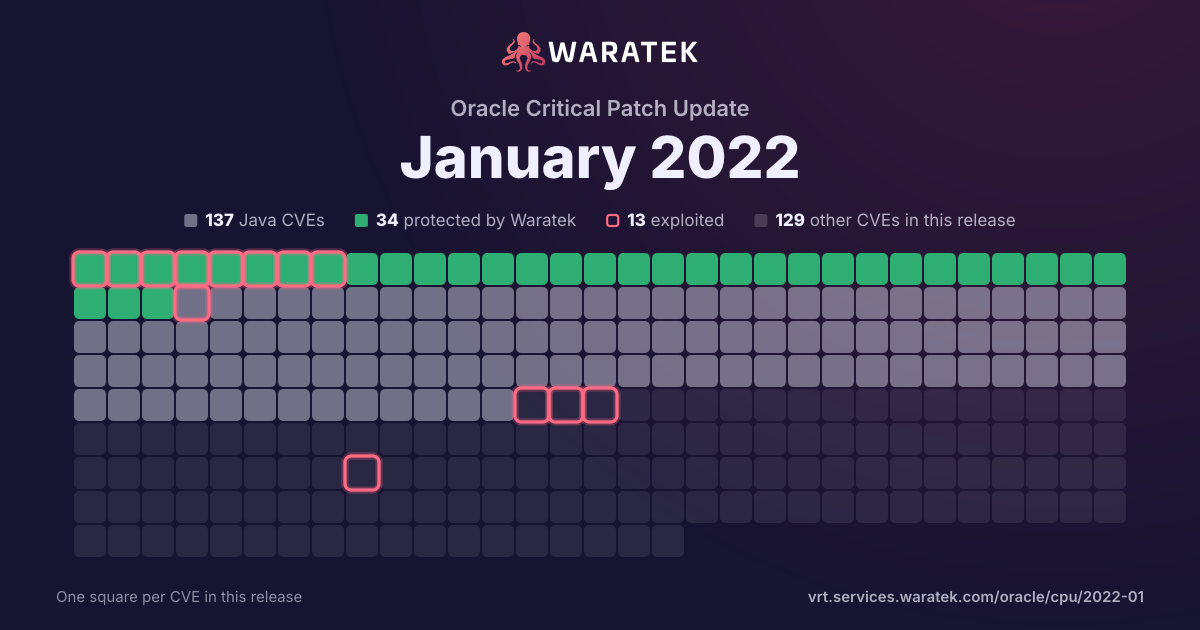
By status
34Protected by Waratek5Mitigation candidate108No exploit published2Outside Waratek scope117Not applicable
13Exploited, marked by the ring
No exploit published. For 74 of them, Oracle's security advisory is the source of public detail.
Protected by Waratek. Waratek RASP can block exploitation of these on systems that have not applied the patch yet.
Overview 3 matches · 1 protected · 0 exploited · 0 CISA KEV · 0 public PoC · 0 EPSS ≥ 0.5
Protected by Waratek
1
33.3%
Rule in development
0
0.0%
Mitigation candidate
0
0.0%
No exploit published
2
66.7%
blocked by ARMR today
1
33.3%
partly blocked
0
0.0%
not blocked
2
66.7%
not established
0
0.0%
unrecorded
0
0.0%
Exploited
0
0.0%
Working exploit published
0
0.0%
Proof of concept only
0
0.0%
Forecast only
0
0.0%
No public exploit
3
100.0%
split by
peak 3 / month
Dec 20
| CVE | Severity | Published▾ | Status | Exploitation | Description |
|---|---|---|---|---|---|
| CVE-2020-28052 | High | 2020-12-18 | No exploit published | No public exploit | An issue was discovered in Legion of the Bouncy Castle BC Java 1.65 and 1.66. The OpenBSDBCrypt.checkPassword utility method compared incorrect data when checking the password, allowing incorrect passwords to indicate they were matching with previously hashed ones that were different. |
| CVE-2020-25649 | High | 2020-12-03 | Protected by Waratek | No public exploit | A flaw was found in FasterXML Jackson Databind, where it did not have entity expansion secured properly. This flaw allows vulnerability to XML external entity (XXE) attacks. The highest threat from this vulnerability is data integrity. |
| CVE-2020-17527 | High | 2020-12-03 | No exploit published | No public exploit | While investigating bug 64830 it was discovered that Apache Tomcat 10.0.0-M1 to 10.0.0-M9, 9.0.0-M1 to 9.0.39 and 8.5.0 to 8.5.59 could re-use an HTTP request header value from the previous stream received on an HTTP/2 connection for the request associated with the subsequent stream. While this would most likely lead to an error and the closure of the HTTP/2 connection, it is possible that information could leak between requests. |