
Oracle Critical Patch Update January 2022
Released January 2022 · Oracle's advisory ↗ · ← Critical Patch Update, October 2021 · Critical Patch Update, April 2022 →
266 CVEs in this release, one square each
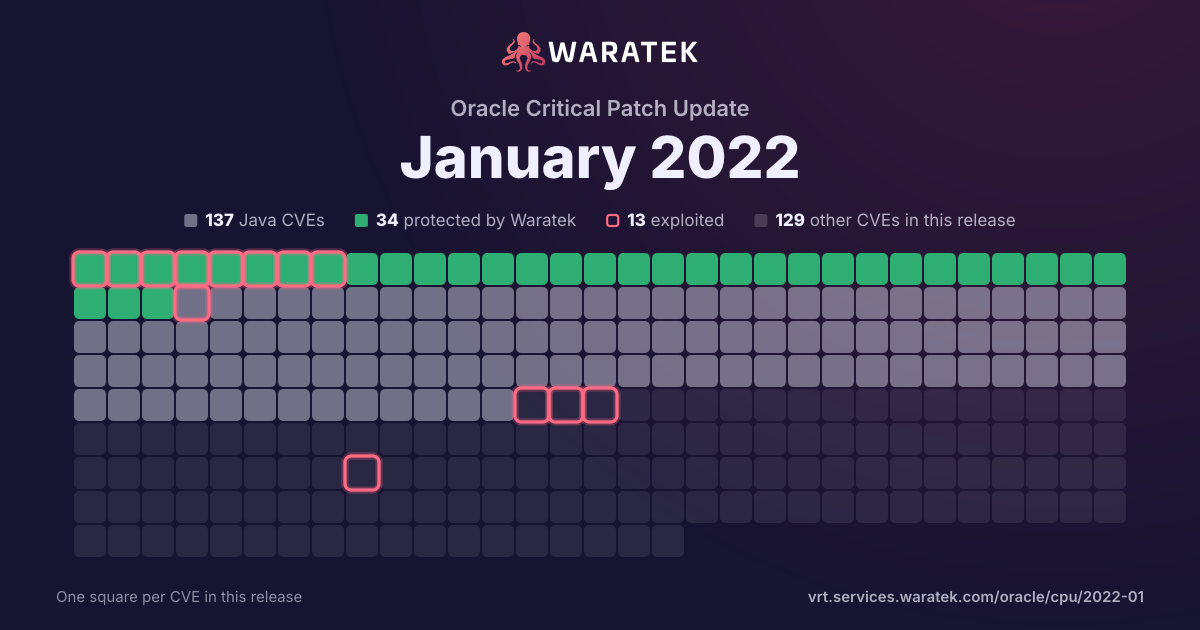
By status
29Protected by Waratek4Mitigation candidate111No exploit published2Outside Waratek scope120Not applicable
13Exploited, marked by the ring
No exploit published. For 69 of them, Oracle's security advisory is the source of public detail.
Protected by Waratek. Waratek RASP can block exploitation of these on systems that have not applied the patch yet.
Overview 5 matches · 1 in Waratek scope · 1 protected · 0 exploited · 0 CISA KEV · 1 public PoC · 0 EPSS ≥ 0.5
5matches
1in Waratek scope20.0%
1protected20.0%
0exploited0.0%
0CISA KEV0.0%
1public PoC20.0%
0EPSS ≥ 0.50.0%
Protected by Waratek
1
20.0%
Rule in development
0
0.0%
Mitigation candidate
0
0.0%
No exploit published
0
0.0%
Outside Waratek scope
0
0.0%
Not applicable
4
80.0%
Withdrawn CVE
0
0.0%
blocked by ARMR today
1
20.0%
partly blocked
0
0.0%
not blocked
4
80.0%
not established
0
0.0%
unrecorded
0
0.0%
Exploited
0
0.0%
Working exploit published
0
0.0%
Proof of concept only
5
100.0%
Forecast only
0
0.0%
No public exploit
0
0.0%
split by
peak 1 / month
Dec 201
Not applicable1
High1
not blocked1
Proof of concept only1
Jan 211
Not applicable1
Critical1
not blocked1
Proof of concept only1
Feb 210
Mar 210
Apr 210
May 210
Jun 210
Jul 211
Not applicable1
High1
not blocked1
Proof of concept only1
Aug 210
Sep 211
Not applicable1
High1
not blocked1
Proof of concept only1
Oct 210
Nov 210
Dec 210
Jan 221
Protected by Waratek1
Medium1
blocked by ARMR today1
Proof of concept only1
Jan 21Mar 21May 21Jul 21Sep 21Nov 21Jan 22
| CVE | Severity | Published▾ | Status | Exploitation | Description |
|---|---|---|---|---|---|
| CVE-2022-21341 | Medium | 2022-01-19 | Protected by Waratek | Proof of concept only | Vulnerability in the Oracle Java SE, Oracle GraalVM Enterprise Edition product of Oracle Java SE (component: Serialization). Supported versions that are affected are Oracle Java SE: 7u321, 8u311, 11.0.13, 17.0.1; Oracle GraalVM Enterprise Edition: 20.3.4 and 21.3.0. Easily exploitable vulnerability allows unauthenticated attacker with network access via multiple protocols to compromise Oracle Java SE, Oracle GraalVM Enterprise Edition. Successful attacks of this vulnerability can result in unauthorized ability to cause a partial denial of service (partial DOS) of Oracle Java SE, Oracle GraalVM Enterprise Edition. Note: This vulnerability applies to Java deployments, typically in clients running sandboxed Java Web Start applications or sandboxed Java applets, that load and run untrusted code (e.g., code that comes from the internet) and rely on the Java sandbox for security. This vulnerability can also be exploited by using APIs in the specified Component, e.g., through a web service which supplies data to the APIs. CVSS 3.1 Base Score 5.3 (Availability impacts). CVSS Vector: (CVSS:3.1/AV:N/AC:L/PR:N/UI:N/S:U/C:N/I:N/A:L). |
| CVE-2021-22946 | High | 2021-09-29 | Not applicable | Proof of concept only | A user can tell curl >= 7.20.0 and <= 7.78.0 to require a successful upgrade to TLS when speaking to an IMAP, POP3 or FTP server (`--ssl-reqd` on the command line or`CURLOPT_USE_SSL` set to `CURLUSESSL_CONTROL` or `CURLUSESSL_ALL` withlibcurl). This requirement could be bypassed if the server would return a properly crafted but perfectly legitimate response.This flaw would then make curl silently continue its operations **withoutTLS** contrary to the instructions and expectations, exposing possibly sensitive data in clear text over the network. |
| CVE-2021-33909 | High | 2021-07-20 | Not applicable | Proof of concept only | fs/seq_file.c in the Linux kernel 3.16 through 5.13.x before 5.13.4 does not properly restrict seq buffer allocations, leading to an integer overflow, an Out-of-bounds Write, and escalation to root by an unprivileged user, aka CID-8cae8cd89f05. |
| CVE-2021-3177 | Critical | 2021-01-19 | Not applicable | Proof of concept only | Python 3.x through 3.9.1 has a buffer overflow in PyCArg_repr in _ctypes/callproc.c, which may lead to remote code execution in certain Python applications that accept floating-point numbers as untrusted input, as demonstrated by a 1e300 argument to c_double.from_param. This occurs because sprintf is used unsafely. |
| CVE-2020-8285 | High | 2020-12-14 | Not applicable | Proof of concept only | curl 7.21.0 to and including 7.73.0 is vulnerable to uncontrolled recursion due to a stack overflow issue in FTP wildcard match parsing. |