
WaratekVRT Sign in

Oracle Critical Patch Update January 2022

Released January 2022 · Oracle's advisory ↗ · ← Critical Patch Update, October 2021 · Critical Patch Update, April 2022 →

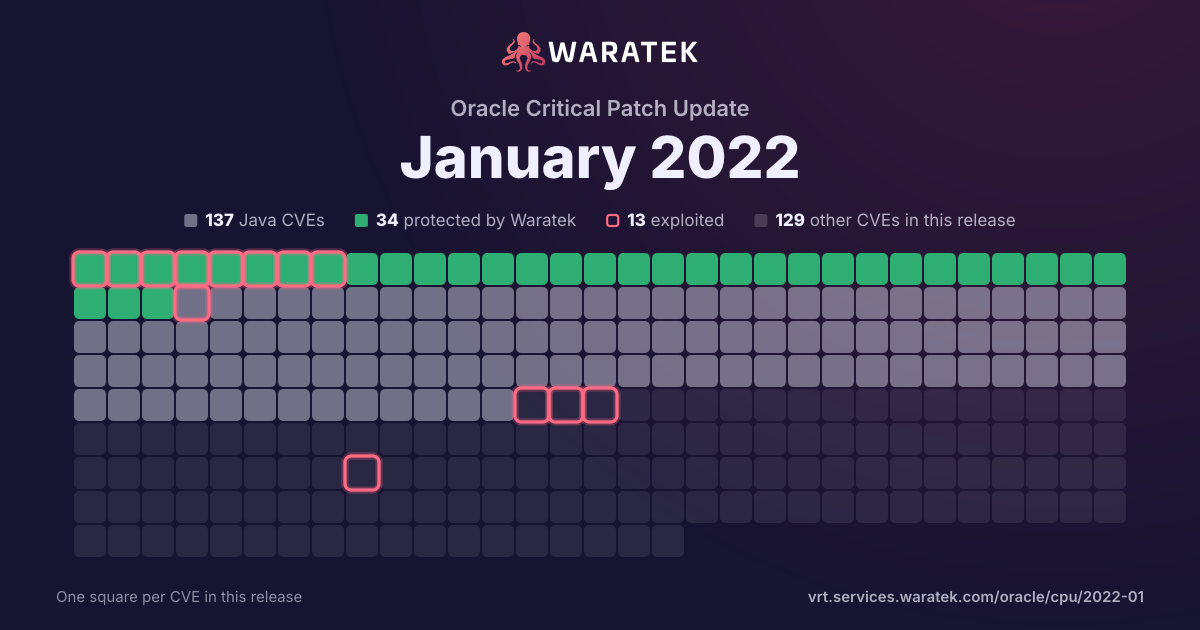
266 CVEs in this release, one square each
Protected by Waratek, exploitedProtected by Waratek, exploitedProtected by Waratek, exploitedProtected by Waratek, exploitedProtected by Waratek, exploitedProtected by Waratek, exploitedProtected by Waratek, exploitedProtected by Waratek, exploitedProtected by WaratekProtected by WaratekProtected by WaratekProtected by WaratekProtected by WaratekProtected by WaratekProtected by WaratekProtected by WaratekProtected by WaratekProtected by WaratekProtected by WaratekProtected by WaratekProtected by WaratekProtected by WaratekProtected by WaratekProtected by WaratekProtected by WaratekProtected by WaratekProtected by WaratekProtected by WaratekProtected by WaratekProtected by WaratekProtected by WaratekProtected by WaratekProtected by WaratekProtected by WaratekMitigation candidate, exploitedMitigation candidateMitigation candidateNo exploit publishedNo exploit publishedNo exploit publishedNo exploit publishedNo exploit publishedNo exploit publishedNo exploit publishedNo exploit publishedNo exploit publishedNo exploit publishedNo exploit publishedNo exploit publishedNo exploit publishedNo exploit publishedNo exploit publishedNo exploit publishedNo exploit publishedNo exploit publishedNo exploit publishedNo exploit publishedNo exploit publishedNo exploit publishedNo exploit publishedNo exploit publishedNo exploit publishedNo exploit publishedNo exploit publishedNo exploit publishedNo exploit publishedNo exploit publishedNo exploit publishedNo exploit publishedNo exploit publishedNo exploit publishedNo exploit publishedNo exploit publishedNo exploit publishedNo exploit publishedNo exploit publishedNo exploit publishedNo exploit publishedNo exploit publishedNo exploit publishedNo exploit publishedNo exploit publishedNo exploit publishedNo exploit publishedNo exploit publishedNo exploit publishedNo exploit publishedNo exploit publishedNo exploit publishedNo exploit publishedNo exploit publishedNo exploit publishedNo exploit publishedNo exploit publishedNo exploit publishedNo exploit publishedNo exploit publishedNo exploit publishedNo exploit publishedNo exploit publishedNo exploit publishedNo exploit publishedNo exploit publishedNo exploit publishedNo exploit publishedNo exploit publishedNo exploit publishedNo exploit publishedNo exploit publishedNo exploit publishedNo exploit publishedNo exploit publishedNo exploit publishedNo exploit publishedNo exploit publishedNo exploit publishedNo exploit publishedNo exploit publishedNo exploit publishedNo exploit publishedNo exploit publishedNo exploit publishedNo exploit publishedNo exploit publishedNo exploit publishedNo exploit publishedNo exploit publishedNo exploit publishedNo exploit publishedNo exploit publishedNo exploit publishedNo exploit publishedNo exploit publishedNo exploit publishedNo exploit publishedNo exploit publishedNo exploit publishedOutside Waratek scope, exploitedOutside Waratek scope, exploitedOutside Waratek scope, exploitedOutside Waratek scopeOutside Waratek scopeOutside Waratek scopeOutside Waratek scopeOutside Waratek scopeOutside Waratek scopeOutside Waratek scopeOutside Waratek scopeOutside Waratek scopeOutside Waratek scopeOutside Waratek scopeOutside Waratek scopeOutside Waratek scopeOutside Waratek scopeOutside Waratek scopeOutside Waratek scopeOutside Waratek scopeOutside Waratek scopeOutside Waratek scopeOutside Waratek scopeOutside Waratek scopeOutside Waratek scopeOutside Waratek scopeOutside Waratek scopeOutside Waratek scopeOutside Waratek scopeOutside Waratek scopeOutside Waratek scopeOutside Waratek scopeOutside Waratek scopeOutside Waratek scopeOutside Waratek scopeOutside Waratek scopeOutside Waratek scopeOutside Waratek scopeOutside Waratek scopeOutside Waratek scopeOutside Waratek scopeOutside Waratek scopeOutside Waratek scopeOutside Waratek scopeOutside Waratek scopeOutside Waratek scopeOutside Waratek scopeOutside Waratek scopeOutside Waratek scopeOutside Waratek scopeOutside Waratek scopeOutside Waratek scopeOutside Waratek scopeOutside Waratek scopeOutside Waratek scopeOutside Waratek scopeOutside Waratek scopeNot applicable, exploitedNot applicableNot applicableNot applicableNot applicableNot applicableNot applicableNot applicableNot applicableNot applicableNot applicableNot applicableNot applicableNot applicableNot applicableNot applicableNot applicableNot applicableNot applicableNot applicableNot applicableNot applicableNot applicableNot applicableNot applicableNot applicableNot applicableNot applicableNot applicableNot applicableNot applicableNot applicableNot applicableNot applicableNot applicableNot applicableNot applicableNot applicableNot applicableNot applicableNot applicableNot applicableNot applicableNot applicableNot applicableNot applicableNot applicableNot applicableNot applicableNot applicableNot applicableNot applicableNot applicableNot applicableNot applicableNot applicableNot applicableNot applicableNot applicableNot applicableNot applicableNot applicableNot applicableNot applicableNot applicableNot applicableNot applicableNot applicableNot applicableNot applicableNot applicableNot applicable
Share this chart Oracle Critical Patch Update January 2022, one square per CVE: 137 Java CVEs, 34 protected by Waratek, 13 exploited, 129 other CVEs in this release.

Download the image

By status

No exploit published. For 71 of them, Oracle's security advisory is the source of public detail.

Protected by Waratek. Waratek RASP can block exploitation of these on systems that have not applied the patch yet.

Reset
More filters
Columns
Including CVEs outside Waratek scope✕
Overview 2 matches · 0 in Waratek scope · 0 protected · 0 exploited · 0 CISA KEV · 0 public PoC
2matches 0in Waratek scope0.0% 0protected0.0% 0exploited0.0% 0CISA KEV0.0% 0public PoC0.0%
Protected by Waratek 0 0.0% Rule in development 0 0.0% Mitigation candidate 0 0.0% No exploit published 0 0.0% Outside Waratek scope 2 100.0% Not applicable 0 0.0% Withdrawn CVE 0 0.0%
Critical 2 100.0% High 0 0.0% Medium 0 0.0% Low 0 0.0% None 0 0.0% Unknown 0 0.0%
blocked by ARMR today 0 0.0% partly blocked 0 0.0% not blocked 2 100.0% not established 0 0.0% unrecorded 0 0.0%
Exploited 0 0.0% Working exploit published 0 0.0% Proof of concept only 0 0.0% Forecast only 2 100.0% No public exploit 0 0.0%
split by peak 1 / month
Jun 21Jul 21Aug 21
2 matches Sign in to download these CVEs as CSV or JSON, or to follow them in a feed.
CVE Severity Published▾ Status Exploitation Description
CVE-2021-3711 Critical 2021-08-24 Outside Waratek scope Forecast only In order to decrypt SM2 encrypted data an application is expected to call the API function EVP_PKEY_decrypt(). Typically an application will call this function twice. The first time, on entry, the "out" parameter can be NULL and, on exit, the "outlen" parameter is populated with the buffer size required to hold the decrypted plaintext. The application can then allocate a sufficiently sized buffer and call EVP_PKEY_decrypt() again, but this time passing a non-NULL value for the "out" parameter. A bug in the implementation of the SM2 decryption code means that the calculation of the buffer size required to hold the plaintext returned by the first call to EVP_PKEY_decrypt() can be smaller than the actual size required by the second call. This can lead to a buffer overflow when EVP_PKEY_decrypt() is called by the application a second time with a buffer that is too small. A malicious attacker who is able present SM2 content for decryption to an application could cause attacker chosen data to overflow the buffer by up to a maximum of 62 bytes altering the contents of other data held after the buffer, possibly changing application behaviour or causing the application to crash. The location of the buffer is application dependent but is typically heap allocated. Fixed in OpenSSL 1.1.1l (Affected 1.1.1-1.1.1k).
CVE-2021-26691 Critical 2021-06-10 Outside Waratek scope Forecast only In Apache HTTP Server versions 2.4.0 to 2.4.46 a specially crafted SessionHeader sent by an origin server could cause a heap overflow