
Oracle Critical Patch Update January 2022
Released January 2022 · Oracle's advisory ↗ · ← Critical Patch Update, October 2021 · Critical Patch Update, April 2022 →
266 CVEs in this release, one square each
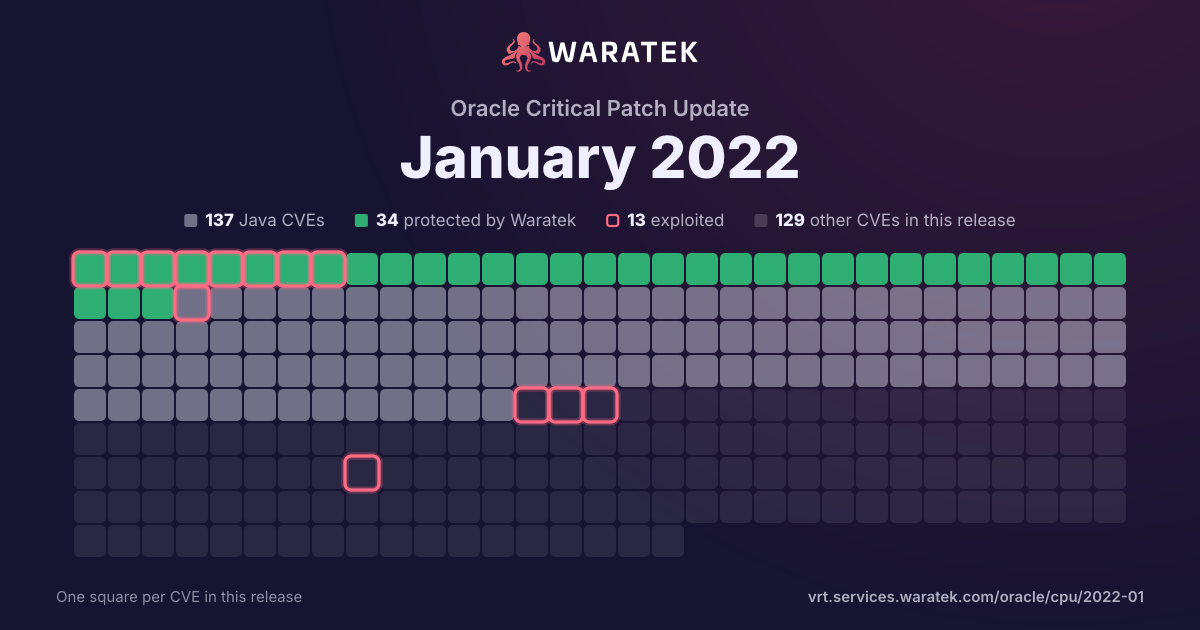
By status
29Protected by Waratek4Mitigation candidate111No exploit published2Outside Waratek scope120Not applicable
13Exploited, marked by the ring
No exploit published. For 69 of them, Oracle's security advisory is the source of public detail.
Protected by Waratek. Waratek RASP can block exploitation of these on systems that have not applied the patch yet.
Overview 11 matches · 4 exploited · 1 CISA KEV · 4 public PoC · 4 EPSS ≥ 0.5
Protected by Waratek
11
100.0%
Rule in development
0
0.0%
Mitigation candidate
0
0.0%
No exploit published
0
0.0%
blocked by ARMR today
11
100.0%
partly blocked
0
0.0%
not blocked
0
0.0%
not established
0
0.0%
unrecorded
0
0.0%
Exploited
4
36.4%
Working exploit published
1
9.1%
Proof of concept only
0
0.0%
Forecast only
0
0.0%
No public exploit
6
54.5%
split by
peak 3 / month
Nov 201
Protected by Waratek1
High1
blocked by ARMR today1
No public exploit1
Dec 203
Protected by Waratek3
Critical1
High1
Medium1
blocked by ARMR today3
Exploited1
No public exploit2
Jan 210
Feb 211
Protected by Waratek1
Medium1
blocked by ARMR today1
No public exploit1
Mar 211
Protected by Waratek1
High1
blocked by ARMR today1
No public exploit1
Apr 211
Protected by Waratek1
Medium1
blocked by ARMR today1
No public exploit1
May 210
Jun 211
Protected by Waratek1
Medium1
blocked by ARMR today1
Working exploit published1
Jul 211
Protected by Waratek1
Medium1
blocked by ARMR today1
Exploited1
Aug 210
Sep 210
Oct 210
Nov 210
Dec 212
Protected by Waratek2
Medium2
blocked by ARMR today2
Exploited2
Dec 20Feb 21Apr 21Jun 21Aug 21Oct 21Dec 21
| CVE | Severity | Published▾ | Status | Exploitation | Description |
|---|---|---|---|---|---|
| CVE-2021-44832 | Medium | 2021-12-28 | Protected by Waratek | Exploited | Apache Log4j2 versions 2.0-beta7 through 2.17.0 (excluding security fix releases 2.3.2 and 2.12.4) are vulnerable to a remote code execution (RCE) attack when a configuration uses a JDBC Appender with a JNDI LDAP data source URI when an attacker has control of the target LDAP server. This issue is fixed by limiting JNDI data source names to the java protocol in Log4j2 versions 2.17.1, 2.12.4, and 2.3.2. |
| CVE-2021-45105 | Medium | 2021-12-18 | Protected by Waratek | Exploited | Apache Log4j2 versions 2.0-alpha1 through 2.16.0 (excluding 2.12.3 and 2.3.1) did not protect from uncontrolled recursion from self-referential lookups. This allows an attacker with control over Thread Context Map data to cause a denial of service when a crafted string is interpreted. This issue was fixed in Log4j 2.17.0, 2.12.3, and 2.3.1. |
| CVE-2021-34429 | Medium | 2021-07-15 | Protected by Waratek | Exploited | For Eclipse Jetty versions 9.4.37-9.4.42, 10.0.1-10.0.5 & 11.0.1-11.0.5, URIs can be crafted using some encoded characters to access the content of the WEB-INF directory and/or bypass some security constraints. This is a variation of the vulnerability reported in CVE-2021-28164/GHSA-v7ff-8wcx-gmc5. |
| CVE-2020-6950 | Medium | 2021-06-02 | Protected by Waratek | Working exploit published | Directory traversal in Eclipse Mojarra before 2.3.14 allows attackers to read arbitrary files via the loc parameter or con parameter. |
| CVE-2021-29425 | Medium | 2021-04-13 | Protected by Waratek | No public exploit | In Apache Commons IO before 2.7, When invoking the method FileNameUtils.normalize with an improper input string, like "//../foo", or "\\..\foo", the result would be the same value, thus possibly providing access to files in the parent directory, but not further above (thus "limited" path traversal), if the calling code would use the result to construct a path value. |
| CVE-2021-25122 | High | 2021-03-01 | Protected by Waratek | No public exploit | When responding to new h2c connection requests, Apache Tomcat versions 10.0.0-M1 to 10.0.0, 9.0.0.M1 to 9.0.41 and 8.5.0 to 8.5.61 could duplicate request headers and a limited amount of request body from one request to another meaning user A and user B could both see the results of user A's request. |
| CVE-2021-27568 | Medium | 2021-02-23 | Protected by Waratek | No public exploit | An issue was discovered in netplex json-smart-v1 through 2015-10-23 and json-smart-v2 through 2.4. An exception is thrown from a function, but it is not caught, as demonstrated by NumberFormatException. When it is not caught, it may cause programs using the library to crash or expose sensitive information. |
| CVE-2020-17530 | Critical | 2020-12-11 | Protected by Waratek | Exploited | Forced OGNL evaluation, when evaluated on raw user input in tag attributes, may lead to remote code execution. Affected software : Apache Struts 2.0.0 - Struts 2.5.25. |
| CVE-2020-17521 | Medium | 2020-12-07 | Protected by Waratek | No public exploit | Apache Groovy provides extension methods to aid with creating temporary directories. Prior to this fix, Groovy's implementation of those extension methods was using a now superseded Java JDK method call that is potentially not secure on some operating systems in some contexts. Users not using the extension methods mentioned in the advisory are not affected, but may wish to read the advisory for further details. Versions Affected: 2.0 to 2.4.20, 2.5.0 to 2.5.13, 3.0.0 to 3.0.6, and 4.0.0-alpha-1. Fixed in versions 2.4.21, 2.5.14, 3.0.7, 4.0.0-alpha-2. |
| CVE-2020-25649 | High | 2020-12-03 | Protected by Waratek | No public exploit | A flaw was found in FasterXML Jackson Databind, where it did not have entity expansion secured properly. This flaw allows vulnerability to XML external entity (XXE) attacks. The highest threat from this vulnerability is data integrity. |
| CVE-2019-17566 | High | 2020-11-12 | Protected by Waratek | No public exploit | Apache Batik is vulnerable to server-side request forgery, caused by improper input validation by the "xlink:href" attributes. By using a specially-crafted argument, an attacker could exploit this vulnerability to cause the underlying server to make arbitrary GET requests. |