
Oracle Critical Patch Update January 2022
Released January 2022 · Oracle's advisory ↗ · ← Critical Patch Update, October 2021 · Critical Patch Update, April 2022 →
266 CVEs in this release, one square each
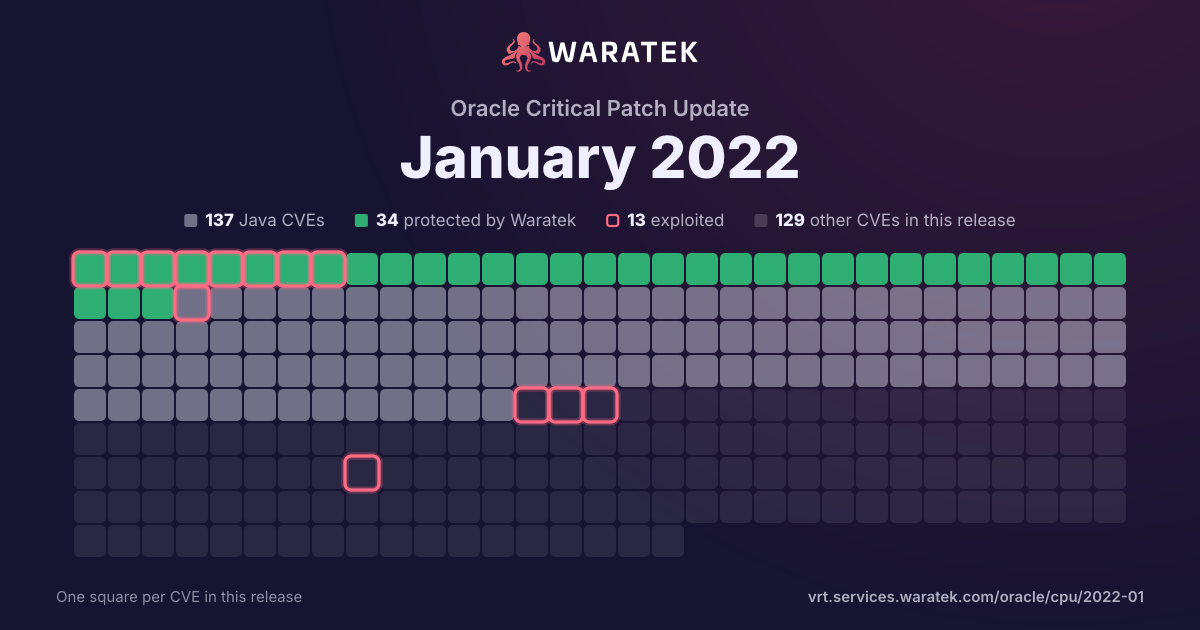
By status
29Protected by Waratek4Mitigation candidate111No exploit published2Outside Waratek scope120Not applicable
13Exploited, marked by the ring
No exploit published. For 69 of them, Oracle's security advisory is the source of public detail.
Protected by Waratek. Waratek RASP can block exploitation of these on systems that have not applied the patch yet.
Overview 26 matches · 3 protected · 4 exploited · 0 CISA KEV · 2 public PoC · 4 EPSS ≥ 0.5
Protected by Waratek
3
11.5%
Rule in development
0
0.0%
Mitigation candidate
1
3.8%
No exploit published
22
84.6%
blocked by ARMR today
3
11.5%
partly blocked
0
0.0%
not blocked
23
88.5%
not established
0
0.0%
unrecorded
0
0.0%
Exploited
4
15.4%
Working exploit published
0
0.0%
Proof of concept only
0
0.0%
Forecast only
1
3.8%
No public exploit
21
80.8%
split by
peak 13 / month
Jul 215
Protected by Waratek1
No exploit published4
High2
Medium3
blocked by ARMR today1
not blocked4
Exploited1
Forecast only1
No public exploit3
Aug 213
No exploit published3
Critical1
High2
not blocked3
No public exploit3
Sep 211
Mitigation candidate1
Medium1
not blocked1
Exploited1
Oct 212
No exploit published2
High2
not blocked2
No public exploit2
Nov 210
Dec 212
Protected by Waratek2
Medium2
blocked by ARMR today2
Exploited2
Jan 2213
No exploit published13
High2
Medium11
not blocked13
No public exploit13
Jul 21Aug 21Sep 21Oct 21Nov 21Dec 21Jan 22
| CVE | Severity | Published▾ | Status | Exploitation | Description |
|---|---|---|---|---|---|
| CVE-2022-21403 | Medium | 2022-01-19 | No exploit published | No public exploit | Vulnerability in the Oracle Communications Operations Monitor product of Oracle Communications (component: Mediation Engine). Supported versions that are affected are 3.4, 4.2, 4.3, 4.4 and 5.0. Easily exploitable vulnerability allows high privileged attacker with network access via HTTP to compromise Oracle Communications Operations Monitor. While the vulnerability is in Oracle Communications Operations Monitor, attacks may significantly impact additional products. Successful attacks of this vulnerability can result in unauthorized update, insert or delete access to some of Oracle Communications Operations Monitor accessible data as well as unauthorized read access to a subset of Oracle Communications Operations Monitor accessible data and unauthorized ability to cause a partial denial of service (partial DOS) of Oracle Communications Operations Monitor. CVSS 3.1 Base Score 6.6 (Confidentiality, Integrity and Availability impacts). CVSS Vector: (CVSS:3.1/AV:N/AC:L/PR:H/UI:N/S:C/C:L/I:L/A:L). |
| CVE-2022-21402 | Medium | 2022-01-19 | No exploit published | No public exploit | Vulnerability in the Oracle Communications Operations Monitor product of Oracle Communications (component: Mediation Engine). Supported versions that are affected are 3.4, 4.2, 4.3, 4.4 and 5.0. Easily exploitable vulnerability allows high privileged attacker with network access via HTTP to compromise Oracle Communications Operations Monitor. Successful attacks require human interaction from a person other than the attacker and while the vulnerability is in Oracle Communications Operations Monitor, attacks may significantly impact additional products. Successful attacks of this vulnerability can result in unauthorized update, insert or delete access to some of Oracle Communications Operations Monitor accessible data as well as unauthorized read access to a subset of Oracle Communications Operations Monitor accessible data. CVSS 3.1 Base Score 4.8 (Confidentiality and Integrity impacts). CVSS Vector: (CVSS:3.1/AV:N/AC:L/PR:H/UI:R/S:C/C:L/I:L/A:N). |
| CVE-2022-21401 | Medium | 2022-01-19 | No exploit published | No public exploit | Vulnerability in the Oracle Communications Operations Monitor product of Oracle Communications (component: Mediation Engine). Supported versions that are affected are 3.4, 4.2, 4.3, 4.4 and 5.0. Easily exploitable vulnerability allows high privileged attacker with network access via HTTP to compromise Oracle Communications Operations Monitor. While the vulnerability is in Oracle Communications Operations Monitor, attacks may significantly impact additional products. Successful attacks of this vulnerability can result in unauthorized update, insert or delete access to some of Oracle Communications Operations Monitor accessible data as well as unauthorized read access to a subset of Oracle Communications Operations Monitor accessible data and unauthorized ability to cause a partial denial of service (partial DOS) of Oracle Communications Operations Monitor. CVSS 3.1 Base Score 6.6 (Confidentiality, Integrity and Availability impacts). CVSS Vector: (CVSS:3.1/AV:N/AC:L/PR:H/UI:N/S:C/C:L/I:L/A:L). |
| CVE-2022-21400 | Medium | 2022-01-19 | No exploit published | No public exploit | Vulnerability in the Oracle Communications Operations Monitor product of Oracle Communications (component: Mediation Engine). Supported versions that are affected are 3.4, 4.2, 4.3, 4.4 and 5.0. Easily exploitable vulnerability allows low privileged attacker with network access via HTTP to compromise Oracle Communications Operations Monitor. Successful attacks require human interaction from a person other than the attacker and while the vulnerability is in Oracle Communications Operations Monitor, attacks may significantly impact additional products. Successful attacks of this vulnerability can result in unauthorized update, insert or delete access to some of Oracle Communications Operations Monitor accessible data as well as unauthorized read access to a subset of Oracle Communications Operations Monitor accessible data. CVSS 3.1 Base Score 5.4 (Confidentiality and Integrity impacts). CVSS Vector: (CVSS:3.1/AV:N/AC:L/PR:L/UI:R/S:C/C:L/I:L/A:N). |
| CVE-2022-21399 | Medium | 2022-01-19 | No exploit published | No public exploit | Vulnerability in the Oracle Communications Operations Monitor product of Oracle Communications (component: Mediation Engine). Supported versions that are affected are 3.4, 4.2, 4.3, 4.4 and 5.0. Easily exploitable vulnerability allows high privileged attacker with network access via HTTP to compromise Oracle Communications Operations Monitor. While the vulnerability is in Oracle Communications Operations Monitor, attacks may significantly impact additional products. Successful attacks of this vulnerability can result in unauthorized update, insert or delete access to some of Oracle Communications Operations Monitor accessible data as well as unauthorized read access to a subset of Oracle Communications Operations Monitor accessible data and unauthorized ability to cause a partial denial of service (partial DOS) of Oracle Communications Operations Monitor. CVSS 3.1 Base Score 6.6 (Confidentiality, Integrity and Availability impacts). CVSS Vector: (CVSS:3.1/AV:N/AC:L/PR:H/UI:N/S:C/C:L/I:L/A:L). |
| CVE-2022-21398 | Medium | 2022-01-19 | No exploit published | No public exploit | Vulnerability in the Oracle Communications Operations Monitor product of Oracle Communications (component: Mediation Engine). Supported versions that are affected are 3.4, 4.2, 4.3, 4.4 and 5.0. Easily exploitable vulnerability allows low privileged attacker with network access via HTTP to compromise Oracle Communications Operations Monitor. Successful attacks require human interaction from a person other than the attacker and while the vulnerability is in Oracle Communications Operations Monitor, attacks may significantly impact additional products. Successful attacks of this vulnerability can result in unauthorized update, insert or delete access to some of Oracle Communications Operations Monitor accessible data as well as unauthorized read access to a subset of Oracle Communications Operations Monitor accessible data. CVSS 3.1 Base Score 5.4 (Confidentiality and Integrity impacts). CVSS Vector: (CVSS:3.1/AV:N/AC:L/PR:L/UI:R/S:C/C:L/I:L/A:N). |
| CVE-2022-21397 | Medium | 2022-01-19 | No exploit published | No public exploit | Vulnerability in the Oracle Communications Operations Monitor product of Oracle Communications (component: Mediation Engine). Supported versions that are affected are 3.4, 4.2, 4.3, 4.4 and 5.0. Easily exploitable vulnerability allows low privileged attacker with network access via HTTP to compromise Oracle Communications Operations Monitor. Successful attacks require human interaction from a person other than the attacker and while the vulnerability is in Oracle Communications Operations Monitor, attacks may significantly impact additional products. Successful attacks of this vulnerability can result in unauthorized update, insert or delete access to some of Oracle Communications Operations Monitor accessible data as well as unauthorized read access to a subset of Oracle Communications Operations Monitor accessible data. CVSS 3.1 Base Score 5.4 (Confidentiality and Integrity impacts). CVSS Vector: (CVSS:3.1/AV:N/AC:L/PR:L/UI:R/S:C/C:L/I:L/A:N). |
| CVE-2022-21396 | Medium | 2022-01-19 | No exploit published | No public exploit | Vulnerability in the Oracle Communications Operations Monitor product of Oracle Communications (component: Mediation Engine). Supported versions that are affected are 3.4, 4.2, 4.3, 4.4 and 5.0. Easily exploitable vulnerability allows low privileged attacker with network access via HTTP to compromise Oracle Communications Operations Monitor. Successful attacks require human interaction from a person other than the attacker and while the vulnerability is in Oracle Communications Operations Monitor, attacks may significantly impact additional products. Successful attacks of this vulnerability can result in unauthorized update, insert or delete access to some of Oracle Communications Operations Monitor accessible data as well as unauthorized read access to a subset of Oracle Communications Operations Monitor accessible data. CVSS 3.1 Base Score 5.4 (Confidentiality and Integrity impacts). CVSS Vector: (CVSS:3.1/AV:N/AC:L/PR:L/UI:R/S:C/C:L/I:L/A:N). |
| CVE-2022-21395 | High | 2022-01-19 | No exploit published | No public exploit | Vulnerability in the Oracle Communications Operations Monitor product of Oracle Communications (component: Mediation Engine). Supported versions that are affected are 3.4, 4.2, 4.3, 4.4 and 5.0. Easily exploitable vulnerability allows high privileged attacker with network access via HTTP to compromise Oracle Communications Operations Monitor. Successful attacks of this vulnerability can result in takeover of Oracle Communications Operations Monitor. CVSS 3.1 Base Score 7.2 (Confidentiality, Integrity and Availability impacts). CVSS Vector: (CVSS:3.1/AV:N/AC:L/PR:H/UI:N/S:U/C:H/I:H/A:H). |
| CVE-2022-21383 | Medium | 2022-01-19 | No exploit published | No public exploit | Vulnerability in the Oracle Enterprise Session Border Controller product of Oracle Communications (component: Log). Supported versions that are affected are 8.4 and 9.0. Easily exploitable vulnerability allows low privileged attacker with network access via HTTP to compromise Oracle Enterprise Session Border Controller. Successful attacks of this vulnerability can result in unauthorized ability to cause a partial denial of service (partial DOS) of Oracle Enterprise Session Border Controller. CVSS 3.1 Base Score 4.3 (Availability impacts). CVSS Vector: (CVSS:3.1/AV:N/AC:L/PR:L/UI:N/S:U/C:N/I:N/A:L). |
| CVE-2022-21382 | High | 2022-01-19 | No exploit published | No public exploit | Vulnerability in the Oracle Enterprise Session Border Controller product of Oracle Communications (component: WebUI). Supported versions that are affected are 8.4 and 9.0. Easily exploitable vulnerability allows low privileged attacker with network access via HTTP to compromise Oracle Enterprise Session Border Controller. While the vulnerability is in Oracle Enterprise Session Border Controller, attacks may significantly impact additional products. Successful attacks of this vulnerability can result in unauthorized creation, deletion or modification access to critical data or all Oracle Enterprise Session Border Controller accessible data. CVSS 3.1 Base Score 7.7 (Integrity impacts). CVSS Vector: (CVSS:3.1/AV:N/AC:L/PR:L/UI:N/S:C/C:N/I:H/A:N). |
| CVE-2022-21381 | Medium | 2022-01-19 | No exploit published | No public exploit | Vulnerability in the Oracle Enterprise Session Border Controller product of Oracle Communications (component: WebUI). Supported versions that are affected are 8.4 and 9.0. Easily exploitable vulnerability allows low privileged attacker with network access via HTTP to compromise Oracle Enterprise Session Border Controller. While the vulnerability is in Oracle Enterprise Session Border Controller, attacks may significantly impact additional products. Successful attacks of this vulnerability can result in unauthorized update, insert or delete access to some of Oracle Enterprise Session Border Controller accessible data as well as unauthorized read access to a subset of Oracle Enterprise Session Border Controller accessible data. CVSS 3.1 Base Score 6.4 (Confidentiality and Integrity impacts). CVSS Vector: (CVSS:3.1/AV:N/AC:L/PR:L/UI:N/S:C/C:L/I:L/A:N). |
| CVE-2022-21246 | Medium | 2022-01-19 | No exploit published | No public exploit | Vulnerability in the Oracle Communications Operations Monitor product of Oracle Communications (component: Mediation Engine). Supported versions that are affected are 3.4, 4.2, 4.3, 4.4 and 5.0. Easily exploitable vulnerability allows low privileged attacker with network access via HTTP to compromise Oracle Communications Operations Monitor. Successful attacks require human interaction from a person other than the attacker and while the vulnerability is in Oracle Communications Operations Monitor, attacks may significantly impact additional products. Successful attacks of this vulnerability can result in unauthorized update, insert or delete access to some of Oracle Communications Operations Monitor accessible data as well as unauthorized read access to a subset of Oracle Communications Operations Monitor accessible data. CVSS 3.1 Base Score 5.4 (Confidentiality and Integrity impacts). CVSS Vector: (CVSS:3.1/AV:N/AC:L/PR:L/UI:R/S:C/C:L/I:L/A:N). |
| CVE-2021-44832 | Medium | 2021-12-28 | Protected by Waratek | Exploited | Apache Log4j2 versions 2.0-beta7 through 2.17.0 (excluding security fix releases 2.3.2 and 2.12.4) are vulnerable to a remote code execution (RCE) attack when a configuration uses a JDBC Appender with a JNDI LDAP data source URI when an attacker has control of the target LDAP server. This issue is fixed by limiting JNDI data source names to the java protocol in Log4j2 versions 2.17.1, 2.12.4, and 2.3.2. |
| CVE-2021-45105 | Medium | 2021-12-18 | Protected by Waratek | Exploited | Apache Log4j2 versions 2.0-alpha1 through 2.16.0 (excluding 2.12.3 and 2.3.1) did not protect from uncontrolled recursion from self-referential lookups. This allows an attacker with control over Thread Context Map data to cause a denial of service when a crafted string is interpreted. This issue was fixed in Log4j 2.17.0, 2.12.3, and 2.3.1. |
| CVE-2021-37137 | High | 2021-10-19 | No exploit published | No public exploit | The Snappy frame decoder function doesn't restrict the chunk length which may lead to excessive memory usage. Beside this it also may buffer reserved skippable chunks until the whole chunk was received which may lead to excessive memory usage as well. This vulnerability can be triggered by supplying malicious input that decompresses to a very big size (via a network stream or a file) or by sending a huge skippable chunk. |
| CVE-2021-42340 | High | 2021-10-14 | No exploit published | No public exploit | The fix for bug 63362 present in Apache Tomcat 10.1.0-M1 to 10.1.0-M5, 10.0.0-M1 to 10.0.11, 9.0.40 to 9.0.53 and 8.5.60 to 8.5.71 introduced a memory leak. The object introduced to collect metrics for HTTP upgrade connections was not released for WebSocket connections once the connection was closed. This created a memory leak that, over time, could lead to a denial of service via an OutOfMemoryError. |
| CVE-2021-38153 | Medium | 2021-09-22 | Mitigation candidate | Exploited | Some components in Apache Kafka use `Arrays.equals` to validate a password or key, which is vulnerable to timing attacks that make brute force attacks for such credentials more likely to be successful. Users should upgrade to 2.8.1 or higher, or 3.0.0 or higher where this vulnerability has been fixed. The affected versions include Apache Kafka 2.0.0, 2.0.1, 2.1.0, 2.1.1, 2.2.0, 2.2.1, 2.2.2, 2.3.0, 2.3.1, 2.4.0, 2.4.1, 2.5.0, 2.5.1, 2.6.0, 2.6.1, 2.6.2, 2.7.0, 2.7.1, and 2.8.0. |
| CVE-2021-39153 | High | 2021-08-23 | No exploit published | No public exploit | XStream is a simple library to serialize objects to XML and back again. In affected versions this vulnerability may allow a remote attacker to load and execute arbitrary code from a remote host only by manipulating the processed input stream, if using the version out of the box with Java runtime version 14 to 8 or with JavaFX installed. No user is affected, who followed the recommendation to setup XStream's security framework with a whitelist limited to the minimal required types. XStream 1.4.18 uses no longer a blacklist by default, since it cannot be secured for general purpose. |
| CVE-2021-39139 | High | 2021-08-23 | No exploit published | No public exploit | XStream is a simple library to serialize objects to XML and back again. In affected versions this vulnerability may allow a remote attacker to load and execute arbitrary code from a remote host only by manipulating the processed input stream. A user is only affected if using the version out of the box with JDK 1.7u21 or below. However, this scenario can be adjusted easily to an external Xalan that works regardless of the version of the Java runtime. No user is affected, who followed the recommendation to setup XStream's security framework with a whitelist limited to the minimal required types. XStream 1.4.18 uses no longer a blacklist by default, since it cannot be secured for general purpose. |
| CVE-2021-32827 | Critical | 2021-08-16 | No exploit published | No public exploit | MockServer is open source software which enables easy mocking of any system you integrate with via HTTP or HTTPS. An attacker that can trick a victim into visiting a malicious site while running MockServer locally, will be able to run arbitrary code on the MockServer machine. With an overly broad default CORS configuration MockServer allows any site to send cross-site requests. Additionally, MockServer allows you to create dynamic expectations using Javascript or Velocity templates. Both engines may allow an attacker to execute arbitrary code on-behalf of MockServer. By combining these two issues (Overly broad CORS configuration + Script injection), an attacker could serve a malicious page so that if a developer running MockServer visits it, they will get compromised. For more details including a PoC see the referenced GHSL-2021-059. |
| CVE-2021-2351 | High | 2021-07-21 | No exploit published | No public exploit | Vulnerability in the Advanced Networking Option component of Oracle Database Server. Supported versions that are affected are 12.1.0.2, 12.2.0.1 and 19c. Difficult to exploit vulnerability allows unauthenticated attacker with network access via Oracle Net to compromise Advanced Networking Option. Successful attacks require human interaction from a person other than the attacker and while the vulnerability is in Advanced Networking Option, attacks may significantly impact additional products. Successful attacks of this vulnerability can result in takeover of Advanced Networking Option. Note: The July 2021 Critical Patch Update introduces a number of Native Network Encryption changes to deal with vulnerability CVE-2021-2351 and prevent the use of weaker ciphers. Customers should review: "Changes in Native Network Encryption with the July 2021 Critical Patch Update" (Doc ID 2791571.1). CVSS 3.1 Base Score 8.3 (Confidentiality, Integrity and Availability impacts). CVSS Vector: (CVSS:3.1/AV:N/AC:H/PR:N/UI:R/S:C/C:H/I:H/A:H). |
| CVE-2021-34429 | Medium | 2021-07-15 | Protected by Waratek | Exploited | For Eclipse Jetty versions 9.4.37-9.4.42, 10.0.1-10.0.5 & 11.0.1-11.0.5, URIs can be crafted using some encoded characters to access the content of the WEB-INF directory and/or bypass some security constraints. This is a variation of the vulnerability reported in CVE-2021-28164/GHSA-v7ff-8wcx-gmc5. |
| CVE-2021-36374 | Medium | 2021-07-14 | No exploit published | No public exploit | When reading a specially crafted ZIP archive, or a derived formats, an Apache Ant build can be made to allocate large amounts of memory that leads to an out of memory error, even for small inputs. This can be used to disrupt builds using Apache Ant. Commonly used derived formats from ZIP archives are for instance JAR files and many office files. Apache Ant prior to 1.9.16 and 1.10.11 were affected. |
| CVE-2021-36090 | High | 2021-07-13 | No exploit published | No public exploit | When reading a specially crafted ZIP archive, Compress can be made to allocate large amounts of memory that finally leads to an out of memory error even for very small inputs. This could be used to mount a denial of service attack against services that use Compress' zip package. |
| CVE-2021-33037 | Medium | 2021-07-12 | No exploit published | Forecast only | Apache Tomcat 10.0.0-M1 to 10.0.6, 9.0.0.M1 to 9.0.46 and 8.5.0 to 8.5.66 did not correctly parse the HTTP transfer-encoding request header in some circumstances leading to the possibility to request smuggling when used with a reverse proxy. Specifically: - Tomcat incorrectly ignored the transfer encoding header if the client declared it would only accept an HTTP/1.0 response; - Tomcat honoured the identify encoding; and - Tomcat did not ensure that, if present, the chunked encoding was the final encoding. |