
Oracle Critical Patch Update October 2021
Released October 2021 · Oracle's advisory ↗ · ← Critical Patch Update, July 2021 · Critical Patch Update, January 2022 →
231 CVEs in this release, one square each
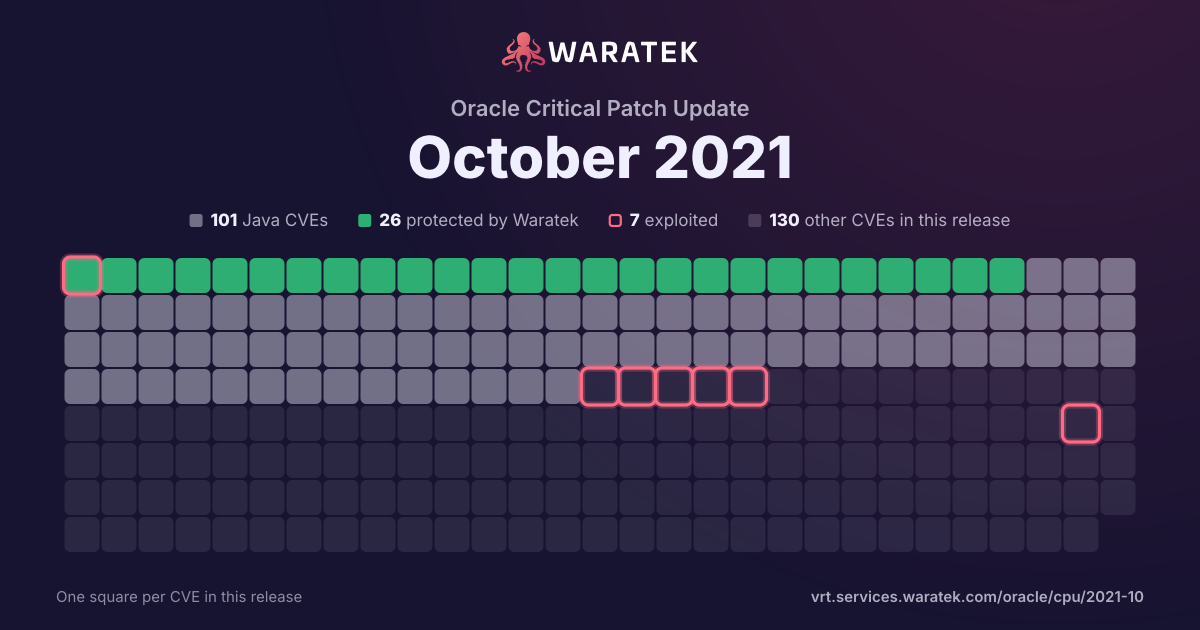
By status
27Protected by Waratek11Mitigation candidate81No exploit published3Outside Waratek scope109Not applicable
7Exploited, marked by the ring
No exploit published. For 54 of them, Oracle's security advisory is the source of public detail.
Protected by Waratek. Waratek RASP can block exploitation of these on systems that have not applied the patch yet.
Overview 6 matches · 0 in Waratek scope · 0 protected · 0 exploited · 0 CISA KEV · 1 public PoC · 2 EPSS ≥ 0.5
6matches
0in Waratek scope0.0%
0protected0.0%
0exploited0.0%
0CISA KEV0.0%
1public PoC16.7%
2EPSS ≥ 0.533.3%
Protected by Waratek
0
0.0%
Rule in development
0
0.0%
Mitigation candidate
0
0.0%
No exploit published
0
0.0%
Outside Waratek scope
0
0.0%
Not applicable
6
100.0%
Withdrawn CVE
0
0.0%
blocked by ARMR today
0
0.0%
partly blocked
0
0.0%
not blocked
6
100.0%
not established
0
0.0%
unrecorded
0
0.0%
Exploited
0
0.0%
Working exploit published
0
0.0%
Proof of concept only
2
33.3%
Forecast only
0
0.0%
No public exploit
4
66.7%
split by
peak 3 / quarter
Q3 161
Not applicable1
High1
not blocked1
Proof of concept only1
Q4 160
Q1 170
Q2 170
Q3 170
Q4 170
Q1 180
Q2 180
Q3 180
Q4 180
Q1 191
Not applicable1
Medium1
not blocked1
No public exploit1
Q2 191
Not applicable1
High1
not blocked1
No public exploit1
Q3 190
Q4 190
Q1 200
Q2 203
Not applicable3
High3
not blocked3
Proof of concept only1
No public exploit2
Q4 16Q2 17Q4 17Q2 18Q4 18Q2 19Q4 19Q2 20
| CVE | Severity | Published▾ | Status | Exploitation | Description |
|---|---|---|---|---|---|
| CVE-2020-10878 | High | 2020-06-05 | Not applicable | No public exploit | Perl before 5.30.3 has an integer overflow related to mishandling of a "PL_regkind[OP(n)] == NOTHING" situation. A crafted regular expression could lead to malformed bytecode with a possibility of instruction injection. |
| CVE-2020-10543 | High | 2020-06-05 | Not applicable | No public exploit | Perl before 5.30.3 on 32-bit platforms allows a heap-based buffer overflow because nested regular expression quantifiers have an integer overflow. |
| CVE-2020-1967 | High | 2020-04-21 | Not applicable | Proof of concept only | Server or client applications that call the SSL_check_chain() function during or after a TLS 1.3 handshake may crash due to a NULL pointer dereference as a result of incorrect handling of the "signature_algorithms_cert" TLS extension. The crash occurs if an invalid or unrecognised signature algorithm is received from the peer. This could be exploited by a malicious peer in a Denial of Service attack. OpenSSL version 1.1.1d, 1.1.1e, and 1.1.1f are affected by this issue. This issue did not affect OpenSSL versions prior to 1.1.1d. Fixed in OpenSSL 1.1.1g (Affected 1.1.1d-1.1.1f). |
| CVE-2018-20843 | High | 2019-06-24 | Not applicable | No public exploit | In libexpat in Expat before 2.2.7, XML input including XML names that contain a large number of colons could make the XML parser consume a high amount of RAM and CPU resources while processing (enough to be usable for denial-of-service attacks). |
| CVE-2019-7317 | Medium | 2019-02-04 | Not applicable | No public exploit | png_image_free in png.c in libpng 1.6.x before 1.6.37 has a use-after-free because png_image_free_function is called under png_safe_execute. |
| CVE-2016-2183 | High | 2016-09-01 | Not applicable | Proof of concept only | The DES and Triple DES ciphers, as used in the TLS, SSH, and IPSec protocols and other protocols and products, have a birthday bound of approximately four billion blocks, which makes it easier for remote attackers to obtain cleartext data via a birthday attack against a long-duration encrypted session, as demonstrated by an HTTPS session using Triple DES in CBC mode, aka a "Sweet32" attack. |