
Oracle Critical Patch Update October 2021
Released October 2021 · Oracle's advisory ↗ · ← Critical Patch Update, July 2021 · Critical Patch Update, January 2022 →
231 CVEs in this release, one square each
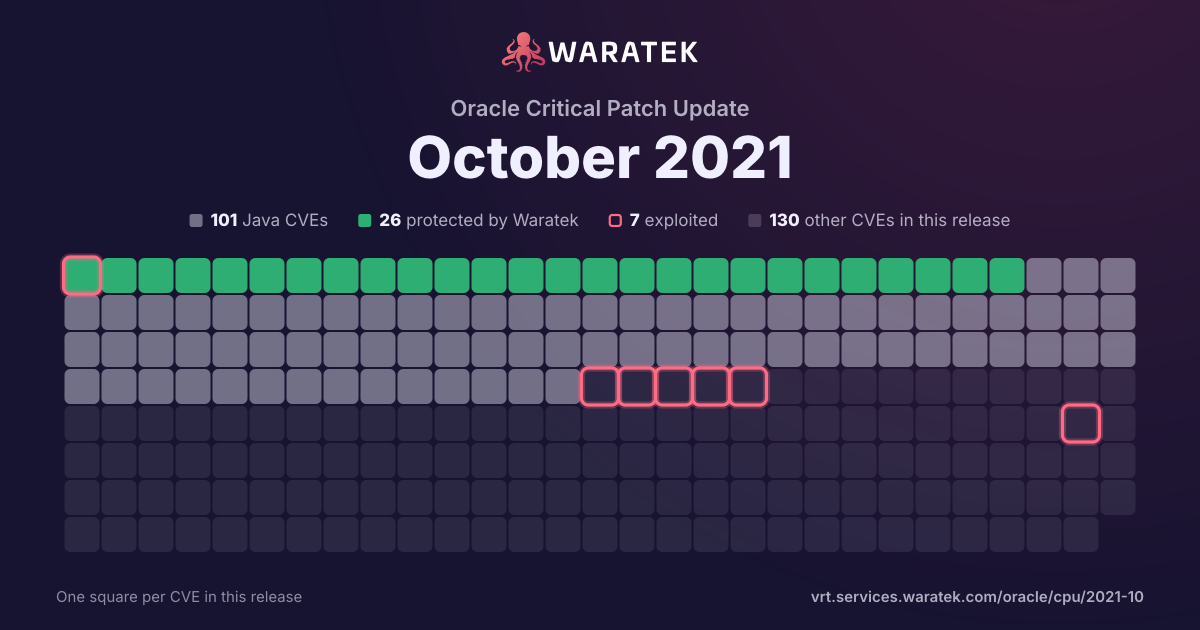
By status
27Protected by Waratek11Mitigation candidate81No exploit published3Outside Waratek scope109Not applicable
7Exploited, marked by the ring
No exploit published. For 54 of them, Oracle's security advisory is the source of public detail.
Protected by Waratek. Waratek RASP can block exploitation of these on systems that have not applied the patch yet.
Overview 208 matches · 100 in Waratek scope · 20 protected · 3 exploited · 2 CISA KEV · 11 public PoC · 16 EPSS ≥ 0.5
208matches
100in Waratek scope48.1%
20protected9.6%
3exploited1.4%
2CISA KEV1.0%
11public PoC5.3%
16EPSS ≥ 0.57.7%
Protected by Waratek
20
9.6%
Rule in development
0
0.0%
Mitigation candidate
4
1.9%
No exploit published
76
36.5%
Outside Waratek scope
3
1.4%
Not applicable
105
50.5%
Withdrawn CVE
0
0.0%
blocked by ARMR today
20
9.6%
partly blocked
0
0.0%
not blocked
188
90.4%
not established
0
0.0%
unrecorded
0
0.0%
split by
peak 137 / month
May 203
Protected by Waratek2
No exploit published1
Critical1
High1
Medium1
blocked by ARMR today2
not blocked1
Working exploit published1
No public exploit2
Jun 202
Not applicable2
High2
not blocked2
No public exploit2
Jul 203
No exploit published2
Not applicable1
Critical1
High2
not blocked3
No public exploit3
Aug 202
No exploit published1
Not applicable1
High1
Medium1
not blocked2
No public exploit2
Sep 203
Protected by Waratek2
Not applicable1
Critical1
High1
Low1
blocked by ARMR today2
not blocked1
No public exploit3
Oct 202
No exploit published2
High2
not blocked2
No public exploit2
Nov 201
No exploit published1
Medium1
not blocked1
No public exploit1
Dec 208
Protected by Waratek3
No exploit published3
Not applicable2
Critical1
High3
Medium3
Low1
blocked by ARMR today3
not blocked5
Exploited1
Proof of concept only1
No public exploit6
Jan 215
Protected by Waratek1
Mitigation candidate1
No exploit published1
Not applicable2
Critical2
High2
Medium1
blocked by ARMR today1
not blocked4
Exploited1
Proof of concept only1
No public exploit3
Feb 214
No exploit published2
Not applicable2
High3
Medium1
not blocked4
Exploited1
No public exploit3
Mar 2111
Protected by Waratek2
No exploit published4
Not applicable5
Critical2
High4
Medium5
blocked by ARMR today2
not blocked9
Working exploit published1
No public exploit10
Apr 214
Protected by Waratek1
No exploit published2
Not applicable1
High3
Medium1
blocked by ARMR today1
not blocked3
Forecast only1
No public exploit3
May 214
Protected by Waratek1
Mitigation candidate1
Not applicable2
High4
blocked by ARMR today1
not blocked3
Working exploit published1
No public exploit3
Jun 217
Protected by Waratek1
No exploit published4
Not applicable2
Critical1
High3
Medium3
blocked by ARMR today1
not blocked6
Working exploit published2
Forecast only1
No public exploit4
Jul 217
No exploit published6
Outside Waratek scope1
High3
Medium4
not blocked7
Forecast only1
No public exploit6
Aug 215
Not applicable5
Critical2
High3
not blocked5
Proof of concept only1
Forecast only1
No public exploit3
Sep 210
Oct 21137
Protected by Waratek7
Mitigation candidate2
No exploit published47
Outside Waratek scope2
Not applicable79
Critical2
High34
Medium90
Low11
blocked by ARMR today7
not blocked130
Proof of concept only4
Forecast only6
No public exploit127
Jun 20Aug 20Oct 20Dec 20Feb 21Apr 21Jun 21Aug 21Oct 21
| CVE | Severity | Published▾ | Status | Exploitation | Description |
|---|---|---|---|---|---|
| CVE-2020-5413 | Critical | 2020-07-31 | No exploit published | No public exploit | Spring Integration framework provides Kryo Codec implementations as an alternative for Java (de)serialization. When Kryo is configured with default options, all unregistered classes are resolved on demand. This leads to the "deserialization gadgets" exploit when provided data contains malicious code for execution during deserialization. In order to protect against this type of attack, Kryo can be configured to require a set of trusted classes for (de)serialization. Spring Integration should be proactive against blocking unknown "deserialization gadgets" when configuring Kryo in code. |
| CVE-2020-8203 | High | 2020-07-15 | Not applicable | No public exploit | Prototype pollution attack when using _.zipObjectDeep in lodash before 4.17.20. |
| CVE-2020-11994 | High | 2020-07-08 | No exploit published | No public exploit | Server-Side Template Injection and arbitrary file disclosure on Camel templating components |
| CVE-2020-10878 | High | 2020-06-05 | Not applicable | No public exploit | Perl before 5.30.3 has an integer overflow related to mishandling of a "PL_regkind[OP(n)] == NOTHING" situation. A crafted regular expression could lead to malformed bytecode with a possibility of instruction injection. |
| CVE-2020-10543 | High | 2020-06-05 | Not applicable | No public exploit | Perl before 5.30.3 on 32-bit platforms allows a heap-based buffer overflow because nested regular expression quantifiers have an integer overflow. |
| CVE-2020-9484 | High | 2020-05-20 | Protected by Waratek | Working exploit published | When using Apache Tomcat versions 10.0.0-M1 to 10.0.0-M4, 9.0.0.M1 to 9.0.34, 8.5.0 to 8.5.54 and 7.0.0 to 7.0.103 if a) an attacker is able to control the contents and name of a file on the server; and b) the server is configured to use the PersistenceManager with a FileStore; and c) the PersistenceManager is configured with sessionAttributeValueClassNameFilter="null" (the default unless a SecurityManager is used) or a sufficiently lax filter to allow the attacker provided object to be deserialized; and d) the attacker knows the relative file path from the storage location used by FileStore to the file the attacker has control over; then, using a specifically crafted request, the attacker will be able to trigger remote code execution via deserialization of the file under their control. Note that all of conditions a) to d) must be true for the attack to succeed. |
| CVE-2020-1945 | Medium | 2020-05-14 | No exploit published | No public exploit | Apache Ant 1.1 to 1.9.14 and 1.10.0 to 1.10.7 uses the default temporary directory identified by the Java system property java.io.tmpdir for several tasks and may thus leak sensitive information. The fixcrlf and replaceregexp tasks also copy files from the temporary directory back into the build tree allowing an attacker to inject modified source files into the build process. |
| CVE-2020-10683 | Critical | 2020-05-01 | Protected by Waratek | No public exploit | dom4j before 2.0.3 and 2.1.x before 2.1.3 allows external DTDs and External Entities by default, which might enable XXE attacks. However, there is popular external documentation from OWASP showing how to enable the safe, non-default behavior in any application that uses dom4j. |