
Oracle Critical Patch Update October 2021
Released October 2021 · Oracle's advisory ↗ · ← Critical Patch Update, July 2021 · Critical Patch Update, January 2022 →
231 CVEs in this release, one square each
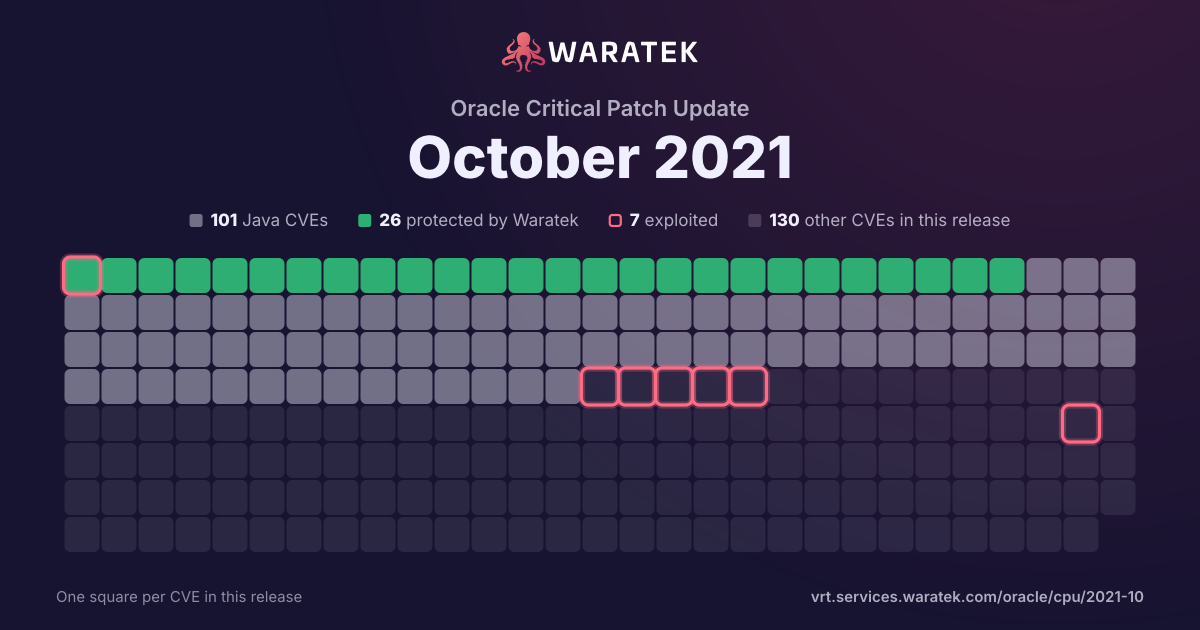
By status
26Protected by Waratek3Mitigation candidate72No exploit published42Outside Waratek scope88Not applicable
7Exploited, marked by the ring
No exploit published. For 52 of them, Oracle's security advisory is the source of public detail.
Protected by Waratek. Waratek RASP can block exploitation of these on systems that have not applied the patch yet.
Overview 119 matches · 46 in Waratek scope · 12 protected · 3 exploited · 1 CISA KEV · 7 public PoC · 10 EPSS ≥ 0.5
119matches
46in Waratek scope38.7%
12protected10.1%
3exploited2.5%
1CISA KEV0.8%
7public PoC5.9%
10EPSS ≥ 0.58.4%
Protected by Waratek
12
10.1%
Rule in development
0
0.0%
Mitigation candidate
2
1.7%
No exploit published
32
26.9%
Outside Waratek scope
17
14.3%
Not applicable
56
47.1%
Withdrawn CVE
0
0.0%
blocked by ARMR today
12
10.1%
partly blocked
0
0.0%
not blocked
107
89.9%
not established
0
0.0%
unrecorded
0
0.0%
split by
peak 90 / quarter
Q2 181
Protected by Waratek1
Medium1
blocked by ARMR today1
No public exploit1
Q3 180
Q4 180
Q1 191
Not applicable1
Medium1
not blocked1
No public exploit1
Q2 191
Outside Waratek scope1
Medium1
not blocked1
Exploited1
Q3 192
Protected by Waratek1
Outside Waratek scope1
Medium2
blocked by ARMR today1
not blocked1
No public exploit2
Q4 191
Protected by Waratek1
Medium1
blocked by ARMR today1
No public exploit1
Q1 200
Q2 203
Outside Waratek scope3
Medium3
not blocked3
Exploited2
No public exploit1
Q3 201
Outside Waratek scope1
Medium1
not blocked1
No public exploit1
Q4 204
Protected by Waratek1
No exploit published1
Outside Waratek scope2
Medium4
blocked by ARMR today1
not blocked3
Proof of concept only1
No public exploit3
Q1 217
No exploit published3
Outside Waratek scope2
Not applicable2
Medium7
not blocked7
No public exploit7
Q2 214
Protected by Waratek2
No exploit published2
Medium4
blocked by ARMR today2
not blocked2
Working exploit published1
No public exploit3
Q3 214
No exploit published4
Medium4
not blocked4
Forecast only1
No public exploit3
Q4 2190
Protected by Waratek6
Mitigation candidate2
No exploit published22
Outside Waratek scope7
Not applicable53
Medium90
blocked by ARMR today6
not blocked84
Proof of concept only4
Forecast only6
No public exploit80
Q2 18Q4 18Q2 19Q4 19Q2 20Q4 20Q2 21Q4 21
| CVE | Severity | Published▾ | Status | Exploitation | Description |
|---|---|---|---|---|---|
| CVE-2021-20227 | Medium | 2021-03-23 | Not applicable | No public exploit | A flaw was found in SQLite's SELECT query functionality (src/select.c). This flaw allows an attacker who is capable of running SQL queries locally on the SQLite database to cause a denial of service or possible code execution by triggering a use-after-free. The highest threat from this vulnerability is to system availability. |
| CVE-2021-27906 | Medium | 2021-03-19 | No exploit published | No public exploit | A carefully crafted PDF file can trigger an OutOfMemory-Exception while loading the file. This issue affects Apache PDFBox version 2.0.22 and prior 2.0.x versions. |
| CVE-2021-28363 | Medium | 2021-03-15 | Not applicable | No public exploit | The urllib3 library 1.26.x before 1.26.4 for Python omits SSL certificate validation in some cases involving HTTPS to HTTPS proxies. The initial connection to the HTTPS proxy (if an SSLContext isn't given via proxy_config) doesn't verify the hostname of the certificate. This means certificates for different servers that still validate properly with the default urllib3 SSLContext will be silently accepted. |
| CVE-2021-23841 | Medium | 2021-02-16 | Outside Waratek scope | No public exploit | The OpenSSL public API function X509_issuer_and_serial_hash() attempts to create a unique hash value based on the issuer and serial number data contained within an X509 certificate. However it fails to correctly handle any errors that may occur while parsing the issuer field (which might occur if the issuer field is maliciously constructed). This may subsequently result in a NULL pointer deref and a crash leading to a potential denial of service attack. The function X509_issuer_and_serial_hash() is never directly called by OpenSSL itself so applications are only vulnerable if they use this function directly and they use it on certificates that may have been obtained from untrusted sources. OpenSSL versions 1.1.1i and below are affected by this issue. Users of these versions should upgrade to OpenSSL 1.1.1j. OpenSSL versions 1.0.2x and below are affected by this issue. However OpenSSL 1.0.2 is out of support and no longer receiving public updates. Premium support customers of OpenSSL 1.0.2 should upgrade to 1.0.2y. Other users should upgrade to 1.1.1j. Fixed in OpenSSL 1.1.1j (Affected 1.1.1-1.1.1i). Fixed in OpenSSL 1.0.2y (Affected 1.0.2-1.0.2x). |
| CVE-2021-26272 | Medium | 2021-01-26 | Outside Waratek scope | No public exploit | It was possible to execute a ReDoS-type attack inside CKEditor 4 before 4.16 by persuading a victim to paste crafted URL-like text into the editor, and then press Enter or Space (in the Autolink plugin). |
| CVE-2020-1971 | Medium | 2020-12-08 | Outside Waratek scope | Proof of concept only | The X.509 GeneralName type is a generic type for representing different types of names. One of those name types is known as EDIPartyName. OpenSSL provides a function GENERAL_NAME_cmp which compares different instances of a GENERAL_NAME to see if they are equal or not. This function behaves incorrectly when both GENERAL_NAMEs contain an EDIPARTYNAME. A NULL pointer dereference and a crash may occur leading to a possible denial of service attack. OpenSSL itself uses the GENERAL_NAME_cmp function for two purposes: 1) Comparing CRL distribution point names between an available CRL and a CRL distribution point embedded in an X509 certificate 2) When verifying that a timestamp response token signer matches the timestamp authority name (exposed via the API functions TS_RESP_verify_response and TS_RESP_verify_token) If an attacker can control both items being compared then that attacker could trigger a crash. For example if the attacker can trick a client or server into checking a malicious certificate against a malicious CRL then this may occur. Note that some applications automatically download CRLs based on a URL embedded in a certificate. This checking happens prior to the signatures on the certificate and CRL being verified. OpenSSL's s_server, s_client and verify tools have support for the "-crl_download" option which implements automatic CRL downloading and this attack has been demonstrated to work against those tools. Note that an unrelated bug means that affected versions of OpenSSL cannot parse or construct correct encodings of EDIPARTYNAME. However it is possible to construct a malformed EDIPARTYNAME that OpenSSL's parser will accept and hence trigger this attack. All OpenSSL 1.1.1 and 1.0.2 versions are affected by this issue. Other OpenSSL releases are out of support and have not been checked. Fixed in OpenSSL 1.1.1i (Affected 1.1.1-1.1.1h). Fixed in OpenSSL 1.0.2x (Affected 1.0.2-1.0.2w). |
| CVE-2020-17521 | Medium | 2020-12-07 | Protected by Waratek | No public exploit | Apache Groovy provides extension methods to aid with creating temporary directories. Prior to this fix, Groovy's implementation of those extension methods was using a now superseded Java JDK method call that is potentially not secure on some operating systems in some contexts. Users not using the extension methods mentioned in the advisory are not affected, but may wish to read the advisory for further details. Versions Affected: 2.0 to 2.4.20, 2.5.0 to 2.5.13, 3.0.0 to 3.0.6, and 4.0.0-alpha-1. Fixed in versions 2.4.21, 2.5.14, 3.0.7, 4.0.0-alpha-2. |
| CVE-2020-13956 | Medium | 2020-12-02 | Outside Waratek scope | No public exploit | Apache HttpClient versions prior to version 4.5.13 and 5.0.3 can misinterpret malformed authority component in request URIs passed to the library as java.net.URI object and pick the wrong target host for request execution. |
| CVE-2020-27218 | Medium | 2020-11-28 | No exploit published | No public exploit | In Eclipse Jetty version 9.4.0.RC0 to 9.4.34.v20201102, 10.0.0.alpha0 to 10.0.0.beta2, and 11.0.0.alpha0 to 11.0.0.beta2, if GZIP request body inflation is enabled and requests from different clients are multiplexed onto a single connection, and if an attacker can send a request with a body that is received entirely but not consumed by the application, then a subsequent request on the same connection will see that body prepended to its body. The attacker will not see any data but may inject data into the body of the subsequent request. |
| CVE-2020-8622 | Medium | 2020-08-21 | Outside Waratek scope | No public exploit | In BIND 9.0.0 -> 9.11.21, 9.12.0 -> 9.16.5, 9.17.0 -> 9.17.3, also affects 9.9.3-S1 -> 9.11.21-S1 of the BIND 9 Supported Preview Edition, An attacker on the network path for a TSIG-signed request, or operating the server receiving the TSIG-signed request, could send a truncated response to that request, triggering an assertion failure, causing the server to exit. Alternately, an off-path attacker would have to correctly guess when a TSIG-signed request was sent, along with other characteristics of the packet and message, and spoof a truncated response to trigger an assertion failure, causing the server to exit. |
| CVE-2020-1945 | Medium | 2020-05-14 | Outside Waratek scope | No public exploit | Apache Ant 1.1 to 1.9.14 and 1.10.0 to 1.10.7 uses the default temporary directory identified by the Java system property java.io.tmpdir for several tasks and may thus leak sensitive information. The fixcrlf and replaceregexp tasks also copy files from the temporary directory back into the build tree allowing an attacker to inject modified source files into the build process. |
| CVE-2020-11023 | Medium | 2020-04-29 | Outside Waratek scope | Exploited | In jQuery versions greater than or equal to 1.0.3 and before 3.5.0, passing HTML containing <option> elements from untrusted sources - even after sanitizing it - to one of jQuery's DOM manipulation methods (i.e. .html(), .append(), and others) may execute untrusted code. This problem is patched in jQuery 3.5.0. |
| CVE-2020-11022 | Medium | 2020-04-29 | Outside Waratek scope | Exploited | In jQuery starting with 1.12.0 and before 3.5.0, passing HTML from untrusted sources - even after sanitizing it - to one of jQuery's DOM manipulation methods (i.e. .html(), .append(), and others) may execute untrusted code. This problem is patched in jQuery 3.5.0. |
| CVE-2019-12415 | Medium | 2019-10-23 | Protected by Waratek | No public exploit | In Apache POI up to 4.1.0, when using the tool XSSFExportToXml to convert user-provided Microsoft Excel documents, a specially crafted document can allow an attacker to read files from the local filesystem or from internal network resources via XML External Entity (XXE) Processing. |
| CVE-2019-3740 | Medium | 2019-09-18 | Outside Waratek scope | No public exploit | RSA BSAFE Crypto-J versions prior to 6.2.5 are vulnerable to an Information Exposure Through Timing Discrepancy vulnerabilities during DSA key generation. A malicious remote attacker could potentially exploit those vulnerabilities to recover DSA keys. |
| CVE-2019-12400 | Medium | 2019-08-23 | Protected by Waratek | No public exploit | In version 2.0.3 Apache Santuario XML Security for Java, a caching mechanism was introduced to speed up creating new XML documents using a static pool of DocumentBuilders. However, if some untrusted code can register a malicious implementation with the thread context class loader first, then this implementation might be cached and re-used by Apache Santuario - XML Security for Java, leading to potential security flaws when validating signed documents, etc. The vulnerability affects Apache Santuario - XML Security for Java 2.0.x releases from 2.0.3 and all 2.1.x releases before 2.1.4. |
| CVE-2019-11358 | Medium | 2019-04-20 | Outside Waratek scope | Exploited | jQuery before 3.4.0, as used in Drupal, Backdrop CMS, and other products, mishandles jQuery.extend(true, {}, ...) because of Object.prototype pollution. If an unsanitized source object contained an enumerable __proto__ property, it could extend the native Object.prototype. |
| CVE-2019-7317 | Medium | 2019-02-04 | Not applicable | No public exploit | png_image_free in png.c in libpng 1.6.x before 1.6.37 has a use-after-free because png_image_free_function is called under png_safe_execute. |
| CVE-2018-10237 | Medium | 2018-04-26 | Protected by Waratek | No public exploit | Unbounded memory allocation in Google Guava 11.0 through 24.x before 24.1.1 allows remote attackers to conduct denial of service attacks against servers that depend on this library and deserialize attacker-provided data, because the AtomicDoubleArray class (when serialized with Java serialization) and the CompoundOrdering class (when serialized with GWT serialization) perform eager allocation without appropriate checks on what a client has sent and whether the data size is reasonable. |