
Oracle Critical Patch Update October 2021
Released October 2021 · Oracle's advisory ↗ · ← Critical Patch Update, July 2021 · Critical Patch Update, January 2022 →
231 CVEs in this release, one square each
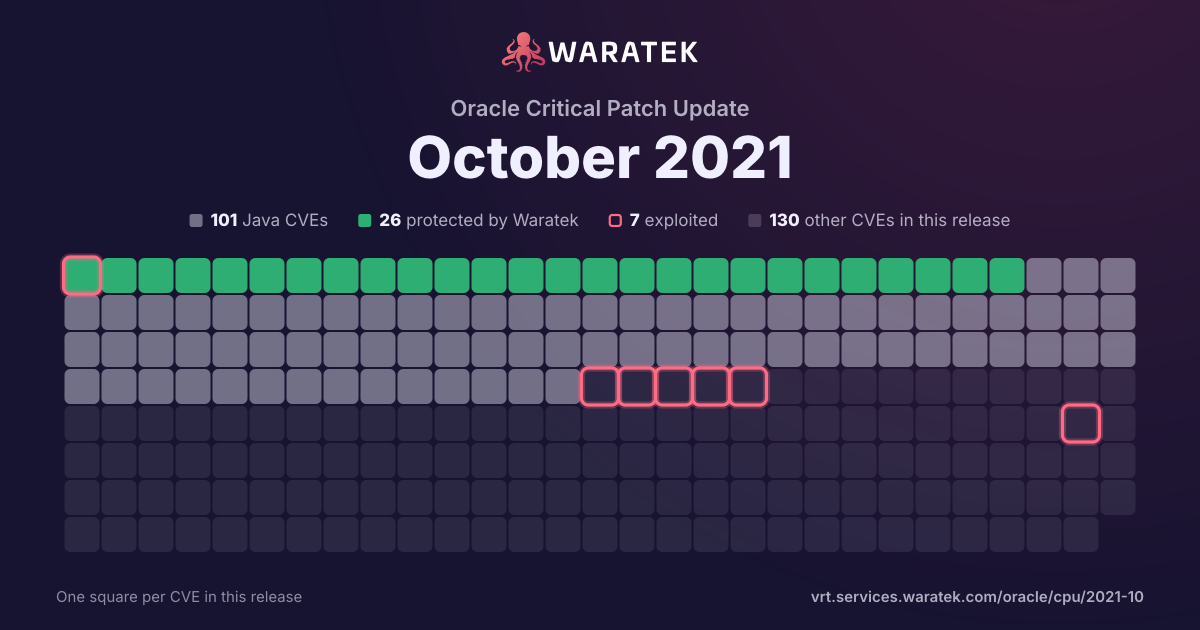
By status
25Protected by Waratek6Mitigation candidate81No exploit published3Outside Waratek scope116Not applicable
7Exploited, marked by the ring
No exploit published. For 48 of them, Oracle's security advisory is the source of public detail.
Protected by Waratek. Waratek RASP can block exploitation of these on systems that have not applied the patch yet.
Overview 5 matches · 2 in Waratek scope · 0 protected · 0 exploited · 0 CISA KEV · 4 public PoC · 2 EPSS ≥ 0.5
5matches
2in Waratek scope40.0%
0protected0.0%
0exploited0.0%
0CISA KEV0.0%
4public PoC80.0%
2EPSS ≥ 0.540.0%
Protected by Waratek
0
0.0%
Rule in development
0
0.0%
Mitigation candidate
2
40.0%
No exploit published
0
0.0%
Outside Waratek scope
0
0.0%
Not applicable
3
60.0%
Withdrawn CVE
0
0.0%
blocked by ARMR today
0
0.0%
partly blocked
0
0.0%
not blocked
5
100.0%
not established
0
0.0%
unrecorded
0
0.0%
Exploited
0
0.0%
Working exploit published
0
0.0%
Proof of concept only
5
100.0%
Forecast only
0
0.0%
No public exploit
0
0.0%
split by
peak 1 / month
Oct 191
Mitigation candidate1
Critical1
not blocked1
Proof of concept only1
Nov 190
Dec 190
Jan 201
Mitigation candidate1
High1
not blocked1
Proof of concept only1
Feb 200
Mar 200
Apr 201
Not applicable1
High1
not blocked1
Proof of concept only1
May 200
Jun 200
Jul 200
Aug 200
Sep 200
Oct 200
Nov 200
Dec 201
Not applicable1
Medium1
not blocked1
Proof of concept only1
Jan 211
Not applicable1
Critical1
not blocked1
Proof of concept only1
Nov 19Jan 20Mar 20May 20Jul 20Sep 20Nov 20Jan 21
| CVE | Severity | Published▾ | Status | Exploitation | Description |
|---|---|---|---|---|---|
| CVE-2021-3177 | Critical | 2021-01-19 | Not applicable | Proof of concept only | Python 3.x through 3.9.1 has a buffer overflow in PyCArg_repr in _ctypes/callproc.c, which may lead to remote code execution in certain Python applications that accept floating-point numbers as untrusted input, as demonstrated by a 1e300 argument to c_double.from_param. This occurs because sprintf is used unsafely. |
| CVE-2020-1971 | Medium | 2020-12-08 | Not applicable | Proof of concept only | The X.509 GeneralName type is a generic type for representing different types of names. One of those name types is known as EDIPartyName. OpenSSL provides a function GENERAL_NAME_cmp which compares different instances of a GENERAL_NAME to see if they are equal or not. This function behaves incorrectly when both GENERAL_NAMEs contain an EDIPARTYNAME. A NULL pointer dereference and a crash may occur leading to a possible denial of service attack. OpenSSL itself uses the GENERAL_NAME_cmp function for two purposes: 1) Comparing CRL distribution point names between an available CRL and a CRL distribution point embedded in an X509 certificate 2) When verifying that a timestamp response token signer matches the timestamp authority name (exposed via the API functions TS_RESP_verify_response and TS_RESP_verify_token) If an attacker can control both items being compared then that attacker could trigger a crash. For example if the attacker can trick a client or server into checking a malicious certificate against a malicious CRL then this may occur. Note that some applications automatically download CRLs based on a URL embedded in a certificate. This checking happens prior to the signatures on the certificate and CRL being verified. OpenSSL's s_server, s_client and verify tools have support for the "-crl_download" option which implements automatic CRL downloading and this attack has been demonstrated to work against those tools. Note that an unrelated bug means that affected versions of OpenSSL cannot parse or construct correct encodings of EDIPARTYNAME. However it is possible to construct a malformed EDIPARTYNAME that OpenSSL's parser will accept and hence trigger this attack. All OpenSSL 1.1.1 and 1.0.2 versions are affected by this issue. Other OpenSSL releases are out of support and have not been checked. Fixed in OpenSSL 1.1.1i (Affected 1.1.1-1.1.1h). Fixed in OpenSSL 1.0.2x (Affected 1.0.2-1.0.2w). |
| CVE-2020-1967 | High | 2020-04-21 | Not applicable | Proof of concept only | Server or client applications that call the SSL_check_chain() function during or after a TLS 1.3 handshake may crash due to a NULL pointer dereference as a result of incorrect handling of the "signature_algorithms_cert" TLS extension. The crash occurs if an invalid or unrecognised signature algorithm is received from the peer. This could be exploited by a malicious peer in a Denial of Service attack. OpenSSL version 1.1.1d, 1.1.1e, and 1.1.1f are affected by this issue. This issue did not affect OpenSSL versions prior to 1.1.1d. Fixed in OpenSSL 1.1.1g (Affected 1.1.1d-1.1.1f). |
| CVE-2020-5398 | High | 2020-01-17 | Mitigation candidate | Proof of concept only | In Spring Framework, versions 5.2.x prior to 5.2.3, versions 5.1.x prior to 5.1.13, and versions 5.0.x prior to 5.0.16, an application is vulnerable to a reflected file download (RFD) attack when it sets a "Content-Disposition" header in the response where the filename attribute is derived from user supplied input. |
| CVE-2019-17195 | Critical | 2019-10-15 | Mitigation candidate | Proof of concept only | Connect2id Nimbus JOSE+JWT before v7.9 can throw various uncaught exceptions while parsing a JWT, which could result in an application crash (potential information disclosure) or a potential authentication bypass. |