
Oracle Critical Patch Update October 2021
Released October 2021 · Oracle's advisory ↗ · ← Critical Patch Update, July 2021 · Critical Patch Update, January 2022 →
231 CVEs in this release, one square each
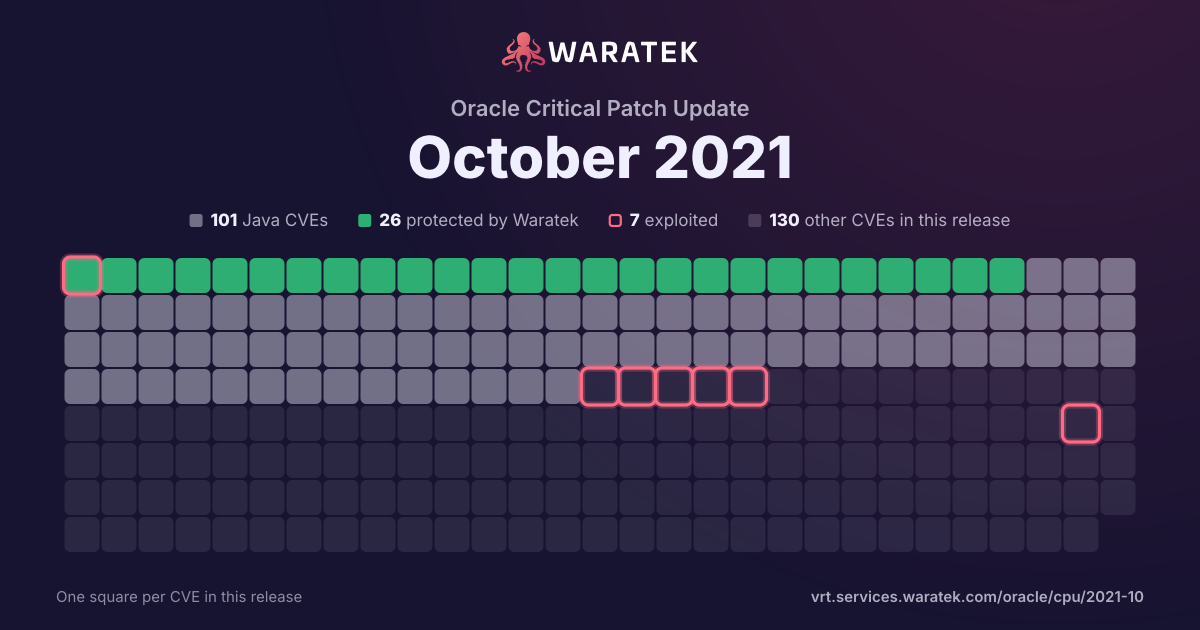
By status
26Protected by Waratek3Mitigation candidate72No exploit published42Outside Waratek scope88Not applicable
7Exploited, marked by the ring
No exploit published. For 52 of them, Oracle's security advisory is the source of public detail.
Protected by Waratek. Waratek RASP can block exploitation of these on systems that have not applied the patch yet.
Overview 18 matches · 1 exploited · 1 CISA KEV · 4 public PoC · 3 EPSS ≥ 0.5
Protected by Waratek
18
100.0%
Rule in development
0
0.0%
Mitigation candidate
0
0.0%
No exploit published
0
0.0%
blocked by ARMR today
18
100.0%
partly blocked
0
0.0%
not blocked
0
0.0%
not established
0
0.0%
unrecorded
0
0.0%
Exploited
1
5.6%
Working exploit published
3
16.7%
Proof of concept only
0
0.0%
Forecast only
0
0.0%
No public exploit
14
77.8%
split by
peak 3 / quarter
Q4 161
Protected by Waratek1
Critical1
blocked by ARMR today1
No public exploit1
Q1 170
Q2 170
Q3 170
Q4 170
Q1 181
Protected by Waratek1
Critical1
blocked by ARMR today1
No public exploit1
Q2 181
Protected by Waratek1
Medium1
blocked by ARMR today1
No public exploit1
Q3 180
Q4 180
Q1 190
Q2 190
Q3 192
Protected by Waratek2
High1
Medium1
blocked by ARMR today2
No public exploit2
Q4 191
Protected by Waratek1
Medium1
blocked by ARMR today1
No public exploit1
Q1 200
Q2 202
Protected by Waratek2
Critical1
High1
blocked by ARMR today2
Working exploit published1
No public exploit1
Q3 202
Protected by Waratek2
Critical1
High1
blocked by ARMR today2
No public exploit2
Q4 203
Protected by Waratek3
Critical1
High1
Medium1
blocked by ARMR today3
Exploited1
No public exploit2
Q1 213
Protected by Waratek3
Critical2
High1
blocked by ARMR today3
Working exploit published1
No public exploit2
Q2 212
Protected by Waratek2
Medium2
blocked by ARMR today2
Working exploit published1
No public exploit1
Q4 16Q2 17Q4 17Q2 18Q4 18Q2 19Q4 19Q2 20Q4 20Q2 21
| CVE | Severity | Published▾ | Status | Exploitation | Description |
|---|---|---|---|---|---|
| CVE-2020-6950 | Medium | 2021-06-02 | Protected by Waratek | Working exploit published | Directory traversal in Eclipse Mojarra before 2.3.14 allows attackers to read arbitrary files via the loc parameter or con parameter. |
| CVE-2021-29425 | Medium | 2021-04-13 | Protected by Waratek | No public exploit | In Apache Commons IO before 2.7, When invoking the method FileNameUtils.normalize with an improper input string, like "//../foo", or "\\..\foo", the result would be the same value, thus possibly providing access to files in the parent directory, but not further above (thus "limited" path traversal), if the calling code would use the result to construct a path value. |
| CVE-2021-21345 | Critical | 2021-03-23 | Protected by Waratek | Working exploit published | XStream is a Java library to serialize objects to XML and back again. In XStream before version 1.4.16, there is a vulnerability which may allow a remote attacker who has sufficient rights to execute commands of the host only by manipulating the processed input stream. No user is affected, who followed the recommendation to setup XStream's security framework with a whitelist limited to the minimal required types. If you rely on XStream's default blacklist of the Security Framework, you will have to use at least version 1.4.16. |
| CVE-2021-25122 | High | 2021-03-01 | Protected by Waratek | No public exploit | When responding to new h2c connection requests, Apache Tomcat versions 10.0.0-M1 to 10.0.0, 9.0.0.M1 to 9.0.41 and 8.5.0 to 8.5.61 could duplicate request headers and a limited amount of request body from one request to another meaning user A and user B could both see the results of user A's request. |
| CVE-2021-23926 | Critical | 2021-01-14 | Protected by Waratek | No public exploit | The XML parsers used by XMLBeans up to version 2.6.0 did not set the properties needed to protect the user from malicious XML input. Vulnerabilities include possibilities for XML Entity Expansion attacks. Affects XMLBeans up to and including v2.6.0. |
| CVE-2020-17530 | Critical | 2020-12-11 | Protected by Waratek | Exploited | Forced OGNL evaluation, when evaluated on raw user input in tag attributes, may lead to remote code execution. Affected software : Apache Struts 2.0.0 - Struts 2.5.25. |
| CVE-2020-17521 | Medium | 2020-12-07 | Protected by Waratek | No public exploit | Apache Groovy provides extension methods to aid with creating temporary directories. Prior to this fix, Groovy's implementation of those extension methods was using a now superseded Java JDK method call that is potentially not secure on some operating systems in some contexts. Users not using the extension methods mentioned in the advisory are not affected, but may wish to read the advisory for further details. Versions Affected: 2.0 to 2.4.20, 2.5.0 to 2.5.13, 3.0.0 to 3.0.6, and 4.0.0-alpha-1. Fixed in versions 2.4.21, 2.5.14, 3.0.7, 4.0.0-alpha-2. |
| CVE-2020-25649 | High | 2020-12-03 | Protected by Waratek | No public exploit | A flaw was found in FasterXML Jackson Databind, where it did not have entity expansion secured properly. This flaw allows vulnerability to XML external entity (XXE) attacks. The highest threat from this vulnerability is data integrity. |
| CVE-2020-24750 | High | 2020-09-17 | Protected by Waratek | No public exploit | FasterXML jackson-databind 2.x before 2.9.10.6 mishandles the interaction between serialization gadgets and typing, related to com.pastdev.httpcomponents.configuration.JndiConfiguration. |
| CVE-2020-11998 | Critical | 2020-09-10 | Protected by Waratek | No public exploit | A regression has been introduced in the commit preventing JMX re-bind. By passing an empty environment map to RMIConnectorServer, instead of the map that contains the authentication credentials, it leaves ActiveMQ open to the following attack: https://docs.oracle.com/javase/8/docs/technotes/guides/management/agent.html "A remote client could create a javax.management.loading.MLet MBean and use it to create new MBeans from arbitrary URLs, at least if there is no security manager. In other words, a rogue remote client could make your Java application execute arbitrary code." Mitigation: Upgrade to Apache ActiveMQ 5.15.13 |
| CVE-2020-9484 | High | 2020-05-20 | Protected by Waratek | Working exploit published | When using Apache Tomcat versions 10.0.0-M1 to 10.0.0-M4, 9.0.0.M1 to 9.0.34, 8.5.0 to 8.5.54 and 7.0.0 to 7.0.103 if a) an attacker is able to control the contents and name of a file on the server; and b) the server is configured to use the PersistenceManager with a FileStore; and c) the PersistenceManager is configured with sessionAttributeValueClassNameFilter="null" (the default unless a SecurityManager is used) or a sufficiently lax filter to allow the attacker provided object to be deserialized; and d) the attacker knows the relative file path from the storage location used by FileStore to the file the attacker has control over; then, using a specifically crafted request, the attacker will be able to trigger remote code execution via deserialization of the file under their control. Note that all of conditions a) to d) must be true for the attack to succeed. |
| CVE-2020-10683 | Critical | 2020-05-01 | Protected by Waratek | No public exploit | dom4j before 2.0.3 and 2.1.x before 2.1.3 allows external DTDs and External Entities by default, which might enable XXE attacks. However, there is popular external documentation from OWASP showing how to enable the safe, non-default behavior in any application that uses dom4j. |
| CVE-2019-12415 | Medium | 2019-10-23 | Protected by Waratek | No public exploit | In Apache POI up to 4.1.0, when using the tool XSSFExportToXml to convert user-provided Microsoft Excel documents, a specially crafted document can allow an attacker to read files from the local filesystem or from internal network resources via XML External Entity (XXE) Processing. |
| CVE-2019-12400 | Medium | 2019-08-23 | Protected by Waratek | No public exploit | In version 2.0.3 Apache Santuario XML Security for Java, a caching mechanism was introduced to speed up creating new XML documents using a static pool of DocumentBuilders. However, if some untrusted code can register a malicious implementation with the thread context class loader first, then this implementation might be cached and re-used by Apache Santuario - XML Security for Java, leading to potential security flaws when validating signed documents, etc. The vulnerability affects Apache Santuario - XML Security for Java 2.0.x releases from 2.0.3 and all 2.1.x releases before 2.1.4. |
| CVE-2019-10086 | High | 2019-08-20 | Protected by Waratek | No public exploit | In Apache Commons Beanutils 1.9.2, a special BeanIntrospector class was added which allows suppressing the ability for an attacker to access the classloader via the class property available on all Java objects. We, however were not using this by default characteristic of the PropertyUtilsBean. |
| CVE-2018-10237 | Medium | 2018-04-26 | Protected by Waratek | No public exploit | Unbounded memory allocation in Google Guava 11.0 through 24.x before 24.1.1 allows remote attackers to conduct denial of service attacks against servers that depend on this library and deserialize attacker-provided data, because the AtomicDoubleArray class (when serialized with Java serialization) and the CompoundOrdering class (when serialized with GWT serialization) perform eager allocation without appropriate checks on what a client has sent and whether the data size is reasonable. |
| CVE-2018-8088 | Critical | 2018-03-20 | Protected by Waratek | No public exploit | org.slf4j.ext.EventData in the slf4j-ext module in QOS.CH SLF4J before 1.8.0-beta2 allows remote attackers to bypass intended access restrictions via crafted data. EventData in the slf4j-ext module in QOS.CH SLF4J, has been fixed in SLF4J versions 1.7.26 later and in the 2.0.x series. |
| CVE-2016-1000031 | Critical | 2016-10-25 | Protected by Waratek | No public exploit | Apache Commons FileUpload before 1.3.3 DiskFileItem File Manipulation Remote Code Execution |