
Oracle Critical Patch Update October 2021
Released October 2021 · Oracle's advisory ↗ · ← Critical Patch Update, July 2021 · Critical Patch Update, January 2022 →
231 CVEs in this release, one square each
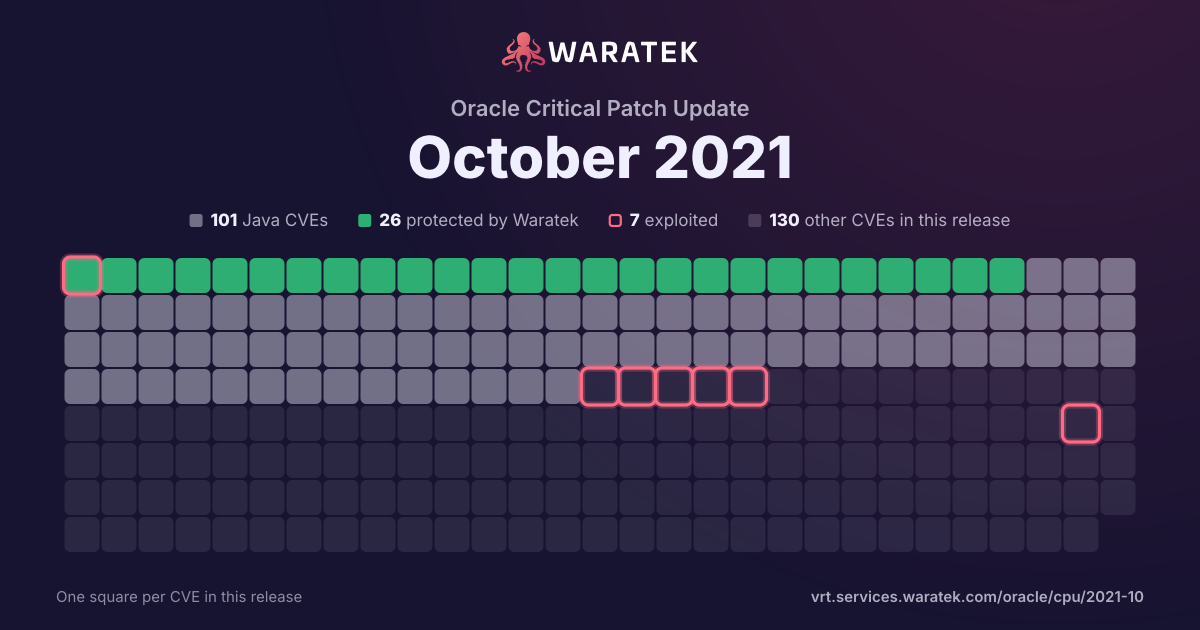
By status
25Protected by Waratek6Mitigation candidate81No exploit published3Outside Waratek scope116Not applicable
7Exploited, marked by the ring
No exploit published. For 48 of them, Oracle's security advisory is the source of public detail.
Protected by Waratek. Waratek RASP can block exploitation of these on systems that have not applied the patch yet.
Overview 11 matches · 1 protected · 0 exploited · 0 CISA KEV · 1 public PoC · 1 EPSS ≥ 0.5
Protected by Waratek
1
9.1%
Rule in development
0
0.0%
Mitigation candidate
0
0.0%
No exploit published
10
90.9%
blocked by ARMR today
1
9.1%
partly blocked
0
0.0%
not blocked
10
90.9%
not established
0
0.0%
unrecorded
0
0.0%
Exploited
0
0.0%
Working exploit published
1
9.1%
Proof of concept only
0
0.0%
Forecast only
1
9.1%
No public exploit
9
81.8%
split by
peak 4 / month
Jun 213
Protected by Waratek1
No exploit published2
High1
Medium2
blocked by ARMR today1
not blocked2
Working exploit published1
No public exploit2
Jul 214
No exploit published4
High2
Medium2
not blocked4
Forecast only1
No public exploit3
Aug 210
Sep 210
Oct 214
No exploit published4
Critical1
High2
Medium1
not blocked4
No public exploit4
Jun 21Jul 21Aug 21Sep 21Oct 21
| CVE | Severity | Published▾ | Status | Exploitation | Description |
|---|---|---|---|---|---|
| CVE-2021-35620 | High | 2021-10-20 | No exploit published | No public exploit | Vulnerability in the Oracle WebLogic Server product of Oracle Fusion Middleware (component: Core). Supported versions that are affected are 10.3.6.0.0, 12.1.3.0.0, 12.2.1.3.0, 12.2.1.4.0 and 14.1.1.0.0. Easily exploitable vulnerability allows unauthenticated attacker with network access via T3 to compromise Oracle WebLogic Server. Successful attacks of this vulnerability can result in unauthorized ability to cause a hang or frequently repeatable crash (complete DOS) of Oracle WebLogic Server. CVSS 3.1 Base Score 7.5 (Availability impacts). CVSS Vector: (CVSS:3.1/AV:N/AC:L/PR:N/UI:N/S:U/C:N/I:N/A:H). |
| CVE-2021-35617 | Critical | 2021-10-20 | No exploit published | No public exploit | Vulnerability in the Oracle WebLogic Server product of Oracle Fusion Middleware (component: Coherence Container). Supported versions that are affected are 12.1.3.0.0, 12.2.1.3.0, 12.2.1.4.0 and 14.1.1.0.0. Easily exploitable vulnerability allows unauthenticated attacker with network access via IIOP to compromise Oracle WebLogic Server. Successful attacks of this vulnerability can result in takeover of Oracle WebLogic Server. CVSS 3.1 Base Score 9.8 (Confidentiality, Integrity and Availability impacts). CVSS Vector: (CVSS:3.1/AV:N/AC:L/PR:N/UI:N/S:U/C:H/I:H/A:H). |
| CVE-2021-35574 | High | 2021-10-20 | No exploit published | No public exploit | Vulnerability in the Oracle Outside In Technology product of Oracle Fusion Middleware (component: Outside In Filters). The supported version that is affected is 8.5.5. Easily exploitable vulnerability allows unauthenticated attacker with network access via HTTP to compromise Oracle Outside In Technology. Successful attacks of this vulnerability can result in unauthorized ability to cause a hang or frequently repeatable crash (complete DOS) of Oracle Outside In Technology. Note: Outside In Technology is a suite of software development kits (SDKs). The protocol and CVSS Base Score depend on the software that uses Outside In Technology. The CVSS score assumes that the software passes data received over a network directly to Outside In Technology, but if data is not received over a network the CVSS score may be lower. CVSS 3.1 Base Score 7.5 (Availability impacts). CVSS Vector: (CVSS:3.1/AV:N/AC:L/PR:N/UI:N/S:U/C:N/I:N/A:H). |
| CVE-2021-35552 | Medium | 2021-10-20 | No exploit published | No public exploit | Vulnerability in the Oracle WebLogic Server product of Oracle Fusion Middleware (component: Diagnostics). Supported versions that are affected are 12.2.1.3.0, 12.2.1.4.0 and 14.1.1.0.0. Easily exploitable vulnerability allows unauthenticated attacker with network access via HTTP to compromise Oracle WebLogic Server. Successful attacks of this vulnerability can result in unauthorized update, insert or delete access to some of Oracle WebLogic Server accessible data. CVSS 3.1 Base Score 5.3 (Integrity impacts). CVSS Vector: (CVSS:3.1/AV:N/AC:L/PR:N/UI:N/S:U/C:N/I:L/A:N). |
| CVE-2021-2351 | High | 2021-07-21 | No exploit published | No public exploit | Vulnerability in the Advanced Networking Option component of Oracle Database Server. Supported versions that are affected are 12.1.0.2, 12.2.0.1 and 19c. Difficult to exploit vulnerability allows unauthenticated attacker with network access via Oracle Net to compromise Advanced Networking Option. Successful attacks require human interaction from a person other than the attacker and while the vulnerability is in Advanced Networking Option, attacks may significantly impact additional products. Successful attacks of this vulnerability can result in takeover of Advanced Networking Option. Note: The July 2021 Critical Patch Update introduces a number of Native Network Encryption changes to deal with vulnerability CVE-2021-2351 and prevent the use of weaker ciphers. Customers should review: "Changes in Native Network Encryption with the July 2021 Critical Patch Update" (Doc ID 2791571.1). CVSS 3.1 Base Score 8.3 (Confidentiality, Integrity and Availability impacts). CVSS Vector: (CVSS:3.1/AV:N/AC:H/PR:N/UI:R/S:C/C:H/I:H/A:H). |
| CVE-2021-36374 | Medium | 2021-07-14 | No exploit published | No public exploit | When reading a specially crafted ZIP archive, or a derived formats, an Apache Ant build can be made to allocate large amounts of memory that leads to an out of memory error, even for small inputs. This can be used to disrupt builds using Apache Ant. Commonly used derived formats from ZIP archives are for instance JAR files and many office files. Apache Ant prior to 1.9.16 and 1.10.11 were affected. |
| CVE-2021-36090 | High | 2021-07-13 | No exploit published | No public exploit | When reading a specially crafted ZIP archive, Compress can be made to allocate large amounts of memory that finally leads to an out of memory error even for very small inputs. This could be used to mount a denial of service attack against services that use Compress' zip package. |
| CVE-2021-33037 | Medium | 2021-07-12 | No exploit published | Forecast only | Apache Tomcat 10.0.0-M1 to 10.0.6, 9.0.0.M1 to 9.0.46 and 8.5.0 to 8.5.66 did not correctly parse the HTTP transfer-encoding request header in some circumstances leading to the possibility to request smuggling when used with a reverse proxy. Specifically: - Tomcat incorrectly ignored the transfer encoding header if the client declared it would only accept an HTTP/1.0 response; - Tomcat honoured the identify encoding; and - Tomcat did not ensure that, if present, the chunked encoding was the final encoding. |
| CVE-2021-30468 | High | 2021-06-16 | No exploit published | No public exploit | A vulnerability in the JsonMapObjectReaderWriter of Apache CXF allows an attacker to submit malformed JSON to a web service, which results in the thread getting stuck in an infinite loop, consuming CPU indefinitely. This issue affects Apache CXF versions prior to 3.4.4; Apache CXF versions prior to 3.3.11. |
| CVE-2021-31812 | Medium | 2021-06-12 | No exploit published | No public exploit | In Apache PDFBox, a carefully crafted PDF file can trigger an infinite loop while loading the file. This issue affects Apache PDFBox version 2.0.23 and prior 2.0.x versions. |
| CVE-2020-6950 | Medium | 2021-06-02 | Protected by Waratek | Working exploit published | Directory traversal in Eclipse Mojarra before 2.3.14 allows attackers to read arbitrary files via the loc parameter or con parameter. |