
Oracle Critical Patch Update October 2021
Released October 2021 · Oracle's advisory ↗ · ← Critical Patch Update, July 2021 · Critical Patch Update, January 2022 →
231 CVEs in this release, one square each
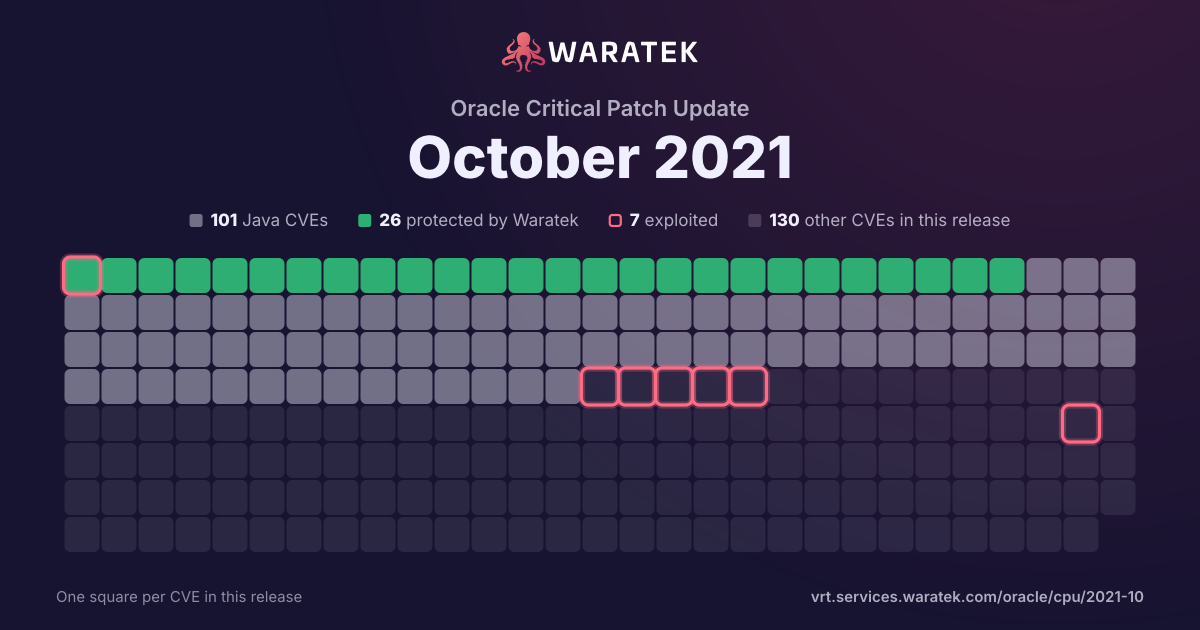
By status
26Protected by Waratek3Mitigation candidate72No exploit published42Outside Waratek scope88Not applicable
7Exploited, marked by the ring
No exploit published. For 52 of them, Oracle's security advisory is the source of public detail.
Protected by Waratek. Waratek RASP can block exploitation of these on systems that have not applied the patch yet.
Overview 4 matches · 0 protected · 0 exploited · 0 CISA KEV · 0 public PoC · 0 EPSS ≥ 0.5
4matches
0protected0.0%
0exploited0.0%
0CISA KEV0.0%
0public PoC0.0%
0EPSS ≥ 0.50.0%
Protected by Waratek
0
0.0%
Rule in development
0
0.0%
Mitigation candidate
0
0.0%
No exploit published
4
100.0%
blocked by ARMR today
0
0.0%
partly blocked
0
0.0%
not blocked
4
100.0%
not established
0
0.0%
unrecorded
0
0.0%
Exploited
0
0.0%
Working exploit published
0
0.0%
Proof of concept only
0
0.0%
Forecast only
0
0.0%
No public exploit
4
100.0%
split by
peak 2 / month
Jul 201
No exploit published1
Critical1
not blocked1
No public exploit1
Aug 200
Sep 200
Oct 200
Nov 200
Dec 200
Jan 210
Feb 210
Mar 211
No exploit published1
Critical1
not blocked1
No public exploit1
Apr 210
May 210
Jun 210
Jul 210
Aug 210
Sep 210
Oct 212
No exploit published2
Critical2
not blocked2
No public exploit2
Aug 20Oct 20Dec 20Feb 21Apr 21Jun 21Aug 21Oct 21
| CVE | Severity | Published▾ | Status | Exploitation | Description |
|---|---|---|---|---|---|
| CVE-2021-35652 | Critical | 2021-10-20 | No exploit published | No public exploit | Vulnerability in the Essbase Administration Services product of Oracle Essbase (component: EAS Console). The supported versions that are affected are Prior to 11.1.2.4.046 and Prior to 21.3. Easily exploitable vulnerability allows unauthenticated attacker with network access via HTTP to compromise Essbase Administration Services. While the vulnerability is in Essbase Administration Services, attacks may significantly impact additional products. Successful attacks of this vulnerability can result in takeover of Essbase Administration Services. CVSS 3.1 Base Score 10.0 (Confidentiality, Integrity and Availability impacts). CVSS Vector: (CVSS:3.1/AV:N/AC:L/PR:N/UI:N/S:C/C:H/I:H/A:H). |
| CVE-2021-35617 | Critical | 2021-10-20 | No exploit published | No public exploit | Vulnerability in the Oracle WebLogic Server product of Oracle Fusion Middleware (component: Coherence Container). Supported versions that are affected are 12.1.3.0.0, 12.2.1.3.0, 12.2.1.4.0 and 14.1.1.0.0. Easily exploitable vulnerability allows unauthenticated attacker with network access via IIOP to compromise Oracle WebLogic Server. Successful attacks of this vulnerability can result in takeover of Oracle WebLogic Server. CVSS 3.1 Base Score 9.8 (Confidentiality, Integrity and Availability impacts). CVSS Vector: (CVSS:3.1/AV:N/AC:L/PR:N/UI:N/S:U/C:H/I:H/A:H). |
| CVE-2021-21783 | Critical | 2021-03-25 | No exploit published | No public exploit | A code execution vulnerability exists in the WS-Addressing plugin functionality of Genivia gSOAP 2.8.107. A specially crafted SOAP request can lead to remote code execution. An attacker can send an HTTP request to trigger this vulnerability. |
| CVE-2020-5413 | Critical | 2020-07-31 | No exploit published | No public exploit | Spring Integration framework provides Kryo Codec implementations as an alternative for Java (de)serialization. When Kryo is configured with default options, all unregistered classes are resolved on demand. This leads to the "deserialization gadgets" exploit when provided data contains malicious code for execution during deserialization. In order to protect against this type of attack, Kryo can be configured to require a set of trusted classes for (de)serialization. Spring Integration should be proactive against blocking unknown "deserialization gadgets" when configuring Kryo in code. |