
Oracle Critical Patch Update October 2021
Released October 2021 · Oracle's advisory ↗ · ← Critical Patch Update, July 2021 · Critical Patch Update, January 2022 →
231 CVEs in this release, one square each
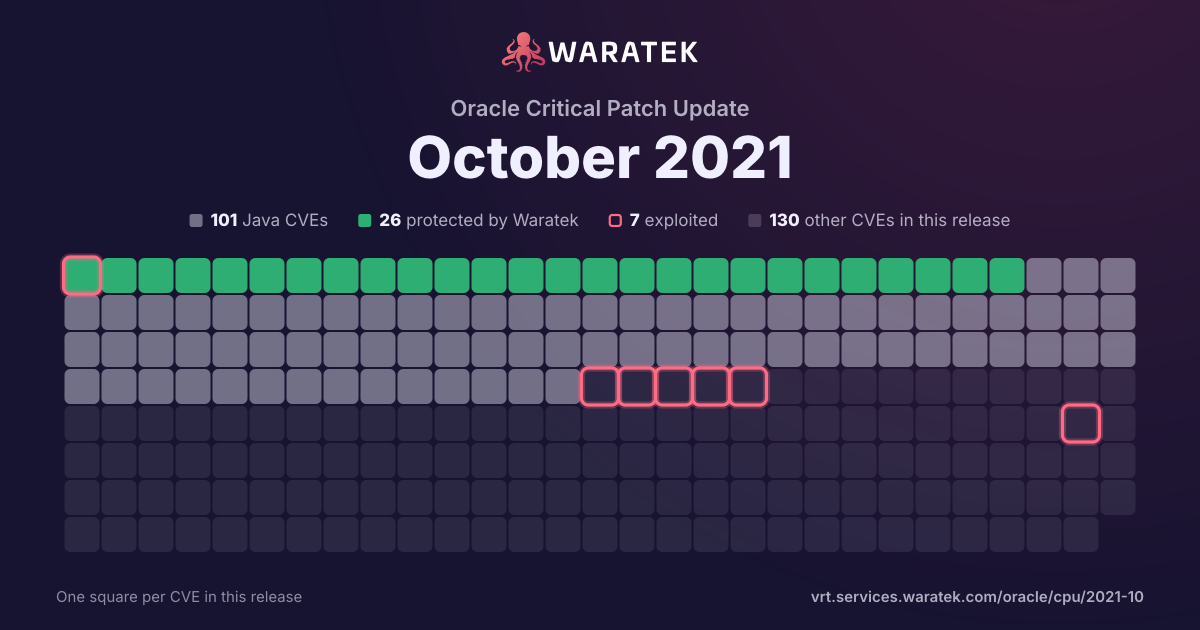
By status
26Protected by Waratek3Mitigation candidate72No exploit published42Outside Waratek scope88Not applicable
7Exploited, marked by the ring
No exploit published. For 52 of them, Oracle's security advisory is the source of public detail.
Protected by Waratek. Waratek RASP can block exploitation of these on systems that have not applied the patch yet.
Overview 18 matches · 11 in Waratek scope · 7 protected · 2 exploited · 2 CISA KEV · 4 public PoC · 5 EPSS ≥ 0.5
18matches
11in Waratek scope61.1%
7protected38.9%
2exploited11.1%
2CISA KEV11.1%
4public PoC22.2%
5EPSS ≥ 0.527.8%
Protected by Waratek
7
38.9%
Rule in development
0
0.0%
Mitigation candidate
0
0.0%
No exploit published
4
22.2%
Outside Waratek scope
6
33.3%
Not applicable
1
5.6%
Withdrawn CVE
0
0.0%
blocked by ARMR today
7
38.9%
partly blocked
0
0.0%
not blocked
11
61.1%
not established
0
0.0%
unrecorded
0
0.0%
split by
peak 4 / quarter
Q4 161
Protected by Waratek1
Critical1
blocked by ARMR today1
No public exploit1
Q1 170
Q2 171
Outside Waratek scope1
Critical1
not blocked1
Exploited1
Q3 170
Q4 170
Q1 181
Protected by Waratek1
Critical1
blocked by ARMR today1
No public exploit1
Q2 180
Q3 180
Q4 180
Q1 190
Q2 190
Q3 191
Outside Waratek scope1
Critical1
not blocked1
No public exploit1
Q4 191
Outside Waratek scope1
Critical1
not blocked1
Proof of concept only1
Q1 200
Q2 201
Protected by Waratek1
Critical1
blocked by ARMR today1
No public exploit1
Q3 202
Protected by Waratek1
No exploit published1
Critical2
blocked by ARMR today1
not blocked1
No public exploit2
Q4 201
Protected by Waratek1
Critical1
blocked by ARMR today1
Exploited1
Q1 214
Protected by Waratek2
No exploit published1
Outside Waratek scope1
Critical4
blocked by ARMR today2
not blocked2
Working exploit published1
Proof of concept only1
No public exploit2
Q2 211
Outside Waratek scope1
Critical1
not blocked1
Forecast only1
Q3 212
Outside Waratek scope1
Not applicable1
Critical2
not blocked2
Forecast only1
No public exploit1
Q4 212
No exploit published2
Critical2
not blocked2
No public exploit2
Q4 16Q2 17Q4 17Q2 18Q4 18Q2 19Q4 19Q2 20Q4 20Q2 21Q4 21
| CVE | Severity | Published▾ | Status | Exploitation | Description |
|---|---|---|---|---|---|
| CVE-2021-35652 | Critical | 2021-10-20 | No exploit published | No public exploit | Vulnerability in the Essbase Administration Services product of Oracle Essbase (component: EAS Console). The supported versions that are affected are Prior to 11.1.2.4.046 and Prior to 21.3. Easily exploitable vulnerability allows unauthenticated attacker with network access via HTTP to compromise Essbase Administration Services. While the vulnerability is in Essbase Administration Services, attacks may significantly impact additional products. Successful attacks of this vulnerability can result in takeover of Essbase Administration Services. CVSS 3.1 Base Score 10.0 (Confidentiality, Integrity and Availability impacts). CVSS Vector: (CVSS:3.1/AV:N/AC:L/PR:N/UI:N/S:C/C:H/I:H/A:H). |
| CVE-2021-35617 | Critical | 2021-10-20 | No exploit published | No public exploit | Vulnerability in the Oracle WebLogic Server product of Oracle Fusion Middleware (component: Coherence Container). Supported versions that are affected are 12.1.3.0.0, 12.2.1.3.0, 12.2.1.4.0 and 14.1.1.0.0. Easily exploitable vulnerability allows unauthenticated attacker with network access via IIOP to compromise Oracle WebLogic Server. Successful attacks of this vulnerability can result in takeover of Oracle WebLogic Server. CVSS 3.1 Base Score 9.8 (Confidentiality, Integrity and Availability impacts). CVSS Vector: (CVSS:3.1/AV:N/AC:L/PR:N/UI:N/S:U/C:H/I:H/A:H). |
| CVE-2021-3711 | Critical | 2021-08-24 | Outside Waratek scope | Forecast only | In order to decrypt SM2 encrypted data an application is expected to call the API function EVP_PKEY_decrypt(). Typically an application will call this function twice. The first time, on entry, the "out" parameter can be NULL and, on exit, the "outlen" parameter is populated with the buffer size required to hold the decrypted plaintext. The application can then allocate a sufficiently sized buffer and call EVP_PKEY_decrypt() again, but this time passing a non-NULL value for the "out" parameter. A bug in the implementation of the SM2 decryption code means that the calculation of the buffer size required to hold the plaintext returned by the first call to EVP_PKEY_decrypt() can be smaller than the actual size required by the second call. This can lead to a buffer overflow when EVP_PKEY_decrypt() is called by the application a second time with a buffer that is too small. A malicious attacker who is able present SM2 content for decryption to an application could cause attacker chosen data to overflow the buffer by up to a maximum of 62 bytes altering the contents of other data held after the buffer, possibly changing application behaviour or causing the application to crash. The location of the buffer is application dependent but is typically heap allocated. Fixed in OpenSSL 1.1.1l (Affected 1.1.1-1.1.1k). |
| CVE-2021-22931 | Critical | 2021-08-16 | Not applicable | No public exploit | Node.js before 16.6.0, 14.17.4, and 12.22.4 is vulnerable to Remote Code Execution, XSS, Application crashes due to missing input validation of host names returned by Domain Name Servers in Node.js dns library which can lead to output of wrong hostnames (leading to Domain Hijacking) and injection vulnerabilities in applications using the library. |
| CVE-2021-26691 | Critical | 2021-06-10 | Outside Waratek scope | Forecast only | In Apache HTTP Server versions 2.4.0 to 2.4.46 a specially crafted SessionHeader sent by an origin server could cause a heap overflow |
| CVE-2021-21783 | Critical | 2021-03-25 | No exploit published | No public exploit | A code execution vulnerability exists in the WS-Addressing plugin functionality of Genivia gSOAP 2.8.107. A specially crafted SOAP request can lead to remote code execution. An attacker can send an HTTP request to trigger this vulnerability. |
| CVE-2021-21345 | Critical | 2021-03-23 | Protected by Waratek | Working exploit published | XStream is a Java library to serialize objects to XML and back again. In XStream before version 1.4.16, there is a vulnerability which may allow a remote attacker who has sufficient rights to execute commands of the host only by manipulating the processed input stream. No user is affected, who followed the recommendation to setup XStream's security framework with a whitelist limited to the minimal required types. If you rely on XStream's default blacklist of the Security Framework, you will have to use at least version 1.4.16. |
| CVE-2021-3177 | Critical | 2021-01-19 | Outside Waratek scope | Proof of concept only | Python 3.x through 3.9.1 has a buffer overflow in PyCArg_repr in _ctypes/callproc.c, which may lead to remote code execution in certain Python applications that accept floating-point numbers as untrusted input, as demonstrated by a 1e300 argument to c_double.from_param. This occurs because sprintf is used unsafely. |
| CVE-2021-23926 | Critical | 2021-01-14 | Protected by Waratek | No public exploit | The XML parsers used by XMLBeans up to version 2.6.0 did not set the properties needed to protect the user from malicious XML input. Vulnerabilities include possibilities for XML Entity Expansion attacks. Affects XMLBeans up to and including v2.6.0. |
| CVE-2020-17530 | Critical | 2020-12-11 | Protected by Waratek | Exploited | Forced OGNL evaluation, when evaluated on raw user input in tag attributes, may lead to remote code execution. Affected software : Apache Struts 2.0.0 - Struts 2.5.25. |
| CVE-2020-11998 | Critical | 2020-09-10 | Protected by Waratek | No public exploit | A regression has been introduced in the commit preventing JMX re-bind. By passing an empty environment map to RMIConnectorServer, instead of the map that contains the authentication credentials, it leaves ActiveMQ open to the following attack: https://docs.oracle.com/javase/8/docs/technotes/guides/management/agent.html "A remote client could create a javax.management.loading.MLet MBean and use it to create new MBeans from arbitrary URLs, at least if there is no security manager. In other words, a rogue remote client could make your Java application execute arbitrary code." Mitigation: Upgrade to Apache ActiveMQ 5.15.13 |
| CVE-2020-5413 | Critical | 2020-07-31 | No exploit published | No public exploit | Spring Integration framework provides Kryo Codec implementations as an alternative for Java (de)serialization. When Kryo is configured with default options, all unregistered classes are resolved on demand. This leads to the "deserialization gadgets" exploit when provided data contains malicious code for execution during deserialization. In order to protect against this type of attack, Kryo can be configured to require a set of trusted classes for (de)serialization. Spring Integration should be proactive against blocking unknown "deserialization gadgets" when configuring Kryo in code. |
| CVE-2020-10683 | Critical | 2020-05-01 | Protected by Waratek | No public exploit | dom4j before 2.0.3 and 2.1.x before 2.1.3 allows external DTDs and External Entities by default, which might enable XXE attacks. However, there is popular external documentation from OWASP showing how to enable the safe, non-default behavior in any application that uses dom4j. |
| CVE-2019-17195 | Critical | 2019-10-15 | Outside Waratek scope | Proof of concept only | Connect2id Nimbus JOSE+JWT before v7.9 can throw various uncaught exceptions while parsing a JWT, which could result in an application crash (potential information disclosure) or a potential authentication bypass. |
| CVE-2019-13990 | Critical | 2019-07-26 | Outside Waratek scope | No public exploit | initDocumentParser in xml/XMLSchedulingDataProcessor.java in Terracotta Quartz Scheduler through 2.3.0 allows XXE attacks via a job description. |
| CVE-2018-8088 | Critical | 2018-03-20 | Protected by Waratek | No public exploit | org.slf4j.ext.EventData in the slf4j-ext module in QOS.CH SLF4J before 1.8.0-beta2 allows remote attackers to bypass intended access restrictions via crafted data. EventData in the slf4j-ext module in QOS.CH SLF4J, has been fixed in SLF4J versions 1.7.26 later and in the 2.0.x series. |
| CVE-2017-9841 | Critical | 2017-06-27 | Outside Waratek scope | Exploited | Util/PHP/eval-stdin.php in PHPUnit before 4.8.28 and 5.x before 5.6.3 allows remote attackers to execute arbitrary PHP code via HTTP POST data beginning with a "<?php " substring, as demonstrated by an attack on a site with an exposed /vendor folder, i.e., external access to the /vendor/phpunit/phpunit/src/Util/PHP/eval-stdin.php URI. |
| CVE-2016-1000031 | Critical | 2016-10-25 | Protected by Waratek | No public exploit | Apache Commons FileUpload before 1.3.3 DiskFileItem File Manipulation Remote Code Execution |