
Oracle Critical Patch Update July 2021
Released July 2021 · Oracle's advisory ↗ · ← Critical Patch Update, April 2021 · Critical Patch Update, October 2021 →
231 CVEs in this release, one square each
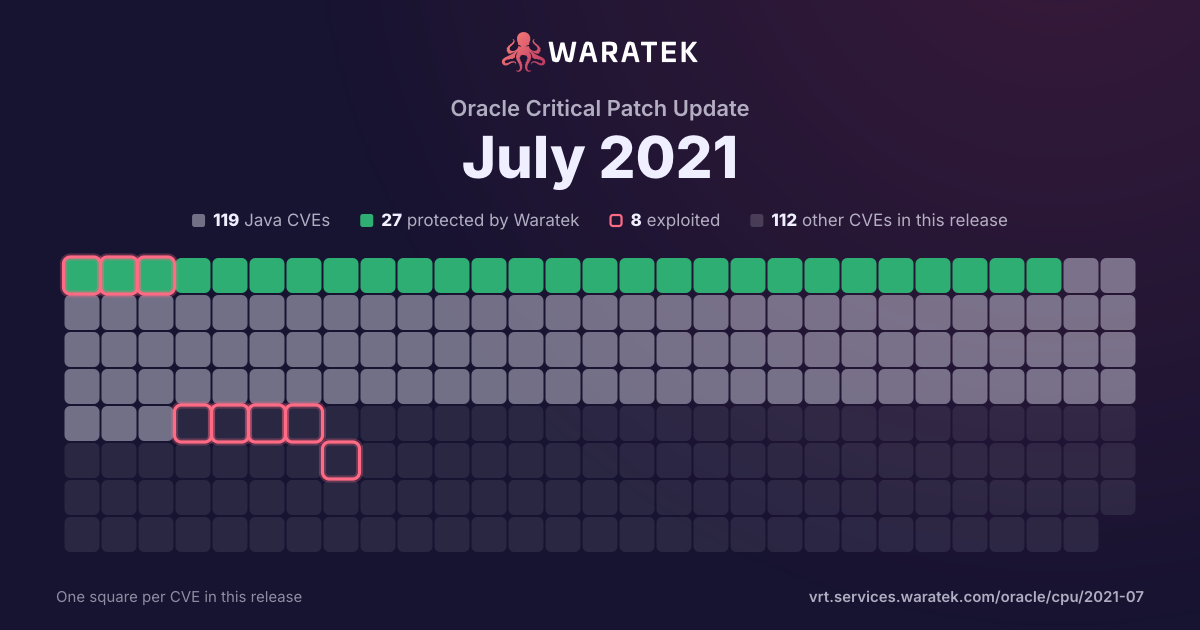
By status
27Protected by Waratek2Mitigation candidate90No exploit published33Outside Waratek scope79Not applicable
8Exploited, marked by the ring
No exploit published. For 70 of them, Oracle's security advisory is the source of public detail.
Protected by Waratek. Waratek RASP can block exploitation of these on systems that have not applied the patch yet.
Overview 33 matches · 0 in Waratek scope · 0 protected · 4 exploited · 2 CISA KEV · 10 public PoC · 7 EPSS ≥ 0.5
33matches
0in Waratek scope0.0%
0protected0.0%
4exploited12.1%
2CISA KEV6.1%
10public PoC30.3%
7EPSS ≥ 0.521.2%
Protected by Waratek
0
0.0%
Rule in development
0
0.0%
Mitigation candidate
0
0.0%
No exploit published
0
0.0%
Outside Waratek scope
33
100.0%
Not applicable
0
0.0%
Withdrawn CVE
0
0.0%
blocked by ARMR today
0
0.0%
partly blocked
0
0.0%
not blocked
33
100.0%
not established
0
0.0%
unrecorded
0
0.0%
split by
peak 7 / quarter
Q3 171
Outside Waratek scope1
Medium1
not blocked1
No public exploit1
Q4 171
Outside Waratek scope1
High1
not blocked1
Working exploit published1
Q1 181
Outside Waratek scope1
Critical1
not blocked1
No public exploit1
Q2 180
Q3 180
Q4 181
Outside Waratek scope1
High1
not blocked1
Working exploit published1
Q1 190
Q2 191
Outside Waratek scope1
Medium1
not blocked1
Exploited1
Q3 193
Outside Waratek scope3
Critical2
Medium1
not blocked3
No public exploit3
Q4 191
Outside Waratek scope1
Critical1
not blocked1
Proof of concept only1
Q1 202
Outside Waratek scope2
High2
not blocked2
Proof of concept only1
No public exploit1
Q2 206
Outside Waratek scope6
High3
Medium3
not blocked6
Exploited2
No public exploit4
Q3 200
Q4 207
Outside Waratek scope7
High3
Medium4
not blocked7
Proof of concept only1
No public exploit6
Q1 215
Outside Waratek scope5
Critical1
High3
Medium1
not blocked5
Exploited1
Proof of concept only2
No public exploit2
Q2 212
Outside Waratek scope2
Critical1
High1
not blocked2
Forecast only1
No public exploit1
Q3 212
Outside Waratek scope2
High1
Medium1
not blocked2
No public exploit2
Q3 17Q1 18Q3 18Q1 19Q3 19Q1 20Q3 20Q1 21Q3 21
| CVE | Severity | Published▾ | Status | Exploitation | Description |
|---|---|---|---|---|---|
| CVE-2021-2388 | High | 2021-07-21 | Outside Waratek scope | No public exploit | Vulnerability in the Java SE, Oracle GraalVM Enterprise Edition product of Oracle Java SE (component: Hotspot). Supported versions that are affected are Java SE: 8u291, 11.0.11, 16.0.1; Oracle GraalVM Enterprise Edition: 20.3.2 and 21.1.0. Difficult to exploit vulnerability allows unauthenticated attacker with network access via multiple protocols to compromise Java SE, Oracle GraalVM Enterprise Edition. Successful attacks require human interaction from a person other than the attacker. Successful attacks of this vulnerability can result in takeover of Java SE, Oracle GraalVM Enterprise Edition. Note: This vulnerability applies to Java deployments, typically in clients running sandboxed Java Web Start applications or sandboxed Java applets, that load and run untrusted code (e.g., code that comes from the internet) and rely on the Java sandbox for security. This vulnerability does not apply to Java deployments, typically in servers, that load and run only trusted code (e.g., code installed by an administrator). CVSS 3.1 Base Score 7.5 (Confidentiality, Integrity and Availability impacts). CVSS Vector: (CVSS:3.1/AV:N/AC:H/PR:N/UI:R/S:U/C:H/I:H/A:H). |
| CVE-2021-2369 | Medium | 2021-07-21 | Outside Waratek scope | No public exploit | Vulnerability in the Java SE, Oracle GraalVM Enterprise Edition product of Oracle Java SE (component: Library). Supported versions that are affected are Java SE: 7u301, 8u291, 11.0.11, 16.0.1; Oracle GraalVM Enterprise Edition: 20.3.2 and 21.1.0. Easily exploitable vulnerability allows unauthenticated attacker with network access via multiple protocols to compromise Java SE, Oracle GraalVM Enterprise Edition. Successful attacks require human interaction from a person other than the attacker. Successful attacks of this vulnerability can result in unauthorized update, insert or delete access to some of Java SE, Oracle GraalVM Enterprise Edition accessible data. Note: This vulnerability applies to Java deployments, typically in clients running sandboxed Java Web Start applications or sandboxed Java applets, that load and run untrusted code (e.g., code that comes from the internet) and rely on the Java sandbox for security. This vulnerability does not apply to Java deployments, typically in servers, that load and run only trusted code (e.g., code installed by an administrator). CVSS 3.1 Base Score 4.3 (Integrity impacts). CVSS Vector: (CVSS:3.1/AV:N/AC:L/PR:N/UI:R/S:U/C:N/I:L/A:N). |
| CVE-2021-22901 | High | 2021-06-11 | Outside Waratek scope | Forecast only | curl 7.75.0 through 7.76.1 suffers from a use-after-free vulnerability resulting in already freed memory being used when a TLS 1.3 session ticket arrives over a connection. A malicious server can use this in rare unfortunate circumstances to potentially reach remote code execution in the client. When libcurl at run-time sets up support for TLS 1.3 session tickets on a connection using OpenSSL, it stores pointers to the transfer in-memory object for later retrieval when a session ticket arrives. If the connection is used by multiple transfers (like with a reused HTTP/1.1 connection or multiplexed HTTP/2 connection) that first transfer object might be freed before the new session is established on that connection and then the function will access a memory buffer that might be freed. When using that memory, libcurl might even call a function pointer in the object, making it possible for a remote code execution if the server could somehow manage to get crafted memory content into the correct place in memory. |
| CVE-2021-29921 | Critical | 2021-05-06 | Outside Waratek scope | No public exploit | In Python before 3,9,5, the ipaddress library mishandles leading zero characters in the octets of an IP address string. This (in some situations) allows attackers to bypass access control that is based on IP addresses. |
| CVE-2021-22884 | High | 2021-03-03 | Outside Waratek scope | No public exploit | Node.js before 10.24.0, 12.21.0, 14.16.0, and 15.10.0 is vulnerable to DNS rebinding attacks as the whitelist includes “localhost6”. When “localhost6” is not present in /etc/hosts, it is just an ordinary domain that is resolved via DNS, i.e., over network. If the attacker controls the victim's DNS server or can spoof its responses, the DNS rebinding protection can be bypassed by using the “localhost6” domain. As long as the attacker uses the “localhost6” domain, they can still apply the attack described in CVE-2018-7160. |
| CVE-2021-3345 | High | 2021-01-29 | Outside Waratek scope | Proof of concept only | _gcry_md_block_write in cipher/hash-common.c in Libgcrypt version 1.9.0 has a heap-based buffer overflow when the digest final function sets a large count value. It is recommended to upgrade to 1.9.1 or later. |
| CVE-2021-3156 | High | 2021-01-26 | Outside Waratek scope | Exploited | Sudo before 1.9.5p2 contains an off-by-one error that can result in a heap-based buffer overflow, which allows privilege escalation to root via "sudoedit -s" and a command-line argument that ends with a single backslash character. |
| CVE-2021-26272 | Medium | 2021-01-26 | Outside Waratek scope | No public exploit | It was possible to execute a ReDoS-type attack inside CKEditor 4 before 4.16 by persuading a victim to paste crafted URL-like text into the editor, and then press Enter or Space (in the Autolink plugin). |
| CVE-2021-3177 | Critical | 2021-01-19 | Outside Waratek scope | Proof of concept only | Python 3.x through 3.9.1 has a buffer overflow in PyCArg_repr in _ctypes/callproc.c, which may lead to remote code execution in certain Python applications that accept floating-point numbers as untrusted input, as demonstrated by a 1e300 argument to c_double.from_param. This occurs because sprintf is used unsafely. |
| CVE-2020-8286 | High | 2020-12-14 | Outside Waratek scope | No public exploit | curl 7.41.0 through 7.73.0 is vulnerable to an improper check for certificate revocation due to insufficient verification of the OCSP response. |
| CVE-2020-1971 | Medium | 2020-12-08 | Outside Waratek scope | Proof of concept only | The X.509 GeneralName type is a generic type for representing different types of names. One of those name types is known as EDIPartyName. OpenSSL provides a function GENERAL_NAME_cmp which compares different instances of a GENERAL_NAME to see if they are equal or not. This function behaves incorrectly when both GENERAL_NAMEs contain an EDIPARTYNAME. A NULL pointer dereference and a crash may occur leading to a possible denial of service attack. OpenSSL itself uses the GENERAL_NAME_cmp function for two purposes: 1) Comparing CRL distribution point names between an available CRL and a CRL distribution point embedded in an X509 certificate 2) When verifying that a timestamp response token signer matches the timestamp authority name (exposed via the API functions TS_RESP_verify_response and TS_RESP_verify_token) If an attacker can control both items being compared then that attacker could trigger a crash. For example if the attacker can trick a client or server into checking a malicious certificate against a malicious CRL then this may occur. Note that some applications automatically download CRLs based on a URL embedded in a certificate. This checking happens prior to the signatures on the certificate and CRL being verified. OpenSSL's s_server, s_client and verify tools have support for the "-crl_download" option which implements automatic CRL downloading and this attack has been demonstrated to work against those tools. Note that an unrelated bug means that affected versions of OpenSSL cannot parse or construct correct encodings of EDIPARTYNAME. However it is possible to construct a malformed EDIPARTYNAME that OpenSSL's parser will accept and hence trigger this attack. All OpenSSL 1.1.1 and 1.0.2 versions are affected by this issue. Other OpenSSL releases are out of support and have not been checked. Fixed in OpenSSL 1.1.1i (Affected 1.1.1-1.1.1h). Fixed in OpenSSL 1.0.2x (Affected 1.0.2-1.0.2w). |
| CVE-2020-13956 | Medium | 2020-12-02 | Outside Waratek scope | No public exploit | Apache HttpClient versions prior to version 4.5.13 and 5.0.3 can misinterpret malformed authority component in request URIs passed to the library as java.net.URI object and pick the wrong target host for request execution. |
| CVE-2020-28928 | Medium | 2020-11-24 | Outside Waratek scope | No public exploit | In musl libc through 1.2.1, wcsnrtombs mishandles particular combinations of destination buffer size and source character limit, as demonstrated by an invalid write access (buffer overflow). |
| CVE-2020-27193 | Medium | 2020-11-12 | Outside Waratek scope | No public exploit | A cross-site scripting (XSS) vulnerability in the Color Dialog plugin for CKEditor 4.15.0 allows remote attackers to run arbitrary web script after persuading a user to copy and paste crafted HTML code into one of editor inputs. |
| CVE-2020-28196 | High | 2020-11-06 | Outside Waratek scope | No public exploit | MIT Kerberos 5 (aka krb5) before 1.17.2 and 1.18.x before 1.18.3 allows unbounded recursion via an ASN.1-encoded Kerberos message because the lib/krb5/asn.1/asn1_encode.c support for BER indefinite lengths lacks a recursion limit. |
| CVE-2020-25648 | High | 2020-10-20 | Outside Waratek scope | No public exploit | A flaw was found in the way NSS handled CCS (ChangeCipherSpec) messages in TLS 1.3. This flaw allows a remote attacker to send multiple CCS messages, causing a denial of service for servers compiled with the NSS library. The highest threat from this vulnerability is to system availability. This flaw affects NSS versions before 3.58. |
| CVE-2020-10878 | High | 2020-06-05 | Outside Waratek scope | No public exploit | Perl before 5.30.3 has an integer overflow related to mishandling of a "PL_regkind[OP(n)] == NOTHING" situation. A crafted regular expression could lead to malformed bytecode with a possibility of instruction injection. |
| CVE-2020-10543 | High | 2020-06-05 | Outside Waratek scope | No public exploit | Perl before 5.30.3 on 32-bit platforms allows a heap-based buffer overflow because nested regular expression quantifiers have an integer overflow. |
| CVE-2020-1945 | Medium | 2020-05-14 | Outside Waratek scope | No public exploit | Apache Ant 1.1 to 1.9.14 and 1.10.0 to 1.10.7 uses the default temporary directory identified by the Java system property java.io.tmpdir for several tasks and may thus leak sensitive information. The fixcrlf and replaceregexp tasks also copy files from the temporary directory back into the build tree allowing an attacker to inject modified source files into the build process. |
| CVE-2020-11023 | Medium | 2020-04-29 | Outside Waratek scope | Exploited | In jQuery versions greater than or equal to 1.0.3 and before 3.5.0, passing HTML containing <option> elements from untrusted sources - even after sanitizing it - to one of jQuery's DOM manipulation methods (i.e. .html(), .append(), and others) may execute untrusted code. This problem is patched in jQuery 3.5.0. |
| CVE-2020-11022 | Medium | 2020-04-29 | Outside Waratek scope | Exploited | In jQuery starting with 1.12.0 and before 3.5.0, passing HTML from untrusted sources - even after sanitizing it - to one of jQuery's DOM manipulation methods (i.e. .html(), .append(), and others) may execute untrusted code. This problem is patched in jQuery 3.5.0. |
| CVE-2020-11612 | High | 2020-04-07 | Outside Waratek scope | No public exploit | The ZlibDecoders in Netty 4.1.x before 4.1.46 allow for unbounded memory allocation while decoding a ZlibEncoded byte stream. An attacker could send a large ZlibEncoded byte stream to the Netty server, forcing the server to allocate all of its free memory to a single decoder. |
| CVE-2020-5258 | High | 2020-03-10 | Outside Waratek scope | No public exploit | In affected versions of dojo (NPM package), the deepCopy method is vulnerable to Prototype Pollution. Prototype Pollution refers to the ability to inject properties into existing JavaScript language construct prototypes, such as objects. An attacker manipulates these attributes to overwrite, or pollute, a JavaScript application object prototype of the base object by injecting other values. This has been patched in versions 1.12.8, 1.13.7, 1.14.6, 1.15.3 and 1.16.2 |
| CVE-2020-5398 | High | 2020-01-17 | Outside Waratek scope | Proof of concept only | In Spring Framework, versions 5.2.x prior to 5.2.3, versions 5.1.x prior to 5.1.13, and versions 5.0.x prior to 5.0.16, an application is vulnerable to a reflected file download (RFD) attack when it sets a "Content-Disposition" header in the response where the filename attribute is derived from user supplied input. |
| CVE-2019-17195 | Critical | 2019-10-15 | Outside Waratek scope | Proof of concept only | Connect2id Nimbus JOSE+JWT before v7.9 can throw various uncaught exceptions while parsing a JWT, which could result in an application crash (potential information disclosure) or a potential authentication bypass. |
| CVE-2019-3740 | Medium | 2019-09-18 | Outside Waratek scope | No public exploit | RSA BSAFE Crypto-J versions prior to 6.2.5 are vulnerable to an Information Exposure Through Timing Discrepancy vulnerabilities during DSA key generation. A malicious remote attacker could potentially exploit those vulnerabilities to recover DSA keys. |
| CVE-2019-12260 | Critical | 2019-08-09 | Outside Waratek scope | No public exploit | Wind River VxWorks 6.9 and vx7 has a Buffer Overflow in the TCP component (issue 2 of 4). This is an IPNET security vulnerability: TCP Urgent Pointer state confusion caused by a malformed TCP AO option. |
| CVE-2019-13990 | Critical | 2019-07-26 | Outside Waratek scope | No public exploit | initDocumentParser in xml/XMLSchedulingDataProcessor.java in Terracotta Quartz Scheduler through 2.3.0 allows XXE attacks via a job description. |
| CVE-2019-11358 | Medium | 2019-04-20 | Outside Waratek scope | Exploited | jQuery before 3.4.0, as used in Drupal, Backdrop CMS, and other products, mishandles jQuery.extend(true, {}, ...) because of Object.prototype pollution. If an unsanitized source object contained an enumerable __proto__ property, it could extend the native Object.prototype. |
| CVE-2018-15686 | High | 2018-10-26 | Outside Waratek scope | Working exploit published | A vulnerability in unit_deserialize of systemd allows an attacker to supply arbitrary state across systemd re-execution via NotifyAccess. This can be used to improperly influence systemd execution and possibly lead to root privilege escalation. Affected releases are systemd versions up to and including 239. |
| CVE-2018-7183 | Critical | 2018-03-08 | Outside Waratek scope | No public exploit | Buffer overflow in the decodearr function in ntpq in ntp 4.2.8p6 through 4.2.8p10 allows remote attackers to execute arbitrary code by leveraging an ntpq query and sending a response with a crafted array. |
| CVE-2017-5637 | High | 2017-10-10 | Outside Waratek scope | Working exploit published | Two four letter word commands "wchp/wchc" are CPU intensive and could cause spike of CPU utilization on Apache ZooKeeper server if abused, which leads to the server unable to serve legitimate client requests. Apache ZooKeeper thru version 3.4.9 and 3.5.2 suffer from this issue, fixed in 3.4.10, 3.5.3, and later. |
| CVE-2016-0762 | Medium | 2017-08-10 | Outside Waratek scope | No public exploit | The Realm implementations in Apache Tomcat versions 9.0.0.M1 to 9.0.0.M9, 8.5.0 to 8.5.4, 8.0.0.RC1 to 8.0.36, 7.0.0 to 7.0.70 and 6.0.0 to 6.0.45 did not process the supplied password if the supplied user name did not exist. This made a timing attack possible to determine valid user names. Note that the default configuration includes the LockOutRealm which makes exploitation of this vulnerability harder. |