
Oracle Critical Patch Update July 2021
Released July 2021 · Oracle's advisory ↗ · ← Critical Patch Update, April 2021 · Critical Patch Update, October 2021 →
231 CVEs in this release, one square each
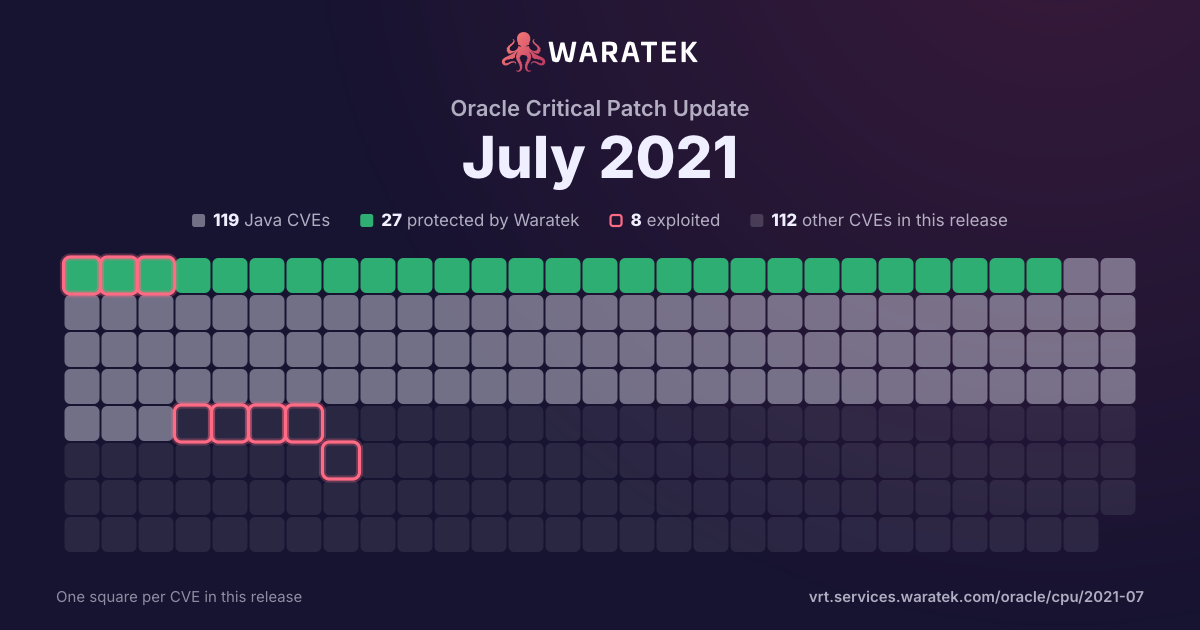
By status
29Protected by Waratek10Mitigation candidate99No exploit published3Outside Waratek scope90Not applicable
8Exploited, marked by the ring
No exploit published. For 72 of them, Oracle's security advisory is the source of public detail.
Protected by Waratek. Waratek RASP can block exploitation of these on systems that have not applied the patch yet.
Overview 23 matches · 0 in Waratek scope · 0 protected · 1 exploited · 0 CISA KEV · 2 public PoC · 2 EPSS ≥ 0.5
23matches
0in Waratek scope0.0%
0protected0.0%
1exploited4.3%
0CISA KEV0.0%
2public PoC8.7%
2EPSS ≥ 0.58.7%
Protected by Waratek
0
0.0%
Rule in development
0
0.0%
Mitigation candidate
0
0.0%
No exploit published
0
0.0%
Outside Waratek scope
0
0.0%
Not applicable
23
100.0%
Withdrawn CVE
0
0.0%
blocked by ARMR today
0
0.0%
partly blocked
0
0.0%
not blocked
23
100.0%
not established
0
0.0%
unrecorded
0
0.0%
Exploited
1
4.3%
Working exploit published
0
0.0%
Proof of concept only
4
17.4%
Forecast only
0
0.0%
No public exploit
18
78.3%
split by
peak 6 / quarter
Q2 161
Not applicable1
Medium1
not blocked1
No public exploit1
Q3 160
Q4 160
Q1 170
Q2 171
Not applicable1
Critical1
not blocked1
No public exploit1
Q3 170
Q4 171
Not applicable1
Critical1
not blocked1
No public exploit1
Q1 181
Not applicable1
Medium1
not blocked1
No public exploit1
Q2 180
Q3 180
Q4 180
Q1 191
Not applicable1
High1
not blocked1
Exploited1
Q2 190
Q3 192
Not applicable2
Critical2
not blocked2
No public exploit2
Q4 192
Not applicable2
Critical1
High1
not blocked2
No public exploit2
Q1 201
Not applicable1
High1
not blocked1
No public exploit1
Q2 202
Not applicable2
High2
not blocked2
No public exploit2
Q3 203
Not applicable3
High2
Medium1
not blocked3
No public exploit3
Q4 206
Not applicable6
High3
Medium3
not blocked6
Proof of concept only3
No public exploit3
Q1 212
Not applicable2
Critical1
Medium1
not blocked2
Proof of concept only1
No public exploit1
Q3 16Q1 17Q3 17Q1 18Q3 18Q1 19Q3 19Q1 20Q3 20Q1 21
| CVE | Severity | Published▾ | Status | Exploitation | Description |
|---|---|---|---|---|---|
| CVE-2021-26272 | Medium | 2021-01-26 | Not applicable | No public exploit | It was possible to execute a ReDoS-type attack inside CKEditor 4 before 4.16 by persuading a victim to paste crafted URL-like text into the editor, and then press Enter or Space (in the Autolink plugin). |
| CVE-2021-3177 | Critical | 2021-01-19 | Not applicable | Proof of concept only | Python 3.x through 3.9.1 has a buffer overflow in PyCArg_repr in _ctypes/callproc.c, which may lead to remote code execution in certain Python applications that accept floating-point numbers as untrusted input, as demonstrated by a 1e300 argument to c_double.from_param. This occurs because sprintf is used unsafely. |
| CVE-2020-8286 | High | 2020-12-14 | Not applicable | No public exploit | curl 7.41.0 through 7.73.0 is vulnerable to an improper check for certificate revocation due to insufficient verification of the OCSP response. |
| CVE-2020-8285 | High | 2020-12-14 | Not applicable | Proof of concept only | curl 7.21.0 to and including 7.73.0 is vulnerable to uncontrolled recursion due to a stack overflow issue in FTP wildcard match parsing. |
| CVE-2020-1971 | Medium | 2020-12-08 | Not applicable | Proof of concept only | The X.509 GeneralName type is a generic type for representing different types of names. One of those name types is known as EDIPartyName. OpenSSL provides a function GENERAL_NAME_cmp which compares different instances of a GENERAL_NAME to see if they are equal or not. This function behaves incorrectly when both GENERAL_NAMEs contain an EDIPARTYNAME. A NULL pointer dereference and a crash may occur leading to a possible denial of service attack. OpenSSL itself uses the GENERAL_NAME_cmp function for two purposes: 1) Comparing CRL distribution point names between an available CRL and a CRL distribution point embedded in an X509 certificate 2) When verifying that a timestamp response token signer matches the timestamp authority name (exposed via the API functions TS_RESP_verify_response and TS_RESP_verify_token) If an attacker can control both items being compared then that attacker could trigger a crash. For example if the attacker can trick a client or server into checking a malicious certificate against a malicious CRL then this may occur. Note that some applications automatically download CRLs based on a URL embedded in a certificate. This checking happens prior to the signatures on the certificate and CRL being verified. OpenSSL's s_server, s_client and verify tools have support for the "-crl_download" option which implements automatic CRL downloading and this attack has been demonstrated to work against those tools. Note that an unrelated bug means that affected versions of OpenSSL cannot parse or construct correct encodings of EDIPARTYNAME. However it is possible to construct a malformed EDIPARTYNAME that OpenSSL's parser will accept and hence trigger this attack. All OpenSSL 1.1.1 and 1.0.2 versions are affected by this issue. Other OpenSSL releases are out of support and have not been checked. Fixed in OpenSSL 1.1.1i (Affected 1.1.1-1.1.1h). Fixed in OpenSSL 1.0.2x (Affected 1.0.2-1.0.2w). |
| CVE-2020-8277 | High | 2020-11-19 | Not applicable | Proof of concept only | A Node.js application that allows an attacker to trigger a DNS request for a host of their choice could trigger a Denial of Service in versions < 15.2.1, < 14.15.1, and < 12.19.1 by getting the application to resolve a DNS record with a larger number of responses. This is fixed in 15.2.1, 14.15.1, and 12.19.1. |
| CVE-2020-27193 | Medium | 2020-11-12 | Not applicable | No public exploit | A cross-site scripting (XSS) vulnerability in the Color Dialog plugin for CKEditor 4.15.0 allows remote attackers to run arbitrary web script after persuading a user to copy and paste crafted HTML code into one of editor inputs. |
| CVE-2020-26870 | Medium | 2020-10-07 | Not applicable | No public exploit | Cure53 DOMPurify before 2.0.17 allows mutation XSS. This occurs because a serialize-parse roundtrip does not necessarily return the original DOM tree, and a namespace can change from HTML to MathML, as demonstrated by nesting of FORM elements. |
| CVE-2020-7733 | High | 2020-09-16 | Not applicable | No public exploit | The package ua-parser-js before 0.7.22 are vulnerable to Regular Expression Denial of Service (ReDoS) via the regex for Redmi Phones and Mi Pad Tablets UA. |
| CVE-2020-24553 | Medium | 2020-09-02 | Not applicable | No public exploit | Go before 1.14.8 and 1.15.x before 1.15.1 allows XSS because text/html is the default for CGI/FCGI handlers that lack a Content-Type header. |
| CVE-2020-8203 | High | 2020-07-15 | Not applicable | No public exploit | Prototype pollution attack when using _.zipObjectDeep in lodash before 4.17.20. |
| CVE-2020-10878 | High | 2020-06-05 | Not applicable | No public exploit | Perl before 5.30.3 has an integer overflow related to mishandling of a "PL_regkind[OP(n)] == NOTHING" situation. A crafted regular expression could lead to malformed bytecode with a possibility of instruction injection. |
| CVE-2020-10543 | High | 2020-06-05 | Not applicable | No public exploit | Perl before 5.30.3 on 32-bit platforms allows a heap-based buffer overflow because nested regular expression quantifiers have an integer overflow. |
| CVE-2019-5064 | High | 2020-01-03 | Not applicable | No public exploit | An exploitable heap buffer overflow vulnerability exists in the data structure persistence functionality of OpenCV, before version 4.2.0. A specially crafted JSON file can cause a buffer overflow, resulting in multiple heap corruptions and potentially code execution. An attacker can provide a specially crafted file to trigger this vulnerability. |
| CVE-2019-17545 | Critical | 2019-10-14 | Not applicable | No public exploit | GDAL through 3.0.1 has a poolDestroy double free in OGRExpatRealloc in ogr/ogr_expat.cpp when the 10MB threshold is exceeded. |
| CVE-2019-17543 | High | 2019-10-14 | Not applicable | No public exploit | LZ4 before 1.9.2 has a heap-based buffer overflow in LZ4_write32 (related to LZ4_compress_destSize), affecting applications that call LZ4_compress_fast with a large input. (This issue can also lead to data corruption.) NOTE: the vendor states "only a few specific / uncommon usages of the API are at risk." |
| CVE-2019-10746 | Critical | 2019-08-23 | Not applicable | No public exploit | mixin-deep is vulnerable to Prototype Pollution in versions before 1.3.2 and version 2.0.0. The function mixin-deep could be tricked into adding or modifying properties of Object.prototype using a constructor payload. |
| CVE-2019-12260 | Critical | 2019-08-09 | Not applicable | No public exploit | Wind River VxWorks 6.9 and vx7 has a Buffer Overflow in the TCP component (issue 2 of 4). This is an IPNET security vulnerability: TCP Urgent Pointer state confusion caused by a malformed TCP AO option. |
| CVE-2019-0190 | High | 2019-01-30 | Not applicable | Exploited | A bug exists in the way mod_ssl handled client renegotiations. A remote attacker could send a carefully crafted request that would cause mod_ssl to enter a loop leading to a denial of service. This bug can be only triggered with Apache HTTP Server version 2.4.37 when using OpenSSL version 1.1.1 or later, due to an interaction in changes to handling of renegotiation attempts. |
| CVE-2018-0739 | Medium | 2018-03-27 | Not applicable | No public exploit | Constructed ASN.1 types with a recursive definition (such as can be found in PKCS7) could eventually exceed the stack given malicious input with excessive recursion. This could result in a Denial Of Service attack. There are no such structures used within SSL/TLS that come from untrusted sources so this is considered safe. Fixed in OpenSSL 1.1.0h (Affected 1.1.0-1.1.0g). Fixed in OpenSSL 1.0.2o (Affected 1.0.2b-1.0.2n). |
| CVE-2017-16931 | Critical | 2017-11-23 | Not applicable | No public exploit | parser.c in libxml2 before 2.9.5 mishandles parameter-entity references because the NEXTL macro calls the xmlParserHandlePEReference function in the case of a '%' character in a DTD name. |
| CVE-2017-5461 | Critical | 2017-05-11 | Not applicable | No public exploit | Mozilla Network Security Services (NSS) before 3.21.4, 3.22.x through 3.28.x before 3.28.4, 3.29.x before 3.29.5, and 3.30.x before 3.30.1 allows remote attackers to cause a denial of service (out-of-bounds write) or possibly have unspecified other impact by leveraging incorrect base64 operations. |
| CVE-2016-4429 | Medium | 2016-06-10 | Not applicable | No public exploit | Stack-based buffer overflow in the clntudp_call function in sunrpc/clnt_udp.c in the GNU C Library (aka glibc or libc6) allows remote servers to cause a denial of service (crash) or possibly unspecified other impact via a flood of crafted ICMP and UDP packets. |