
Oracle Critical Patch Update July 2021
Released July 2021 · Oracle's advisory ↗ · ← Critical Patch Update, April 2021 · Critical Patch Update, October 2021 →
231 CVEs in this release, one square each
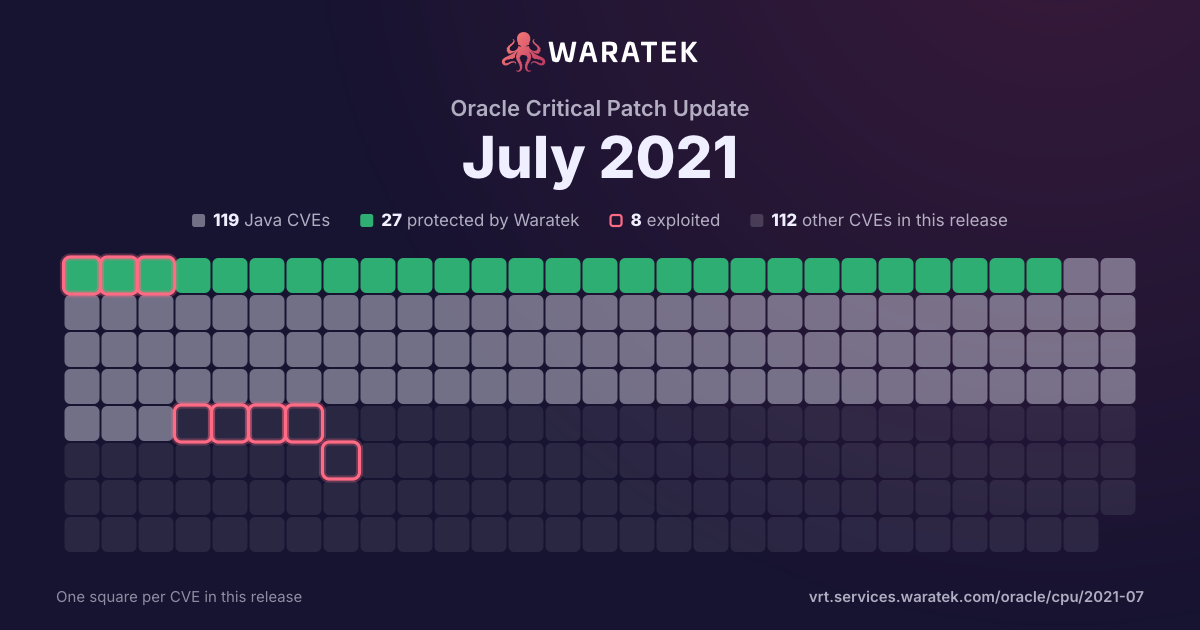
By status
29Protected by Waratek10Mitigation candidate99No exploit published3Outside Waratek scope90Not applicable
8Exploited, marked by the ring
No exploit published. For 72 of them, Oracle's security advisory is the source of public detail.
Protected by Waratek. Waratek RASP can block exploitation of these on systems that have not applied the patch yet.
Overview 9 matches · 7 in Waratek scope · 3 protected · 1 exploited · 0 CISA KEV · 2 public PoC · 2 EPSS ≥ 0.5
9matches
7in Waratek scope77.8%
3protected33.3%
1exploited11.1%
0CISA KEV0.0%
2public PoC22.2%
2EPSS ≥ 0.522.2%
Protected by Waratek
3
33.3%
Rule in development
0
0.0%
Mitigation candidate
1
11.1%
No exploit published
3
33.3%
Outside Waratek scope
0
0.0%
Not applicable
2
22.2%
Withdrawn CVE
0
0.0%
blocked by ARMR today
3
33.3%
partly blocked
0
0.0%
not blocked
6
66.7%
not established
0
0.0%
unrecorded
0
0.0%
Exploited
1
11.1%
Working exploit published
2
22.2%
Proof of concept only
0
0.0%
Forecast only
0
0.0%
No public exploit
6
66.7%
split by
peak 2 / quarter
Q1 151
Protected by Waratek1
High1
blocked by ARMR today1
No public exploit1
Q2 150
Q3 150
Q4 150
Q1 160
Q2 160
Q3 160
Q4 160
Q1 170
Q2 171
No exploit published1
High1
not blocked1
No public exploit1
Q3 170
Q4 172
Mitigation candidate1
No exploit published1
High2
not blocked2
Working exploit published1
No public exploit1
Q1 180
Q2 180
Q3 180
Q4 181
Protected by Waratek1
High1
blocked by ARMR today1
Working exploit published1
Q1 191
Not applicable1
High1
not blocked1
Exploited1
Q2 190
Q3 192
Protected by Waratek1
No exploit published1
High2
blocked by ARMR today1
not blocked1
No public exploit2
Q4 191
Not applicable1
High1
not blocked1
No public exploit1
Q2 15Q4 15Q2 16Q4 16Q2 17Q4 17Q2 18Q4 18Q2 19Q4 19
| CVE | Severity | Published▾ | Status | Exploitation | Description |
|---|---|---|---|---|---|
| CVE-2019-17543 | High | 2019-10-14 | Not applicable | No public exploit | LZ4 before 1.9.2 has a heap-based buffer overflow in LZ4_write32 (related to LZ4_compress_destSize), affecting applications that call LZ4_compress_fast with a large input. (This issue can also lead to data corruption.) NOTE: the vendor states "only a few specific / uncommon usages of the API are at risk." |
| CVE-2019-12402 | High | 2019-08-30 | No exploit published | No public exploit | The file name encoding algorithm used internally in Apache Commons Compress 1.15 to 1.18 can get into an infinite loop when faced with specially crafted inputs. This can lead to a denial of service attack if an attacker can choose the file names inside of an archive created by Compress. |
| CVE-2019-10086 | High | 2019-08-20 | Protected by Waratek | No public exploit | In Apache Commons Beanutils 1.9.2, a special BeanIntrospector class was added which allows suppressing the ability for an attacker to access the classloader via the class property available on all Java objects. We, however were not using this by default characteristic of the PropertyUtilsBean. |
| CVE-2019-0190 | High | 2019-01-30 | Not applicable | Exploited | A bug exists in the way mod_ssl handled client renegotiations. A remote attacker could send a carefully crafted request that would cause mod_ssl to enter a loop leading to a denial of service. This bug can be only triggered with Apache HTTP Server version 2.4.37 when using OpenSSL version 1.1.1 or later, due to an interaction in changes to handling of renegotiation attempts. |
| CVE-2018-15686 | High | 2018-10-26 | Protected by Waratek | Working exploit published | A vulnerability in unit_deserialize of systemd allows an attacker to supply arbitrary state across systemd re-execution via NotifyAccess. This can be used to improperly influence systemd execution and possibly lead to root privilege escalation. Affected releases are systemd versions up to and including 239. |
| CVE-2012-0881 | High | 2017-10-30 | No exploit published | No public exploit | Apache Xerces2 Java Parser before 2.12.0 allows remote attackers to cause a denial of service (CPU consumption) via a crafted message to an XML service, which triggers hash table collisions. |
| CVE-2017-5637 | High | 2017-10-10 | Mitigation candidate | Working exploit published | Two four letter word commands "wchp/wchc" are CPU intensive and could cause spike of CPU utilization on Apache ZooKeeper server if abused, which leads to the server unable to serve legitimate client requests. Apache ZooKeeper thru version 3.4.9 and 3.5.2 suffer from this issue, fixed in 3.4.10, 3.5.3, and later. |
| CVE-2017-9735 | High | 2017-06-16 | No exploit published | No public exploit | Jetty through 9.4.x is prone to a timing channel in util/security/Password.java, which makes it easier for remote attackers to obtain access by observing elapsed times before rejection of incorrect passwords. |
| CVE-2015-0254 | High | 2015-03-09 | Protected by Waratek | No public exploit | Apache Standard Taglibs before 1.2.3 allows remote attackers to execute arbitrary code or conduct external XML entity (XXE) attacks via a crafted XSLT extension in a (1) <x:parse> or (2) <x:transform> JSTL XML tag. |