
Oracle Critical Patch Update July 2021
Released July 2021 · Oracle's advisory ↗ · ← Critical Patch Update, April 2021 · Critical Patch Update, October 2021 →
231 CVEs in this release, one square each
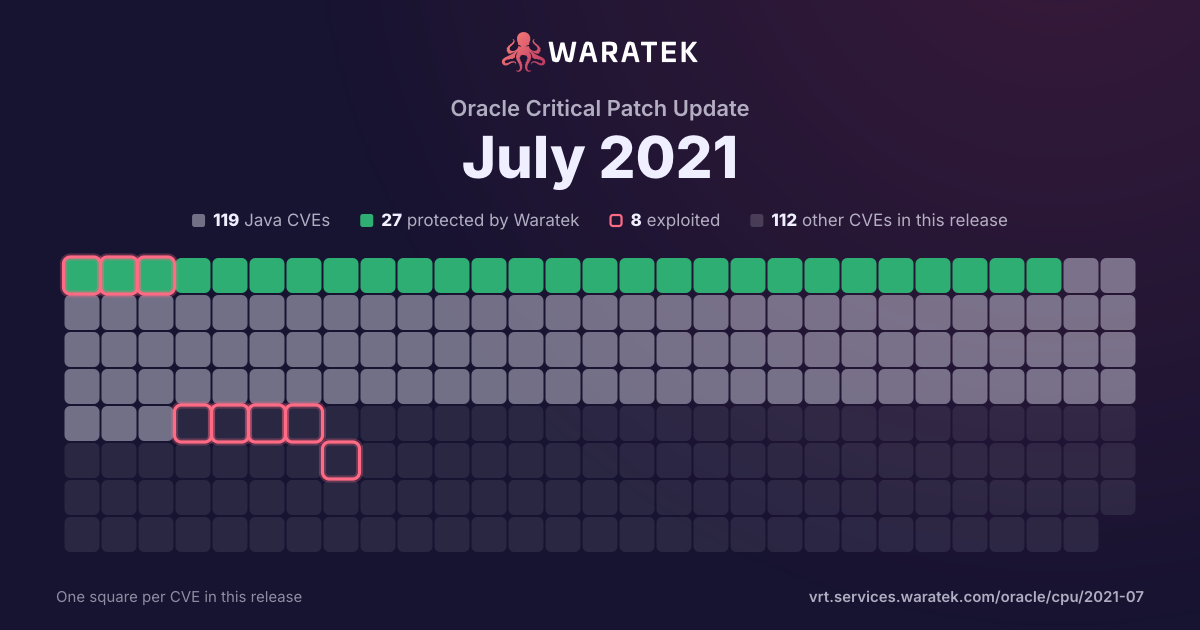
By status
29Protected by Waratek10Mitigation candidate99No exploit published3Outside Waratek scope90Not applicable
8Exploited, marked by the ring
No exploit published. For 72 of them, Oracle's security advisory is the source of public detail.
Protected by Waratek. Waratek RASP can block exploitation of these on systems that have not applied the patch yet.
Overview 8 matches · 5 in Waratek scope · 2 protected · 0 exploited · 0 CISA KEV · 1 public PoC · 1 EPSS ≥ 0.5
8matches
5in Waratek scope62.5%
2protected25.0%
0exploited0.0%
0CISA KEV0.0%
1public PoC12.5%
1EPSS ≥ 0.512.5%
Protected by Waratek
2
25.0%
Rule in development
0
0.0%
Mitigation candidate
0
0.0%
No exploit published
3
37.5%
Outside Waratek scope
0
0.0%
Not applicable
3
37.5%
Withdrawn CVE
0
0.0%
blocked by ARMR today
2
25.0%
partly blocked
0
0.0%
not blocked
6
75.0%
not established
0
0.0%
unrecorded
0
0.0%
Exploited
0
0.0%
Working exploit published
1
12.5%
Proof of concept only
0
0.0%
Forecast only
0
0.0%
No public exploit
7
87.5%
| CVE | Severity | Published▾ | Status | Exploitation | Description |
|---|---|---|---|---|---|
| CVE-2021-21409 | Medium | 2021-03-30 | No exploit published | No public exploit | Netty is an open-source, asynchronous event-driven network application framework for rapid development of maintainable high performance protocol servers & clients. In Netty (io.netty:netty-codec-http2) before version 4.1.61.Final there is a vulnerability that enables request smuggling. The content-length header is not correctly validated if the request only uses a single Http2HeaderFrame with the endStream set to to true. This could lead to request smuggling if the request is proxied to a remote peer and translated to HTTP/1.1. This is a followup of GHSA-wm47-8v5p-wjpj/CVE-2021-21295 which did miss to fix this one case. This was fixed as part of 4.1.61.Final. |
| CVE-2021-3450 | High | 2021-03-25 | Not applicable | No public exploit | The X509_V_FLAG_X509_STRICT flag enables additional security checks of the certificates present in a certificate chain. It is not set by default. Starting from OpenSSL version 1.1.1h a check to disallow certificates in the chain that have explicitly encoded elliptic curve parameters was added as an additional strict check. An error in the implementation of this check meant that the result of a previous check to confirm that certificates in the chain are valid CA certificates was overwritten. This effectively bypasses the check that non-CA certificates must not be able to issue other certificates. If a "purpose" has been configured then there is a subsequent opportunity for checks that the certificate is a valid CA. All of the named "purpose" values implemented in libcrypto perform this check. Therefore, where a purpose is set the certificate chain will still be rejected even when the strict flag has been used. A purpose is set by default in libssl client and server certificate verification routines, but it can be overridden or removed by an application. In order to be affected, an application must explicitly set the X509_V_FLAG_X509_STRICT verification flag and either not set a purpose for the certificate verification or, in the case of TLS client or server applications, override the default purpose. OpenSSL versions 1.1.1h and newer are affected by this issue. Users of these versions should upgrade to OpenSSL 1.1.1k. OpenSSL 1.0.2 is not impacted by this issue. Fixed in OpenSSL 1.1.1k (Affected 1.1.1h-1.1.1j). |
| CVE-2021-21345 | Critical | 2021-03-23 | Protected by Waratek | Working exploit published | XStream is a Java library to serialize objects to XML and back again. In XStream before version 1.4.16, there is a vulnerability which may allow a remote attacker who has sufficient rights to execute commands of the host only by manipulating the processed input stream. No user is affected, who followed the recommendation to setup XStream's security framework with a whitelist limited to the minimal required types. If you rely on XStream's default blacklist of the Security Framework, you will have to use at least version 1.4.16. |
| CVE-2021-20227 | Medium | 2021-03-23 | Not applicable | No public exploit | A flaw was found in SQLite's SELECT query functionality (src/select.c). This flaw allows an attacker who is capable of running SQL queries locally on the SQLite database to cause a denial of service or possible code execution by triggering a use-after-free. The highest threat from this vulnerability is to system availability. |
| CVE-2021-27906 | Medium | 2021-03-19 | No exploit published | No public exploit | A carefully crafted PDF file can trigger an OutOfMemory-Exception while loading the file. This issue affects Apache PDFBox version 2.0.22 and prior 2.0.x versions. |
| CVE-2021-27807 | Medium | 2021-03-19 | No exploit published | No public exploit | A carefully crafted PDF file can trigger an infinite loop while loading the file. This issue affects Apache PDFBox version 2.0.22 and prior 2.0.x versions. |
| CVE-2021-22884 | High | 2021-03-03 | Not applicable | No public exploit | Node.js before 10.24.0, 12.21.0, 14.16.0, and 15.10.0 is vulnerable to DNS rebinding attacks as the whitelist includes “localhost6”. When “localhost6” is not present in /etc/hosts, it is just an ordinary domain that is resolved via DNS, i.e., over network. If the attacker controls the victim's DNS server or can spoof its responses, the DNS rebinding protection can be bypassed by using the “localhost6” domain. As long as the attacker uses the “localhost6” domain, they can still apply the attack described in CVE-2018-7160. |
| CVE-2021-25122 | High | 2021-03-01 | Protected by Waratek | No public exploit | When responding to new h2c connection requests, Apache Tomcat versions 10.0.0-M1 to 10.0.0, 9.0.0.M1 to 9.0.41 and 8.5.0 to 8.5.61 could duplicate request headers and a limited amount of request body from one request to another meaning user A and user B could both see the results of user A's request. |