
Oracle Critical Patch Update July 2021
Released July 2021 · Oracle's advisory ↗ · ← Critical Patch Update, April 2021 · Critical Patch Update, October 2021 →
231 CVEs in this release, one square each
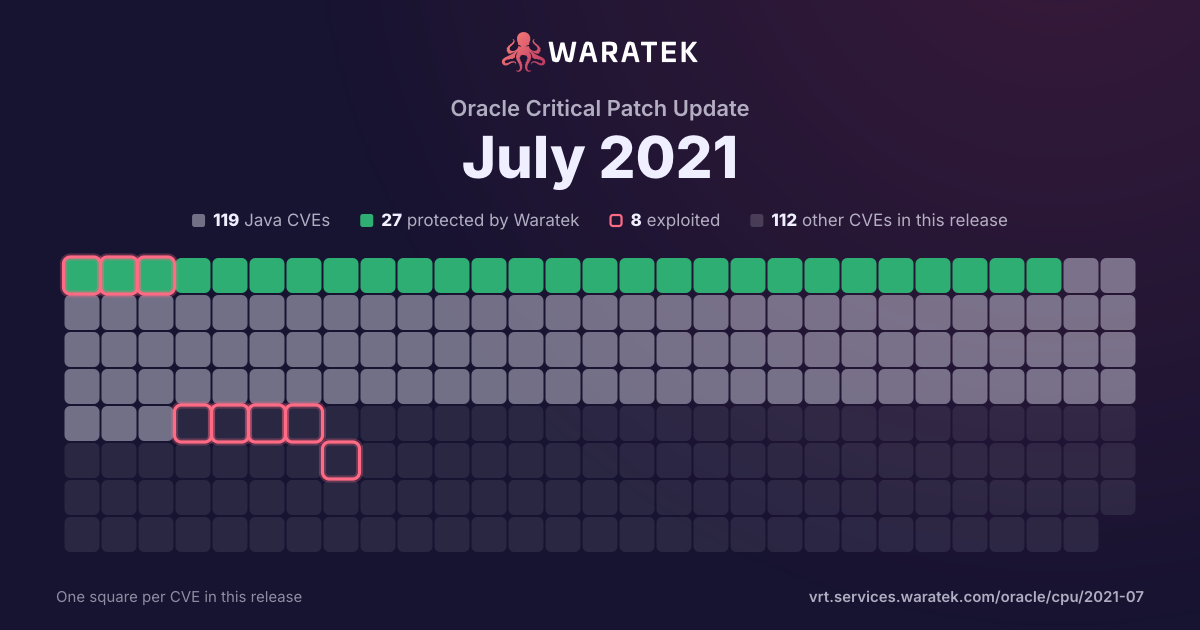
By status
29Protected by Waratek10Mitigation candidate99No exploit published3Outside Waratek scope90Not applicable
8Exploited, marked by the ring
No exploit published. For 72 of them, Oracle's security advisory is the source of public detail.
Protected by Waratek. Waratek RASP can block exploitation of these on systems that have not applied the patch yet.
Overview 6 matches · 4 in Waratek scope · 1 protected · 0 exploited · 0 CISA KEV · 1 public PoC · 1 EPSS ≥ 0.5
6matches
4in Waratek scope66.7%
1protected16.7%
0exploited0.0%
0CISA KEV0.0%
1public PoC16.7%
1EPSS ≥ 0.516.7%
Protected by Waratek
1
16.7%
Rule in development
0
0.0%
Mitigation candidate
0
0.0%
No exploit published
3
50.0%
Outside Waratek scope
0
0.0%
Not applicable
2
33.3%
Withdrawn CVE
0
0.0%
blocked by ARMR today
1
16.7%
partly blocked
0
0.0%
not blocked
5
83.3%
not established
0
0.0%
unrecorded
0
0.0%
Exploited
0
0.0%
Working exploit published
0
0.0%
Proof of concept only
1
16.7%
Forecast only
0
0.0%
No public exploit
5
83.3%
| CVE | Severity | Published▾ | Status | Exploitation | Description |
|---|---|---|---|---|---|
| CVE-2020-27218 | Medium | 2020-11-28 | No exploit published | No public exploit | In Eclipse Jetty version 9.4.0.RC0 to 9.4.34.v20201102, 10.0.0.alpha0 to 10.0.0.beta2, and 11.0.0.alpha0 to 11.0.0.beta2, if GZIP request body inflation is enabled and requests from different clients are multiplexed onto a single connection, and if an attacker can send a request with a body that is received entirely but not consumed by the application, then a subsequent request on the same connection will see that body prepended to its body. The attacker will not see any data but may inject data into the body of the subsequent request. |
| CVE-2020-28928 | Medium | 2020-11-24 | No exploit published | No public exploit | In musl libc through 1.2.1, wcsnrtombs mishandles particular combinations of destination buffer size and source character limit, as demonstrated by an invalid write access (buffer overflow). |
| CVE-2020-8277 | High | 2020-11-19 | Not applicable | Proof of concept only | A Node.js application that allows an attacker to trigger a DNS request for a host of their choice could trigger a Denial of Service in versions < 15.2.1, < 14.15.1, and < 12.19.1 by getting the application to resolve a DNS record with a larger number of responses. This is fixed in 15.2.1, 14.15.1, and 12.19.1. |
| CVE-2020-27193 | Medium | 2020-11-12 | Not applicable | No public exploit | A cross-site scripting (XSS) vulnerability in the Color Dialog plugin for CKEditor 4.15.0 allows remote attackers to run arbitrary web script after persuading a user to copy and paste crafted HTML code into one of editor inputs. |
| CVE-2019-17566 | High | 2020-11-12 | Protected by Waratek | No public exploit | Apache Batik is vulnerable to server-side request forgery, caused by improper input validation by the "xlink:href" attributes. By using a specially-crafted argument, an attacker could exploit this vulnerability to cause the underlying server to make arbitrary GET requests. |
| CVE-2020-28196 | High | 2020-11-06 | No exploit published | No public exploit | MIT Kerberos 5 (aka krb5) before 1.17.2 and 1.18.x before 1.18.3 allows unbounded recursion via an ASN.1-encoded Kerberos message because the lib/krb5/asn.1/asn1_encode.c support for BER indefinite lengths lacks a recursion limit. |