
Oracle Critical Patch Update July 2021
Released July 2021 · Oracle's advisory ↗ · ← Critical Patch Update, April 2021 · Critical Patch Update, October 2021 →
231 CVEs in this release, one square each
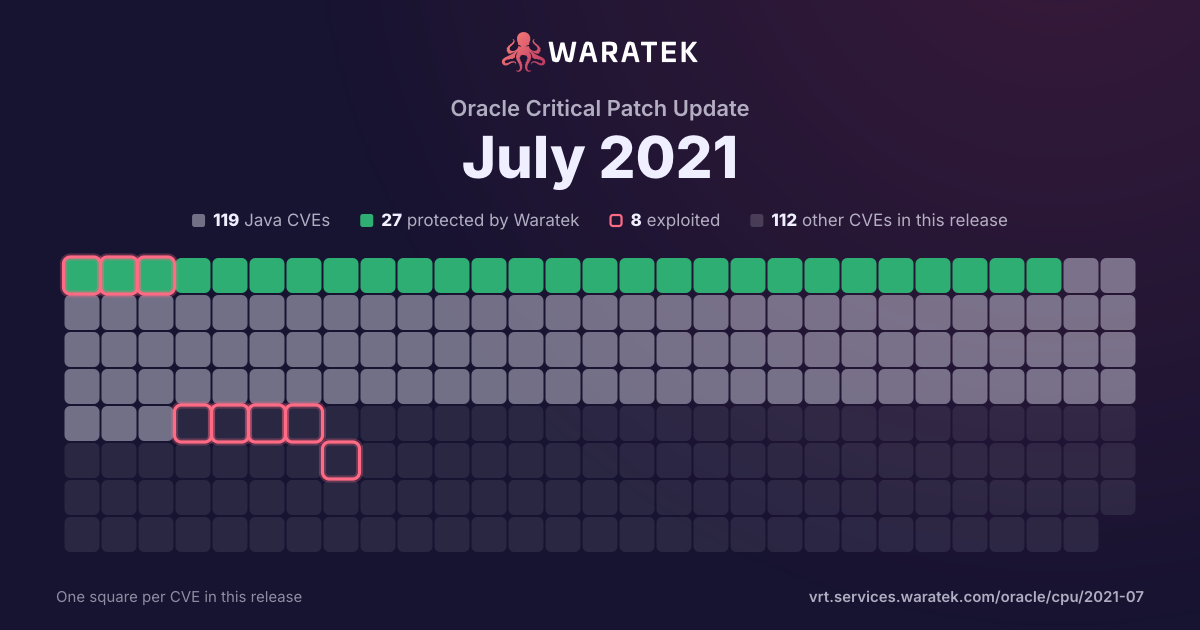
By status
29Protected by Waratek10Mitigation candidate99No exploit published3Outside Waratek scope90Not applicable
8Exploited, marked by the ring
No exploit published. For 72 of them, Oracle's security advisory is the source of public detail.
Protected by Waratek. Waratek RASP can block exploitation of these on systems that have not applied the patch yet.
Overview 27 matches · 16 in Waratek scope · 0 protected · 4 exploited · 1 CISA KEV · 6 public PoC · 6 EPSS ≥ 0.5
27matches
16in Waratek scope59.3%
0protected0.0%
4exploited14.8%
1CISA KEV3.7%
6public PoC22.2%
6EPSS ≥ 0.522.2%
Protected by Waratek
0
0.0%
Rule in development
0
0.0%
Mitigation candidate
6
22.2%
No exploit published
10
37.0%
Outside Waratek scope
1
3.7%
Not applicable
10
37.0%
Withdrawn CVE
0
0.0%
blocked by ARMR today
0
0.0%
partly blocked
0
0.0%
not blocked
27
100.0%
not established
0
0.0%
unrecorded
0
0.0%
split by
peak 5 / quarter
Q2 161
Not applicable1
Medium1
not blocked1
No public exploit1
Q3 160
Q4 160
Q1 170
Q2 172
No exploit published1
Not applicable1
Critical1
High1
not blocked2
No public exploit2
Q3 171
No exploit published1
Medium1
not blocked1
No public exploit1
Q4 173
Mitigation candidate1
No exploit published1
Not applicable1
Critical1
High2
not blocked3
Working exploit published1
No public exploit2
Q1 182
Outside Waratek scope1
Not applicable1
Critical1
Medium1
not blocked2
No public exploit2
Q2 180
Q3 180
Q4 180
Q1 191
Not applicable1
High1
not blocked1
Exploited1
Q2 191
Mitigation candidate1
Medium1
not blocked1
Exploited1
Q3 194
No exploit published2
Not applicable2
Critical2
High1
Medium1
not blocked4
No public exploit4
Q4 194
Mitigation candidate1
No exploit published1
Not applicable2
Critical2
High1
Medium1
not blocked4
Proof of concept only1
No public exploit3
Q1 205
Mitigation candidate1
No exploit published3
Not applicable1
Critical1
High4
not blocked5
Proof of concept only1
No public exploit4
Q2 203
Mitigation candidate2
No exploit published1
High1
Medium2
not blocked3
Exploited2
No public exploit1
Q2 16Q4 16Q2 17Q4 17Q2 18Q4 18Q2 19Q4 19Q2 20
| CVE | Severity | Published▾ | Status | Exploitation | Description |
|---|---|---|---|---|---|
| CVE-2020-11023 | Medium | 2020-04-29 | Mitigation candidate | Exploited | In jQuery versions greater than or equal to 1.0.3 and before 3.5.0, passing HTML containing <option> elements from untrusted sources - even after sanitizing it - to one of jQuery's DOM manipulation methods (i.e. .html(), .append(), and others) may execute untrusted code. This problem is patched in jQuery 3.5.0. |
| CVE-2020-11022 | Medium | 2020-04-29 | Mitigation candidate | Exploited | In jQuery starting with 1.12.0 and before 3.5.0, passing HTML from untrusted sources - even after sanitizing it - to one of jQuery's DOM manipulation methods (i.e. .html(), .append(), and others) may execute untrusted code. This problem is patched in jQuery 3.5.0. |
| CVE-2020-11612 | High | 2020-04-07 | No exploit published | No public exploit | The ZlibDecoders in Netty 4.1.x before 4.1.46 allow for unbounded memory allocation while decoding a ZlibEncoded byte stream. An attacker could send a large ZlibEncoded byte stream to the Netty server, forcing the server to allocate all of its free memory to a single decoder. |
| CVE-2020-5258 | High | 2020-03-10 | No exploit published | No public exploit | In affected versions of dojo (NPM package), the deepCopy method is vulnerable to Prototype Pollution. Prototype Pollution refers to the ability to inject properties into existing JavaScript language construct prototypes, such as objects. An attacker manipulates these attributes to overwrite, or pollute, a JavaScript application object prototype of the base object by injecting other values. This has been patched in versions 1.12.8, 1.13.7, 1.14.6, 1.15.3 and 1.16.2 |
| CVE-2020-5398 | High | 2020-01-17 | Mitigation candidate | Proof of concept only | In Spring Framework, versions 5.2.x prior to 5.2.3, versions 5.1.x prior to 5.1.13, and versions 5.0.x prior to 5.0.16, an application is vulnerable to a reflected file download (RFD) attack when it sets a "Content-Disposition" header in the response where the filename attribute is derived from user supplied input. |
| CVE-2019-12399 | High | 2020-01-14 | No exploit published | No public exploit | When Connect workers in Apache Kafka 2.0.0, 2.0.1, 2.1.0, 2.1.1, 2.2.0, 2.2.1, or 2.3.0 are configured with one or more config providers, and a connector is created/updated on that Connect cluster to use an externalized secret variable in a substring of a connector configuration property value, then any client can issue a request to the same Connect cluster to obtain the connector's task configuration and the response will contain the plaintext secret rather than the externalized secrets variables. |
| CVE-2019-0219 | Critical | 2020-01-14 | No exploit published | No public exploit | A website running in the InAppBrowser webview on Android could execute arbitrary JavaScript in the main application's webview using a specially crafted gap-iab: URI. |
| CVE-2019-5064 | High | 2020-01-03 | Not applicable | No public exploit | An exploitable heap buffer overflow vulnerability exists in the data structure persistence functionality of OpenCV, before version 4.2.0. A specially crafted JSON file can cause a buffer overflow, resulting in multiple heap corruptions and potentially code execution. An attacker can provide a specially crafted file to trigger this vulnerability. |
| CVE-2019-2897 | Medium | 2019-10-16 | No exploit published | No public exploit | Vulnerability in the Oracle Business Intelligence Enterprise Edition product of Oracle Fusion Middleware (component: Analytics Actions). Supported versions that are affected are 12.2.1.3.0 and 12.2.1.4.0. Easily exploitable vulnerability allows low privileged attacker with network access via HTTP to compromise Oracle Business Intelligence Enterprise Edition. While the vulnerability is in Oracle Business Intelligence Enterprise Edition, attacks may significantly impact additional products. Successful attacks of this vulnerability can result in unauthorized update, insert or delete access to some of Oracle Business Intelligence Enterprise Edition accessible data as well as unauthorized read access to a subset of Oracle Business Intelligence Enterprise Edition accessible data. CVSS 3.0 Base Score 6.4 (Confidentiality and Integrity impacts). CVSS Vector: (CVSS:3.0/AV:N/AC:L/PR:L/UI:N/S:C/C:L/I:L/A:N). |
| CVE-2019-17195 | Critical | 2019-10-15 | Mitigation candidate | Proof of concept only | Connect2id Nimbus JOSE+JWT before v7.9 can throw various uncaught exceptions while parsing a JWT, which could result in an application crash (potential information disclosure) or a potential authentication bypass. |
| CVE-2019-17545 | Critical | 2019-10-14 | Not applicable | No public exploit | GDAL through 3.0.1 has a poolDestroy double free in OGRExpatRealloc in ogr/ogr_expat.cpp when the 10MB threshold is exceeded. |
| CVE-2019-17543 | High | 2019-10-14 | Not applicable | No public exploit | LZ4 before 1.9.2 has a heap-based buffer overflow in LZ4_write32 (related to LZ4_compress_destSize), affecting applications that call LZ4_compress_fast with a large input. (This issue can also lead to data corruption.) NOTE: the vendor states "only a few specific / uncommon usages of the API are at risk." |
| CVE-2019-3740 | Medium | 2019-09-18 | No exploit published | No public exploit | RSA BSAFE Crypto-J versions prior to 6.2.5 are vulnerable to an Information Exposure Through Timing Discrepancy vulnerabilities during DSA key generation. A malicious remote attacker could potentially exploit those vulnerabilities to recover DSA keys. |
| CVE-2019-12402 | High | 2019-08-30 | No exploit published | No public exploit | The file name encoding algorithm used internally in Apache Commons Compress 1.15 to 1.18 can get into an infinite loop when faced with specially crafted inputs. This can lead to a denial of service attack if an attacker can choose the file names inside of an archive created by Compress. |
| CVE-2019-10746 | Critical | 2019-08-23 | Not applicable | No public exploit | mixin-deep is vulnerable to Prototype Pollution in versions before 1.3.2 and version 2.0.0. The function mixin-deep could be tricked into adding or modifying properties of Object.prototype using a constructor payload. |
| CVE-2019-12260 | Critical | 2019-08-09 | Not applicable | No public exploit | Wind River VxWorks 6.9 and vx7 has a Buffer Overflow in the TCP component (issue 2 of 4). This is an IPNET security vulnerability: TCP Urgent Pointer state confusion caused by a malformed TCP AO option. |
| CVE-2019-11358 | Medium | 2019-04-20 | Mitigation candidate | Exploited | jQuery before 3.4.0, as used in Drupal, Backdrop CMS, and other products, mishandles jQuery.extend(true, {}, ...) because of Object.prototype pollution. If an unsanitized source object contained an enumerable __proto__ property, it could extend the native Object.prototype. |
| CVE-2019-0190 | High | 2019-01-30 | Not applicable | Exploited | A bug exists in the way mod_ssl handled client renegotiations. A remote attacker could send a carefully crafted request that would cause mod_ssl to enter a loop leading to a denial of service. This bug can be only triggered with Apache HTTP Server version 2.4.37 when using OpenSSL version 1.1.1 or later, due to an interaction in changes to handling of renegotiation attempts. |
| CVE-2018-0739 | Medium | 2018-03-27 | Not applicable | No public exploit | Constructed ASN.1 types with a recursive definition (such as can be found in PKCS7) could eventually exceed the stack given malicious input with excessive recursion. This could result in a Denial Of Service attack. There are no such structures used within SSL/TLS that come from untrusted sources so this is considered safe. Fixed in OpenSSL 1.1.0h (Affected 1.1.0-1.1.0g). Fixed in OpenSSL 1.0.2o (Affected 1.0.2b-1.0.2n). |
| CVE-2018-7183 | Critical | 2018-03-08 | Outside Waratek scope | No public exploit | Buffer overflow in the decodearr function in ntpq in ntp 4.2.8p6 through 4.2.8p10 allows remote attackers to execute arbitrary code by leveraging an ntpq query and sending a response with a crafted array. |
| CVE-2017-16931 | Critical | 2017-11-23 | Not applicable | No public exploit | parser.c in libxml2 before 2.9.5 mishandles parameter-entity references because the NEXTL macro calls the xmlParserHandlePEReference function in the case of a '%' character in a DTD name. |
| CVE-2012-0881 | High | 2017-10-30 | No exploit published | No public exploit | Apache Xerces2 Java Parser before 2.12.0 allows remote attackers to cause a denial of service (CPU consumption) via a crafted message to an XML service, which triggers hash table collisions. |
| CVE-2017-5637 | High | 2017-10-10 | Mitigation candidate | Working exploit published | Two four letter word commands "wchp/wchc" are CPU intensive and could cause spike of CPU utilization on Apache ZooKeeper server if abused, which leads to the server unable to serve legitimate client requests. Apache ZooKeeper thru version 3.4.9 and 3.5.2 suffer from this issue, fixed in 3.4.10, 3.5.3, and later. |
| CVE-2016-0762 | Medium | 2017-08-10 | No exploit published | No public exploit | The Realm implementations in Apache Tomcat versions 9.0.0.M1 to 9.0.0.M9, 8.5.0 to 8.5.4, 8.0.0.RC1 to 8.0.36, 7.0.0 to 7.0.70 and 6.0.0 to 6.0.45 did not process the supplied password if the supplied user name did not exist. This made a timing attack possible to determine valid user names. Note that the default configuration includes the LockOutRealm which makes exploitation of this vulnerability harder. |
| CVE-2017-9735 | High | 2017-06-16 | No exploit published | No public exploit | Jetty through 9.4.x is prone to a timing channel in util/security/Password.java, which makes it easier for remote attackers to obtain access by observing elapsed times before rejection of incorrect passwords. |
| CVE-2017-5461 | Critical | 2017-05-11 | Not applicable | No public exploit | Mozilla Network Security Services (NSS) before 3.21.4, 3.22.x through 3.28.x before 3.28.4, 3.29.x before 3.29.5, and 3.30.x before 3.30.1 allows remote attackers to cause a denial of service (out-of-bounds write) or possibly have unspecified other impact by leveraging incorrect base64 operations. |
| CVE-2016-4429 | Medium | 2016-06-10 | Not applicable | No public exploit | Stack-based buffer overflow in the clntudp_call function in sunrpc/clnt_udp.c in the GNU C Library (aka glibc or libc6) allows remote servers to cause a denial of service (crash) or possibly unspecified other impact via a flood of crafted ICMP and UDP packets. |