
Oracle Critical Patch Update July 2021
Released July 2021 · Oracle's advisory ↗ · ← Critical Patch Update, April 2021 · Critical Patch Update, October 2021 →
231 CVEs in this release, one square each
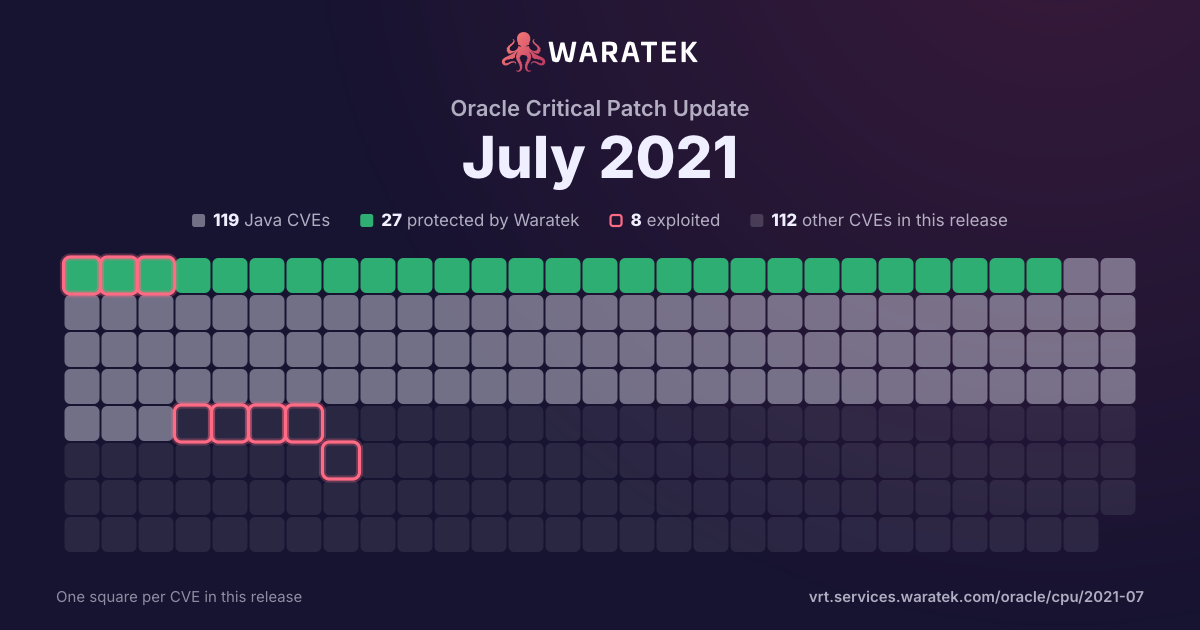
By status
29Protected by Waratek10Mitigation candidate99No exploit published3Outside Waratek scope90Not applicable
8Exploited, marked by the ring
No exploit published. For 72 of them, Oracle's security advisory is the source of public detail.
Protected by Waratek. Waratek RASP can block exploitation of these on systems that have not applied the patch yet.
Overview 13 matches · 0 protected · 1 exploited · 0 CISA KEV · 4 public PoC · 3 EPSS ≥ 0.5
Protected by Waratek
0
0.0%
Rule in development
0
0.0%
Mitigation candidate
4
30.8%
No exploit published
9
69.2%
blocked by ARMR today
0
0.0%
partly blocked
0
0.0%
not blocked
13
100.0%
not established
0
0.0%
unrecorded
0
0.0%
split by
peak 4 / quarter
Q2 171
No exploit published1
High1
not blocked1
No public exploit1
Q3 171
No exploit published1
Medium1
not blocked1
No public exploit1
Q4 172
Mitigation candidate1
No exploit published1
High2
not blocked2
Working exploit published1
No public exploit1
Q1 180
Q2 180
Q3 180
Q4 180
Q1 190
Q2 191
Mitigation candidate1
Medium1
not blocked1
Exploited1
Q3 192
No exploit published2
High1
Medium1
not blocked2
No public exploit2
Q4 192
Mitigation candidate1
No exploit published1
Critical1
Medium1
not blocked2
Proof of concept only1
No public exploit1
Q1 204
Mitigation candidate1
No exploit published3
Critical1
High3
not blocked4
Proof of concept only1
No public exploit3
Q2 17Q3 17Q4 17Q1 18Q2 18Q3 18Q4 18Q1 19Q2 19Q3 19Q4 19Q1 20
| CVE | Severity | Published▾ | Status | Exploitation | Description |
|---|---|---|---|---|---|
| CVE-2020-5258 | High | 2020-03-10 | No exploit published | No public exploit | In affected versions of dojo (NPM package), the deepCopy method is vulnerable to Prototype Pollution. Prototype Pollution refers to the ability to inject properties into existing JavaScript language construct prototypes, such as objects. An attacker manipulates these attributes to overwrite, or pollute, a JavaScript application object prototype of the base object by injecting other values. This has been patched in versions 1.12.8, 1.13.7, 1.14.6, 1.15.3 and 1.16.2 |
| CVE-2020-5398 | High | 2020-01-17 | Mitigation candidate | Proof of concept only | In Spring Framework, versions 5.2.x prior to 5.2.3, versions 5.1.x prior to 5.1.13, and versions 5.0.x prior to 5.0.16, an application is vulnerable to a reflected file download (RFD) attack when it sets a "Content-Disposition" header in the response where the filename attribute is derived from user supplied input. |
| CVE-2019-12399 | High | 2020-01-14 | No exploit published | No public exploit | When Connect workers in Apache Kafka 2.0.0, 2.0.1, 2.1.0, 2.1.1, 2.2.0, 2.2.1, or 2.3.0 are configured with one or more config providers, and a connector is created/updated on that Connect cluster to use an externalized secret variable in a substring of a connector configuration property value, then any client can issue a request to the same Connect cluster to obtain the connector's task configuration and the response will contain the plaintext secret rather than the externalized secrets variables. |
| CVE-2019-0219 | Critical | 2020-01-14 | No exploit published | No public exploit | A website running in the InAppBrowser webview on Android could execute arbitrary JavaScript in the main application's webview using a specially crafted gap-iab: URI. |
| CVE-2019-2897 | Medium | 2019-10-16 | No exploit published | No public exploit | Vulnerability in the Oracle Business Intelligence Enterprise Edition product of Oracle Fusion Middleware (component: Analytics Actions). Supported versions that are affected are 12.2.1.3.0 and 12.2.1.4.0. Easily exploitable vulnerability allows low privileged attacker with network access via HTTP to compromise Oracle Business Intelligence Enterprise Edition. While the vulnerability is in Oracle Business Intelligence Enterprise Edition, attacks may significantly impact additional products. Successful attacks of this vulnerability can result in unauthorized update, insert or delete access to some of Oracle Business Intelligence Enterprise Edition accessible data as well as unauthorized read access to a subset of Oracle Business Intelligence Enterprise Edition accessible data. CVSS 3.0 Base Score 6.4 (Confidentiality and Integrity impacts). CVSS Vector: (CVSS:3.0/AV:N/AC:L/PR:L/UI:N/S:C/C:L/I:L/A:N). |
| CVE-2019-17195 | Critical | 2019-10-15 | Mitigation candidate | Proof of concept only | Connect2id Nimbus JOSE+JWT before v7.9 can throw various uncaught exceptions while parsing a JWT, which could result in an application crash (potential information disclosure) or a potential authentication bypass. |
| CVE-2019-3740 | Medium | 2019-09-18 | No exploit published | No public exploit | RSA BSAFE Crypto-J versions prior to 6.2.5 are vulnerable to an Information Exposure Through Timing Discrepancy vulnerabilities during DSA key generation. A malicious remote attacker could potentially exploit those vulnerabilities to recover DSA keys. |
| CVE-2019-12402 | High | 2019-08-30 | No exploit published | No public exploit | The file name encoding algorithm used internally in Apache Commons Compress 1.15 to 1.18 can get into an infinite loop when faced with specially crafted inputs. This can lead to a denial of service attack if an attacker can choose the file names inside of an archive created by Compress. |
| CVE-2019-11358 | Medium | 2019-04-20 | Mitigation candidate | Exploited | jQuery before 3.4.0, as used in Drupal, Backdrop CMS, and other products, mishandles jQuery.extend(true, {}, ...) because of Object.prototype pollution. If an unsanitized source object contained an enumerable __proto__ property, it could extend the native Object.prototype. |
| CVE-2012-0881 | High | 2017-10-30 | No exploit published | No public exploit | Apache Xerces2 Java Parser before 2.12.0 allows remote attackers to cause a denial of service (CPU consumption) via a crafted message to an XML service, which triggers hash table collisions. |
| CVE-2017-5637 | High | 2017-10-10 | Mitigation candidate | Working exploit published | Two four letter word commands "wchp/wchc" are CPU intensive and could cause spike of CPU utilization on Apache ZooKeeper server if abused, which leads to the server unable to serve legitimate client requests. Apache ZooKeeper thru version 3.4.9 and 3.5.2 suffer from this issue, fixed in 3.4.10, 3.5.3, and later. |
| CVE-2016-0762 | Medium | 2017-08-10 | No exploit published | No public exploit | The Realm implementations in Apache Tomcat versions 9.0.0.M1 to 9.0.0.M9, 8.5.0 to 8.5.4, 8.0.0.RC1 to 8.0.36, 7.0.0 to 7.0.70 and 6.0.0 to 6.0.45 did not process the supplied password if the supplied user name did not exist. This made a timing attack possible to determine valid user names. Note that the default configuration includes the LockOutRealm which makes exploitation of this vulnerability harder. |
| CVE-2017-9735 | High | 2017-06-16 | No exploit published | No public exploit | Jetty through 9.4.x is prone to a timing channel in util/security/Password.java, which makes it easier for remote attackers to obtain access by observing elapsed times before rejection of incorrect passwords. |